Savannah cats and wolfdogs turn up in exam rooms more often than they used to, and they arrive with a question their owners can't quite shake: is this a pet, or a wild animal in a collar? Animal hybridization is why that question is hard to answer — and why it stopped being a zoo curiosity some time ago. Warming ranges are pushing species into contact that never used to meet, and the resulting hybrid animals are turning up in the Arctic and in living rooms alike.
So: a plain definition, the real hybrids people ask about — ligers, mules, pizzly bears — why most can't reproduce and the chromosomal reason why, and the part the listicles skip entirely: what any of it means if you're thinking about bringing a hybrid home.
One promise about how I'll handle it. The evidence here varies enormously — some is settled genetics, some is a handful of animals in a single marine park, and some is internet folklore. I'll tell you which is which as we go.
What Is Animal Hybridization?
Animal hybridization is the crossing of two different species, subspecies, or genera to produce offspring — a hybrid — that blends traits from both parents. A liger (lion × tiger) and a mule (donkey × horse) are the classic examples. It happens both naturally in the wild and deliberately through human breeding.
The word people usually reach for instead is crossbreeding, and the distinction matters more than it sounds. A hybrid crosses the species line. A crossbreed mixes within a single species — a labradoodle is a Labrador and a poodle, both Canis familiaris, both entirely capable of producing fertile puppies. Goldendoodles are crossbreeds. Ligers are hybrids. Nearly everything that makes hybrids strange — the sterility, the health problems, the legal tangle — comes from that one difference.
Hybridization is also far less exotic than it reads. The figure I'd anchor on is that around 25% of plant species and 10% of animal species have been affected by hybridization — and since I'm asking you to anchor on it, here's its pedigree. I found it in a 2021 systematic review of 115 mammal-hybridization studies in the journal Genes, but that review is where it's quoted, not where it's from: it sits in the opening paragraphs as imported background, credited to a 1997 book — Arnold's Natural Hybridization and Evolution. It's a long-standing estimate the field keeps carrying forward, not something those 115 papers went out and counted. Take it as the working number it is: one animal species in ten, somewhere in its range, is exchanging genes across a species boundary. Not a freak show. A background rate.
This article covers both routes — what nature does on its own, and what people do on purpose. If genetics is what brought you here, there's more in our pet genetics section.
Why Hybrid Animals Are Showing Up More Often
Some hybrids arise in the wild with no human involvement. Others exist only because someone arranged them. The line between those two is moving, and it's moving in one direction.
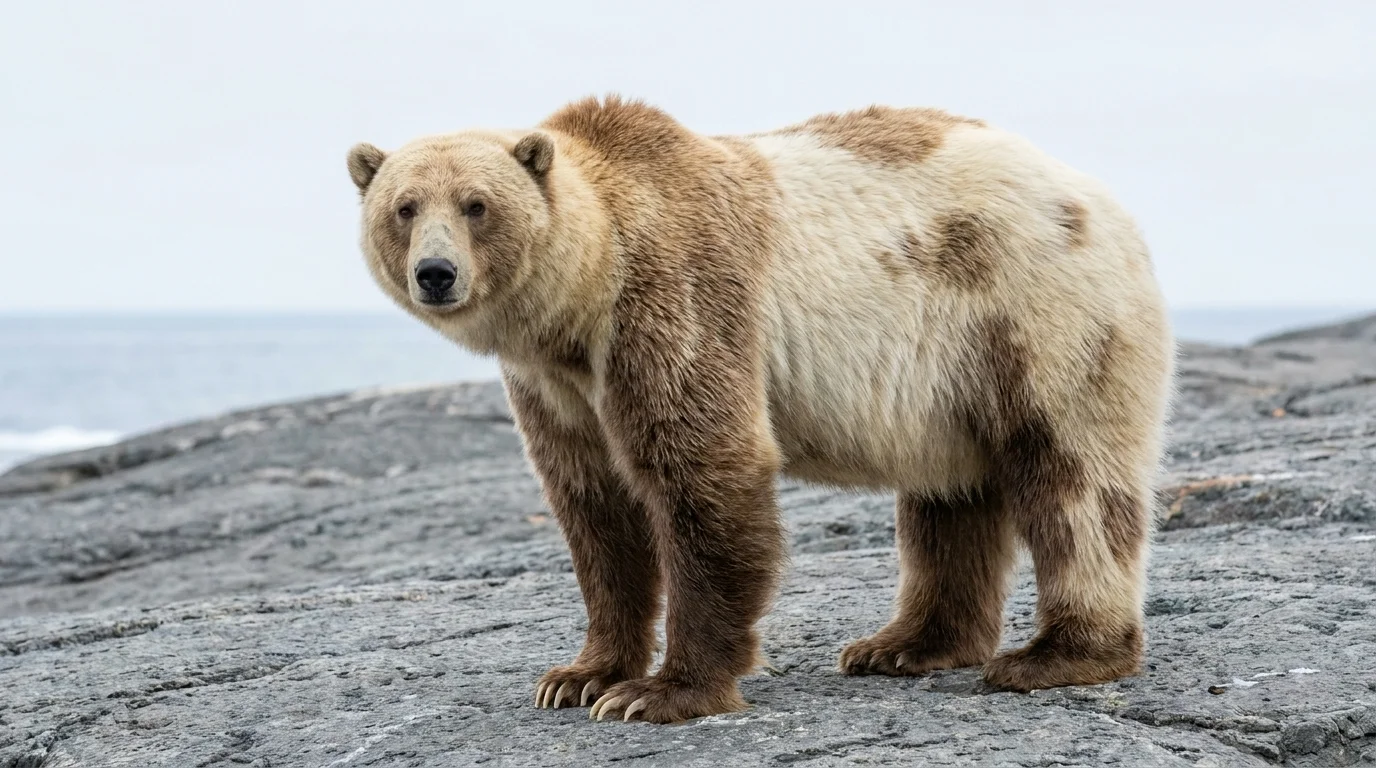
The flagship case is the pizzly — or grolar — bear, a polar bear crossed with a grizzly. (Grizzlies are brown bears, Ursus arctos, under a North American name — worth knowing, because the sources switch between the two words.) National Geographic's account of how animal hybrids happen notes that hybrids between brown bears and polar bears "may become more common as temperatures warm and the species' ranges overlap". The field data underneath that sentence is more specific than the sentence is: a 2017 study in the journal Arctic reports that since 2004 it has become increasingly common to observe grizzly bears north of their traditional range, sometimes 500 km or more from the mainland coast, well into polar bear country in the Canadian Arctic Archipelago — and that the bears making that trip are overwhelmingly male.
Two newer pieces of work reframe what that means. An April 2026 review in Ecology and Evolution argues that "hybridization can reshape immune function by introducing novel genetic variation and combining parental immune traits", and that this matters "in a changing world, where environmental stressors like habitat loss and climate change may alter outcomes of host–pathogen interactions." That's a review — it synthesizes and argues rather than proves. Separately, a 2023 paper in Nature Climate Change found natural hybridization can reduce a species' vulnerability to climate change by moving adaptive variants between populations. "Evolutionary rescue," in the jargon.
Now the caveat, because the literature is lopsided. That same Genes review — and here it's the 115 papers talking, not a borrowed estimate — found negative outcomes reported in 49% of studies against positive ones in 13%, with genetic swamping in 21% and novel adaptive variation in only 8%. Before reading that as a verdict, note that the authors themselves attribute the skew to detection methods rather than to reality — harm is simply easier to notice than benefit. That's an evidence gap, not a finding.
Real Hybrid Animals: The Classic List
These are the ones people actually mean. All of them are real — photographed, and in several cases still alive — which is worth saying plainly, because this topic attracts a great deal that is not.
| Hybrid | Cross | Wild or human-made? | Fertile? |
|---|---|---|---|
| Liger | male lion × female tiger | Captivity | Rarely, if at all |
| Tigon | male tiger × female lion | Captivity | Rarely, if at all |
| Mule | male donkey × female horse | Human-bred, at scale | Almost never — 63 chromosomes |
| Hinny | male horse × female donkey | Human-bred | Almost never — the same 63 |
| Zonkey / zorse | zebra × donkey / zebra × horse | Captivity | Rarely, if at all |
| Pizzly (grolar) bear | polar bear × grizzly bear | Wild | Yes — backcrosses documented |
| Wholphin | false killer whale × bottlenose dolphin | Captivity | Yes — one female had three calves |
| Beefalo | domestic cattle × American bison | Human-bred as livestock | The outlier — see below |
| Cama | dromedary camel × llama | Captivity | Rarely, if at all |
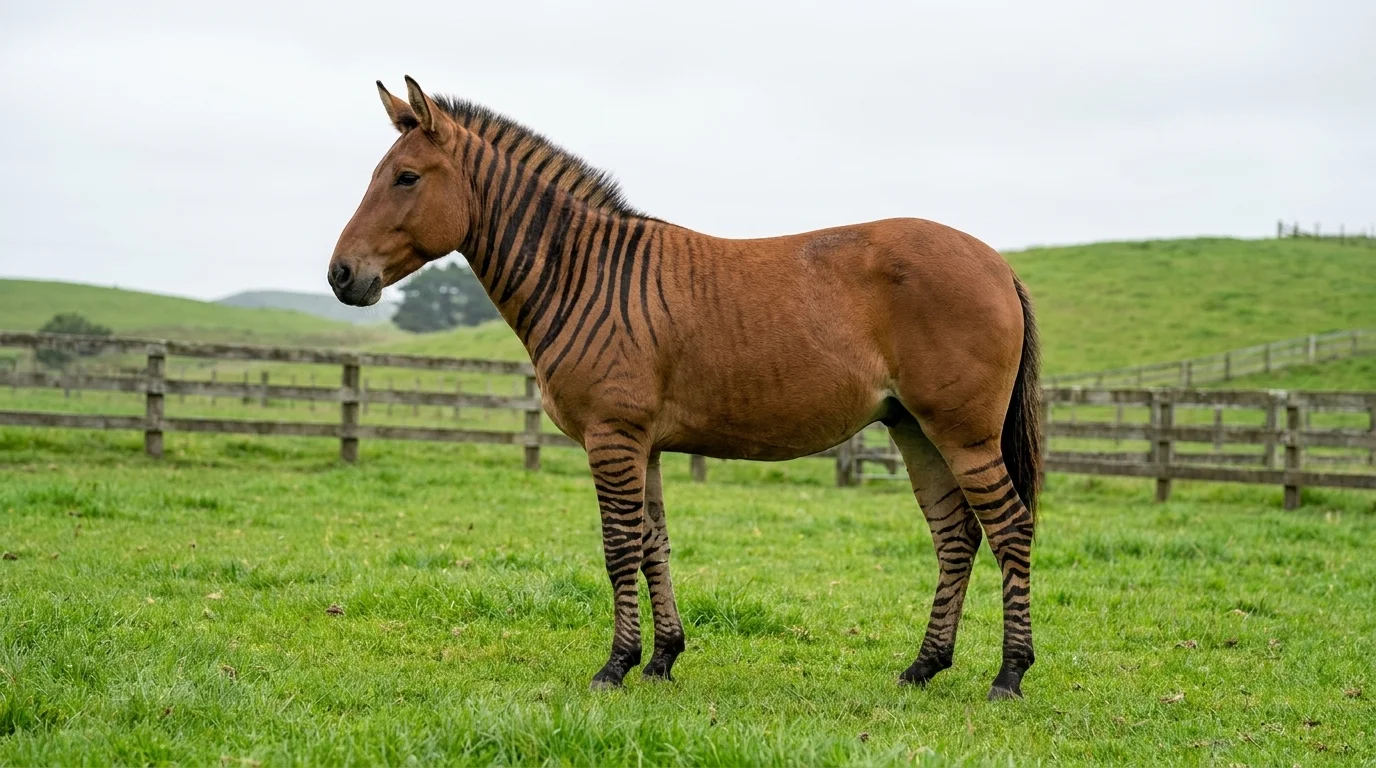
Read the last two columns carefully, because they're the ones I'd grade most cautiously, and for different reasons.
On fertility, the general rule is well supported: National Geographic's explainer states that most such crosses "cannot reproduce because the parent species may not have the same genetic makeup, meaning the offspring's chromosomes may not match up, leaving them infertile". The mule is better than well supported — its chromosome arithmetic is documented down to the number, and I'll walk through it next. But "rarely, if at all" next to a cama or a zorse is the general rule talking, not a per-animal verdict. Some of these crosses are represented by a handful of individual animals in the entire historical record, and a handful of animals is not a fertility statistic. The two rows where I've written something firmer — the pizzly and the wholphin — are the two where somebody actually went and checked, and I've cited both below. The beefalo I've left as an outlier on purpose: it's bred as livestock rather than as a novelty, and a blanket sterility rule sits badly with an animal that's kept as a working breed. I'm not going to call that one from a general rule I can't check against systematic data.
The wild-or-human-made column deserves the same warning, so here it is plainly rather than left for the table to imply. Exactly one cell in it is carried by a study: the pizzly is wild, and that's the National Geographic and Arctic material. "Human-bred" for the mule, hinny and beefalo is about as settled as animal husbandry gets — these are working animals with centuries of deliberate breeding behind them. For the rest I've written "captivity" rather than "human-made", because captivity is the part I can stand behind. Whether a particular cross was deliberately arranged or simply happened between two animals sharing an enclosure is not something the record reliably tells me, and it differs case by case.
A few are worth knowing individually.
The liger — a male lion crossed with a female tiger — is the one the internet loves, and you've never seen one in a nature documentary for a good reason: lions and tigers essentially don't meet without human help. Like most of the exotic entries here, it's a captive cross that seldom if ever happens on its own.
The mule — a male donkey over a female horse — is the entry with a job. It's also the cleanest illustration of hybrid sterility on the list, which is the next section.
The pizzly bear is the only row that's a genuinely wild phenomenon rather than a captive curiosity, and the only one whose fertility isn't a footnote. That 2017 Arctic study did the parentage work: alongside four first-generation hybrids, it identified four offspring of F1 hybrids and grizzly bears — backcrosses. First-generation pizzlies breed. That's documented, not inferred from a rule.
The next step is the one I want to be careful about, because it's the one nearly everybody takes for granted, and I nearly did too. Fertile hybrids are how gene flow between two species could happen — but whether it is happening between polar bears and grizzlies is a separate question, and the same study answers it the other way. All eight hybrid bears trace back to a single female polar bear who mated with two grizzlies. The authors reduce the whole apparent wave to "the unusual mating activities of three non-hybrid parents," and conclude that introgression "has not been a meaningful feature of the recent history of northern Canadian grizzly bears and polar bears." Despite what they describe as powerful detection systems, that one extended family was the only hybridization they found.
Be precise about what that does and doesn't mean, because the correction is as easy to overshoot as the claim. Gene flow between these two species is not fiction — the same paper reviews genomic evidence that it happened on an evolutionary timescale, with some island grizzly populations in southeastern Alaska carrying a polar bear component approaching 10%. What's missing is evidence that it's happening now, in the warming Arctic, in the way the climate framing invites you to assume. The hybrids are real and they breed. The contemporary gene-pool merger is a hypothesis, and the people closest to the data are the ones saying so.
The wholphin — a false killer whale crossed with a bottlenose dolphin — is a good test of your skepticism: it sounds invented, and it isn't. Kekaimalu, born at a Hawaii marine park in 1985, went on to have three calves sired by bottlenose dolphins. That account is Wikipedia's rather than a journal's, so I'd hold it a tier below the bear work — but it's specific, and it points where the biology already points: false killer whales and bottlenose dolphins both carry 44 chromosomes, and a matching count is one of the things that allows a hybrid to stay fertile. It's also a reminder of how thin the record gets at the exotic end of this list, where cases are counted in individual animals rather than populations.
Why Can't Most Hybrids Reproduce?
Most hybrids are sterile because their parent species carry different chromosome counts, so the chromosomes can't pair evenly when sperm and eggs are made.
Here's the arithmetic, and it really is this simple. A donkey has 62 chromosomes. A horse has 64. Each parent contributes half, so the mule inherits 31 from one and 32 from the other: 63 chromosomes — an odd number. That count comes from Wikipedia's hybrid-biology entry rather than a journal, which I'd normally flag as a limitation; here I'd just note that mule karyotype is about as settled as this subject gets.
Odd numbers are the problem. Making sperm or eggs requires every chromosome to line up with a matching partner and split cleanly. With 63, something is always left without a partner, the pairing fails, and the cell can't produce viable gametes. The mule gets a working body out of the deal and no offspring. Female-mule fertility has been documented, but it's vanishingly rare — the exception that earns a name and a news story precisely because it almost never happens.
The rule is a gradient, not a switch, and this is where most explainers flatten it. Sterility tracks how far apart the parents are, and chromosome count is a serviceable proxy for that distance. Donkeys and horses differ by two, and two is enough to break meiosis outright. Polar bears and grizzlies don't differ at all: a 2022 genome paper in Genome Biology and Evolution notes that both are ursine bears with a stable karyotype of 2n = 74, and the genome alignment it produced showed "no major chromosomal rearrangements" between the two. Same count, same architecture — and, as we saw, hybrids that breed. False killer whales and bottlenose dolphins both carry 44, with the same result. A completely sterile hybrid is an evolutionary dead end. A partly fertile one is a bridge.
That gradient stops being an abstraction if you own a cat. The same rule shows up in hybrid pets, with the same asymmetry.
Hybrid Pets: What a Vet Wants You to Know
This is the part the science listicles leave out, and it's the part that walks into my exam room.
It isn't a fringe concern either. In that Genes review, 36% of the hybridization studies involved domestic animals crossing with wild relatives — better than a third of the mammal literature is about exactly this: our animals mixing with theirs.
Hybrid cats (savannah & bengal)
Savannah cats trace back to a serval — a wild African cat — crossed with a domestic cat; bengals to an Asian leopard cat. Breeders count the distance from that wild ancestor in generations: F1 is the first cross, F2 the next, on through F5 and beyond.
That generation ladder is where the mule story returns in miniature. FOUR PAWS USA reports that hybrid-cat males are typically infertile through the F3 generation. A serval and a house cat, same principle as 63 chromosomes, different animal. And notice what the ladder itself tells you: F4 and F5 cats exist, so the females must be fertile. That's an inference from the generations rather than a stated finding, but it isn't a subtle one — every later generation is the product of a hybrid female who bred.
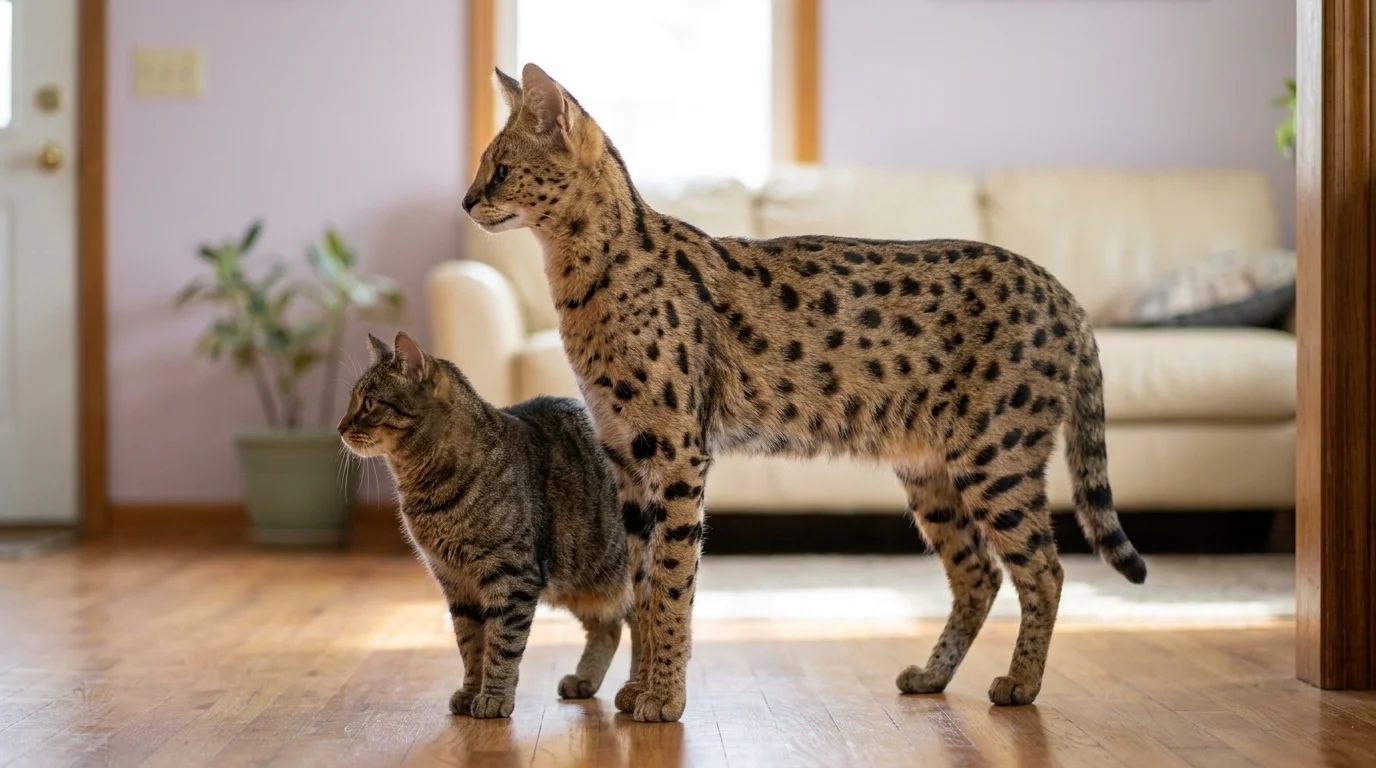
The health picture is where I'd ask you to slow down. FOUR PAWS names hypertrophic cardiomyopathy (HCM), progressive retinal atrophy (PRA), inflammatory bowel disease (IBD), and pyruvate kinase (PK) deficiency among the conditions reported in these breeds. I want to be precise about what that is and isn't: it's a list of conditions documented in the population, not a prevalence rate. Nobody has handed me a number for what fraction of savannahs develop HCM. As lists go, though, it isn't a trivial one — HCM is a heart disease, PRA takes vision, and IBD and PK deficiency are both chronic, lifelong management problems.
Wolfdogs & other hybrid pets
A wolfdog is a wolf crossed with a domestic dog. Hybrid macaws and other parrots sit in the same category: engineered for appearance, sold into homes built for something tamer.
Behavior is the part owners underestimate, and FOUR PAWS puts it bluntly — "the dominance of wild animal genes makes harmonious cohabitation with them almost impossible." That's an animal-welfare organization's framing and I'd label it as such, but it lines up with what clinicians see. A wild-derived animal is not a badly trained pet. It's an animal whose instincts are doing exactly what they evolved to do, in a living room.
Is it legal to own a hybrid pet?
It depends on your state and on the generation, which catches people out. Petful's state-by-state roundup — a pet-media compilation rather than a legal database, and I'd treat it as a starting point rather than an authority — puts most US states in the position of treating later-generation savannahs (F4, F5, SBT) as ordinary domestic cats. But Hawaii effectively prohibits hybrid cats outright, and Georgia, Nebraska, and Rhode Island are commonly cited as full-ban states.
Check before you buy, not after, and check against your state's own current statute rather than any roundup including this one — these laws change, and a compilation is only as fresh as its last edit. When a law turns out to apply, the one who gets surrendered is the animal.
None of this is a diagnosis, and none of it is breed-specific medical advice for your cat. If you own a hybrid or you're considering one, that conversation belongs with your own veterinarian — the person who can actually examine the animal in front of you.
The Ethics of Creating Hybrids
There's a difference between hybridization happening and hybridization being arranged, and it's worth holding onto.
When it happens on its own, the story is genuinely mixed and sometimes hopeful. The Genes review notes that "introgression may facilitate species evolutionary responses to environmental changes by promoting rapid acquisition of new adaptive genetic variants", and the Nature Climate Change work makes a similar case: genetic mixing can improve survival odds for species that don't tolerate much environmental variation. Nature isn't doing anything wrong when a grizzly meets a polar bear.
Deliberately manufacturing a hybrid for novelty or the pet trade is a different act with a different bill. Two of the costs are already on this page and sourced: infertility engineered in by design, and the inherited disease FOUR PAWS documents in hybrid cats. The third — the breeding stress that producing these crosses puts on the parent animals, which for the size-mismatched pairings is not a small thing — I'd flag as my own read of what the process involves rather than a figure anyone has handed me. FOUR PAWS USA's position is unambiguous — "Hybrid cats are not suitable as pets."
I'd label that for what it is: an advocacy organization's stance, not a peer-reviewed finding, and reasonable people in my profession land in different places on it. What isn't much in dispute is the arithmetic underneath. A hybrid pet is an animal engineered to be striking, and the striking part is not free.
Can Humans Hybridize With Animals?
No. Humans are far too genetically distant from any other species for a viable hybrid, and no case has ever been documented.
This is the mule rule run to its limit. Hybridization is a close-relatives phenomenon — every real example on this page is a pair of near neighbors: lion and tiger, horse and donkey, polar bear and grizzly. Even those close pairs mostly produce sterile offspring, and the failure comes from comparatively small mismatches in chromosome number and structure. Humans aren't in that neighborhood with anything. The distance isn't a chromosome or two either way — it's the whole genome, and no amount of chromosome arithmetic gets you across it.
Let me label this one honestly: I'm reasoning from the established mechanism and from the complete absence of a documented case, not citing a study that set out to test it. The question persists because it's ancient — it lives in mythology, scripture, and internet folklore, which is a very different category of evidence from anything else on this page.
The Takeaway
Animal hybridization is real, more common than the freak-show framing suggests, and accelerating in the wild for reasons that have nothing to do with novelty. The biology underneath is knowable: most hybrids can't reproduce, and the reason is a chromosome count that won't divide evenly.
If you're considering a hybrid pet, two things. Check your state's law and the generation you'd be buying. Then talk to your own veterinarian — before the animal is in your house, not after. There's more where this came from in our pet genetics category.
Frequently Asked Questions
It depends on your state and on the generation. Most US states treat later-generation savannah cats (F4, F5, SBT) as ordinary domestic cats, but Hawaii effectively prohibits hybrid cats outright, and Georgia, Nebraska, and Rhode Island are commonly cited as full-ban states. Check your state's law before you buy, not after.
Hybridization crosses two different species, subspecies, or genera — a liger or a mule. Crossbreeding mixes breeds within a single species, like a labradoodle, whose parents are both domestic dogs. That one difference is where hybrid sterility and most hybrid health problems come from.
Yes. A liger is a real hybrid of a male lion and a female tiger, and one of the classic named hybrids. Like most exotic hybrids, it's a captive cross that seldom if ever happens on its own — lions and tigers essentially don't meet without human help.
Among the rarest are the wholphin (a false killer whale crossed with a bottlenose dolphin) and the cama (a dromedary camel crossed with a llama). Most exotic hybrids arose in captivity and are counted in individual animals rather than populations, so the historical record for them is thin — thin enough that a blanket claim about any one of them, including whether it can reproduce, usually outruns the evidence.
A pizzly — or grolar — bear is a polar bear crossed with a grizzly, and the flagship example of hybridization happening in the wild rather than in captivity. National Geographic notes such hybrids may become more common as warming pushes the two species' ranges together. They are fertile — a 2017 study in Arctic documented backcrosses to grizzly bears — though that same study found no evidence this has produced meaningful gene flow between the two species.