Sustainable Solutions for Pet Grooming: Eco-Friendly Practices and Products


On January 1, 2027, a proposed U.S. restriction takes effect on a class of preservatives called formaldehyde-releasers — DMDM hydantoin, imidazolidinyl urea, diazolidinyl urea, quaternium-15 — that still sit on the ingredient lists of mainstream pet shampoos sold in every big-box pet aisle in North America. The EU already mandates a warning label on products containing them. Most U.S. shoppers buying a bottle of "natural pet shampoo" this month have no idea any of this is happening, because the marketing copy on the front of the bottle is not where regulatory disclosure lives. The back-of-bottle ingredient list is. Read the back of the bottle.
That is the actual story behind the phrase "sustainable pet grooming," and it is more useful than the slogan version. Canine skin sits at a pH of roughly 6.2 to 7.4, against a human range of 5.5 to 5.6, which is why a human shampoo bottle is the wrong tool for a dog's coat and why a "gentle, eco-friendly" claim on a pet-formulated bottle is meaningless without a label you can verify. This guide is about what the labels mean, which ingredients are being phased out, which certifications have teeth, and how to bathe a dog without a plastic bottle if that matters to you. No brand rankings. No affiliate links.
Why the money is moving toward "eco" right now
The global pet grooming products market reached an estimated USD 5.5 billion in 2026 and is forecast to hit USD 8.29 billion by 2035, according to Business Research Insights data summarized in industry trend coverage. The services side is larger and growing faster: roughly USD 19.5 billion in 2026, projected to reach USD 46.7 billion by 2036 at a 9.1% compound annual growth rate, per Stuck Soap's 2026 trend brief. Demand for organic and vegan grooming products jumped roughly 58% year over year, and 62% of buyers report a preference for eco-friendly packaging, per Pet Innovation Awards data referenced in the same coverage. Roughly 73% of pet parents say they are willing to pay an average 33% premium for products with credible environmental claims, and 69% of Millennials and Gen Z respondents describe their pets as full family members — the demographic that is funding the premium.
That is the commercial pressure. It explains why every shampoo bottle on the shelf now carries the word "natural" or "eco" somewhere on the front, and it explains why those words mean very little without a certification or an ingredient list to back them up. It also explains the regulatory pressure: when 73% of buyers are paying a premium for a sustainability claim, the FTC and the FDA have a reason to scrutinize what those claims actually require.
Decoding the label: what "natural," "organic," and "biodegradable" actually require
These three words are the load-bearing terms on a sustainable pet shampoo bottle, and they are not interchangeable.
"Natural" is the weakest of the three. There is no federal regulation in the United States that defines "natural" on a pet shampoo label. A brand can use the word with no third-party verification and no minimum threshold of plant-derived ingredients. It is a marketing claim, not a regulatory one.
"Organic" is regulated only when it appears alongside a USDA seal. The USDA Organic certification requires at least 70% certified-organic ingredients, with no synthetic preservatives, no artificial fragrances, and no formaldehyde-releasing preservatives, per theroundup.org's organic dog shampoo guide and The Good Trade's natural pet shampoo coverage. Without the seal, the word "organic" on a pet shampoo bottle has no enforceable definition. 4-Legger is one of the small number of pet shampoo brands that carries the USDA Organic certification, which is why it ranks highly in U.S. search results for organic dog shampoo and biodegradable dog shampoo — the certification is doing the work.
"Biodegradable" describes what happens to the product after it goes down the drain. It is a chemistry claim, not a sourcing one. A biodegradable shampoo can still contain synthetic surfactants — it just has to break down within a specified time frame under specified conditions. There is no single U.S. agency that enforces a biodegradability standard on cosmetic-class products for pets, which is why this claim, too, is mostly self-asserted on the bottle.
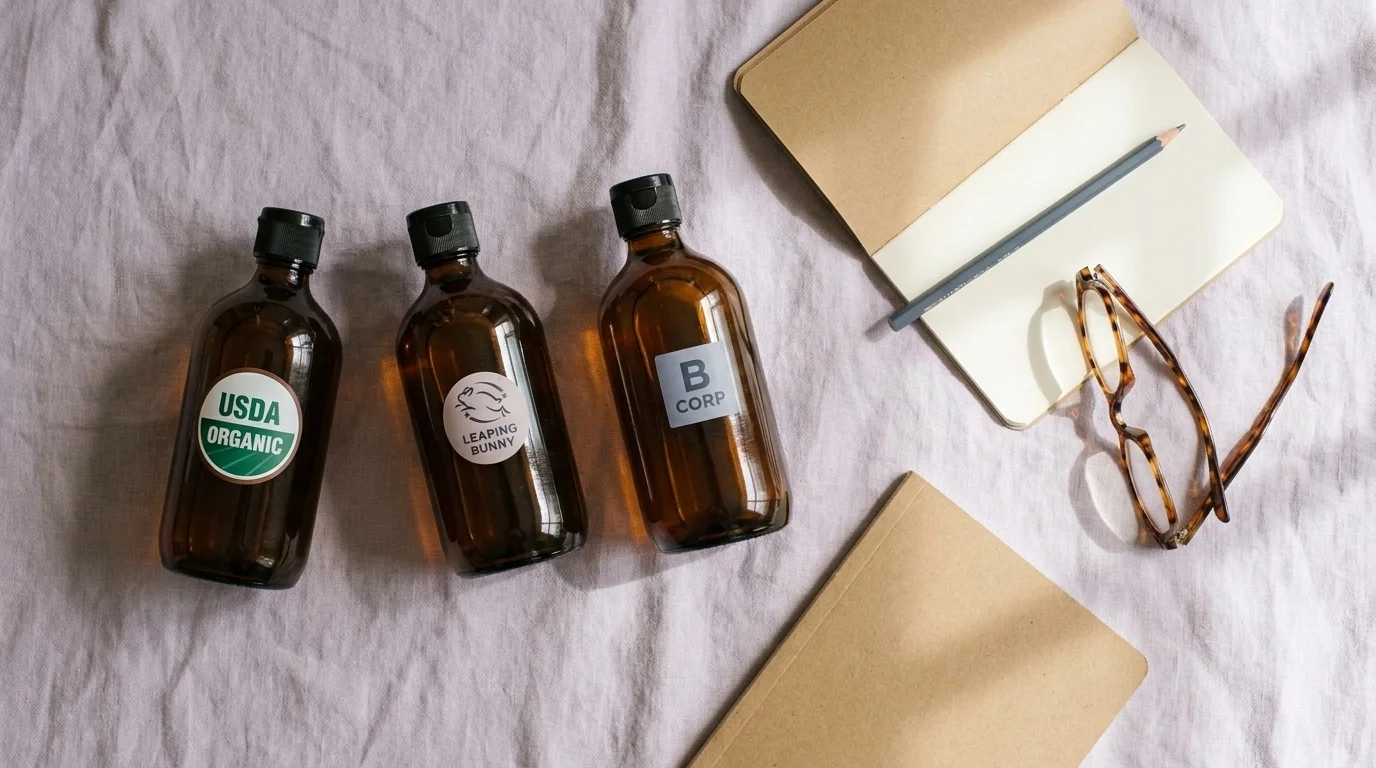
The certifications below are the ones with documented requirements behind them. Use them as a screening tool, not as a buying recommendation.
| Certification | What it actually requires | What it does NOT mean |
|---|---|---|
| USDA Organic | ≥70% certified-organic ingredients; no synthetic preservatives | Does not certify packaging, animal welfare, or carbon claim |
| Leaping Bunny | No animal testing at any stage of production | Does not certify ingredient sourcing or biodegradability |
| ECOCERT | Defined minimums of natural and organic ingredients (EU origin) | Is not a U.S. federal certification; standards vary by tier |
| B Corp | Company-level audit on social and environmental performance | Does not certify the formula in any individual bottle |
| EPA Safer Choice | Formula screened against EPA's safer-chemistry criteria | Is rare in pet products; almost no pet shampoos carry it |
| Made Safe | Screens against known toxins and persistent pollutants | Privately operated; coverage varies by product category |
Related Article: The Impact of Sustainability on Pet Care Purchasing Decisions
The ingredients regulators are coming for
Several common pet shampoo ingredients are either restricted, scheduled for restriction, or flagged for carcinogenicity by U.S. and EU agencies. The list below is the working version as of mid-2026, drawn from 4-Legger's toxic ingredients reference and Dogtown's 2025 safe-shampoo guide.
- Formaldehyde-releasing preservatives (FRPs): DMDM hydantoin, imidazolidinyl urea, diazolidinyl urea, quaternium-15. The proposed U.S. restriction has an effective date of January 1, 2027. The EU requires a warning label already.
- Methylisothiazolinone (MI) and methylchloroisothiazolinone (CMIT/MIT): Sensitizers documented in dermatology literature; EU has tightened concentration limits in leave-on cosmetics.
- Cocamide DEA: California's Proposition 65 list classifies it as a carcinogen at sustained exposure.
- Coal tar: Used in some medicated pet shampoos; classified as a known human carcinogen by IARC.
- Phthalates (often hidden under "fragrance" on the label): Linked to endocrine disruption in the published literature. Because "fragrance" is a regulated trade-secret term, the actual phthalate content is not required to be disclosed on the ingredient list.
- Sulfates (SLS, SLES): Not classified as carcinogenic in the relevant agency reviews, but flagged for skin irritation and for a manufacturing-stage 1,4-dioxane contamination risk.
- Parabens and mineral-oil derivatives: Documented for environmental persistence in aquatic systems, per ecofurball.com's review of organic dog shampoo safety. Endocrine-disruption signals on parabens are an active research area.
The pattern: most of these ingredients persist in waterways after the wash water leaves the drain. The "eco" claim and the "safe for your dog" claim are the same claim, traced one step downstream.
Beyond shampoo: brushes, wipes, and the format ladder
A natural pet shampoo bottle is the highest-traffic SKU in this category, but the sustainability conversation does not end at the rinse cycle.
Format ladder. The same shampoo formula is now sold in three different sustainability configurations: standard plastic bottle, refillable concentrate (often shipped as a small aluminum or glass pouch the buyer dilutes at home), and solid shampoo bar (no bottle at all). The concentrate cuts shipping weight and packaging volume; the solid bar eliminates the bottle entirely. Both formats moved from niche to mainstream during 2024-2026, per the Stuck Soap 2026 trend coverage. Searches for plastic free dog shampoo and eco friendly dog shampoo track this format shift directly.
Brushes. A bamboo dog brush is a renewable-material substitute for a plastic-handled brush of equivalent function. Bamboo is a fast-growing grass that does not require pesticide-intensive cultivation in most commercial sourcing. The brush itself is not a regulated category — there is no certification on the wood, only on the brand-level claims around it. The same logic applies to organic-cotton grooming towels.
Wipes, ear cleaners, and conditioner refills. Biodegradable grooming wipes, plant-based ear-cleaning solutions, and refillable conditioner bottles are the rest of the eco friendly dog grooming products cluster — a search term whose volume rose roughly 400% year over year, per the Phase 2 search data summarized for this brief. The same label-decoding rules apply: "biodegradable" describes drain behavior, not sourcing; "plant-based" is a marketing phrase without a federal definition; refillability is verifiable only if the brand actually sells refills.
Related Article: Sustainable Practices in Pet Grooming Services: Eco-Friendly Innovations for Fur Salon Operations
A DIY natural dog shampoo, with the warnings the marketing copy leaves out
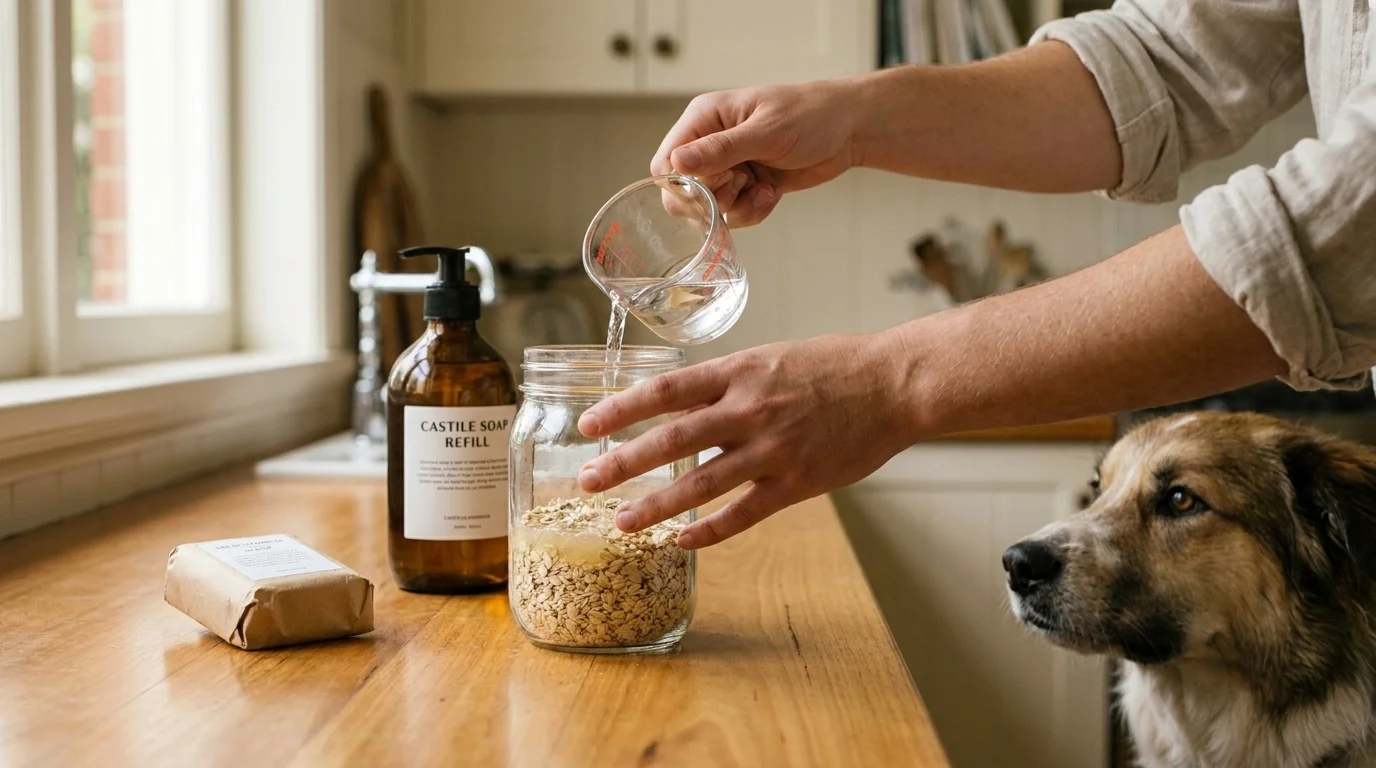
DIY recipes are absent from most published product roundups, which makes them one of the few useful, low-cost on-ramps to chemical-free grooming a pet owner has. The recipe below is adapted from the American Kennel Club's homemade-shampoo guide, which also documents the canine pH range cited at the top of this article.
Basic recipe (single bath, medium-sized dog):
- 2 cups warm water
- 1/4 cup non-toxic liquid Castile soap (unscented or mild)
- 1/2 cup white vinegar (helps neutralize odor and balance pH)
Combine in a clean spray bottle, shake, apply to a wet coat, work into a lather, rinse thoroughly.
For dry or itchy skin (alternate recipe):
- 1 cup raw rolled oats (ground to a fine powder)
- 1/2 cup baking soda
- 1 quart warm water
Pour over a wet coat, leave on for several minutes, rinse.
The warnings the bottle doesn't carry. Never apply undiluted essential oils to a dog's coat or skin — lavender at roughly two drops per cup of base is the AKC's documented ceiling for the few oils that are safe at all. Tea tree, citrus, peppermint, pennyroyal, pine, wintergreen, and several others are toxic to dogs at concentrations marketed as "natural" on adult cosmetics. Avoid the eyes. Avoid open wounds. If your dog has a diagnosed skin condition, ask the vet before substituting any DIY recipe for a prescribed medicated formula.
What to verify before the next bottle
The sustainable pet products category is now USD 5.5 billion in shampoo and personal-care SKUs alone, growing in step with a buyer base willing to pay a roughly 33% premium for credible environmental claims. The premium is what makes the disclosure questions worth asking.
At the checkout, ask three things: Does the back-of-bottle ingredient list contain any of the FRPs the U.S. is restricting in 2027? Does any sustainability claim on the front of the bottle map to a certification — USDA Organic, Leaping Bunny, ECOCERT, B Corp, EPA Safer Choice, Made Safe — that you can verify, or is it self-asserted? And does the brand actually sell the refill or the bar, or is the "eco-friendly" claim limited to the design of the packaging the bottle came in?
Those are the questions that separate a sustainability story from a marketing one. The answers are on the bottle, in eight-point type on the back. Read the eight-point type.
Frequently Asked Questions
No. Canine skin pH is 6.2-7.4 while human skin is 5.5-5.6 — human shampoo is too acidic and strips the protective skin barrier, causing dryness and irritation. Use a pet-formulated shampoo or a vet-approved DIY alternative.
USDA Organic certification requires at least 70% certified-organic ingredients, with no synthetic preservatives, artificial fragrances, or formaldehyde-releasing preservatives. It is currently the strictest third-party standard pet shampoo brands can carry, and the word organic without the USDA seal has no enforceable definition.
Parabens, sulfates (SLS, SLES), artificial fragrance (which can hide phthalates), formaldehyde-releasing preservatives such as DMDM hydantoin and quaternium-15, coal tar, cocamide DEA, and methylisothiazolinone. The U.S. has a proposed restriction on several formaldehyde releasers effective January 1, 2027.
Yes. A simple base recipe is 2 cups warm water, 1/4 cup non-toxic Castile soap, and 1/2 cup white vinegar in a spray bottle. For dry or itchy skin, an oatmeal-and-baking-soda blend works well. Never use undiluted essential oils on a dog, and avoid the eyes.
Yes. Solid shampoo bars eliminate plastic bottles entirely, and concentrated refills cut shipping weight and packaging waste. Both formats are now mainstream in 2026 across eco-focused pet brands, and they directly drive growth in searches like plastic free dog shampoo.