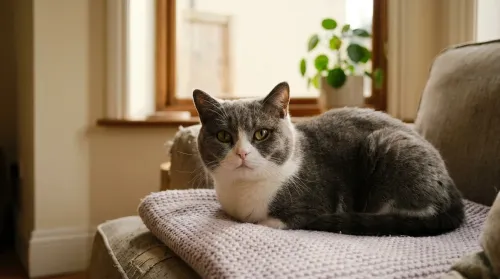


Do cats always land on their feet? No. Usually — yes, often spectacularly — but not always, and the gap between usually and always is exactly where cats get hurt. I want to take the folklore apart carefully here, because this is one of the rare cat-behaviour claims that science has actually tested, and the testing is more interesting than the myth.
A cat needs roughly 12 inches — about 30 centimetres — of fall to complete its righting turn. Below that, there simply isn't time to rotate, which is why a cat sliding off a low coffee table can land in an undignified heap while the same cat drops cleanly from the top of a wardrobe. The reflex is real. It is also bounded — by height at the bottom, and by physics at the top.
How a Cat Actually Turns Itself Over
For years the honest answer to "how does the righting reflex work" was a hand-wave about flexible spines and inner ears. As of this spring, we can do better.
In March 2026, a team at Yamaguchi University published the first proper measurement of where the twist happens, and it overturned the lazy assumption that cats bend in the middle of the back. The rotational engine is the thoracic spine — the upper, chest section. It has what the researchers call a neutral zone, a range where it twists almost freely — up to about 50 degrees — with very little muscular effort. The lower, lumbar spine does the opposite job: it stays stiff and acts as a stabiliser, stopping the whole body from spinning out of control. And the rotation is sequential — the front half of the cat turns first, then the rear follows it round. They confirmed this by mechanically testing cat-cadaver spines and filming live cats dropping onto cushions with high-speed cameras.
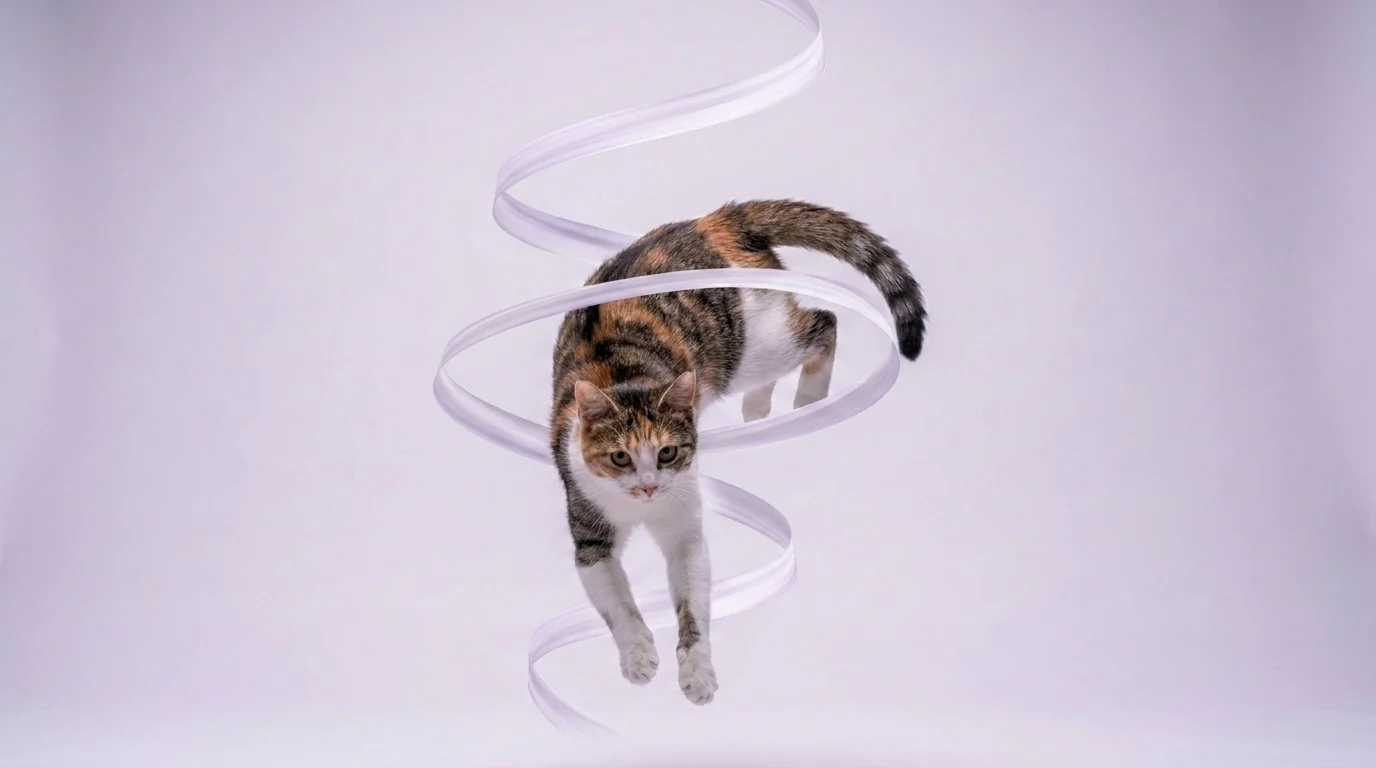
Underneath the cat lies the equipment that makes this possible. The vestibular system in the inner ear tells the cat instantly which way is down — that's the orientation signal. The skeleton then does the work: a cat has around 30 vertebrae and no functional collarbone, which frees the shoulders and lets the spine fold and counter-rotate in ways a stiffer animal simply cannot manage.
The physics that looks like cheating
There's a puzzle people enjoy here, and it's worth answering plainly because so many searchers ask it. A body in free fall can't conjure rotation out of nothing — that would break the conservation of angular momentum. So how does a cat starting back-down end up feet-down? It doesn't create the turn. It redistributes rotation inside its own body, counter-rotating its front and back halves against each other — tucking one set of legs in to spin faster, extending the other to spin slower — until both ends are pointing the right way. No law of physics is broken. The cat is just a far better gymnast than we are.
Why Dogs Can't Do It
This is the question I get asked most by people who own both, so I'll be direct: dogs cannot do this, and it isn't for lack of trying. A dog lacks the cat's combination of an extra-flexible, roughly 30-vertebra spine and a non-functional collarbone, and it never developed the fast air-righting reflex that lets a cat rotate its front and rear independently. This is precisely the "cats are not small dogs" point I make about everything else, written into the skeleton. Same household, same sofa, entirely different animal.
High-Rise Syndrome: Higher Is Not Safer (and What the Biggest Study Found)
Now the part that matters for keeping your cat alive, and the part where I have to correct a story I myself used to repeat.
The famous claim — built on a 1987 veterinary study of 132 cats — was that cats falling from very high (seven storeys and up) often fared better than cats falling from two to six storeys. The proposed reason was elegant: given enough time, a cat reaches its terminal velocity of about 60 mph (a human's is roughly 120), stops accelerating, relaxes, and spreads out flat like a flying squirrel to increase drag and distribute the impact. It's a lovely hypothesis, it's all over the internet, and it should not be stated as settled fact.
Because in 2025 a Freie Universität Berlin team published the largest dataset we have — 1,125 cat falls of four metres or more. They did not find the paradox. Instead, injury severity rose more or less linearly with height: higher generally meant worse. The encouraging headline is that most cats survived — about 87% — but survival stayed above 80% only up to around 21 metres, then fell toward 60% beyond that. The injuries were not minor either: musculoskeletal damage in 92.4% of cases, chest trauma in 58.3%, facial injuries in 51.1%.
So the honest, current answer is this: cats survive falls remarkably often, and the terminal-velocity relaxation almost certainly happens — but do not let anyone tell you a higher window is a safer one. Every fall, from any height, earns a veterinary check, because chest and internal injuries don't always show on the outside. Vet first. Always.
When Falls Actually Happen — and How to Prevent Them
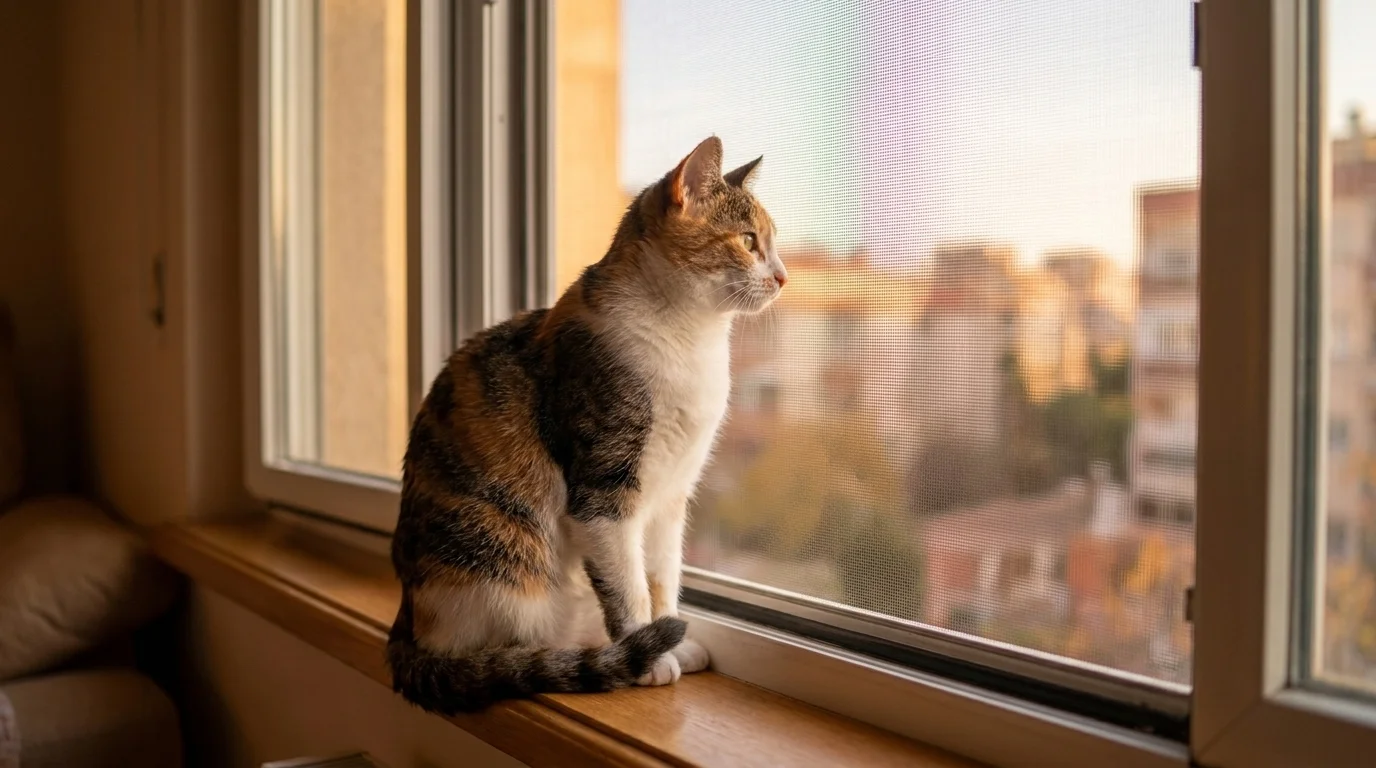
Here is where the science becomes something you can act on, and the timing of this article is not an accident. The same 2025 research mapped exactly when and why these falls happen, and the pattern is seasonal: 77% occurred in the warmer months and 62% at night. The mechanism is almost always the same — a window thrown open for ventilation on a hot evening, or left open when an owner pops out. The median casualty was a young cat, about two years old, with more than a quarter under a year. Curious, athletic, and overconfident, in other words. And most landed on hard surfaces.
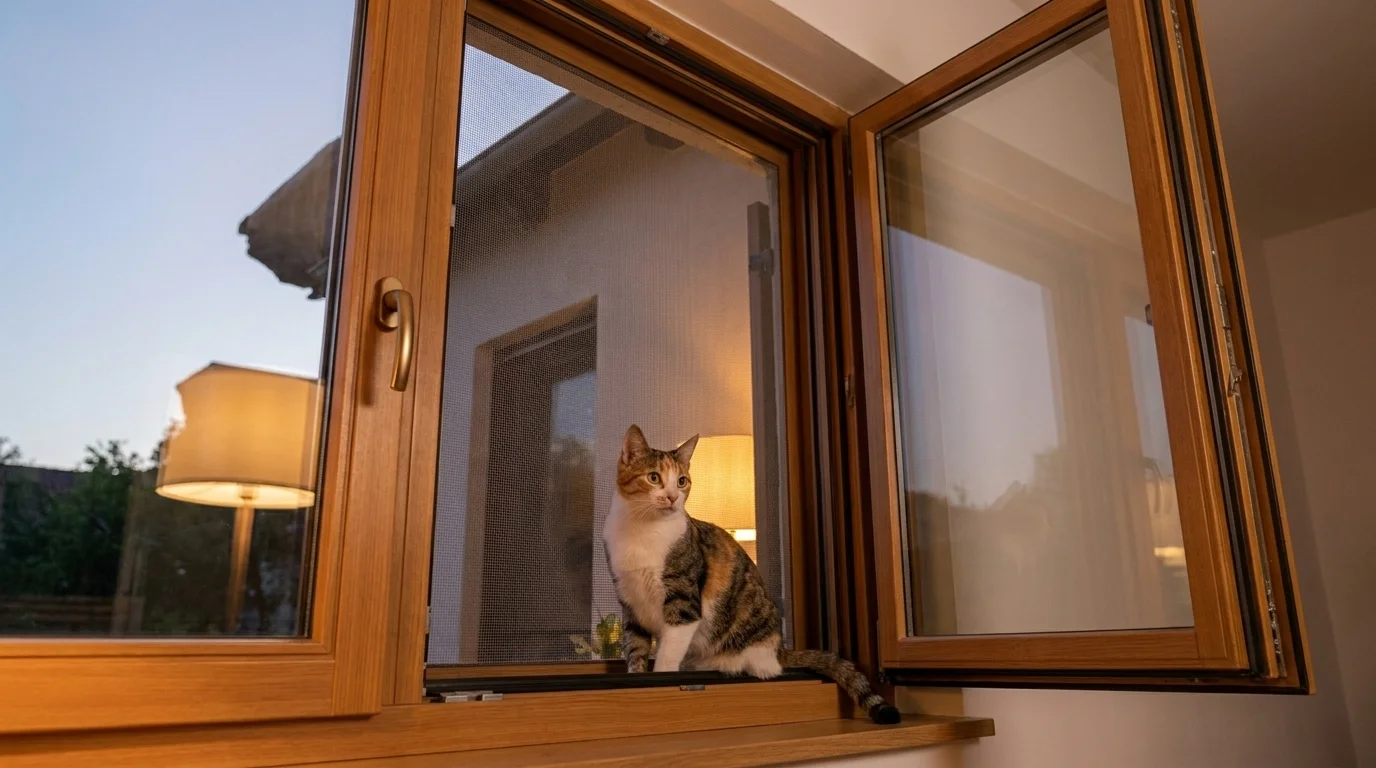
That gives us a precise, unglamorous prevention list:
- Screen your windows properly. Not a loosely propped fly-mesh, but fitted, cat-proof screens on any window you open — especially upper floors, especially in summer. Tilt-and-turn windows are a particular hazard; a cat can become trapped in the gap.
- Treat balconies as off-limits without barriers. A balustrade a cat can squeeze through or leap from is not a safe perch.
- Give the climbing instinct somewhere legitimate to go. This is core environmental enrichment: cat trees, secured shelves, and vertical territory indoors satisfy the urge to be high up without putting your cat on a window ledge. A cat with good vertical territory inside is less interested in the dangerous version outside.
- Mind the life stages. Kittens have the drive but not yet the polished reflex; senior cats may have stiffer spines and slower reactions. Both deserve extra caution around open height.
None of this dims how astonishing the righting reflex is. It is one of the genuinely tested wonders of feline biology — a 30-centimetre minimum, a thoracic spine that twists 50 degrees almost for free, a front-then-rear sequence quicker than your eye can follow. Respect it for what it is: a remarkable piece of evolution, not a safety net. Close the window.
Frequently Asked Questions
No. A cat needs roughly 12 inches (30 cm) to complete the righting reflex, so very short falls can end badly. Very high falls cause severe injury too — survival drops sharply beyond about 21 metres even though most cats survive shorter falls.
Usually their feet. But at terminal velocity (about 60 mph) a cat spreads out flying-squirrel style and may land flatter, on the chest, to spread the impact across the body.
Dogs lack a cat's combination of an extra-flexible 30-vertebra spine, a non-functional collarbone, and the developed air-righting reflex, so they can't twist the front and rear halves of the body independently.
They don't break them. Instead of creating rotation from nothing, a cat redistributes rotation inside its body, twisting at the flexible thoracic (upper) spine while the lower spine stabilizes — measured directly in a 2026 Yamaguchi University study.
Most do. A 2025 study of 1,125 falls found about 87% survived. But injuries such as chest trauma, fractures, and facial wounds rise with height, so any fall warrants a veterinary check even if your cat seems fine.