


Roughly 66 percent of households worldwide own at least one pet as of 2025, with the global population now estimated at about 900 million pet dogs and 370 million pet cats. The headline rate masks how different cultures arrive at that ownership. Cats in ancient Egypt were a state religion before they were a household pet. Hindu households in India coexist with an estimated 62 million street dogs as religious neighbors rather than nuisances. Muslim households read about a guardian dog in Surah Al-Kahf and decide whether to keep one based on which school of jurisprudence their family follows. Mexican families now set out an ofrenda for departed pets every October 27, anchored on a dog breed (the Xoloitzcuintle) that pre-dates the Aztec empire. The "pet care" that the global market is on track to grow from $246.66 billion in 2023 to $483.5 billion by 2035 is six or seven different things at once, depending on whose home the bag of food lands in.
This piece walks through six of those cultures with named scholars, named traditions, named dates, and current data — Ancient and modern Egypt, Islamic jurisprudence on dogs, Hindu animal compassion and India's 2025 stray-dog moment, Japan's Higan-e and maneki-neko, Mexico's Día de Muertos for pets, and the Catholic Blessing of the Animals on the Feast of St. Francis.
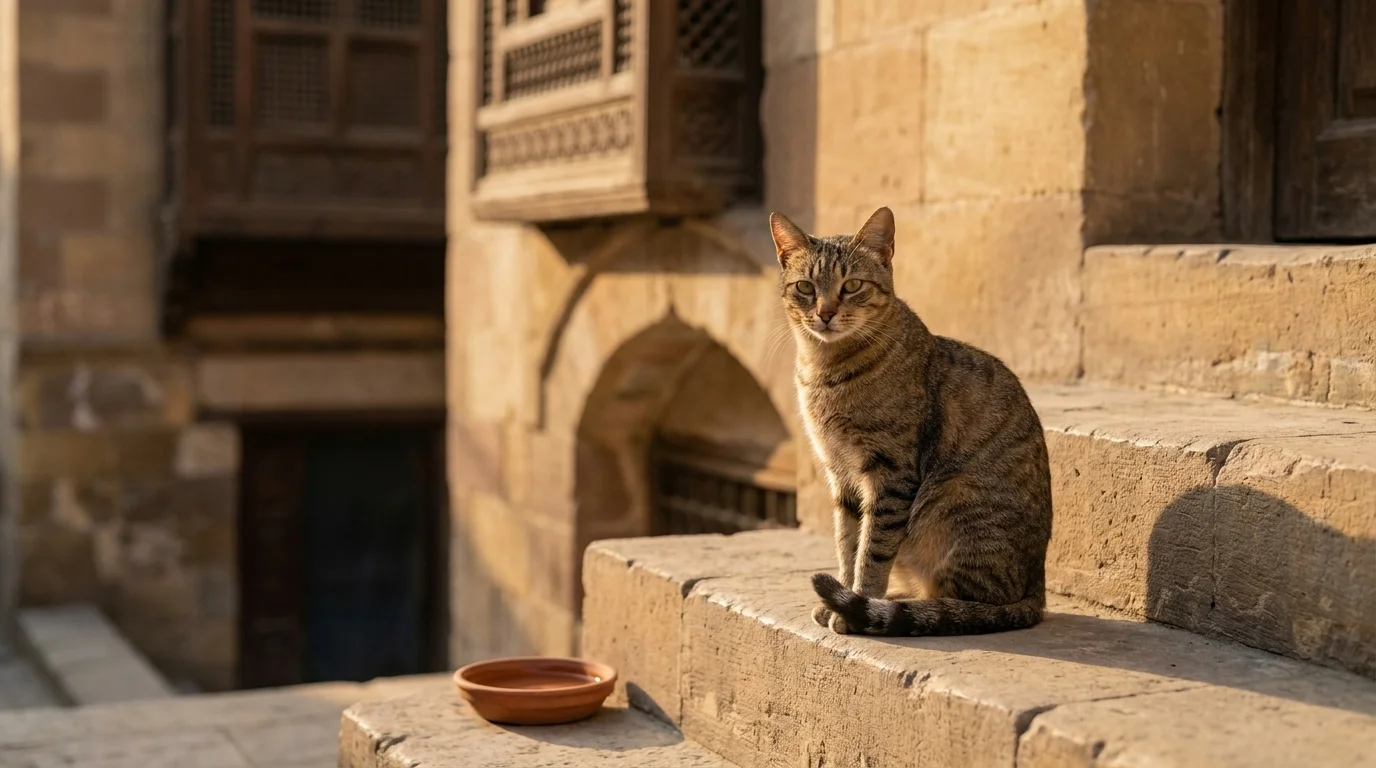
Cats in Ancient and Modern Egypt
The 2025 archaeology consensus tightened: domestic cats spread out of Egypt rather than the Levant, making the Bastet-era cult of cats foundational to global cat domestication rather than one branch among several. The American University in Cairo Press published Divine Companions: Cats, Gods, and the Ancient Egyptians in August 2025 as an academic-popular treatment of the same cult — a useful citation anchor for anyone trying to understand why Egypt sits where it does in the cat story.
The cult itself was specific. Bastet — the cat-headed goddess associated with the home, fertility, and protection — was the central figure; Sekhmet (lion-headed, war and healing) and Mafdet (justice and protection from venomous animals) were the more ferocious counterparts. Cats were valued operationally for killing snakes and rodents that threatened grain stores and the pharaoh's residence, and they were valued religiously as embodied protection. Millions of cats were mummified at temple complexes — Bubastis, in particular — as votive offerings to Bastet. Killing a cat was a capital offence under Egyptian law for most of the relevant period.
The modern continuity is real but should not be romanticised. Egypt today has a large street-cat population that is genuinely tolerated in a way most Western cities no longer manage — fed, sheltered in mosque courtyards and apartment-building entrances, accepted as part of the urban texture. That coexistence has roots in the ancient religious tradition. It also has more prosaic causes: Egypt's mosque tradition has long tolerated cats specifically, and Islamic jurisprudence (Maliki and otherwise) treats cats as ritually pure in a way that dogs are not. Both currents converge in the modern Egyptian street.
Dogs in Islam: Companions in the Qur'an
The "dogs in Islam" question is the highest-volume cultural-pet query that mainstream pet content tends to avoid. The accurate answer is more nuanced than the popular shorthand suggests, and the source material is specific.
The Qur'an itself, in Surah Al-Kahf (18:18), describes a dog stretched out at the entrance of a cave where a group of righteous youths — the Companions of the Cave — were placed in a long sleep by God. The dog is depicted as a faithful guardian of the believers, and classical Islamic commentary names the dog Qitmir. The text is unambiguous that the dog is in the company of the righteous; the verse is not used as an anti-dog reference in Islamic tradition. The Qitmir tradition appears in Tafsir Ibn Kathir and other classical commentaries.
Islamic jurisprudence on dogs splits across the four Sunni schools and within Shia jurisprudence. The Maliki school treats domesticated dog saliva as ritually pure, allowing closer coexistence with household dogs; the Hanafi, Shafi'i, and Hanbali schools tend toward stricter readings, primarily around the requirement to wash after contact with wet dog saliva. Across all schools, working dogs — for guarding, hunting, herding, and assistance — are explicitly permitted by hadith. The famous prophetic hadith of the woman who watered a thirsty dog and was forgiven her sins is shared across schools as a touchstone of the merciful tradition.
Contemporary scholarship has narrowed the gap. Khaled Abou El Fadl, professor of law at UCLA, and Ingrid Mattson, former president of the Islamic Society of North America, have both argued in published work that the harsher anti-dog hadith reflect pre-Islamic Arab customary attitudes rather than authentic Islamic teaching, and that the Qur'an's own portrayal of dogs is welcoming. Neither position adjudicates the jurisprudential debate for any individual reader; both make a documented case for a more compassionate practical posture.
For modern Muslim pet owners, the practical implications follow the school. Maliki households frequently keep house dogs; households following stricter schools typically keep dogs in yards or for working purposes, with attention to ritual cleanliness after wet contact. The journalism point worth making: "dogs are haram in Islam" is not what the tradition actually says, and the Qur'anic anchor in Surah Al-Kahf 18:18 is the citation most often left out of pop-culture summaries.
Hindu Compassion: Kukur Tihar and India's Stray-Dog Streets
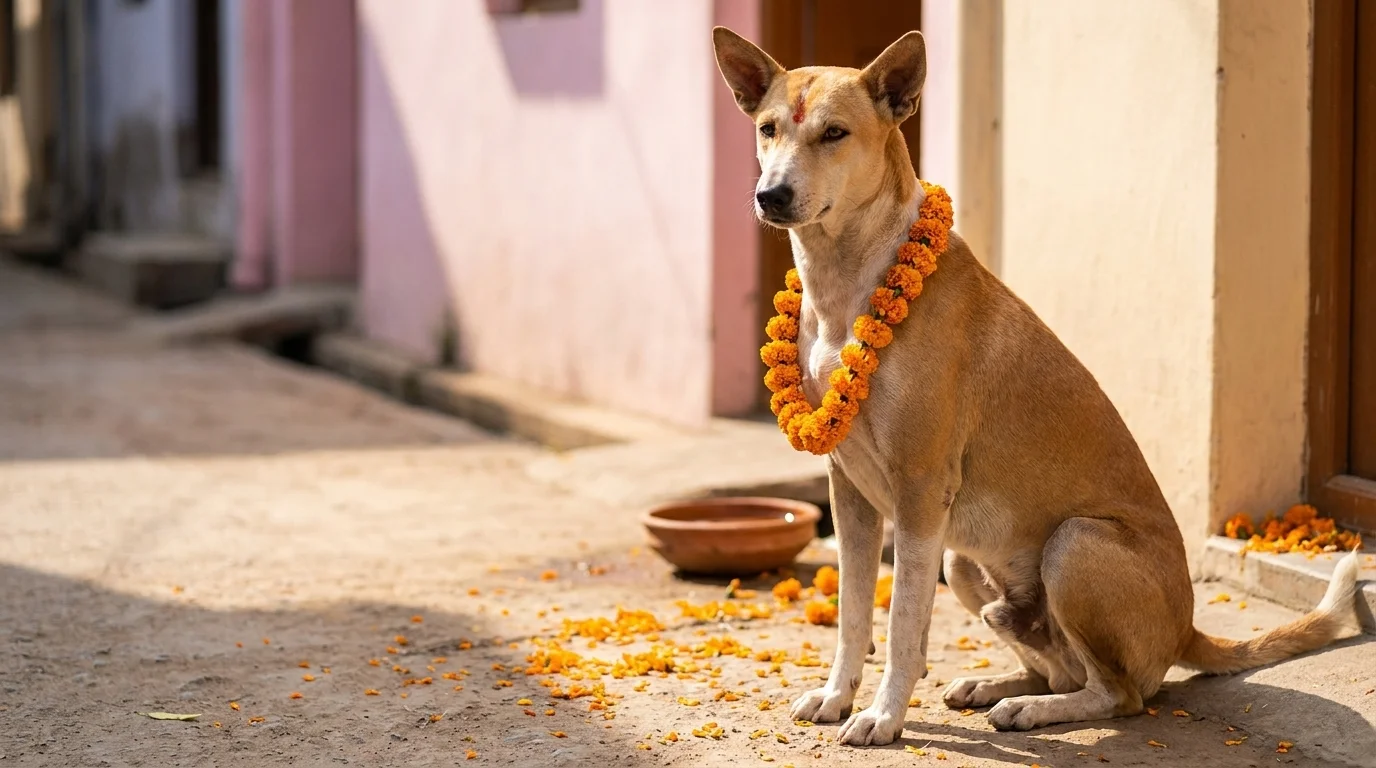
The Hindu animal-compassion tradition runs deeper and stranger than the original article allowed. The headline observance is Kukur Tihar — "Day of the Dogs" — the second day of the five-day Tihar festival celebrated especially in Nepal and parts of India. Families garland their dogs — household pets and street dogs alike — with marigolds, apply a sandalwood tilak to their foreheads, offer prayers, and feed them treats. The festival honours dogs as guardians and as divine messengers in Hindu cosmology (Yama, the god of death, is traditionally accompanied by two dogs). The broader doctrinal anchor is ahimsa, the principle of non-violence toward all living beings that runs through Hindu, Jain, and Buddhist traditions and explains why dogs roam Indian streets as neighbours rather than being culled.
That centuries-old coexistence is now under acute pressure, and 2025 was the year it hit the courts. India's stray-dog population is estimated at around 62 million, with about 2.2 million dog bite cases reported in 2024 and Delhi alone logging more than 35,000 animal-bite incidents in the first half of 2025. India accounts for roughly 36 percent of global rabies deaths and is operating under a 2030 elimination target for dog-mediated human rabies.
The policy frame is the 2023 Animal Birth Control (Dogs) Rules under the Prevention of Cruelty to Animals Act, which mandate a Capture-Neuter-Vaccinate-Release (CNVR) approach and require Urban Local Bodies to cover at least 70 percent of the stray population. India operates 76 accredited dog-sterilization centres for that 62-million-dog responsibility — the bottleneck the rules cannot legislate around.
The cultural-legal collision in August 2025: a lower court ordered Delhi authorities to remove roughly one million stray dogs from the city. After national outcry, India's Supreme Court reversed the order, restoring the dogs' right to remain in their neighbourhoods after sterilization and vaccination. The ahimsa frame is doing real legal work in real time — and the rabies math is doing real legal work back.
Japan: From Higan-e to Maneki-neko
Japan's cat-and-pet culture is a layered story, not a single Higan-e mention. The original article gestured at the Higan-e tradition — the Buddhist observance during the spring and autumn equinoxes when families visit ancestral graves and, in some practices, bring pets. That tradition is real, particularly in rural prefectures, but it is not what searchers usually mean when they look up Japanese pet culture.
The dominant Japanese pet symbol globally is the maneki-neko — the "beckoning cat" ceramic figurine that sits in storefronts, restaurants, and homes inviting good fortune. The most cited origin legend traces it to Gōtoku-ji Temple under Ii Naotaka in the Kan'ei era (roughly 1622-1624), where a temple cat is said to have beckoned the daimyō to shelter just before a lightning strike, leading Ii to patronize the temple. The figurine codified into mass production during the Edo period. Paw and colour symbolism is specific: a raised left paw beckons customers, a raised right paw beckons money, calico and white are traditional, and gold signals financial luck.
Maneki-neko is still a live cultural product, not a relic. Tokoname, the ceramic-production city that has been the dominant manufacturer for over a century, launched a major promotional campaign across Japanese train stations in 2025 to anchor the figurine to the city's tourism positioning. The cat-cafe model (origin Taiwan, scaled by Japan) and the global Hello Kitty franchise are the same cultural current extended into the export economy. Anyone studying global cat culture in 2026 has to account for Japan as an active exporter of cat-positive symbolism, not just as a historical curiosity.
Mexico: Día de Muertos for Pets and the Xoloitzcuintle
The Mexican observance has consolidated since the original article was published. October 27 is now widely observed as Día de Muertos for pets — the pet-specific day that precedes the main Day of the Dead observances on November 1-2. The practice has spread quickly through Mexican and U.S. Hispanic households over the last several years, with dedicated pet ofrendas appearing in homes, community altars, and humane-society events.
The cultural anchor is the Xoloitzcuintle — the Xolo. The hairless Mexican breed is among the oldest in the Americas, pre-Columbian in origin, and traditionally understood as the guide dog of the afterlife, the companion that helps souls cross the river to Mictlán in Aztec cosmology. The 2025 Disney/Pixar afterlife is borrowed from this tradition, not invented for it. A pet ofrenda typically includes a photograph of the departed animal, cempasúchil marigolds, candles, a familiar collar or leash, paw prints if available, and the pet's favorite treats. The ofrenda is set up in the days before October 27 and stays out through the main November 1-2 observances.
The cross-cultural point: this is one of the few mainstream traditions globally that gives departed pets a formally observed day on the calendar. The closest equivalent is the Catholic All Souls' Day extension some parishes make to include pets — but the Mexican observance is older, more specific, and more visible in lived practice.
The Blessing of the Animals: Feast of St. Francis
The original article framed the Blessing of the Animals as a Scottish custom. The dominant tradition is actually the Catholic Feast of St. Francis of Assisi, observed on or around October 4 at Catholic and Anglican parishes worldwide. The practice traces to St. Francis's documented kinship with animals — the legendary preaching to the birds and the truce with the wolf of Gubbio are the famous anecdotes — and has expanded to encompass pets of all faiths in many parishes.
Major U.S. observances on the Oct 3-5, 2025 weekend: Washington National Cathedral hosted its annual blessing; the Cathedral Basilica of Saints Peter and Paul in Philadelphia held an outdoor service; the Archdiocese of Chicago coordinated parish blessings across the diocese; the Cathedral of St. John the Divine in New York continued its long-running ceremony, which has historically included exotic animals from goats to camels. Hispanic Catholic parishes across the U.S. and Latin America observe the same date, often as a more central community event than they are in Anglo-American cities.
The journalism note worth flagging: the Scottish framing the original article used is real (some Scottish parishes do host pet blessings around different feast days), but it is a minor regional variant. The dominant cluster — and the searchable cluster — is the October 4 Catholic observance, and a piece that frames it otherwise loses both accuracy and SEO.

Related Article: Cultural Connotations: Exploring How Different Colors Hold Diverse Symbolism in Pet Care Around the World
How Six Cultures Honor Their Animals
| Culture / region | Primary tradition | Animal focus | Key date(s) | Modern practice |
|---|---|---|---|---|
| Ancient + modern Egypt | Bastet cult; Maliki cat-purity continuity | Cats | Year-round; cat-mummy temples | Tolerated street-cat coexistence in modern Cairo, Alexandria, and beyond |
| Islamic tradition | Surah Al-Kahf 18:18 (Qitmir); four-school jurisprudence | Dogs (cats also permitted) | Year-round practice | Working / household dog ownership varies by school; cats widely kept |
| Hindu / Indian (incl. Nepal) | Kukur Tihar; ahimsa toward strays | Dogs (cows also sacred) | Kukur Tihar (Tihar Day 2, Oct–Nov) | 62M coexisting strays; 2025 SCOTUS protection ruling; 2030 rabies target |
| Japan | Higan-e; maneki-neko | Cats (dogs at temples too) | Higan-e (March + Sept); year-round maneki | Cat cafes, Hello Kitty export, 2025 Tokoname maneki-neko campaign |
| Mexico | Día de Muertos for pets; Xoloitzcuintle | All companion animals | Oct 27 (main observance Nov 1–2) | Pet ofrendas in households + community altars; Xolo breed central |
| Catholic / Hispanic (worldwide) | Blessing of the Animals (Feast of St. Francis) | All animals | Oct 3-5 (around Oct 4) | Parish blessings at U.S. cathedrals (Washington, NYC, Chicago, Philadelphia) and Latin American parishes |
Convergence: Pets as Family Across Cultures
The structural pattern these six traditions share is convergence. Sixty-nine percent of Millennials and Gen Z view pets as family across the markets surveyed, and 85 percent of U.S. pet parents say the same. The U.S. pet ownership rate of 66 percent of households is now matched or exceeded by markets across Latin America and Europe; Russia leads in cat-ownership prevalence at 59 percent of population; Brazil totals 156.4 million pets. The global pet-care market on track for $483.5 billion by 2035 is the financial expression of that demographic convergence.
What is interesting is not that different cultures are arriving at "pets as family" — the destination is shared — but that they arrive from genuinely different starting points. Hindu ahimsa, Egyptian Bastet-era veneration, Mexican pre-Columbian afterlife guidance, Japanese maneki-neko mercantile symbolism, Islamic Qur'anic kinship, and Catholic Franciscan blessing are not the same intellectual tradition. They are six distinct roots producing a partially shared modern practice. The convergence question for the next decade is whether the shared practice deepens — a global "pet-as-family" baseline that absorbs the local traditions — or whether the local traditions reassert themselves as the practice scales. The 2025 evidence is mixed in interesting ways: India's Supreme Court reasserted the ahimsa tradition against modernization pressure, while Mexico's Día de Muertos for pets has spread far beyond its pre-Columbian roots into Anglo households.
The receipt-driven version of "embracing cultural diversity in pet care" is the one that names the date, the deity, the bill number, and the bag of food, and lets the reader decide what to do with the cross-cultural pattern that emerges from those specifics.
Frequently Asked Questions
Ancient Egyptians revered cats as living embodiments of the goddess Bastet, protector of the home and household. Cats were also associated with Sekhmet (war and healing) and Mafdet (justice and protection from venomous animals). They were valued operationally for killing snakes and rodents that threatened grain stores and the pharaoh's residence, and millions of cats were mummified as temple offerings to Bastet, especially at Bubastis. Killing a cat was a capital offence under Egyptian law for most of the relevant period. The 2025 archaeology consensus is that domestic cats spread out of Egypt rather than the Levant, making Egypt foundational to global cat domestication.
Yes — keeping dogs is permitted, particularly for guarding, hunting, herding, or assistance, and is not categorically forbidden as a religious matter. The Qur'an itself (Surah Al-Kahf 18:18) describes a dog — traditionally named Qitmir in classical commentary — as a faithful companion of the Companions of the Cave. Jurisprudential treatment differs across schools: the Maliki school treats domesticated dog saliva as ritually pure, while the Hanafi, Shafi'i, and Hanbali schools tend toward stricter readings around ritual cleanliness after wet contact. Contemporary scholars including Khaled Abou El Fadl and Ingrid Mattson have argued that harsher anti-dog hadith reflect pre-Islamic Arab customary attitudes rather than authentic Islamic teaching.
Kukur Tihar is the second day of the five-day Hindu festival of Tihar, celebrated especially in Nepal and parts of India, dedicated entirely to dogs. Families garland their dogs — including strays — with marigolds, apply a sandalwood tilak to their foreheads, offer prayers, and feed them treats. It honours dogs as guardians and as divine messengers in Hindu cosmology (Yama, the god of death, is traditionally accompanied by two dogs). The broader doctrinal anchor is ahimsa, the principle of non-violence toward all living beings.
October 27 is now widely observed as Día de Muertos for pets in Mexico and U.S. Hispanic households — the day before the main Day of the Dead observances on November 1-2. Families build dedicated pet ofrendas with a photo of the departed animal, cempasúchil marigolds, candles, a familiar collar or leash, paw prints if available, and the pet's favorite treats. The cultural anchor is the Xoloitzcuintle, the hairless pre-Columbian Mexican breed traditionally understood as the guide dog of the afterlife.
On or around October 4 (Feast of St. Francis of Assisi), Catholic and Anglican parishes worldwide host outdoor services where pet owners bring animals — dogs, cats, birds, reptiles, even livestock — to receive an individual blessing. Major U.S. observances include Washington National Cathedral, the Cathedral of St. John the Divine in New York, the Cathedral Basilica of Saints Peter and Paul in Philadelphia, and parishes across the Archdiocese of Chicago. The practice traces to St. Francis's documented kinship with animals and is widely observed by Hispanic Catholic parishes across the U.S. and Latin America.
The maneki-neko (the 'beckoning cat') is the Japanese ceramic figurine of a cat with one raised paw, traditionally placed in shops, restaurants, and homes to invite good fortune. The most cited origin legend traces it to Gōtoku-ji Temple under Ii Naotaka in the Kan'ei era (roughly 1622-1624). A raised left paw beckons customers, a raised right paw beckons money. Calico and white are traditional; gold signals financial luck. The ceramic-production city of Tokoname remains the dominant manufacturer and launched a major train-station promotional campaign in 2025.