Crisis Management in Pet Care: A Groomer's Guide to Handling Emergency Situations with Composure


A friend of mine in Galway brought her Cavalier King Charles spaniel, Bonnie, home from a routine grooming appointment last spring with what was, by any honest reading, a dog cut from grooming — a small razor mark behind her left ear. The groomer had not mentioned it at pickup. Bonnie was uncharacteristically still in the car and would not let my friend touch her right side for the rest of the evening. The mark turned out to be a clipper nick that had stopped bleeding before pickup; the bigger problem was a small clipper-burn rash along Bonnie's belly that nobody had noticed in the salon's lighting. Two days later there were raised, weeping bumps along Bonnie's back. She had post-grooming furunculosis and she ended up on antibiotics for nearly a month.
I am writing this piece because Bonnie's owner spent the next three weeks searching Google for "dog cut from grooming," "clipper burn dog," "groomer nicked my dog," and "raised bumps after bath" — and not one of the top-ranking results she found bridged the four things she actually needed at once: what each kind of injury looks like, when it crosses the line from at-home cleanup to a vet visit, why some salons cause these injuries and others do not, and what to ask before booking the next appointment. The pieces are scattered across Reddit threads, generic first-aid pages, and groomer-defensive blog posts. This is the bridge.
A short note before we start. I am a certified cat behaviour consultant (CCBC through IAABC), not a veterinarian. Everything that follows is owner-side guidance about what grooming injuries are, how to recognise them, and how to choose a salon less likely to cause them. For any wound that is deep, near the eye, in the ear canal, still bleeding after ten minutes of pressure, or accompanied by lethargy or fever, your veterinarian is the next call — not this article.
One number to put the rest of the piece in context. Pet Care Insurance's 2025 Claims Report found that 34% of pet-service insurance claims came from grooming services, disproportionate to grooming's share of covered providers. The broader US dog-related-injury claim pool paid out roughly $1.86 billion in 2025, up 18.6% from 2024. Grooming is an over-represented sub-category in a rising-cost environment. The reason no major consumer page is willing to lead with this stat is that most of those pages are owned by or affiliated with the salon side. This one is not.
What "dog cut from grooming" usually looks like
The four most common grooming-incident injuries in the order owners actually encounter them are: small scissor or clipper nicks (head, ears, belly, sanitary area, paws), clipper burn (the rash that often looks like a cut and is not), ear and nail injuries (the quicked nail bleeding everyone learns about eventually), and post-grooming furunculosis (the bacterial complication that arrives one to two days later, which the rest of this article will spend time on).
The first-aid response for a fresh, superficial scissor or clipper nick is the same as for any superficial wound. Examine the cut in good light. Clean it gently with lukewarm water or saline. Apply a pet-safe antiseptic — not human antiseptics like hydrogen peroxide, which can damage tissue. Prevent licking with an Elizabethan collar or a soft-fabric recovery cone. Watch for swelling, heat, or discharge over the next 48 hours.
Call your vet today if the cut is deeper than superficial, near the eye, in the ear canal, in the genital area, longer than about half an inch, gaping enough to need closure, or still bleeding after ten minutes of direct pressure. Fresh, clean wounds can sometimes be closed with surgical staples instead of sutures requiring anesthesia, which matters for cost and stress; same-day vet contact widens the closure options.
A responsible salon should acknowledge any injury at pickup, explain what happened, document the incident in writing, and offer to cover related vet costs. A salon that sends your dog home with a fresh wound and no mention is not a salon to book again. The Canadian Red Cross's January 2025 grooming-injuries first-aid page is a useful first-aid baseline — but it stops at "clean and dress." The rest of this piece is what it does not cover.
Clipper burn — the most common "cut" that isn't a cut
Clipper burn is the injury most often misidentified by owners and by salons. It looks like a red, raw rash or a shallow abrasion on the dog's skin, frequently on the sensitive areas where the dog has the least hair to cushion the blade: the belly, the groin and armpits, around the base of the tail, the inside of the back legs. It is not a cut. It is a friction-and-heat injury.
Mission Veterinary's clinical reference explains the etiology as continuously running clipper blades that overheat, dull or damaged blades that drag instead of cutting cleanly, or blades pressed too firmly against the skin. The standard prevention is regular blade cooling, sharp blades, and a light hand. The standard treatment for mild cases is gentle cleaning, a pet-safe topical (your vet can recommend; do not use unguents intended for humans without checking), and protecting the area from licking.
Call your vet today if the burn is blistered, weeping, larger than a quarter, accompanied by limping or behavior changes, or showing signs of secondary infection (heat, swelling, pus, foul smell, fever). Severe clipper burn requires veterinary care; it is genuinely painful and can become infected.
The reason clipper burn matters disproportionately is that it is the injury most often discovered hours after the dog is home, sometimes the next day, by which point the salon will say it must have happened after pickup. The clipper-burn pattern — symmetrical, in the friction zones, present on areas the dog cannot easily reach — usually contradicts that account. Document with photos in good light, in the same lighting conditions where you found it.
Post-grooming furunculosis — the named complication nobody warns you about
This is the section the rest of the consumer SERP does not have. Bonnie had post-grooming furunculosis. About 1,000 people a month in the US Google the phrase. Almost no top-ranking "what to do when a groomer cuts your dog" page names it.
Post-grooming furunculosis is a painful bacterial skin infection — most commonly caused by Pseudomonas aeruginosa — that develops within one to two days of a bath, usually on the back from shoulders to rump where the scrubbing was most aggressive. It presents as red, raised, warm, often draining bumps in a roughly linear or scattered pattern along the spine, with the dog flinching from touch in that area.
Today's Veterinary Practice — a peer-reviewed publication for veterinary professionals — covers the mechanism in clinical detail. Two factors converge: wet skin with compromised barrier function (from aggressive scrubbing, harsh shampoo, or hard brushing on wet skin), and bacterial contamination — frequently traced to diluted shampoo bottles that have been sitting in warm conditions long enough for Pseudomonas to colonise them. The bacterial reservoir story is the one that should make every reader of this article ask one specific question at their next salon visit.
The treatment is not at-home antiseptic. It is typically a 3 to 4 week course of antibiotics, sometimes longer if the infection is deep, with bacterial culture and sensitivity testing driving the choice of antibiotic. A vet visit is non-negotiable. Topical antiseptic without systemic antibiotics will not resolve it.
Call your vet today if your dog develops red, raised, painful bumps on the back within one to three days of a groomer's bath, especially if they are warm to the touch or your dog flinches from being touched there. Insist on a bacterial culture and sensitivity test rather than empirical antibiotics; Pseudomonas resistance patterns vary, and a culture-driven antibiotic choice gives the shorter, more effective course.
The prevention side, on the salon's end, is straightforward: undiluted shampoo from sealed containers, fresh dilution at the time of the bath, gentle massage rather than scrubbing, and silicone or soft-bristle tools rather than aggressive brushes on wet skin. The question to ask a salon — "do you dilute your shampoo in advance, and how do you store the bottle?" — is uncomfortable enough that the answer is informative either way.
Scruffing and squirt-bottles are obsolete. Here's what replaced them.
This is the prevention side of the article, and it is also where Saoirse's voice is most useful: identifying the handling shortcuts that cause the next incident.
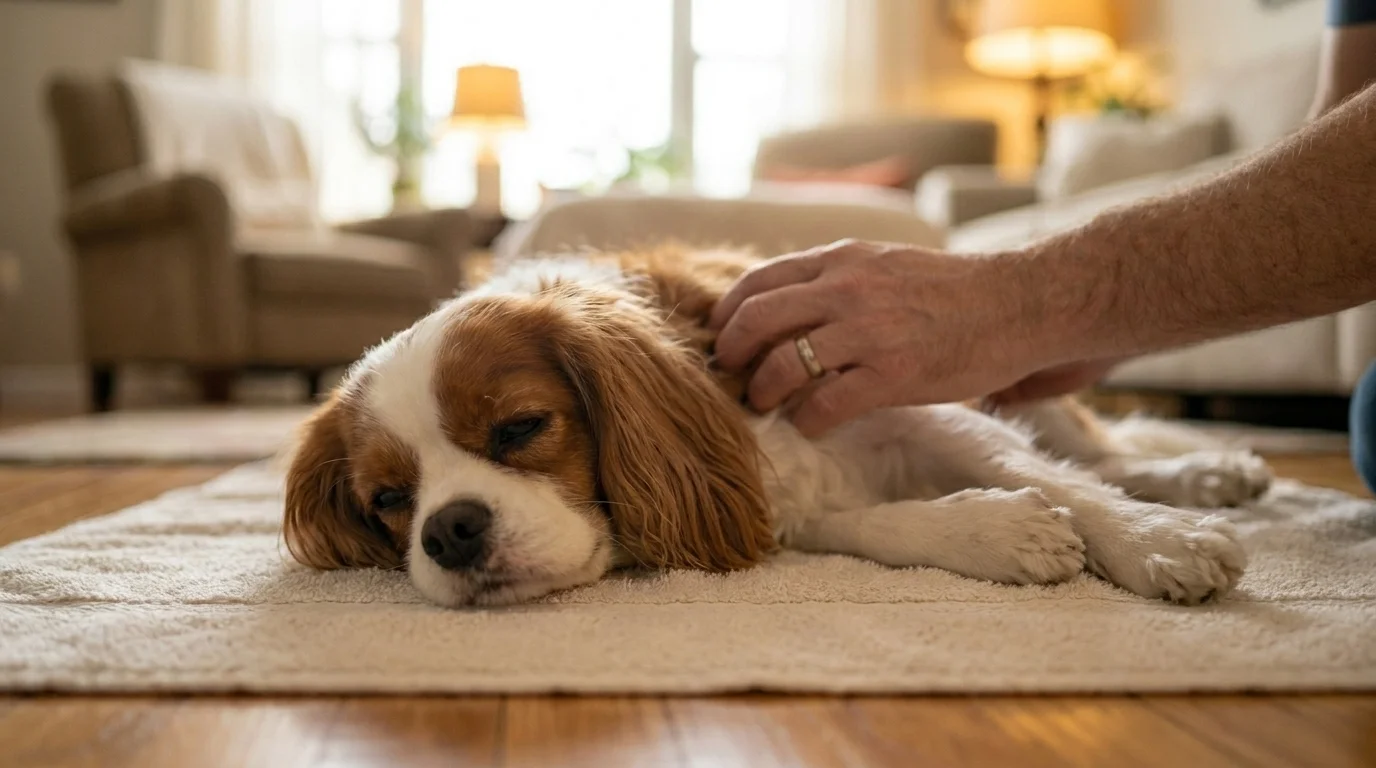
For decades, "low-stress handling" in many grooming salons meant scruffing (grabbing the loose skin behind the neck), nose-tapping, squirt-bottle correction, and hard physical restraint for non-compliant animals. The current evidence-based handling literature considers all of these obsolete and counterproductive. They escalate cortisol, increase heart rate, deepen fear responses, and make the next appointment harder — which makes the next incident more likely, not less.
The cooperative-care alternatives are now named techniques in the groomer trade press. Groomer to Groomer's "Say No to Scruffing" piece walks through chin hold, snake hold, towel wrap, and light-pressure positioning as the modern standard. The point of each is the same: stabilise the animal with the minimum physical pressure required to keep the work safe, paired with treats and breaks, and end the session early if the dog or cat hits its threshold.
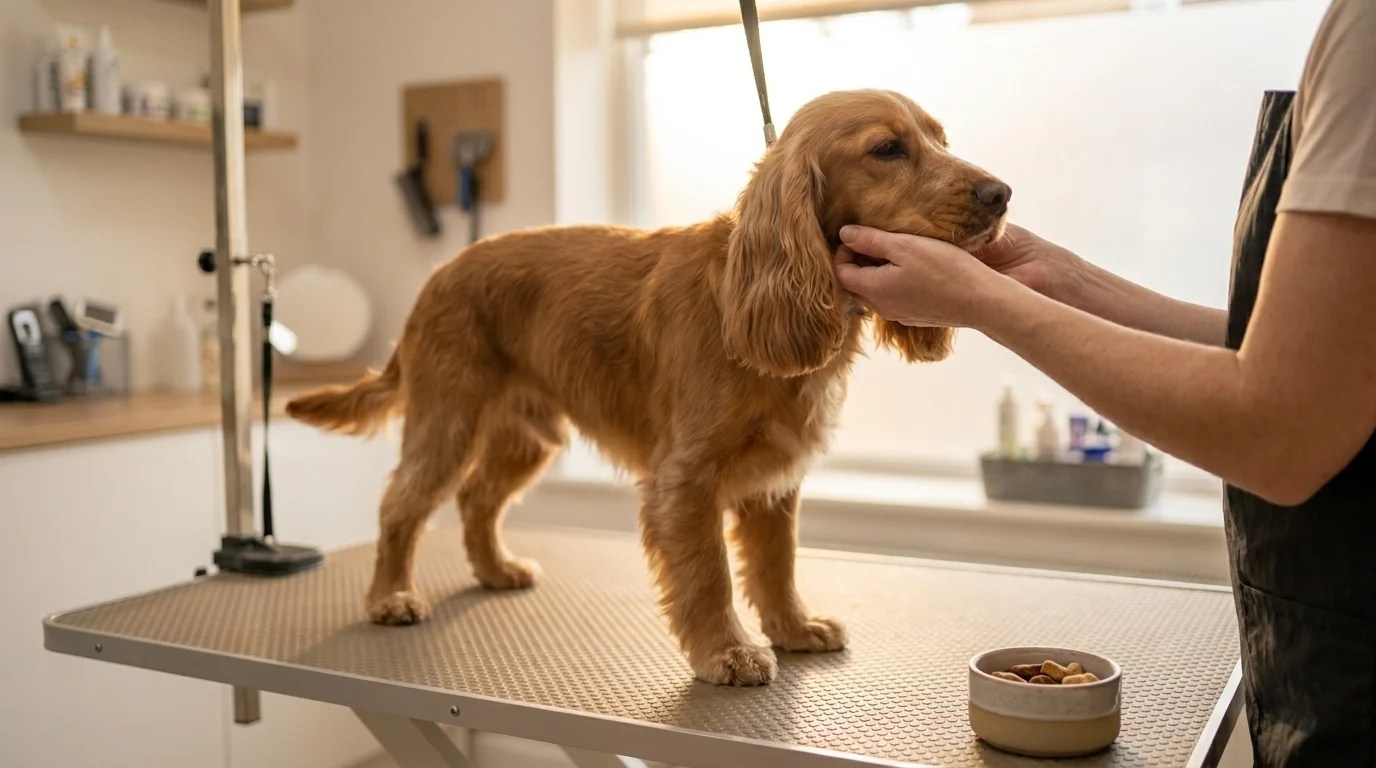
The owner-side version of this conversation is: ask the salon what handling techniques they use. A salon that names chin hold, snake hold, towel wrap, or "we work in shorter sessions and stop if the dog is overwhelmed" is in the current standard of care. A salon that says "we just have a way of getting them calm" or that demonstrates pinning the dog down or scruffing during the consultation is operating to a 1990s standard the field has formally moved past.
Brachycephalic dogs and the dryer-heat risk most owners don't hear about
If you have a flat-faced dog — French bulldog, pug, English bulldog, Boston terrier, boxer, Cavalier King Charles spaniel (Bonnie's breed) — there is a grooming-salon risk that is well documented in trade publications and not well communicated to owners.
K-9 Dryers and Groomer to Groomer's June 2024 brachycephalic-breeds feature both name high-heat blow-dryers as the dominant under-recognised mechanism of grooming-salon heat distress in flat-faced breeds. The underlying biology is brachycephalic airway syndrome — flat-faced dogs have compromised respiratory architecture that limits their ability to thermoregulate by panting. A high-heat dryer in a closed cage, even for a short period, can push a brachycephalic dog into heat distress quickly.
The warning signs to know: excessive panting, a flat or extended tongue, dark or blue or gray gums, drooling, staggering, weakness, collapse. Any of these are veterinary emergencies. The standard of care for brachycephalic dogs in the salon is cool-air drying or low-heat drying with active monitoring, never cage-dryer high-heat. Ask the salon directly: "what's your drying protocol for brachycephalic dogs?" The right answer involves the words "cool" or "low heat" and "monitored."
Call your vet immediately if you collect your brachycephalic dog and they are panting heavily, drooling, weak, or have a dark-coloured tongue. Heat distress in flat-faced breeds can become fatal within hours of the triggering event.
Read the muzzle: it's not the tool, it's how it was introduced
The search term dog grooming muzzle is up roughly 400% year over year, which usually means owners are encountering muzzles in salons more often and don't know how to interpret the practice. The honest framing is that a muzzle is a piece of safety equipment — for the groomer, for handlers, and sometimes for the dog. It is not by itself a red flag.
What matters is how the muzzle was introduced. Cornell Riney Canine Health Center's guidance on muzzle choices recommends a slow acclimation protocol — introducing the muzzle over multiple short sessions paired with high-value treats, putting it on and off many times per day for about a week, and only progressing to wearing it during handling once the dog is comfortable with the object itself. A salon that produces a muzzle mid-session, after the dog is already aroused, and forces it on cold, is using the right tool the wrong way.
The question to ask: "if you need to use a muzzle on my dog, how do you introduce it?" The right answer involves the words "slowly," "with treats," and "with breaks." The wrong answer involves the word "just" — as in, "we just put it on."
What "Fear Free certified" actually means when a groomer says it
The phrase "Fear Free certified" is becoming common on salon websites, and many owners encounter it without knowing what it covers. Here is the operational version.
The Fear Free Groomer Certification is a structured online program. The course is authored by Terrie Hayward, M.Ed., KPA Faculty, CPDT-KA, CSAT — co-author of Grooming without Stress. Groomers must score 80% or higher on each module, sign the Fear Free Pledge committing to a humane code of conduct, and maintain active membership. The credential is recognised by the Professional Animal Care Certification Council (PACCC) for five continuing-education units, which is the third-party validation worth knowing about.
What a Fear Free certified groomer is trained to do: read stress body language (whale eye, lip lick, tongue flick, paw lift, freezing, displacement scratching), use positive reinforcement, work in shorter sessions with breaks, use cooperative-care techniques rather than scruffing, and end the session if the animal hits its threshold. They are not trained to do veterinary procedures or to handle medical emergencies — the credential is about handling, not first aid.
A salon that lists Fear Free certification on its website should be willing to name which of its groomers are certified (the credential is individual, not facility-wide) and how the certification informs daily operations. A salon that uses the phrase without being able to elaborate is using it as marketing.
The related credential worth knowing about is Pet First Aid certification — a roughly 390/month standalone search. The American Red Cross, NAPPS, and Pet Tech all offer recognised programs. Pet First Aid is the credential that covers the medical first-response side that Fear Free does not, and a salon that has both — Fear Free for handling and Pet First Aid for emergencies — is operating at the current standard of care.
Questions to ask before you book
Here is the concrete vetting checklist. Read it before your next intake appointment. The right groomer will answer each clearly and without defensiveness; the wrong groomer will give you vibes instead of answers.
- Are any of your groomers Fear Free certified? Which ones? Individual credential, not facility-wide.
- Is anyone on staff Pet First Aid certified? First-aid response is a different credential from handling.
- What handling techniques do you use for a stressed dog or cat? Right answers name chin hold, snake hold, towel wrap, light-pressure positioning. Wrong answers involve scruffing, squirt-bottle correction, or "just hold them firmly."
- If you need to use a muzzle on my pet, how do you introduce it? Right answer: slow acclimation with treats; right tool used the right way. Wrong answer: "we just put it on."
- What's your bleeding-control protocol if my dog gets a small nick? Right answer mentions styptic powder and immediate pressure; the salon keeps the equipment on hand and uses it without panic.
- Do you dilute your shampoo in advance, and how do you store the bottle? This is the post-grooming furunculosis question. The right answer is "fresh dilution at the time of bath, sealed storage" or equivalent.
- What's your drying protocol for brachycephalic breeds? Right answer: cool air or low heat with active monitoring; never high-heat cage drying.
- What's your written policy when an injury happens? Will I be told at pickup? A salon that has a documented incident-notification policy has thought about this; a salon that says "it depends" has not.
These eight questions take about ten minutes at intake. A salon that responds to them with clear answers is doing the work. A salon that responds to them defensively — that treats them as suspicion rather than diligence — is telling you something useful about whether your dog should walk through that door again.

When your dog needs a vet, not a groomer
A grooming salon can clean, dress, and protect a superficial wound. It cannot diagnose a deep wound, treat an infection, manage post-grooming furunculosis, stabilise heatstroke, suture a laceration, or address behavioural trauma. The line is the line.
For the owner side, the signs that exceed grooming-salon first-aid scope are: any wound deeper than superficial; wounds near the eye or in the ear canal; wounds still bleeding after ten minutes of direct pressure; signs of infection (heat, swelling, foul smell, fever, lethargy); raised painful bumps appearing one to three days after a bath (post-grooming furunculosis); panting, pale or dark gums, weakness, or collapse after grooming, particularly in brachycephalic breeds; and any behaviour change persisting more than a day or two after the appointment.
For the behavioural-aftermath side, where Saoirse's voice has the most to add: if your dog or cat is now refusing the carrier, hiding for days, urinating outside the box (in cats — first a vet visit always, then a behaviour conversation), trembling at the sight of the brush, or reacting fearfully to handling that used to be routine, you are looking at a stress-conditioned response to the grooming experience. The right next step depends on severity. For mild cases, slow desensitisation at home — short treat-paired handling sessions, the grooming tools left out at floor level for the animal to investigate — can rebuild tolerance over weeks. For more severe cases, work with a veterinary behaviorist (a board-certified DACVB) rather than a generic trainer; medical underlying causes need to be ruled out and a structured behaviour-modification plan written.
The grooming salon is one node in your pet's care. The vet is another. The behaviour consultant is a third. When something at the salon goes wrong, the right escalation path runs in that order — and you are the only person standing at the centre of all three with a complete view of what happened. Trust what you saw. Document what you saw. Ask the eight questions before you book again.
Frequently Asked Questions
Examine the cut in good light, clean it gently with lukewarm water or saline, apply a pet-safe antiseptic, and prevent licking with an Elizabethan collar. If the cut is deeper than superficial, near the eye, in the ear canal, in the genital area, longer than about half an inch, or still bleeding after 10 minutes of pressure, contact your vet the same day — fresh, clean wounds can sometimes be closed with surgical staples instead of sutures requiring anesthesia. A responsible salon should acknowledge the injury at pickup, explain what happened, document it, and offer to cover related vet costs.
Post-grooming furunculosis is a painful bacterial skin infection (most commonly Pseudomonas aeruginosa) that develops within 1-2 days of a bath, usually as red, raised, warm, draining bumps along the back from shoulders to rump. It is often linked to vigorous scrubbing on wet skin combined with bacterial contamination from diluted shampoo bottles. Treatment requires a vet-prescribed antibiotic course of 3-4 weeks (sometimes longer) guided by a bacterial culture and sensitivity test — not just antiseptic at home.
It refers to the Fear Free Groomer Certification — an online program authored by Terrie Hayward (co-author of Grooming without Stress) where groomers must score 80% or higher on each module, sign the Fear Free Pledge to follow a humane code of conduct, and maintain active membership. Certified groomers are trained to read stress body language, use positive reinforcement, and apply low-stress handling techniques (chin hold, snake hold, towel wrap) instead of scruffing or hard restraint. The credential is PACCC-approved for 5 continuing-education units.
Ask before you book: Are any of your groomers Fear Free certified? Is anyone Pet First Aid certified? What handling techniques do you use for a stressed dog — scruffing or low-stress techniques like chin hold and towel wrap? If you need to use a muzzle, how do you introduce it? What's your bleeding-control protocol — styptic powder on hand? How do you dilute and store shampoo? What's your drying protocol for brachycephalic dogs? What's your written policy if an injury happens? A salon that answers clearly without defensiveness has thought about safety; a salon that brushes them off has not.
Clipper burn is a friction-and-heat injury caused by continuously running clipper blades that overheat, dull or damaged blades that drag instead of cutting cleanly, or blades pressed too firmly. It looks like a red, raw rash or shallow abrasion — usually on the belly, groin, armpits, around the base of the tail, or inside the back legs. It is not a cut. Mild cases respond to gentle cleaning and a vet-recommended pet-safe topical; severe cases (blistered, weeping, larger than a quarter, accompanied by limping) need a vet visit because they are painful and can become infected.
Brachycephalic dogs — French bulldogs, pugs, English bulldogs, Boston terriers, boxers, Cavalier King Charles spaniels — have compromised respiratory architecture (brachycephalic airway syndrome) that limits their ability to thermoregulate through panting. High-heat blow-dryers in a closed cage, even for a short period, can push them into heat distress quickly. The standard of care is cool-air or low-heat drying with active monitoring. Warning signs to know: excessive panting, flat or extended tongue, dark/blue/gray gums, drooling, staggering, weakness, collapse. Any of these are veterinary emergencies.