Legal Litter: Navigating Evolving Regulatory Landscapes in Global Pet Industry


US pet industry regulation in 2026 spans federal ingredient pathways, the AAFCO label rewrite, puppy-mill enforcement, and the patchwork of breed specific legislation at the city level. The most consequential collapse, though, is upstream of all of it. In September 2025, a wild bobcat in Washington State and several domestic cats in four different US states died after eating commercial raw pet food contaminated with H5N1 avian influenza. The FDA had quietly designated H5N1 a "known or reasonably foreseeable hazard" for raw pet food manufacturers eight months earlier, in January. The September advisory named specific lots of RAWR Raw Cat Food Chicken Eats. The deaths happened anyway, because four parallel ingredient-approval pathways in US pet food now exist where there used to be three, the agency that historically helped enforce ingredient standards quietly lost its memorandum of understanding with FDA the year before, and the inspection workforce charged with catching the upstream problems on the farm side has been cut by roughly 13% in a year.
This piece is the actual US pet industry regulations landscape in 2026 — what changed in 2024–2025, who is enforcing what, which bills are moving through Congress, where breed-specific legislation now lives, and what any of it means for a small pet brand owner, a breeder, an adopter, or a shopper trying to read a bag of food without being lied to. Nothing in this piece is legal advice for your specific business or jurisdiction. For compliance work, talk to an attorney who practices feed law or animal-welfare law; for breed-ban status in your specific city, call your municipal animal-control office; for breeder license questions, USDA APHIS is the answering body.
What follows is reporting.
The FDA–AAFCO MOU just expired. Here's what that actually means.
The structural change underneath everything else in US pet food regulation right now is that the 2007 Memorandum of Understanding between the FDA and the Association of American Feed Control Officials expired on October 1, 2024. The MOU was the document that governed FDA's collaboration with AAFCO on the Ingredient Definition Request process for animal feed and pet food. It was allowed to lapse.
FDA's replacement framework is the Animal Food Ingredient Consultation (AFIC) pathway, finalised as Guidance for Industry (GFI) #294 on January 6, 2025. At the same time, FDA published GFI #293, "FDA Enforcement Policy for AAFCO-Defined Animal Feed Ingredients," on October 23, 2024 — clarifying what the agency will and will not enforce in the absence of the MOU. AAFCO simultaneously stood up its own parallel process in partnership with Kansas State University.
The practical version of this for a small pet brand owner trying to launch a treat with a novel-protein ingredient in 2026 is that there are now four parallel ingredient approval pathways where there used to be three: AAFCO Chapter 6 (the historical AAFCO ingredient definitions), FDA's new AFIC pathway, the AAFCO–Kansas State process, and the existing FDA food-additive petition route. No single arbiter sits over the four. The legal-industry consensus from the law firms that follow this beat — Covington & Burling and Morgan Lewis among them — is that the regulatory landscape is more fragmented than it has been at any point in the last seventeen years.
A separate, smaller piece of the same picture: the Innovative FEED Act of 2025 (H.R. 2203 / S. 1906), introduced in March and May 2025, creates a new regulatory category called "zootechnical animal food substances," regulated as food additives rather than animal drugs. It targets microbiome and digestive-byproduct ingredients and is supported by FDA. If it passes, it adds a fifth route.
The point is not that any of these four-or-five paths is incorrect. The point is that in October 2024 the system shifted from "one agreement, three paths" to "no agreement, four paths," and almost no consumer-facing coverage of US pet food regulation has updated to reflect that. Operators noticed. Consumers were not told.
AAFCO Pet Food Label Modernization, 2025–2031
The bag of food in front of you is also about to change, slowly, over the next six years.
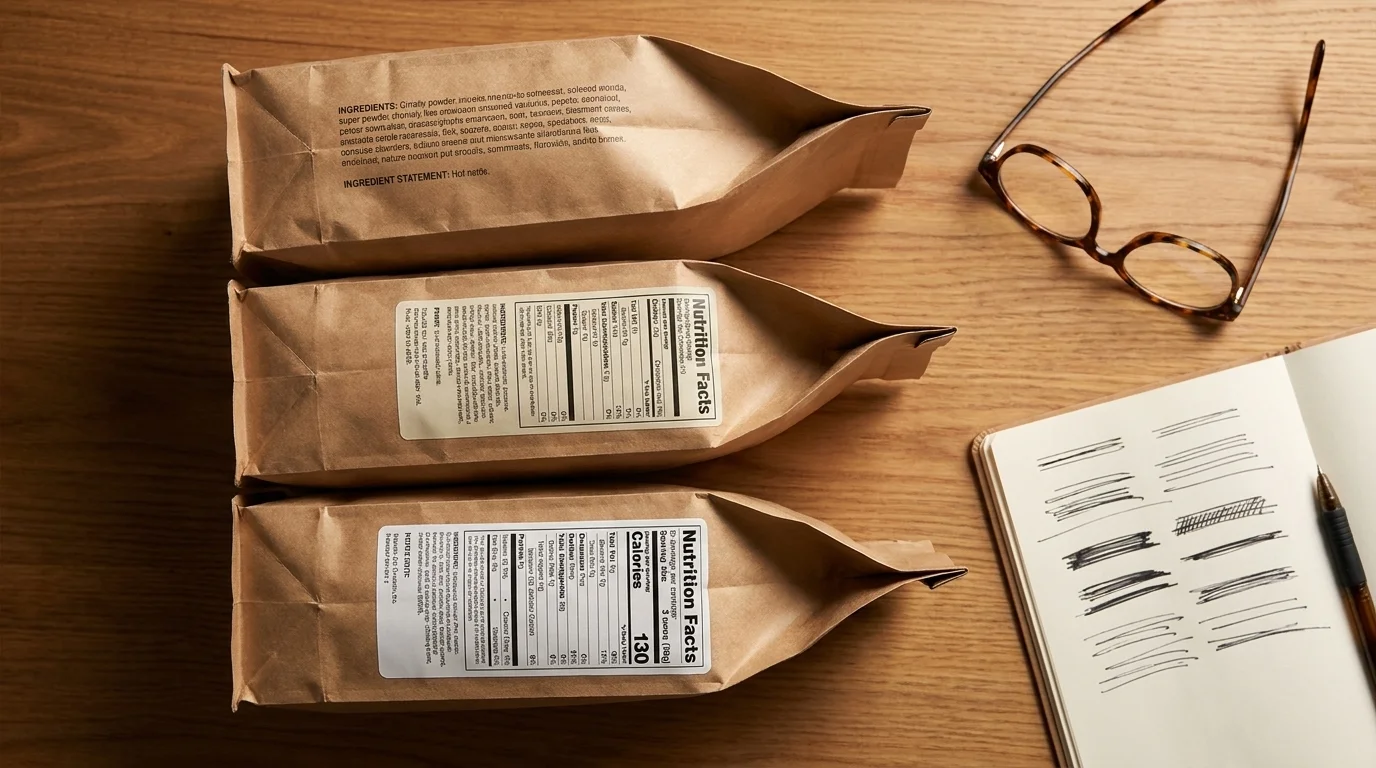
The AAFCO Pet Food Label Modernization (PFLM) was approved in the AAFCO 2024–2025 Official Publication — the first major US pet food labeling overhaul in more than 40 years. Four mandatory changes:
- A "Pet Nutrition Facts" box modeled on the FDA's human-food Nutrition Facts panel — a high-contrast, structured nutritional summary on the back panel.
- The intended-use statement moved to the lower-third front display panel, in plain language about which life stage the food is formulated for.
- Ingredient statement clarifications — including, for example, "chicken liver" instead of the older "meat by-products" framing.
- Standardized handling and storage instructions with optional iconography.
AAFCO has recommended that states use enforcement discretion for six years from the 2024 OP publication. Each state runs its own rulemaking. The practical consequence: through roughly 2031, US shoppers will see both old and new label formats on the same shelf, sometimes within the same brand line. No formal mechanism flags from the front of the pack which version is which.
For a small pet brand owner, PFLM is a meaningful operational cost in addition to a labeling clarification. The Nutrition Facts box requires new die-cut artwork, the relocated intended-use statement reshapes the front of the pack, and the ingredient-statement clarifications may require reformulation language for products that had been describing ingredients in older AAFCO terminology. Talk to a packaging counsel familiar with state feed law before reprinting anything: state-by-state adoption timing varies and budgeting for a single national reprint can be expensive if your largest sales states adopt early and your smaller states adopt late.
Related Article: Regulatory Navigation: Harmonizing International Pet Care Standards and Regulations
The PURR Act of 2025 — federalization, contested
The biggest pending federal-vs-state pet food fight in 2026 is the Pet Food Uniform Regulatory Reform Act, H.R. 597, introduced January 21, 2025. Sponsored by Representatives Steve Womack (R-AR), Derek Schmidt (R-KS), Josh Harder (D-CA), David Valadao (R-CA), and Adrian Smith (R-NE), the bill would strip state authority over dog and cat food labels, labeling, and advertising; deem AAFCO Chapter 6 ingredients GRAS (generally recognized as safe) unless FDA objects; and permit certain claims — including hairball control and tartar control — without premarket approval.
The reason the PURR Act matters at the consumer level is that, today, an out-of-state pet food sold in your state is regulated by your state's feed-control official under your state's feed law. Most of those rules are state adoptions of AAFCO model regulations, but the enforcement is local. The PURR Act would replace that with a single FDA framework — uniform across states, in theory simpler for brands operating in multiple jurisdictions, and in practice removing the layer of state-by-state consumer-protection enforcement that catches what FDA's smaller animal-foods team does not.
AAFCO opposes the bill on consumer-protection grounds. The Pet Food Institute and the American Pet Products Association support it. FDA would have one year from enactment to issue proposed regulations. As of writing, the bill is in committee; if it advances, the next twelve to eighteen months will be the window when the actual scope of the federalization is negotiated.
This is the most important under-reported regulatory story in US pet food in 2026. If you read coverage that does not mention it, you are reading coverage written before January 2025.
H5N1 changed how raw pet food is regulated
In January 2025, the FDA's Center for Veterinary Medicine determined that manufacturers of cat and dog food using uncooked or unpasteurized poultry or cattle ingredients — covered under the FSMA Preventive Controls for Animal Food rule — must reanalyze their food safety plans to address Highly Pathogenic Avian Influenza (H5N1). Food Safety Magazine's coverage walks through the operational consequence: H5N1 is now a "known or reasonably foreseeable hazard" for the raw-pet-food category.
The determination did not come out of nowhere. Domestic and wild cats in four US states had died in late 2024 and early 2025 after eating raw pet food contaminated with H5N1; a September 2025 FDA advisory identified specific lots of RAWR Raw Cat Food Chicken Eats. The disease moved up the food chain into companion animals, and the regulator was forced to respond.
The shopper-side version of this: if you feed your cat or dog raw poultry or beef from a commercial brand, the manufacturer is now legally required to address H5N1 in its food safety plan. That does not mean every brand has done so. If you are unsure, the right question to ask the manufacturer is whether the brand has reanalyzed its FSMA food safety plan to address H5N1 since January 2025, and what that reanalysis concluded. If they can't answer, that is information. If you have a health-vulnerable cat — geriatric, immunocompromised, indoor-outdoor in a region with documented avian-influenza spread — talk to your veterinarian about whether raw is the right call for your specific animal right now.
Related Article: E-commerce in Pet Care: Navigating Opportunities and Challenges
Breed-specific legislation: the slow collapse
The most-searched US pet regulation topic — breed specific legislation — is in a slow but documented retreat at the city level and a quiet reframing at the state level.
The headline repeals: Denver, Colorado repealed its longstanding pit bull ban in 2020 by a 66% ballot margin. Aurora, Colorado repealed its breed ban in November 2024. Miami-Dade County has also moved against its 23-year-old breed ban. At the state level, approximately 22 US states now prohibit or restrict municipal BSL.
The replacement frameworks are where the story has actually moved. Three threads are worth tracking:
- Dangerous-dog laws focused on individual behavior. Ohio HB 247 strengthens the state's dangerous-dog framework on individual-behavior grounds rather than breed. This is the legal architecture that BSL is being replaced with, not replaced by silence.
- Insurance-discrimination bans. Pennsylvania HB 1515 prohibits homeowners' insurance carriers from breed-discriminating unless the dog has been legally declared dangerous. Hawaii has parallel bills (SB 3013, HB 2011) on insurance breed-discrimination.
- Continued state-by-state battles. The BSL Database tracks roughly 21 states permitting or enacting BSL, 13 prohibiting statewide, and 16 allowing local exceptions; pit bull breeds are targeted in approximately 96% of BSL ordinances.
For an adopter who has been told their breed is "banned" in their city, the practical version of all of this is: call your municipal animal-control office and ask in writing what the current ordinance is, and whether any 2024–2026 update has changed it. The web is several years behind the state of the law in many jurisdictions. The animal-control office is not.
The ASPCA's position on BSL, which currently holds the #1 organic search slot, frames the issue as single-issue advocacy. The full regulatory picture in 2026 is wider than that page captures: the BSL story is also an insurance story, a dangerous-dog-law story, and a state-preemption story. All four threads are moving.
Puppy mills: the federal bills and the USDA enforcement gap
Two federal bills sit in committee that would meaningfully change the floor of US dog-breeder regulation, and a parallel USDA enforcement story sits underneath them.
The bills first. The Puppy Protection Act of 2025 (H.R. 2253) would amend the federal Animal Welfare Act to require solid (non-wire) flooring, prescribed temperature ranges, outdoor exercise yards, body-length-based minimum space, twice-daily feeding, year-round potable water, and 30 minutes of socialization per day at USDA-licensed breeding facilities. Goldie's Act (H.R. 349) is the companion bill, strengthening USDA's enforcement authority. Both are in committee as of late 2025; the Animal Legal Defense Fund maintains a current status tracker.
The enforcement story is the part of this picture most consumer-facing pet content does not cover at all. A USDA Office of the Inspector General audit released in late 2025 found that 80% of dog breeders reviewed had at least one Animal Welfare Act noncompliance, and 95% were not inspected in accordance with USDA APHIS's own Risk-Based Inspection System. APHIS staffing dropped from 221 total in fiscal year 2024 to 191 as of March 2025, with inspectors dropping from 130 to 115. In December 2025, a federal judge ruled that USDA's animal-welfare inspectors must report violations they uncover — a ruling that on its face should be unremarkable and was, in fact, the subject of a federal court order. In February 2026, USDA, DOJ, DHS, and HHS launched a coordinated interagency crackdown on chronic dog welfare violators.
For an adopter trying to read this correctly: the AWA floor for breeder welfare is what the law requires, the USDA enforcement gap is what is actually delivered, and the federal Puppy Protection Act would raise the floor. None of those three statements is opinion. They are the conditions an adopter is buying into when they choose a USDA-licensed breeder over a shelter, a rescue, or a private breeder operating below the federal licensing threshold.
Retail pet sale bans: the state-level pressure valve
While the federal puppy-mill bills sit in committee, the state-level story is the rapid expansion of retail pet sale bans.
Eight states have banned retail pet stores from selling dogs and cats as of April 2025: California (AB 485, 2017), Maryland, Maine, Washington, Illinois, New York (the 2022 Puppy Mill Pipeline Bill), Oregon, and Vermont. Approximately 300 cities and counties have local versions of the same ban. Maryland's 2020 bill was the second state-level ban.
The pending and contested bills are where the next twelve months of state-level reporting will land:
- Delaware HB 131 passed the House in January 2025.
- Massachusetts SB 2720 is in Senate consideration as of March 2026.
- Pennsylvania HB 1816 would phase out pet shop sales of dogs, cats, and rabbits by 2027 (the AKC opposes).
- Illinois HB 4753 and HB 1556 are pushback bills attempting to re-open Illinois pet store sales for USDA-licensed "professional breeders" — a fight worth watching because Illinois was an early adopter of the ban, and the rollback attempt is the test case for whether the retail-ban movement can hold against well-organized industry opposition.
For a small pet brand owner whose B2B customers include pet stores that sell live animals, this is a meaningful market-access question to track in your state.
Operator and owner checklist for 2026
This is the part that turns reporting into something usable. None of it is legal advice; everything below presumes you will talk to the appropriate licensed professional for your specific question.
For pet brand operators:
- Monitor PURR Act (H.R. 597) progress. If it advances, the next 12–18 months will reshape the federal-vs-state pet food labeling framework.
- Plan and budget for AAFCO PFLM label retooling by 2031, with phased state-by-state adoption from 2025.
- If you handle uncooked poultry or cattle ingredients, reanalyze your FSMA food safety plan for H5N1 (FDA-CVM, January 2025). If you already did, document the reanalysis and be ready to show it.
- Track your largest state markets for retail-pet-sale-ban changes (especially if your B2B distribution includes live-animal pet stores).
- Engage feed-law counsel before reprinting national packaging — the four-pathway ingredient landscape post-MOU is more fragmented than the previous status quo, and "AAFCO compliance" no longer means a single thing.
For pet owners and adopters:
- For breed-ban status in your specific jurisdiction, call your municipal animal-control office in writing; the web is often years out of date.
- If you have homeowners' insurance and a breed-banned-by-carrier dog, ask your insurance commissioner whether your state has pending breed-discrimination legislation (PA, HI, others).
- If you feed commercial raw, ask the manufacturer whether and when they reanalyzed their FSMA food safety plan to address H5N1.
- If you are buying from a USDA-licensed breeder, understand that the federal AWA enforcement gap is large — the 2025 USDA OIG audit documented 80% noncompliance among reviewed breeders. Visit the facility, ask for the USDA license number, and verify it on the APHIS public search.
- For any compliance, contract, or welfare-law question that affects an actual purchase decision or business decision, talk to an attorney who practices feed law or animal-welfare law in your state. The reporting in this article is not a substitute for that conversation.
The regulatory landscape for the US pet industry in 2026 is not stable, not harmonized, and not what most consumer-facing coverage describes. It is being remade in real time. The receipts are above. The agencies and bills are named. The dates are in the body. What you do with the information is the next conversation.
Frequently Asked Questions
The 17-year FDA-AAFCO Memorandum of Understanding on ingredient definitions expired October 1, 2024. FDA replaced it with the Animal Food Ingredient Consultation (AFIC) pathway (GFI #294, finalized January 6, 2025), and AAFCO stood up a parallel process with Kansas State University. FDA also published GFI #293 ('FDA Enforcement Policy for AAFCO-Defined Animal Feed Ingredients') on October 23, 2024. The result is four parallel ingredient approval pathways where there used to be three.
The first major overhaul of US pet food labels in over 40 years. Four mandatory changes phase in starting in 2025: a 'Pet Nutrition Facts' box modeled on human-food panels, a relocated intended-use statement on the lower-third front display, clearer ingredient statements (for example, 'chicken liver' instead of 'meat by-products'), and standardized handling and storage instructions. AAFCO recommends a six-year transition with full compliance by 2031, and each state runs its own rulemaking.
It is collapsing at the city level. Denver repealed its pit bull ban in 2020 by a 66% ballot margin, Aurora in November 2024, and Miami-Dade has also moved against its 23-year-old ban. Approximately 22 states now prohibit or restrict municipal BSL. Replacement frameworks include dangerous-dog laws focused on individual behavior (Ohio HB 247) and bans on homeowners' insurance breed-discrimination (Pennsylvania HB 1515, Hawaii SB 3013/HB 2011).
The Pet Food Uniform Regulatory Reform Act (H.R. 597), introduced January 21, 2025, would strip state authority over dog and cat food labels, labeling, and advertising in favor of a single FDA framework. It would deem AAFCO Chapter 6 ingredients GRAS unless FDA objects, and permit certain claims (hairball control, tartar control) without premarket approval. AAFCO opposes it on consumer-protection grounds; the Pet Food Institute and American Pet Products Association support it. FDA would have one year from enactment to issue proposed regulations.
The Puppy Protection Act of 2025 (H.R. 2253) would amend the Animal Welfare Act to require solid (non-wire) flooring, prescribed temperature ranges, outdoor exercise yards, body-length-based space minimums, twice-daily feeding, year-round potable water, and 30 minutes of socialization per day at USDA-licensed breeders. Goldie's Act (H.R. 349) is the companion bill strengthening USDA enforcement. Both are in committee as of late 2025. A USDA OIG audit in 2025 found 80% of reviewed breeders had at least one AWA noncompliance and 95% were not inspected per APHIS's own Risk-Based Inspection System.
In January 2025, FDA-CVM determined that manufacturers of cat and dog food using uncooked or unpasteurized poultry or cattle ingredients (covered under the FSMA Preventive Controls for Animal Food rule) must reanalyze their food safety plans to address Highly Pathogenic Avian Influenza (H5N1). The determination followed cat deaths in four states linked to contaminated raw pet food and a September 2025 H5N1 advisory on specific lots of RAWR Raw Cat Food.
Eight as of April 2025: California (2017), Maryland, Maine, Washington, Illinois, New York (2022 Puppy Mill Pipeline Bill), Oregon, and Vermont — plus roughly 300 cities and counties. Delaware HB 131 passed the House in January 2025. Massachusetts SB 2720 is in Senate consideration as of March 2026. Pennsylvania HB 1816 would phase out pet shop sales by 2027. Illinois HB 4753 and HB 1556 are pushback bills attempting to re-open pet store sales for USDA-licensed 'professional breeders.'
For breed-ban or dangerous-dog status in your specific jurisdiction, call your municipal animal-control office in writing — the web is often years out of date. For pet food brand compliance questions, engage an attorney who practices feed law in your state. For USDA breeder license verification, use the USDA APHIS public license search. For homeowners' insurance breed-discrimination questions, your state insurance commissioner is the right starting point. This article is consumer-protection reporting, not legal advice.