


The lepto vaccine for dogs comes up in the parking lot after class about once a week. Someone's veterinarian recommended the leptospirosis shot at a wellness visit. Someone's breeder said absolutely not, in writing, with underlining. The owner has been carrying that contradiction around for a month and wants a tiebreaker.
I'm not it. I'm a dog trainer. I teach loose-leash walking and cooperative care, and I refer out the second a question crosses into medicine — this one crosses immediately.
What I can do is the thing I do with every piece of inherited dog advice: find out where the claim came from and whether it held up. So below is what the veterinary bodies actually say — what leptospirosis is, who's at risk, the schedule, the side effects, the small-breed question, and the cost. Every medical claim is attributed to the people qualified to make it. Every decision goes back to you and your vet.
One thing changed recently, and most of the internet hasn't caught up: the vaccine's official status.
Is the Lepto Vaccine Necessary for Your Dog in 2026?
Since 2024, AAHA has classified the lepto vaccine as core for most dogs — a change from its old non-core label — and 2025–2026 outbreaks now reach cities and small breeds, not just rural ones.
Here's the part that's out of date nearly everywhere you'll look. For years, leptospirosis sat in the non-core column — the tier recommended case by case, for dogs with obvious exposure, rather than for every dog. Then, in its 2024 update to the canine vaccination guidelines, AAHA moved it to core for most dogs, reasoning that "any dog that goes outdoors, whether in an urban or a rural setting, can be exposed to leptospirosis."
Now go search the topic. You will mostly still read "non-core." AVMA's owner-facing page uses the older framing. Google's AI summary uses it. Most of the clinic blogs on page one use it. Nobody is lying to you — the label genuinely was non-core, and citations take years to turn over. But note that even the old framing wasn't lukewarm: the Indiana VMA's version called it "highly recommended for any dog that commonly goes outside." Non-core never meant optional.
The timing isn't arbitrary. Veterinarians spent late 2025 and early 2026 warning about climbing case counts — a Tri-State clinic flagged the trend in November 2025, Berkeley worked an outbreak in January 2026 — and the geography is the story. Lepto is turning up in cities, in small dogs, in the flooded gutter your terrier drinks from on the walk to the mailbox. That Fox19 report names one driver: vaccination rates are falling.
Which brings me to the one belief here I have standing to talk about, because it's a claim about evidence rather than medicine. Tracing dog advice back to where it came from is the pet psychology end of my work, and this one leaves a trail.
The idea that small breeds can't handle this shot has it backwards — though the evidence is firmer on the what than the why, and neither half is as tidy as the people quoting it at you would like. I'll show you both. Writing in Today's Veterinary Practice, Jane Sykes, DACVIM, reports that in a U.S. study of veterinary records, dogs under 15 pounds — Yorkshire terriers especially — had the highest hospital prevalence of leptospirosis between 2000 and 2009. The dogs the fear is aimed at protecting are the ones turning up infected.
That's a real finding. It's also a single one, and Sykes qualifies it in the same paragraph in a way I'd rather hand you than smooth over: risk factors for lepto by breed, age, and sex "have yielded conflicting results and might be subject to changes over time" — and the sentence directly before the small-dog result cites an earlier U.S. report naming the opposite animal. Males, herding dogs, hounds, working dogs, mixed breeds. Not a toy breed on the list. So what's actually on the table is one database, hospital cases, a nine-year window, sitting in a literature that argues with itself about which dogs lepto goes after. The breed picture is contested. The vaccination picture isn't.
The why is the softer part, and Sykes offers it as a hypothesis, so I'll pass it on as one: it may be, she writes, that small breeds are suspected of higher vaccine-reaction risk and were therefore less likely to be vaccinated. May. Suspected. Nobody has nailed that causal link down, and I'm not going to pretend otherwise to make the paragraph land harder. Dr. George Moore, who authored the largest study of canine vaccine reactions on record, put the practical version plainly: "the real risk factor is whether or not the dog is vaccinated."
The clearest illustration is the Los Angeles County outbreak published in the Journal of Clinical Microbiology and reported by CIDRAP: of 47 infected dogs whose vaccination history was documented, not one was fully vaccinated. Ninety-two percent survived to hospital release. That's one outbreak, one serovar, one region where vets had historically not pushed the vaccine — so don't read it as your dog's odds. Read it as the shape of the risk: the dogs who got sick were, almost to the animal, the unvaccinated ones.
None of which tells you what your dog needs. It tells you the default has moved.
What Is Leptospirosis in Dogs?
Leptospirosis is a bacterial infection spread through the urine of infected animals and contaminated water. It can damage a dog's kidneys and liver — and it can infect people.
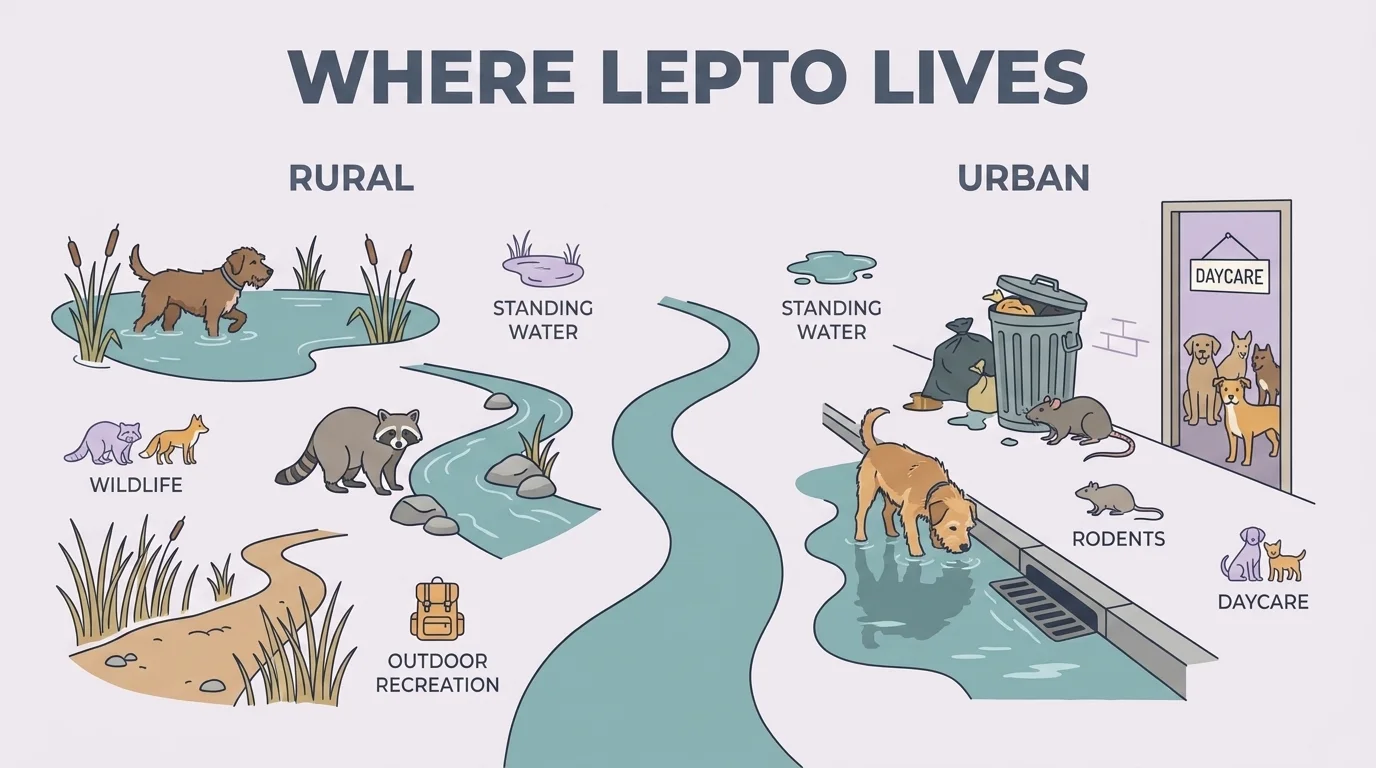
Leptospira are bacteria. They live in the kidneys of infected rodents and other wildlife and leave in the urine, which is how they reach soil, puddles, ponds, and slow water. A dog picks them up by drinking it, wading in it, or getting it onto a mucous membrane or a broken patch of skin. AVMA and the CDC describe that route the same way, which is a useful thing to know when you're deciding whose version to trust.
Once it's in, the infection goes after the kidneys and liver, and both institutions treat it as potentially serious. I'm not going to put a prognosis in my own mouth — that's a vet's call, not a trainer's. What the record shows is the 92% survival figure from the LA outbreak above, which is genuinely reassuring, with the asterisk that those were dogs who made it to a veterinary hospital and got care.
The part that reframes this for a lot of owners: leptospirosis is zoonotic. It moves between animals and people, and it ranks among the most common zoonotic diseases worldwide. The CDC maintains a page on it written specifically for pet owners. An infected dog can pass it to the humans in its household — which means this decision was never only about the dog.
What the Lepto Vaccine Is and How It Works
The lepto vaccine is a killed-bacterin shot that primes a dog's immune system against the Leptospira serovars behind most canine infections.
There's no live bacteria in it. Per AVMA, these are killed whole-cell bacterins — most adjuvanted, with newer nonadjuvanted versions now on the market too. The vaccine shows the immune system the bacteria in a form that can't cause the disease, so the immune system knows the shape of the thing if it ever meets the real one.
Serovars are the wrinkle worth understanding, because a Leptospira vaccine doesn't cover Leptospira generally — it covers specific strains. The older North American vaccines were bivalent, covering Canicola and Icterohaemorrhagiae. The current standard is quadrivalent: AVMA notes that Pomona and Grippotyphosa were added, doubling the coverage.
Hold onto that upgrade, because it's load-bearing for the side-effects argument you're going to hear later. The vaccine your breeder formed an opinion about may not be the vaccine your vet is holding. AVMA's position on the current product is that it "does not appear to be associated with an increased risk of vaccine reactions compared to other vaccines."
Last thing: it isn't a one-and-done. Immunity to lepto fades over roughly a year, which is why the schedule has a booster in it rather than a finish line.
Who Needs the Lepto Vaccine? A Risk-Factor Checklist
Dogs that hike, swim, drink from puddles, or could meet wildlife or rodents — rural or, increasingly, urban — carry the highest leptospirosis risk.
Run your own dog through this. Ask your vet about lepto if your dog:
- Hikes, or has any unsupervised outdoor access — a fenced yard backing onto woods counts
- Swims or wades — ponds, creeks, drainage ditches, the flooded corner of the yard
- Drinks from puddles or standing water — the hardest one to police on a walk
- Could encounter wildlife or rodents — including a city alley, a compost pile, or a park with a rat problem
- Lives rurally — the classic profile everyone already knows about
- Lives in a suburb or a city — the part that changed, and the reason AAHA's 2024 rationale says "urban or rural"
- Goes to daycare or boarding — the LA outbreak traced back to daycare facilities, per CIDRAP
If you read that list and thought "well, most dogs," you've arrived where AAHA arrived: their stated reasoning is that any dog going outdoors — city or country — can be exposed.
What the list can't do is weigh your specific dog. An eleven-year-old with kidney disease, a dog with a documented reaction history, a dog on immunosuppressants — those are conversations with a veterinarian who has the chart in front of her, and no checklist on the internet, including mine, substitutes for that.
Is There a Dog That Doesn't Need It?
Honestly, maybe. A genuinely indoor dog — indoor toileting, no yard, no hikes, no daycare, no standing water — has a real exposure argument to make, and there are medical histories where a vet will say the calculus doesn't work for this animal. Those dogs exist and I won't pretend otherwise.
But "my dog is basically indoor" is worth auditing before you lean on it. Most dogs described that way still get walked, still sniff, and still drink things their owners didn't authorize. If your case for skipping is exposure-based, take the checklist to your vet. If your case is that the vaccine is dangerous for small dogs, hold that thought — the evidence isn't where most people think.
The Lepto Vaccine Schedule for Dogs
Puppies start at about 12 weeks with two doses spaced four weeks apart, followed by a booster every year (AVMA).
AVMA states it about as cleanly as it can be stated: "An initial series of two vaccinations spaced 4 weeks apart is typically recommended, followed by annual boosters, and this series can be started at 12 weeks of age or later."
| Dose | Timing | What it's doing |
|---|---|---|
| Dose 1 | From ~12 weeks of age or later | Starts the initial series — AVMA describes the series as two doses |
| Dose 2 | 2–4 weeks after dose 1 | Completes the initial series (AVMA specifies 4 weeks apart) |
| Annual booster | Every 12 months | Maintains protection as immunity wanes |
Two notes on reading that table honestly. AVMA's number is four weeks; you'll see 2–4 weeks quoted all over the place, which is exactly why the specific date belongs to your vet and not to a blog. And finishing the series matters — among the dogs in the LA outbreak were animals that had received a single dose and never came back for the second. If your dog's series lapsed, ask whether it needs restarting rather than assuming you can resume where you left off.
The annual booster is the part owners quietly skip, and it's the part the whole thing rests on.
How Effective Is the Lepto Vaccine?
The vaccine protects against the four most common Leptospira serovars in North America — reducing risk, though not to zero, with immunity that fades yearly.
This is where I'd rather be straight with you than sell the shot, because overselling it is how trust gets broken later. The quadrivalent vaccine covers four serovars. There are more than four serovars. A vaccinated dog can, on occasion, meet a strain the vaccine doesn't cover — that possibility is real, it's acknowledged in the ACVIM 2023 consensus statement that underpins current 4-serovar practice, and anyone promising you 100% is not reading the same documents.
That's also not a strike against it. No vaccine is 100%, and "not perfect" and "not worth it" are very different claims — the gap between them is where a lot of bad decisions get made. Set the imperfection next to the outbreak data: in LA, the vaccine's four-serovar limitation did not produce a population of vaccinated dogs getting sick. It produced an outbreak in which every infected dog with records was under-vaccinated, and the isolates were serovar Canicola — one the vaccine covers.
And immunity wanes across the year, which is the same fact from the schedule section wearing a different hat. Effectiveness isn't a property the vaccine has permanently; it's a property it has while it's current.
Lepto Vaccine Side Effects: What to Expect
Most dogs have no reaction. Across all canine vaccines, roughly 1 in 250 dogs show mild, short-lived effects like soreness or lethargy, with small young males at slightly higher risk (Moore 2005).
The reaction picture vets describe is unglamorous: soreness at the injection site, lethargy, a mild fever, sometimes some facial puffiness — typically resolving in a day or two. Your dog may be boring and tired that evening. That's the common outcome.
The number worth anchoring on comes from Moore et al. (JAVMA, 2005), still the largest study of canine vaccine reactions on record — more than 1.2 million dogs across 360 hospitals. Read the fine print with me, because it matters: that study measured reactions to every vaccine dogs were getting, not to lepto specifically. It found reactions in roughly 1 in 250 dogs, about 38 per 10,000, plus something practical that rarely makes the conversation: reaction risk rises with the number of vaccines given at a single visit. That's a schedulable variable. If your dog is due for several shots at once, "can we space these out?" is a better question than "should we skip the lepto?"
Which means 1 in 250 is a vaccines-in-general number, and applying it to lepto is an inference. I'd rather show you that join than hide it: the 2015 comparison in the breeder section below found the lepto component doesn't raise the reaction rate above other vaccines. If that holds, the general rate is the best estimate available for this shot — a chain of two studies rather than one measurement of lepto, which is worth knowing when someone quotes the figure at you as though it were.
This isn't a diagnostic checklist. Persistent facial swelling, hives, repeated vomiting, or collapse are the signs veterinary sources say warrant a call — but I'm a trainer, not a veterinarian, and I can't tell you what's happening to your dog. If something looks wrong after a vaccine appointment, call your vet or an emergency clinic and let them decide. Don't sit at home comparing your dog to a list on a website.
On long-term effects: I'm not aware of evidence establishing distinctive long-term harms beyond that acute window, and the published comparison that does exist (below) found no elevated risk attributable to the lepto component. That's an absence of evidence, reported honestly as one — not a promise, and not mine to make.
Side Effects in Small and Toy Breeds
Here's the finding underneath the whole controversy, and it's real: Moore's data showed the highest reaction rates in small-breed, young-adult (roughly 1–3 years), neutered male dogs, with risk dropping steadily as body size increases. That's not breeder folklore — it's the largest dataset we have.
So the fear has a factual seed. The question is what to do with it, and the answer vets reach for is usually to adjust the delivery rather than abandon the protection: splitting shots across visits instead of stacking them, which lines up with Moore's finding about multiple vaccines at one appointment. That's a conversation about your five-pound dog, not a reason to leave her unprotected.
One piece of this is squarely mine. A vaccine appointment is a handling procedure, and handling procedures are trainable. Cooperative care — a chin rest, a consent behavior your dog can use to say "not yet" — won't change her reaction rate, but it changes whether she spends the visit braced and struggling.

Why Do Some Breeders Avoid the Lepto Vaccine?
This one isn't a medical dispute — it's a provenance dispute, which is the kind I'm actually qualified to have.
Here's the fear, stated fairly: the lepto vaccine causes reactions in small dogs, and breeders who've watched a lot of small dogs through a lot of vaccine appointments learned to steer around it. That is not a stupid belief. It came from somewhere.
Where it came from is an earlier generation of the vaccine. The product was reformulated after those early reaction concerns, and AVMA's read on the modern one is that it "does not appear to be associated with an increased risk of vaccine reactions compared to other vaccines." A 2015 JAVMA study tested it directly — comparing owner-reported adverse events in dogs that did and didn't receive a Leptospira vaccine — and found no increased risk attributable to the lepto component. Not "lepto is safe." Specifically: lepto isn't the extra risk it was believed to be.
This is the identical shape as every dominance-theory conversation I have. A belief forms on the evidence available at the time. The evidence moves. The belief doesn't, because nobody circulates a retraction as enthusiastically as they circulated the original warning. The 2006 TV trainer is still on YouTube; the correction isn't.
Except this one may carry a cost, and it lands on exactly the dogs it was meant to spare. Small dogs from urban areas are among the groups the 2023 ACVIM consensus statement lists as still seeing lepto — named in the same breath as inadequately vaccinated dogs, though the statement stops short of connecting the two. Sykes is the one who goes further and suggests the connection may be causal: the reaction fear kept small dogs from being vaccinated. May. It's a hypothesis, not a settled finding — but it's the wrong direction for a protective instinct to be pointing.
I'm not telling you your breeder is a fool. Her concern was reasonable when she formed it, the vaccine changed underneath it, and the data since points the other way — so bring it to your vet as a question, not a verdict.
How Much Does the Lepto Vaccine for Dogs Cost?
A single lepto dose typically runs about $20–$60 depending on clinic type and region; expect a two-dose initial series plus a yearly booster.
Nobody quotes numbers on this, so: roughly $20 to $60 per dose is the realistic band, with Vetco's retail clinics averaging around $45 and real variation by state. Low-cost and community clinics land under that. Full-service hospitals land above it, because you're also paying for the exam and the relationship.
Budget the shape, not the sticker. Year one is two doses. Every year after is one booster. It's frequently bundled into a puppy or wellness package alongside other vaccines — which is worth asking about, though remember Moore's finding on stacking multiple shots at one visit, so "bundled" is a pricing question and a scheduling question.
If cost is the thing genuinely blocking this, say that out loud at the clinic instead of quietly declining. Low-cost vaccine clinics exist and run well below full-service pricing — and in my experience, a vet would much rather point you toward one than watch a dog go unprotected over a number nobody said out loud.
The Short Version
The lepto vaccine for dogs got clearer in one direction and more urgent in another. Clearer: AAHA moved it to core for most dogs in 2024, though most of the internet still says otherwise. More urgent: outbreaks are reaching cities and small dogs — and the old worry that small breeds can't handle the shot points the wrong way.
I can't tell you what your dog needs; that was never my call. But the decision deserves better inputs than a breeder's underlined note and a search result citing a guideline that changed two years ago. Take the checklist to your next wellness visit. Ask about your dog's real exposure, about spacing shots if she's tiny, and about a low-cost clinic if price is the obstacle. Then decide — with the person holding the chart.
Frequently Asked Questions
The concern traces to older worries about small-breed reactions. The vaccine was since reformulated: AVMA says it doesn't raise reaction risk above other vaccines; a 2015 JAVMA study found the same for the lepto component. Meanwhile one U.S. database study (2000–2009) put dogs under 15 pounds at the highest hospital prevalence for lepto. Breed findings conflict, but a veterinary review suggests that very fear may have left them under-vaccinated. Worth raising with your vet, not settled science against the shot.
Across canine vaccines generally, Moore's 2005 JAVMA study of more than 1.2 million dogs found the highest reaction rates in small-breed, young-adult, neutered male dogs, with risk dropping as body size increases — it measured every vaccine, not lepto alone. Reactions are uncommon overall, roughly 1 in 250, and usually mild. Vets often split or space shots for tiny breeds rather than skipping protection entirely. Ask yours what makes sense for your dog.
Risk is rising in 2025–2026 and spreading into cities and small dogs. In one Los Angeles County outbreak reported by CIDRAP, none of the 47 infected dogs with documented vaccination histories were fully vaccinated, and 92% survived. That's one outbreak, not a general odds figure — but it shows vaccination is the single biggest protective factor against infection.
For most dogs, veterinary sources describe it as safe. Reactions occur in roughly 1 in 250 dogs across canine vaccines generally (Moore 2005) — usually mild soreness or lethargy — and a 2015 JAVMA comparison found the lepto component doesn't raise that rate above other vaccines. No vaccine is risk-free, and dogs with a reaction history or specific medical conditions are a different conversation. Discuss any concerns with your veterinarian.