
Weathering Financial Challenges: A Pet Care Entrepreneur's Path to Financial Stability


A friend of a friend named Marissa quit a steady administrative job in Brooklyn last September to walk dogs full time. She had two paying clients lined up, a hand-me-down rolling cart for water bottles, and a modest savings cushion to spend on whatever a dog walking business turned out to need. By the time her first month ended, most of that cushion was gone — on the things her LinkedIn-recommended "how to start a dog walking business" guides had not warned her about — $105 for the New York City commercial dog walker permit, $39 for the twelve-hour animal care course the permit requires, $154 for the first year of base liability insurance, $25 for a current pet-first-aid certificate, a higher-mileage car insurance tier, $35 for an LLC filing, and the rest on miscellaneous tools and one expensive over-the-shoulder waste-bag bandolier. Her first-month client revenue was a few hundred dollars below her first-month spend. The net is what the rest of this article is about.
This piece is the actual operator-finance picture for a solo dog walking business in 2026 — startup costs with vendor names, insurance brackets with line-item premiums, the rate-setting math that includes drive time and self-employment tax, the Rover/Wag vs solo question with current commission numbers, the legal-structure threshold where S-Corp election starts paying for itself, the SBA loan product that actually fits a sub-$20k business, and the city permits that quietly run several hundred dollars in two metros and almost nothing everywhere else. None of it is financial, tax, or legal advice for your specific situation. For your actual return, work with a licensed CPA who handles Schedule C filers; for entity formation, work with a small-business attorney in your state; for a loan, go through an SBA-approved nonprofit intermediary, not this article.
What follows is reporting.
What it actually costs to start in 2026
The honest range for a solo launch is $500 to $2,000, with an upper ceiling of about $4,500 if you front-load premium software, full commercial-auto coverage, and a marketing budget. Jobber Academy and LendingTree both publish line-item startup tables in roughly the same range. The components, with vendor names:
- LLC filing: $35 to $500 by state. California is the example to know — its $800/year LLC franchise tax floor makes the state genuinely expensive for solo operators. Most other states sit in the $50–$200 range plus annual reports.
- Business license: $25 to $500, city or county. Two cities materially exceed that — see the licensing section below.
- Dog walking software: $15 to $35/month. Time To Pet, Scout, EasyBusyPets, and Jobber dominate the category. Most have free trials; most do not have annual discounts worth pre-paying for in year one.
- Pet First Aid and CPR certificate: $25 to $200. The two recognised credentials are through NAPPS (National Association of Professional Pet Sitters) and Pet Tech. NYC permitting requires a separate twelve-hour animal care course on top.
- Insurance: covered in the next section in detail. Budget at minimum $154/year ($14.58/month) for base liability.
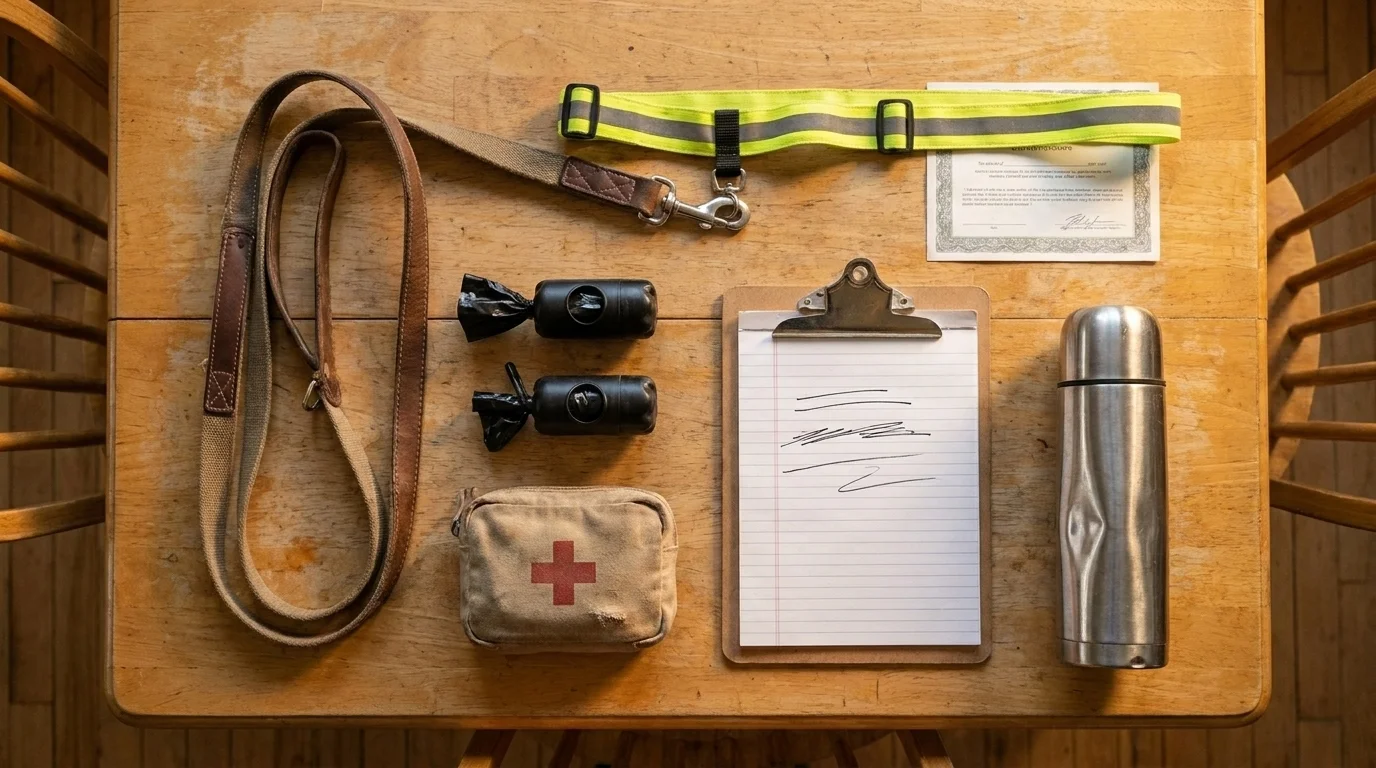
- Tools and consumables: leashes, waste bags, treats, a waterproof bag, a basic walking-shoes upgrade. $50 to $200 line items in aggregate.
There is no industry standard that says you must spend on the high end of this range to be ready. The minimum-viable launch for a solo route walker is closer to $500 than $2,000; the $4,500 ceiling pays for redundancy and front-loaded marketing that most operators do not need in month one.
Insurance: the line item nobody quotes honestly
This is where most "how to start a dog walking business" content hand-waves the most aggressively, because the bar to monetise insurance affiliate traffic is high and the math is genuinely useful to publish.
The cheapest legitimate base policy a solo walker can buy in 2025 is Pet Care Insurance's base dog walker policy at $14.58 per month, or $154 per year. The bundle includes general liability ($1 million per incident / $2 million aggregate), animal bailee coverage ($2,500 per dog / $5,000 aggregate), veterinary reimbursement ($1,000 per dog / $2,500 aggregate with a $250 deductible), and lost-key liability ($2,000 per incident / $2,000 aggregate). Add-ons run roughly $2.42 to $6.58 per month each (equipment, employee dishonesty, cyber liability, broadened property damage, extra vet reimbursement).
The next tier up is a Business Owner's Policy that bundles general liability with property coverage. Insureon's industry average for a BOP for dog walkers is $59/month or $704/year — a meaningful step up for operators with stored equipment, a leased space, or higher claim-frequency expectations.
Commercial auto runs $85 to $147 per month ($1,020 to $1,762 per year) if you transport dogs in your vehicle. Personal auto policies typically exclude commercial use; if you are driving client dogs to a park or to your home for a midday daycare service, this is the line item that prevents a single accident from ending the business.
For seasonal or part-time walkers, on-demand insurance through Thimble runs roughly $5 per hour or $15 per day. The math only pencils against an annual policy under about 30 active days per year — useful for someone walking a few summer routes while keeping a day job, not useful for full-time operators.
The honest framing: a solo route walker should not be cheaper than $154/year (PCI base) and probably should not be more than $1,500/year all-in (BOP + commercial auto) unless their business model genuinely requires the extra coverage. The mid-range — $300 to $800 in total annual insurance — is where most established solo operators land.
How to actually set your rates
National averages from HomeGuide and Rover put the typical 30-minute walk at $21.45 with a range of $16 to $38; the typical 60-minute hourly walk runs $30 to $60. Rover's national rate data confirms the same range, with substantial city-by-city variance. In New York City, 30-minute walks average $18 to $33 and 60-minute walks run roughly $60; San Francisco, Seattle, Denver, and other high-cost-of-living metros routinely clear $40 for a 30-minute walk.
The reason most rate-setting guides fail their reader is that they stop at the published average and never do the underlying P&L math. The math, for an honest one-walker route, looks like this:
Start with the per-hour cost floor. Annual insurance ($154 baseline PCI + $200–$1,500 of additional coverage depending on your situation), software ($180–$420), licensing and entity costs ($50–$800 depending on state, plus city permit if applicable), tools and replacements ($200–$500), and CPA fees at tax time ($300–$800) sum to roughly $1,200–$4,200 in fixed annual operating costs before you have walked a single dog.
Then layer in the variable cost the gig-platform articles never mention: self-employment tax. Schedule C net profit owes 15.3% in self-employment tax on top of whatever income tax bracket the net profit lands in. For a walker netting $35,000 in a year, that is roughly $5,355 in SE tax, on top of federal and state income tax. The walker who advertises $20/half-hour walks and forgets that line item is meaningfully underpriced.
The mileage offset is the part you do want to remember. The IRS standard business mileage rate for 2025 is 70¢ per mile, up from 67¢ in 2024. A solo walker driving 25 miles per day, five days per week, for fifty weeks logs 6,250 business miles — worth a $4,375 mileage deduction at the 2025 rate. That deduction can move the needle on the SE-tax-owed line item by several hundred to a couple thousand dollars depending on your bracket. The catch is that the IRS requires a contemporaneous mileage log; retroactive estimates do not hold up under audit. Track mileage year-round through MileIQ, Stride, or Everlance.
The rate-setting bottom line: in a high-cost-of-living US metro, sustainable solo rates for a 30-minute walk are in the high-$20s to mid-$30s; in lower-cost-of-living regions, $18 to $25 is more typical. Any walker pricing below $15 net of platform commission is meaningfully working below cost once insurance, taxes, and equipment replacement are accounted for honestly.
How much dog walkers actually make
The single most-searched honest question in this category — how much do dog walkers make — runs at roughly 2,400 monthly US searches, and the public answer is usually wrong.
The figure most blogs quote is the Bureau of Labor Statistics "animal care and service workers" median of $31,830/year, which lumps in zookeepers, animal trainers, and shelter workers and meaningfully understates working dog walker earnings. The honest version requires distinguishing three income paths.
The solo route walker — one person, no employees, a regular client roster. Jobber's 2025 salary data puts this operator at roughly $2,980 per month, or $35,770 per year on average, at a $15–$25 take-home hourly rate after expenses. That is the baseline figure most online guides should be quoting.
The gig-platform walker — operating through Rover or Wag, with the platform handling client acquisition and payments. Hourly take-home is similar to the solo route walker on paper, but the platform takes a 20% commission (see the next section), and you are still responsible for self-employment tax. The income profile is more variable, with higher peak weeks during holiday seasons and gaps in slow months.
The owner-operator — a walker who hires other walkers and runs the business as an employer. This income profile can clear $100,000+/year, but it is a different business: you are now responsible for payroll, workers' compensation, employee training, dispatching, scheduling, and client-side service guarantees. The transition from solo to employer typically happens around $80,000–$120,000 in annual revenue, which is the point where the operator's personal hours cap out and they need additional walkers to keep growing.
For most readers, the honest expectation for full-time solo work is in the $30,000–$50,000 range, with the upper end requiring high-rate metros, a full client book, and the operational discipline to keep expenses, mileage tracking, and route planning tight.
Rover vs Wag vs going solo
The single most-asked operational question after rate-setting is whether to work through a gig platform or run as a solo business.
The current commission picture: Rover keeps 20% of each booking (you keep 80%); RoverGO charges 25%; in California, AB5 adds a 25% marketplace fee plus an 11% owner booking fee on top. Wag changed in October 2025 from a historical 40% commission to 20% gross, plus 2.9% + $0.30 per transaction in payment processing. For comparison purposes, the two platforms are now economically similar.
The breakeven question is concrete. A solo walker pays approximately $154 to $1,500 in annual insurance, $35 to $800 in LLC/state fees, and city-dependent licensing — call it $200 to $2,500 in annual operating overhead before any client acquisition cost. A gig-platform walker pays 20% of every gross dollar — call it $7,000 of platform commission on $35,000 in gross bookings.
The math tips toward solo at moderate booking volume. A walker doing $35,000 in solo bookings spends roughly $1,500 to $3,500 on overhead (insurance, fees, marketing, software) versus $7,000 in commission they would have paid the platform. The gap funds the client-acquisition work the platform handles for you. If you are confident in your ability to maintain a regular client roster — through referrals, neighborhood marketing, a website, or local partnerships — solo is the higher-margin model. If client acquisition is the part of the business you most dread, the platform commission is the price you pay to delegate that work.
California operators face a different calculation. The 25% AB5 marketplace fee plus the 11% owner booking fee make Rover specifically much less attractive than in other states; the breakeven point shifts strongly toward solo for any California walker with a viable client-acquisition path.
Sole prop vs LLC vs S-Corp: when the structure actually matters
A single-member LLC is a "disregarded entity" for the IRS, which means it files the same Schedule C as a sole proprietorship. There is no federal income tax difference between the two structures unless you affirmatively elect S-Corp treatment.
What the LLC does buy you is personal asset protection. A dog-bite lawsuit against an unincorporated sole proprietor can reach your personal assets — your savings, your car, your home equity. The same lawsuit against an LLC is constrained, in most cases, to the assets of the business. For a working dog walker, this is the meaningful reason to form one. Cost: a state filing fee ($35–$500), an annual report ($50–$300 in most states), and any state-specific entity tax. California's $800/year LLC franchise tax floor is the example to know — it can swallow the value of LLC protection for very small operators.
The S-Corp election is a separate decision. The rule-of-thumb threshold for when S-Corp election starts paying for itself in self-employment tax savings is roughly $40,000–$60,000 in annual net profit. Below that, the additional payroll administration cost (running yourself on payroll, filing quarterly returns, paying for a more complex tax return) eats the savings. Above that threshold, S-Corp can save several thousand dollars per year. This is the conversation to have with a CPA — not a blog — once your net profit clears about $40,000.
Both sole proprietors and single-member LLCs pay 15.3% self-employment tax on net earnings, calculated on Schedule SE. That is the cost of being your own employer, in addition to whatever federal and state income tax your bracket triggers.
City permits: NYC, San Francisco, and the few places licensing actually bites
Most US jurisdictions require nothing more than a generic business license to walk dogs commercially. Two cities are real exceptions.
New York City requires a 12-hour animal care course ($39), a $105 initial commercial dog walker permit, and a $70 annual renewal. Permits are issued through the New York City Department of Health and Mental Hygiene. San Francisco requires a mandatory commercial dog walker training program, a $285 initial permit, a $114 annual renewal, and caps walkers at eight dogs at a time. In Massachusetts, walking on Department of Conservation and Recreation state park land requires a separate DCR commercial dog walking permit plus a certificate of insurance. Chicago requires an animal care license for any business handling pets.
For everyone else, the answer is the city or county general business license, plus a state-level entity registration if you formed an LLC. The single most accurate way to confirm your specific city's rules is to call your municipal animal-control office in writing — written confirmation gives you something to refer back to during a permit inspection, which is generally the moment you want documentation rather than a guess.

SBA Microloan, and why 7(a) is overkill for this business
Most "how to start a dog walking business" content recommends "consider an SBA loan" without specifying which SBA product fits the actual capital need.
The SBA Microloan program caps at $50,000 per loan, but the average actually disbursed is approximately $13,000. Microloans are issued through SBA-approved nonprofit intermediaries — not directly through banks — and the program is designed for for-profit small businesses (dog walking is in scope). The funds cannot be used to pay existing debt or to purchase real estate, but they can cover startup costs, equipment, inventory, working capital, and the kinds of expenses a launching dog walker actually has.
The SBA 7(a) loan is the agency's flagship small-business loan product, capped at $5 million but with a practical lender floor around $50,000. For a solo dog walker who needs $5,000 to $15,000 for insurance, software, marketing, and a reliable vehicle expense, 7(a) is the wrong tool — it is over-collateralized and over-paperworked for the use case, and most 7(a) lenders will not write a loan that small. The microloan is the product that actually fits.
Find an SBA-approved microloan intermediary in your state through the SBA's official lender match tool. The intermediary handles the underwriting and the disbursement; expect a more involved application than a credit-card cash advance and a meaningfully lower interest rate.
Why the solo walker market is durable
A useful piece of context that frames the rest of the operator-finance picture: the broader pet care sector has been heavily consolidated by private equity over the last decade. Private equity and corporate consolidators now control an estimated 30–50% of US veterinary clinics, up from less than 10% a decade ago. VetCor alone has made 714 acquisitions. The boarding and daycare side of the industry has resisted the same wave — roughly 86% of US pet boarding and daycare facilities remained privately owned as of 2025, despite franchise pressure from Dogtopia (286 US units, $210M systemwide revenue), Camp Bow Wow (220+ locations, acquired by Propelled Brands in 2024), and Hounds Town USA (66 locations).
The dog walking sub-segment has resisted both consolidation pressures even more completely. The reason is structural: clients trust scaled brands for the high-stakes boarding decision (multi-night stays, medication administration, larger physical space) but expect a single named human for the daily-walking relationship. The solo walker is not a market that scales smoothly into a franchised model, which is why most "Rover for dogs" platform attempts have settled into being client-acquisition layers on top of the same single-walker relationship.
For an operator launching in 2026, that is the structural good news. The discipline required is operator-finance discipline — pricing correctly, insuring correctly, tracking mileage, choosing the right legal structure at the right revenue threshold, and reading the platform commission math honestly. The pieces are above. The arithmetic is yours to do, with a CPA, for your specific income, in your specific state. The market itself is, for now, defensible against the scale pressures eating the rest of the pet economy.
Get the receipts on the line items above. The bag is the same whether you bought it for $14.58 a month or $59 a month, but the business underneath it is not.
Frequently Asked Questions
$500 to $2,000 covers a basic solo launch — LLC filing ($35 to $500 by state), business license ($25 to $500), insurance ($154/yr base from Pet Care Insurance), dog walking software ($15 to $35/mo from Time To Pet, Scout, or Jobber), and a Pet First Aid certificate ($25 to $200). Add $1,020 to $1,762/yr for commercial auto if you'll transport dogs. NYC permitting adds $105 plus a $39 twelve-hour animal care course; San Francisco adds $285.
Solo route walkers in the US average $2,980/month ($35,770/yr) after expenses, at a $15 to $25 take-home hourly rate. Owner-operators who hire walkers can clear $100k+/yr but that's a different business with payroll and workers' comp. The BLS 'animal care workers' figure ($31,830) lumps in zookeepers and understates real dog walker earnings.
Both Rover and Wag take 20% commission as of October 2025 (Wag cut from a historical 40%). California adds a 25% marketplace fee plus an 11% owner booking fee under AB5. Solo means you keep 100% but pay insurance ($154 to $1,500/yr), LLC fees ($35 to $800/yr), and licensing — typically break even at moderate booking volume if you can do your own client acquisition. The platform commission is the price you pay to outsource that work.
Not for taxes — a single-member LLC is a disregarded entity for the IRS and files the same Schedule C as a sole proprietor. You'd form one for personal asset protection (so a dog-bite lawsuit can't reach your home or savings). S-Corp election only saves self-employment tax once net profit clears roughly $40,000 to $60,000/yr. California's $800/yr LLC franchise tax floor can swallow the value of LLC protection for very small operators — talk to a small-business attorney in your state before deciding.
General liability is the must-have ($1 million per incident is standard). Pet Care Insurance offers a $14.58/mo base policy ($154/yr) that bundles general liability, animal bailee, vet reimbursement, and lost-key liability. The industry-average Business Owner's Policy (GL + property) runs $59/mo. Add commercial auto ($85 to $147/mo) if you transport dogs. Most established solo operators land in the $300 to $800 annual range all-in.
Yes — the SBA Microloan program caps at $50,000 (average actually disbursed: roughly $13,000) and is the right fit for a dog walking startup. Loans come through SBA-approved nonprofit intermediaries, not banks directly. SBA 7(a) loans are technically available but lenders rarely fund below $50,000, so microloans are the practical product. Find an SBA-approved microloan intermediary in your state through the SBA's official lender match tool.
Business mileage at the 2025 IRS rate of 70¢/mile (often the largest deduction — a 25 mi/day route over 50 weeks = $4,375), insurance premiums, software subscriptions, first-aid certifications, leashes, treats, waste bags, business-use portion of your phone, and any home office space used exclusively for the business. Track miles year-round with MileIQ, Stride, or Everlance — retroactive logs do not hold up under IRS audit. Work with a CPA who handles Schedule C filers for your actual return.
NYC requires a 12-hour animal care course ($39), a $105 initial commercial dog walker permit, and a $70 annual renewal. San Francisco requires mandatory commercial dog walker training, a $285 initial permit, a $114 annual renewal, and caps walkers at eight dogs at a time. Massachusetts requires a separate DCR permit plus a certificate of insurance for walking on state park land. Chicago requires an animal care license. Most other US jurisdictions require only a general business license — call your municipal animal-control office in writing to confirm your specific city.