
Empowerment through Education: Redefining Companion Animal Wellness in Youth Communities


The most common conversation I have with teachers who are thinking about a classroom pet starts with the same hope: that the hamster, the guinea pig, the leopard gecko in the enclosure by the reading corner will, by its presence, teach their students responsibility and empathy. The honest version of that conversation — the one supported by both 2025 teacher-survey data and 2024 peer-reviewed welfare research — is that classroom pets can do exactly that work, very well, and they can also fail catastrophically when the program is set up around the kids' learning experience rather than around the animal's actual needs. The difference between the two outcomes is not luck. It is the structure of the program, and the structure is something a teacher or parent can largely control.
This article is the version of the classroom-pets conversation I wish more first-time teachers got handed during their summer planning weeks. The empirical good news: a 2025 survey of more than 1,300 teachers by the Pets in the Classroom program reported that 97% saw gains in student empathy and compassion, 97% in responsibility, 94% in anxiety reduction, and 99% described the experience overall as positive. The empirical hard news: the same body of research has documented a real welfare gap, including named real-world failures — a Beaverton, Oregon class gerbil with a broken back, three African dwarf frogs that died their first weekend after being sent home with a student, classroom animals dying of heatstroke over breaks — that any honest 2026 guide has to address head-on. What follows is the framework that lets the good outcomes happen and prevents the bad ones, written for teachers and parents who want a class pet and want to do it right.
Do classroom pets actually teach what we hope they teach?
Yes — but only under conditions worth being precise about. The 2025 Pets in the Classroom survey, with its 1,300-plus teacher sample, is the largest recent data point we have on the question, and the reported gains are remarkably consistent: 97% empathy/compassion, 97% responsibility, 97% engagement, 94% anxiety reduction, 94% social skills, 90% self-esteem, 84% behavior and discipline, 76% attendance, and 75% academic performance. A peer-reviewed cohort study published in the Human-Animal Interaction Bulletin, tracking 591 students across 41 classrooms with species ranging from guinea pigs and gerbils to tortoises and toads, found measurable improvements in social integration, fewer aggressive children, and greater observed sensitivity to others' moods and needs. WALTHAM's research summary reports 70% of participating teachers seeing improvements in student attention and interaction during pet-integrated lessons.
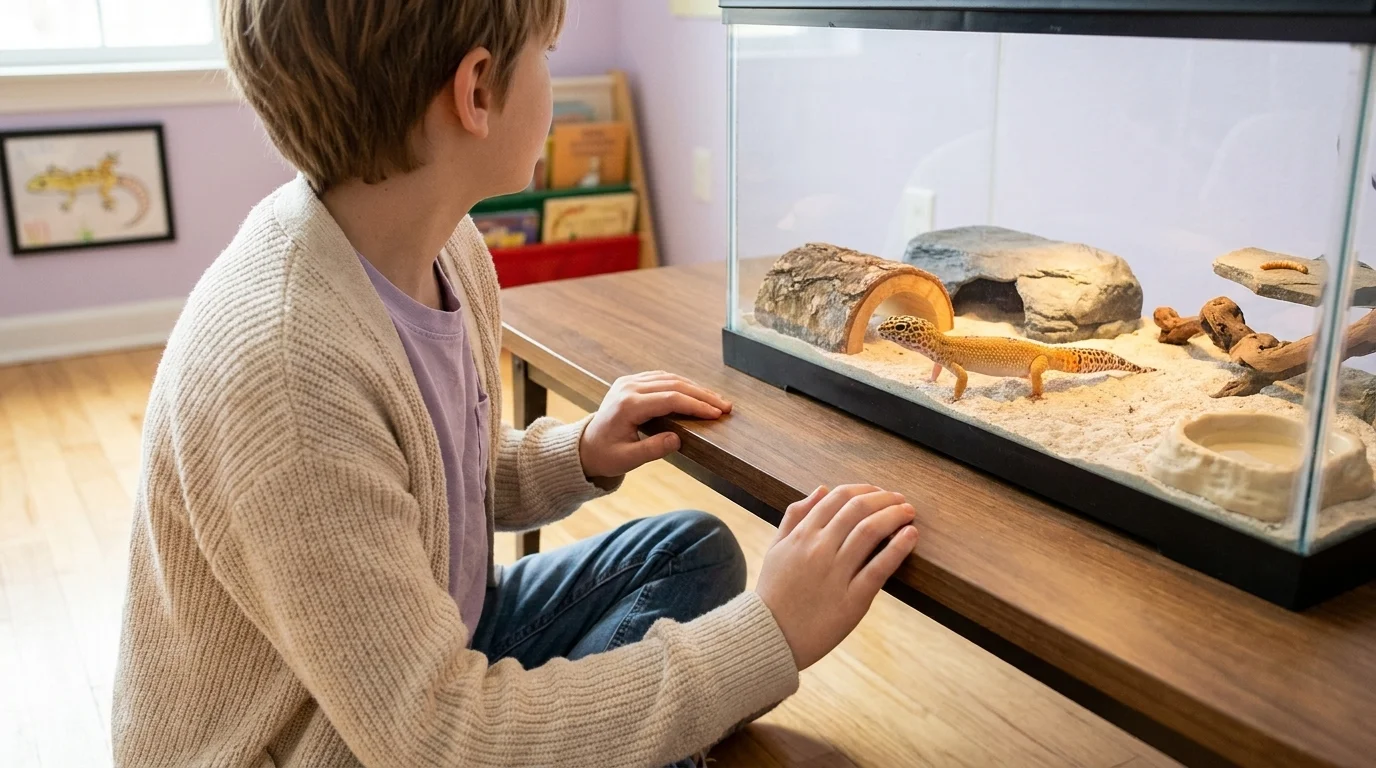
The thing the data does not quite say out loud — and the part most listicle content on classroom pets misses entirely — is the conditional. The animal-welfare outcomes that drive the empathy outcomes only happen when the program is structured to make caring for the animal actually visible to the students. A neglected hamster does not teach responsibility. A guinea pig that the teacher feeds while the children watch through the bars does not teach empathy. A leopard gecko that lives in a tank everyone has stopped noticing teaches that animals are background decoration. The structure of the interaction is the curriculum. The animal is the medium.
The best classroom pets by grade level
Grade-appropriate species selection is where almost every classroom-pet conversation has to start, because the welfare obligations of each species set the floor for what is even possible in a given classroom. The picks below are the ones consistently named across teacher-authored sources, with the welfare reality check that the dominant listicle content tends to skip.
Preschool and early elementary (PreK to grade 2) — observation-only species. The right starting point at this age is animals the children watch and learn to read, not animals they handle. Betta fish (kept singly, with proper filtration and weekly water changes), small freshwater community tanks, and a hermit-crab colony with appropriate humidity are appropriate. Handling is developmentally and welfare-wise premature at these ages.
Late elementary (grades 3 to 5) — supervised handling species. Leopard geckos, corn snakes (where local rules permit), guinea pigs (kept in same-sex pairs, never singly — guinea pigs are obligate social animals), and Russian tortoises. Each of these tolerates short, low-stress, supervised handling sessions and rewards the rotating-veterinarian classroom routine described below. Note the species notes: guinea pigs require companions; hamsters are nocturnal and stress easily under daytime handling — many classroom hamster placements fail for exactly this reason; rabbits need more space and quiet than most classrooms provide.
Middle school (grades 6 to 8) — moderate-husbandry species. Bearded dragons, crested geckos, fancy rats (in pairs or trios), and ball pythons. Students at this age can begin to take genuine ownership of the husbandry — temperature gradients, UV requirements, feeding schedules — and the welfare outcomes get better the more they own the process.
High school (grades 9 to 12) — more demanding species become viable. Reef tank communities, axolotls, ferrets (with significant space and handling commitments), or working partnerships with rehabilitation programs. High school is also where research-style observation projects become curriculum-grade, and the Pets in the Classroom grant program's 2025 expansion to grades 9-12 makes funded high-school placements newly possible.
For the "low maintenance classroom pets" search that has risen 143% year over year — usually a proxy for "an animal that won't die when nobody's here" — the honest answer is that low-maintenance is a property of the system, not the species. Fish, leopard geckos, and tortoises are commonly cited as low-maintenance, but each still requires a written weekend and holiday plan, species-appropriate housing, and a vet of record. No animal in a classroom is genuinely hands-off.
Classroom pets as social-emotional learning
The most useful tactical framework for actually delivering the empathy and responsibility outcomes the survey data shows is possible comes from Edutopia's social-emotional learning treatment of classroom pets, and it works because it makes the care of the animal a structured, visible, rotating responsibility that every student participates in. Four routines do most of the work.
The first is rotating veterinarian-of-the-day. Each day, one student takes on the formal role of monitoring the pet's water, food, enclosure cleanliness, behavior, and any small concern that should be flagged to the teacher. The role rotates on a posted schedule. The role is not optional. The role has visible consequences for the animal, which is precisely the point — kids understand responsibility through cause-and-effect, not through aspiration.
The second is competency-before-handling. Students do not handle the animal — at all — until they have demonstrated, on a checklist the teacher signs, that they know the species' handling rules: how to support a guinea pig's hindquarters, why you do not pick up a leopard gecko by its tail, how to recognize a stress signal in a corn snake. The checklist itself becomes one of the most useful empathy artifacts in the class.
The third is reading-to-the-pet sessions. Younger students reading aloud to a quietly observing animal is one of the most evidence-supported anxiety-reduction routines in the social-emotional learning literature on classroom pets. The animal does not care what the student is reading. The student's nervous system cares enormously.
The fourth is structured processing of difficult moments — illness, surgery, death — through letter-writing, drawing, or class discussion led by the teacher with appropriate language. Classroom pets will, eventually, get sick or die. How that is handled is one of the most consequential pieces of curriculum the year will contain. The class that gets to write farewell letters to a 9-year-old class guinea pig learns more about grief and care than most adults learn in formal coursework.
These routines are why structured programs deliver the 97%-empathy outcomes the survey reports. Without them, you have a pet in a tank. With them, you have a curriculum.
The humane classroom pet program: a checklist
This is the section that should exist on every top-ranking classroom-pets page and does not. A classroom pet program is humane — and is the kind that produces the empathy and responsibility outcomes the research documents — if it can satisfy every one of the following, in writing, before the animal arrives.
- Vet of record identified. A local veterinarian who treats the species is named, contacted in advance, and confirmed willing to see the animal for routine and emergency care. Budget for care is allocated, not assumed.
- Species-appropriate enclosure. Size, substrate, temperature gradient, UV lighting where required, hides, water source — confirmed against the species's published husbandry standards before the animal is acquired, not after.
- Written weekend and holiday care plan. Named person, named address, named pickup/dropoff schedule, named emergency-contact protocol. Vague "the students will rotate weekends" plans are exactly how weekend deaths happen.
- Supervised, competency-gated handling rotation. Per the SEL section above — no handling until the checklist is signed, with reasonable handling limits per session per animal per day.
- Allergy and hygiene protocol. Hand-washing before and after handling. Identification of students with relevant allergies (rodent dander, reptile salmonella exposure rules) handled in coordination with the school nurse.
- Year-end exit plan, named in writing. Where does the animal live in June, July, and August? Where does it live after the teacher retires or the program ends? An animal whose retirement plan is "we'll figure it out" is an animal that ends up at a shelter intake counter.
- Quiet rest space. Even with the best classroom acoustics, animals need a covered, low-stimulus rest space they can retreat to. A pet whose enclosure is constantly being tapped on or peered into is a chronically stressed animal regardless of how well-fed it is.
- Teaching ethics aligned to humane-education principles. A single mention of humane education as the broader pedagogical framework — care as a teachable ethical stance, not just a logistical practice — orients the program correctly.
A classroom pet program that satisfies all eight items is a program that produces the empathy and responsibility outcomes the survey data describes. A program that satisfies fewer than six of them is, in the working consensus of the 2024 welfare literature, a program that should not be launched without addressing the gaps first.
When classroom pets go wrong — and how to prevent it
The welfare counter-narrative on classroom pets is real and worth engaging honestly, because dismissing it is what allows the next preventable failure to happen. PETA's TeachKind program and World Animal Protection document named cases including a Beaverton, Oregon class gerbil that suffered a broken back during student handling, three African dwarf frogs that died their first weekend home with a student, and multiple recorded incidents of classroom animals dying of heatstroke during summer breaks when the school's HVAC was reduced or shut off. The 2024 peer-reviewed paper Classroom Pets in Primary School Education: Benefits and Welfare Concerns catalogues the structural failure modes: inadequate weekend care, untrained handling, environments mismatched to species needs (noise levels, temperature stability, lighting cycles), and unplanned year-end rehoming.
The honest reading: every one of those failures is preventable, and every one of them maps to a missed item on the eight-item checklist above. The Beaverton gerbil case is a competency-before-handling failure. The frog weekend deaths are a written-weekend-plan failure. The heatstroke deaths are an HVAC/environmental-monitoring failure. None of these failures argue that classroom pets are unsalvageable as a category. They argue that classroom pet programs without operational rigor are unsalvageable as programs.
The clean way to handle the welfare critique is the way Idris handles it in dog training: the people raising the concerns are not the enemy. They are the people who have watched the failures and have legitimate authority to demand structural improvements. The argument is not "should classroom pets exist." The argument is "what structural conditions does a classroom pet program need to actually meet its welfare obligations." A teacher or administrator who can stand behind the eight-item checklist has the answer; a teacher who cannot does not yet have one and should pause the program until they do.

Classroom pets grants for 2025-2026
The most reliable US funding source for classroom-pet acquisition and supplies is the Pets in the Classroom grant program, which has been issuing grants since 2010 and has, as of 2025 reporting, issued more than 263,000 grants reaching over 10.5 million students.
The 2025-2026 program window opened on July 1, 2025 and closes May 1, 2026. Grants run $50 to $125 depending on the type, with three categories: store-specific grants (pre-loaded at participating retailers), rebate grants (teacher pays out-of-pocket and submits receipts), and Sustaining Grants up to $50 specifically for ongoing pet maintenance or replacement supplies. The significant 2025-2026 change is the expansion of eligibility from PreK-8 to PreK-12 in both public and private schools in the U.S. and Canada, which makes funded high-school classroom-pet programs newly accessible.
The grant application itself is short — a few paragraphs about the educational use case and species choice — and the funded amounts are modest, but the program's primary value is signaling: a teacher who has applied for and received a grant has typically also thought through the species selection in a way that anticipates several of the checklist items above. Apply early in the cycle; funding is distributed on a rolling basis until exhausted.
Should you let your child bring the class pet home?
The parent-side question that every December and June brings up is whether it is wise to volunteer to take the class pet home for winter break, summer break, or — the version that ends most often in regret — the class-pet retirement at the end of the school year. The honest, force-free-trainer answer mirrors the version I give about acquiring any companion animal: only if your household can fully meet the animal's species-specific needs for its full natural lifespan, which for many classroom pets (guinea pigs, leopard geckos, tortoises, parrots) is meaningfully longer than the child requesting it will live at home. Russian tortoises live 40-plus years. Leopard geckos live 15-20. Guinea pigs need pair-bonded companionship and a vet of record familiar with the species.
If the household can credibly meet those obligations, the class pet at home is genuinely one of the better routes into thoughtful early animal-keeping for a child who has already learned the husbandry through the classroom rotation. If the household cannot, the right answer is to enthusiastically support the class's search for a more suitable retirement home — usually a rescue or experienced keeper rather than another well-meaning student family — and to channel the child's enthusiasm into a species better suited to the household's actual circumstances. The good-first-pets conversation is its own piece of work, and it should be done before the May newsletter goes out asking for a summer host.
Where this leaves the teacher and the parent
A classroom pet, set up under the eight-item humane program structure, with grade-appropriate species selection, rotating-veterinarian competency-gated handling, written weekend and holiday plans, and an honest engagement with the welfare-failure literature, produces measurable empathy, responsibility, and social-emotional outcomes for kids — the 2025 teacher-survey numbers and the 2021 CABI peer-reviewed cohort study both support this clearly. A classroom pet without that structure is a welfare risk to the animal and a quietly negative curriculum to the students, who learn what they observe, which is that the small living being in the corner is everyone's responsibility and therefore nobody's.
The work is the structure. The animal is the medium. The kids are watching closely. If you are setting up the classroom right now and any of the eight checklist items is not yet in writing, the right step is to pause the acquisition until it is. The grant funding will still be there in the next cycle. The animal you do bring in will arrive into a program that actually delivers what it promises, and the children will learn — by direct, observed example — what compassionate care for another living being looks like in practice. That is the curriculum worth running. The hamster is the help.
Frequently Asked Questions
Fish, leopard geckos, and Russian tortoises are the species most consistently named by teacher-authored sources, but 'low maintenance' is honestly a property of the program structure rather than the species itself. Every one of those animals still requires a written weekend and holiday care plan, species-appropriate housing with correct temperature and lighting, a vet of record familiar with the species, and competency-gated handling. No classroom pet is genuinely hands-off — guinea pigs need same-sex companions, hamsters are nocturnal and stress under daytime handling, and even fish need filtration and weekly water checks.
The 2025 Pets in the Classroom survey of more than 1,300 teachers found that 97% saw gains in student empathy and compassion, 97% in responsibility, 97% in engagement, 94% in anxiety reduction, 94% in social skills, 90% in self-esteem, and 99% described the experience overall as positive. A 2021 peer-reviewed cohort study of 591 students across 41 classrooms found measurable improvements in social integration and reductions in aggression. The outcomes are real — provided the program is structured to make the animal's care visible to the students, not invisible, which is the difference between the success cases and the failure cases.
The Pets in the Classroom grant program accepts applications from July 1, 2025 through May 1, 2026 from PreK-12 teachers in public and private schools across the United States and Canada. Grants run $50-$125 in three categories: store-specific grants pre-loaded at participating retailers, rebate grants where teachers pay out-of-pocket and submit receipts, and Sustaining Grants up to $50 for ongoing maintenance or replacement supplies. The 2025-2026 cycle's key change is the new expansion from PreK-8 to PreK-12, making high-school classroom-pet programs newly fundable. Apply early in the cycle since funding is distributed on a rolling basis.
PreK and early elementary (grades 1-2) should be observation-only species — betta fish kept singly, small freshwater community tanks, hermit-crab colonies. Late elementary (grades 3-5) can move to supervised handling species like leopard geckos, corn snakes, guinea pigs (always in same-sex pairs), and Russian tortoises. Middle school (grades 6-8) supports bearded dragons, crested geckos, fancy rats in pairs or trios, and ball pythons, with students taking genuine ownership of the husbandry. High school (grades 9-12) opens up reef tank communities, axolotls, ferrets with significant commitments, or partnerships with local rehabilitation programs.
The documented failure modes are weekend and holiday neglect (the African dwarf frogs that died their first weekend home with a student), untrained handling (the Beaverton, Oregon class gerbil whose back was broken), environments mismatched to species needs, heatstroke during breaks when HVAC is reduced, and unplanned year-end rehoming. All are preventable through an eight-item structural checklist: vet of record identified, species-appropriate enclosure, written weekend and holiday plan with named hosts, competency-gated handling rotation, allergy and hygiene protocol, a year-end exit plan in writing, a quiet rest space, and teaching ethics aligned to humane-education principles. A program that satisfies all eight produces the empathy outcomes the research describes. A program that satisfies fewer than six should not be launched.
Only if your household can credibly meet the animal's full species-specific needs for its complete natural lifespan, which for many classroom pets is significantly longer than the child requesting it will live at home. Russian tortoises live 40-plus years; leopard geckos live 15-20; guinea pigs require same-sex companions and a vet of record familiar with the species. If your household can meet those obligations, a class pet at home can be one of the better routes into thoughtful animal-keeping for a child who has already learned the husbandry. If it cannot, the right answer is to support the class's search for a more suitable retirement home — usually a rescue or experienced keeper rather than another well-meaning student family — and to channel the child's enthusiasm toward a species better suited to your household's actual circumstances.