Nurturing Paws with Policy: Legislative Associations Advocating for Progressive Pet Care Reforms


In 2025, the American Society for the Prevention of Cruelty to Animals reviewed U.S. Department of Agriculture inspection data and counted 680 documented violations of the federal Animal Welfare Act at USDA-licensed dog dealer facilities — sick or injured dogs denied veterinary care, moldy food, water deprivation, rodent and roach infestations. Zero breeders lost their licenses. Zero fines were paid. The Animal Welfare Act (the AWA, codified at 7 U.S.C. § 2131 and the implementing regulations at 9 C.F.R. Parts 1–4) is the only federal statute that regulates how animals are treated in commercial breeding, exhibition, research, and transport. It has been on the books since August 24, 1966. The current question is not whether pet care reform is happening — it is whether the law that already exists is being enforced.
The bills moving on Capitol Hill in 2025 and 2026 say the answer is: not enough. The 119th Congress has at least five pending pieces of legislation that would amend or strengthen the AWA, plus three statutes already on the books since 2019 that are still finding their first prosecutions. Below is what the statute actually does, what has been added to it, what has been proposed, who is supposed to be enforcing it, and what is happening at the state level while the federal enforcement record deteriorates.
What the Animal Welfare Act Actually Does (and Doesn't)
The Animal Welfare Act sets minimum standards for housing, handling, sanitation, ventilation, veterinary care, and protection from temperature extremes for animals used in research, exhibited to the public, transported commercially, or sold by commercial breeders. USDA-licensed facilities must keep inspection-ready records and submit to unannounced visits from the U.S. Department of Agriculture's Animal and Plant Health Inspection Service. Violations can produce administrative warnings, civil fines, license suspensions, and criminal referrals — when the agency is staffed to issue them.
What the AWA does not cover is at least as important as what it does. The statute exempts farm animals raised for food and fiber; birds, rats, and mice used in research; and most pet retail sales handled by licensed pet stores selling directly to the public. It is not a pet-food labeling law (that work happens under FDA authority and AAFCO model regulations) and it is not an anti-cruelty statute for household cruelty cases (those run through state law). It is a federal facility-licensing-and-inspection regime. Most consumers who say "the Animal Welfare Act protects my dog" are actually thinking of state cruelty statutes; the AWA almost certainly does not reach their dog at all unless the dog came from a USDA-licensed commercial breeder.
How the AWA Got Here: 1966 to 2013
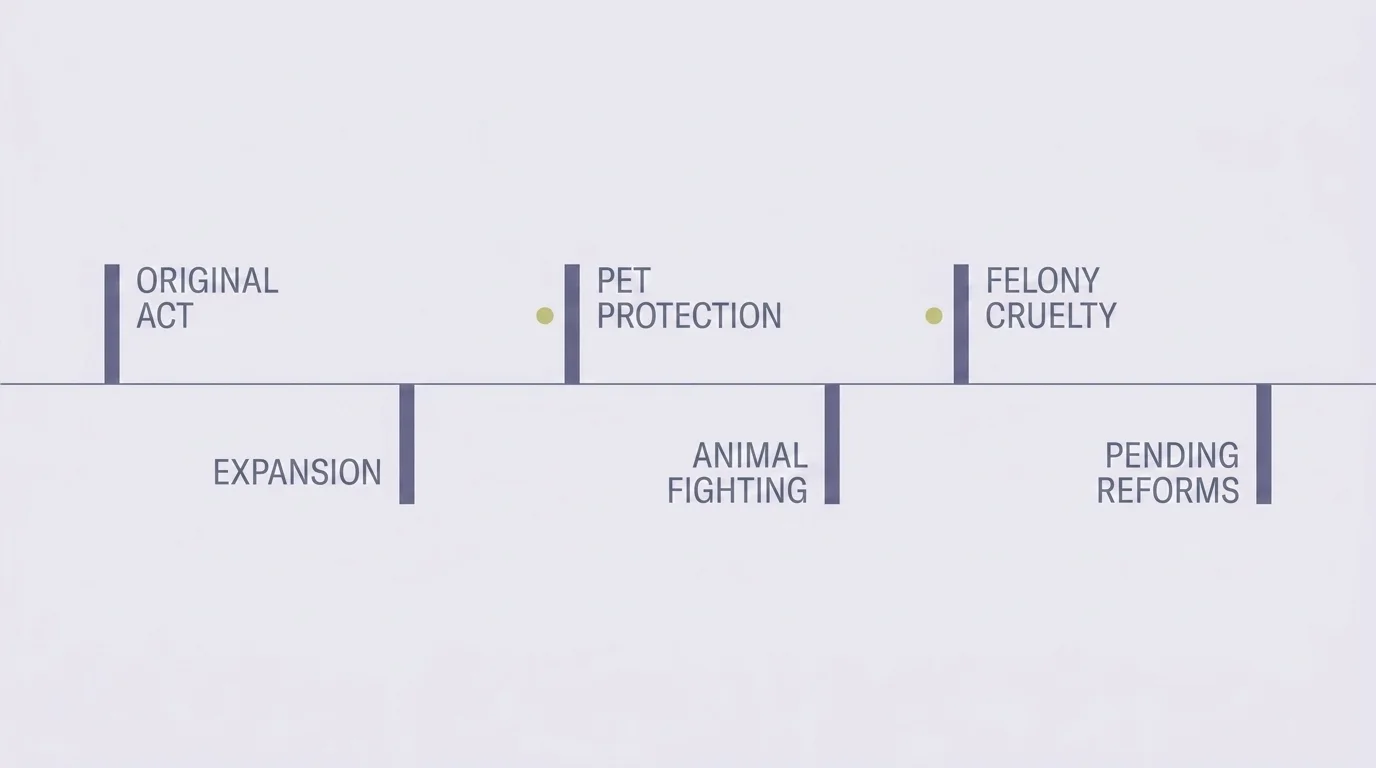
The original 1966 statute was introduced as H.R. 9743 by Rep. Joseph Y. Resnick in response to magazine reporting on stolen pets sold to research laboratories. President Lyndon B. Johnson signed it as Public Law 89-544. Every meaningful expansion since has been a numbered amendment, not a rewrite:
- 1970 (Public Law 91-579) broadened coverage from "dogs, cats, and other selected animals" to a much wider list and renamed the statute.
- 1976 (Public Law 94-279) added animal-fighting provisions and shipment regulations.
- 1985 (Public Law 99-198) introduced the Improved Standards for Laboratory Animals provisions through the Farm Bill.
- 1990 (Public Law 101-624) added the Pet Protection Act, addressing trafficking of stolen pets through Class B random-source dealers.
- 2002 (Public Law 107-171) strengthened animal-fighting prohibitions through the Farm Security and Rural Investment Act.
- 2007 and 2008 (Public Laws 110-22 and 110-246) further restricted animal fighting and clarified enforcement scope.
This chronology runs through the existing top-of-SERP coverage of the AWA, including the Wikipedia entry on the Animal Welfare Act of 1966 and the USDA National Agricultural Library reference page. Neither of those sources covers anything that happened after 2013. The reader who stops there comes away with a statute that effectively froze a decade ago. That is not what happened.
2019–2026: Amendments and Pending Bills You Should Know
Two major federal pet-welfare statutes have been added since the existing online explainers were last updated, and at least five more are pending in the current Congress. Names and bill numbers below; co-sponsors named where they materially shape the bipartisanship of the bill.
PACT Act — Preventing Animal Cruelty and Torture Act (2019, Public Law 116-72). Made it a federal felony to intentionally crush, burn, drown, suffocate, impale, or otherwise subject an animal to serious bodily injury. Bipartisan in both chambers.
Big Cat Public Safety Act (2022, Public Law 117-272). Banned the private ownership of lions, tigers, leopards, cheetahs, jaguars, cougars, and hybrids of those species, and prohibited public contact with big cat cubs at exhibitor facilities. Implementing rules from the U.S. Fish and Wildlife Service became effective in 2023. The first federal prosecutions are now closing: in April 2024 a Texas couple was sentenced for selling a jaguar cub in a parking lot (nine months prison for the husband, two years probation for the wife), and in October 2024 two Arkansas men pleaded guilty after purchasing a tiger cub from a Dallas wildlife broker, facing maximum penalties of five years and $10,000 and three years and $250,000 respectively.
Better CARE for Animals Act (HR 3112 / S. 1538, 119th Congress). Would give the Department of Justice direct authority to sue AWA violators — commercial breeders, roadside zoos, and research facilities — rather than leaving enforcement entirely to APHIS. Within 180 days of enactment the USDA would have to enter a memorandum of understanding with the Attorney General to share data on repeat violators. As of 2025 the bill had 220 House co-sponsors and 39 in the Senate, making it the highest-profile AWA-strengthening bill of the current Congress.
Goldie's Act (HR 349). Named for Goldie, a Golden Retriever who died in a USDA-licensed Iowa puppy mill that had been cited repeatedly without consequence. Would require USDA to report severe AWA violations to local authorities and to impose meaningful fines for non-compliance. Bipartisan sponsorship in the 119th Congress includes Reps. Nicole Malliotakis, Raja Krishnamoorthi, Mike Quigley, Brian Fitzpatrick, Christopher H. Smith, and Zach Nunn.
Puppy Protection Act of 2025 (HR 2253, with Senate companion S. 4437). Would amend the AWA to set breeding-frequency limits, minimum breeding ages, enclosure-engineering standards, pre-breeding veterinary approval, and unrestricted outdoor-yard access for USDA-licensed commercial breeders.
Healthy Dog Importation Act (HR 3349). Passed the House on April 30, 2026. Requires owners and importers of dogs entering the United States to submit a valid health certificate from a USDA-recognized veterinary agency, including microchip and vaccination verification.
Farm Bill 2026 — Farm, Food, and National Security Act of 2026 (HR 7567). Passed the House and includes AWA-strengthening provisions: enhanced pet protections, additional USDA enforcement resources, and stronger electronic health-documentation requirements for pets imported into the U.S.
Animal Cruelty Enforcement Act (February 2025). Bipartisan bill introduced to strengthen prosecution of federal anti-cruelty laws already on the books — including the PACT Act and dogfighting and cockfighting bans in U.S. territories. Aimed at the enforcement gap rather than the statutory gap.
Why 2025 Enforcement Collapsed
The reason this is not just a list of bills is that the agency responsible for AWA enforcement is, by its own data and by federal review, no longer functionally enforcing. The Animal Welfare Institute's 2025 analysis documents a 15 percent decrease in APHIS animal-care inspectors in 2025 alone, on top of an approximately one-third reduction over recent years. Across the same window, from 2021 to 2024, the number of USDA-licensed facilities and registrants rose nearly 50 percent. More licensees, fewer inspectors, each year.
The Congressional Research Service product IF13002 — the federal legislature's own briefing document — reports that a 2025 USDA Office of Inspector General audit found 80 percent of reviewed dog breeders had at least one AWA noncompliance and that 95 percent were not inspected in accordance with APHIS's own Risk-Based Inspection System, with some breeders skipping required annual inspections entirely.
Layered on top of staffing collapse is a legal shock. In June 2024, the Supreme Court decided SEC v. Jarkesy, holding that the Seventh Amendment guarantees a jury trial when the federal government seeks civil penalties for fraud. The decision was about securities enforcement, but its administrative-fine logic transferred. According to reporting from Courthouse News on a follow-up study, APHIS issued only five AWA civil fines in the fourteen months following Jarkesy — a near-stop on the administrative-fine practice that had previously been the agency's primary penalty tool. The 680 violations and zero fines reported by ASPCA for 2025 are the downstream effect.
The honest summary: the Animal Welfare Act is being broken at scale, by entities the USDA itself has licensed, and the federal agency tasked with enforcement is short-staffed, working through a near-50-percent surge in licensees, and operating under a Supreme Court constraint that has effectively suspended its primary fine mechanism. That is the context for every pending bill above. The legislators sponsoring Goldie's Act and the Better CARE for Animals Act are responding to a documented enforcement vacuum, not a vague welfare concern.
What Your State Is Doing
While federal enforcement deteriorates, state legislatures are doing the more aggressive work. On October 9, 2025, California Governor Gavin Newsom signed a five-bill animal welfare package. AB 506 requires pet sellers to disclose an animal's origin and full health history, voids non-refundable deposits, and tightens California's 2019 puppy-mill pipeline ban (AB 485). AB 867 bans non-medical cat declawing statewide. The package treats the federal AWA's exemption for pet retail sales as a problem to be solved at the state level — exactly the gap commercial breeders have used to keep selling into California for the past five years.
California is not alone. New York passed a retail-pet ban in 2022. Illinois enacted the Safe Pets for Illinois Act in 2021. State-by-state, the model is increasingly the same: ban or regulate the retail end of the puppy-mill pipeline, since the federal AWA reaches the breeder license but not the storefront. For most pet owners, the binding regulation in 2026 is state, not federal — and state legislatures have moved faster on the retail-pet end of the pipeline than federal enforcement has on the breeder end.
Who's Actually Working on This: Named Nonprofits and Tools
The nonprofit infrastructure around the AWA is older and more specific than the original article suggested. Five organizations do the bulk of the federal-policy work that is cited in this piece:
- Humane World for Animals (formerly the Humane Society of the United States) — federal lobbying, state-bill campaigns, named-bill scorecards.
- American Society for the Prevention of Cruelty to Animals — annual reviews of USDA inspection data, state-by-state legislative tracking, the 680-violations report above.
- Animal Welfare Institute — primary source for federal-enforcement analysis, including the 2025 APHIS staffing report cited above.
- Animal Legal Defense Fund — state-by-state animal-protection-laws ranking, litigation tracking.
- Center for a Humane Economy — Animal Cruelty Enforcement Act and PACT-Act enforcement advocacy.
The single most underused reader tool is the USDA APHIS public inspection database. Every licensed facility's recent inspection reports are available there by license number — moldy food, water deprivation, denied veterinary care all show up as documented findings in a public file. If you buy a dog from a USDA-licensed breeder, the inspection record is one search away.
What to Ask, and Who to Ask
The concrete actions available to most pet owners in 2026 are state-level, not federal. Ask the breeder for their USDA license number and then read their APHIS inspection record at the link above before you sign anything; ask your state legislator whether your state has a retail-pet ban or origin-disclosure rule and what their position on it is; if your state does have a pet-seller disclosure statute, ask the storefront to provide the disclosure in writing at the point of sale. On the federal side, the bills above all have publicly listed co-sponsors at congress.gov — your representative is either on the co-sponsor list or not, which is itself a piece of information.
This article is informational reporting on federal and state law as of May 2026. It is not legal advice. Jurisdiction-specific questions — whether a particular sale, custody, or cruelty matter falls under the AWA, state cruelty law, or municipal ordinance — should be directed to an animal-law attorney or to your state attorney general's consumer-protection office. Tails' Talks does not represent pet owners in any legal matter, and the named nonprofits above are advocacy organizations, not legal-aid providers, except where they explicitly say otherwise.
Frequently Asked Questions
Signed in 1966 as Public Law 89-544, the Animal Welfare Act (7 U.S.C. § 2131) is the only U.S. federal law that regulates how animals are treated in research, exhibition, transport, and commercial breeding. It sets minimum standards for housing, handling, sanitation, ventilation, veterinary care, and protection from temperature extremes. It does not cover farm animals raised for food, birds bred for research, rats and mice used in research, or most pet retail sales handled directly to the public — those are governed by state law and other federal statutes.
The U.S. Department of Agriculture's Animal and Plant Health Inspection Service (APHIS) enforces the AWA through licensing, unannounced inspections, civil fines, and criminal referrals. According to a 2025 Animal Welfare Institute analysis, APHIS animal-care inspector staffing dropped 15 percent in 2025 alone — and roughly one-third over recent years — while the number of licensed facilities rose nearly 50 percent between 2021 and 2024. This staffing-to-licensee mismatch is the proximate cause of the widely reported 2025 enforcement gaps.
President Lyndon B. Johnson signed the Animal Welfare Act on August 24, 1966, as Public Law 89-544. It was originally introduced as H.R. 9743 by Rep. Joseph Y. Resnick in response to magazine reporting on stolen pets sold to research labs. Major amendments followed in 1970 (91-579), 1976 (94-279), 1985 (99-198), 1990 (101-624 Pet Protection Act), 2002 (107-171), 2007-2008 (110-22 and 110-246), and in the 2013 farm bill (113-79).
A 2025 USDA Office of Inspector General audit found that 80 percent of reviewed dog breeders had at least one AWA noncompliance and that 95 percent were not inspected in accordance with APHIS's own Risk-Based Inspection System. ASPCA review of 2025 USDA inspection data documented 680 violations at USDA-licensed dog dealers — zero breeders lost a license and zero fines were paid. APHIS issued only five AWA civil fines in the fourteen months after the June 2024 Supreme Court decision in SEC v. Jarkesy, which constrained administrative-fine practice across federal agencies. Enforcement is currently considered to be in crisis.
Major recent additions include the PACT Act (2019, Public Law 116-72), which made severe animal cruelty a federal felony, and the Big Cat Public Safety Act (2022, Public Law 117-272), which banned private big-cat ownership. Pending 2025-2026 bills include the Better CARE for Animals Act (HR 3112 / S. 1538), which would give the Department of Justice direct authority to sue AWA violators; Goldie's Act (HR 349); the Puppy Protection Act (HR 2253); the Healthy Dog Importation Act (HR 3349, which passed the House on April 30, 2026); the Animal Cruelty Enforcement Act (introduced February 2025); and AWA-strengthening provisions in the 2026 Farm Bill (HR 7567).