The Psychology of Color in Pet Care: Unveiling the Impact of Hues on Pet Wellness and Behavior


A client of mine, Andrea, sat in my office last spring with a list of paint chips. Her vet had told her that her new rescue, a six-year-old shepherd-mix named Boone with a severe noise-aversion history, would calm down if she repainted the bedroom in a "calming sage green" because chromotherapy research said so. She had spent three hundred and forty dollars on the right shade of green and asked me, with some embarrassment, whether she should also be buying the matching lavender bowls. The underlying question — what colors can dogs see — she had never asked.
The honest answer was no, and I am going to spend the rest of this article explaining why — not because Andrea was wrong to want to help Boone, but because she was given advice rooted in a system of claims that does not survive contact with the actual biology of how dogs see color. The good news, for Boone and for anyone reading this with a similar list of paint chips, is that there is real, well-replicated science on canine and feline color vision, and what it says is more interesting and more useful than what any chromotherapy guide will tell you.
This is what dogs and cats actually see, why it matters for your toys and your training, and what every website that uses the phrase "color psychology for pets" tends to get wrong.
Why "color blind" is the wrong frame
The first myth to clear up is the one most likely to send you to the wrong article on Google. Dogs are not color blind. Neither are cats. Both species are dichromatic, which means they have two functional cone-cell types in the retina instead of the three most humans have. A red-green-colorblind human is also a dichromat. We do not say red-green-colorblind humans are "blind to color"; we say their color vision is different from a trichromat's. The same precision is owed to dogs and cats.
The cleanest behavioral evidence of this came from a 2017 study published in Royal Society Open Science, in which Siniscalchi and colleagues ran sixteen dogs through a modified Ishihara test — the same dot-pattern test used to diagnose red-green color blindness in humans. The dogs responded to color contrasts the same way red-green-colorblind humans do, and failed the same plates that trichromatic humans pass. That is the cleanest available behavioral confirmation of the photoreceptor data we have known for decades. Dogs see color. They see fewer colors than we do.
That distinction matters because almost every claim about how pets respond to colors — "warm hues stimulate excitement," "red toys excite the prey drive," "soft pastels calm anxious dogs" — assumes the pet can actually see the colors being described. Most of the time, they can't. Before any of the rest of this article makes sense, that one premise has to go.
What colors dogs actually see
Canine retinas were characterised in foundational work by Neitz, Geist, and Jacobs in 1989, and the findings have been replicated through the present. Dogs have two functional cone types: a short-wavelength (S) cone that peaks at approximately 429 nm — what humans perceive as blue-violet — and a middle-to-long-wavelength (M) cone that peaks at approximately 555 nm, in what humans perceive as yellow-green. There is no third cone class responsive to long-wavelength red. The wavelengths we call red and orange fall outside the dog's discriminable spectrum and are perceived as desaturated yellow-brown or gray.
The practical version of this is a two-color world: blues and yellows are vivid; greens and reds are mostly variations of murky gray-yellow; orange reads as a slightly different shade of yellow rather than its own colour. In luminance-controlled forced-choice trials, dogs select the rewarded blue or yellow target with roughly 70 to 90% accuracy. When the choice is between red and green, accuracy drops to chance — roughly 50 to 60% — which is exactly what we would expect from a dichromat being asked to distinguish two colours that look almost the same to them.
A methodological note worth flagging, in the spirit of not overclaiming: some older "dogs can distinguish color X from Y" findings were confounded by brightness differences between the test stimuli; when physical luminance is properly controlled, some discrimination claims weaken. The dichromatic blue-yellow conclusion holds across every modern study. The specifics — what dogs prefer among the colours they can see — are where the literature is still cleaning itself up.
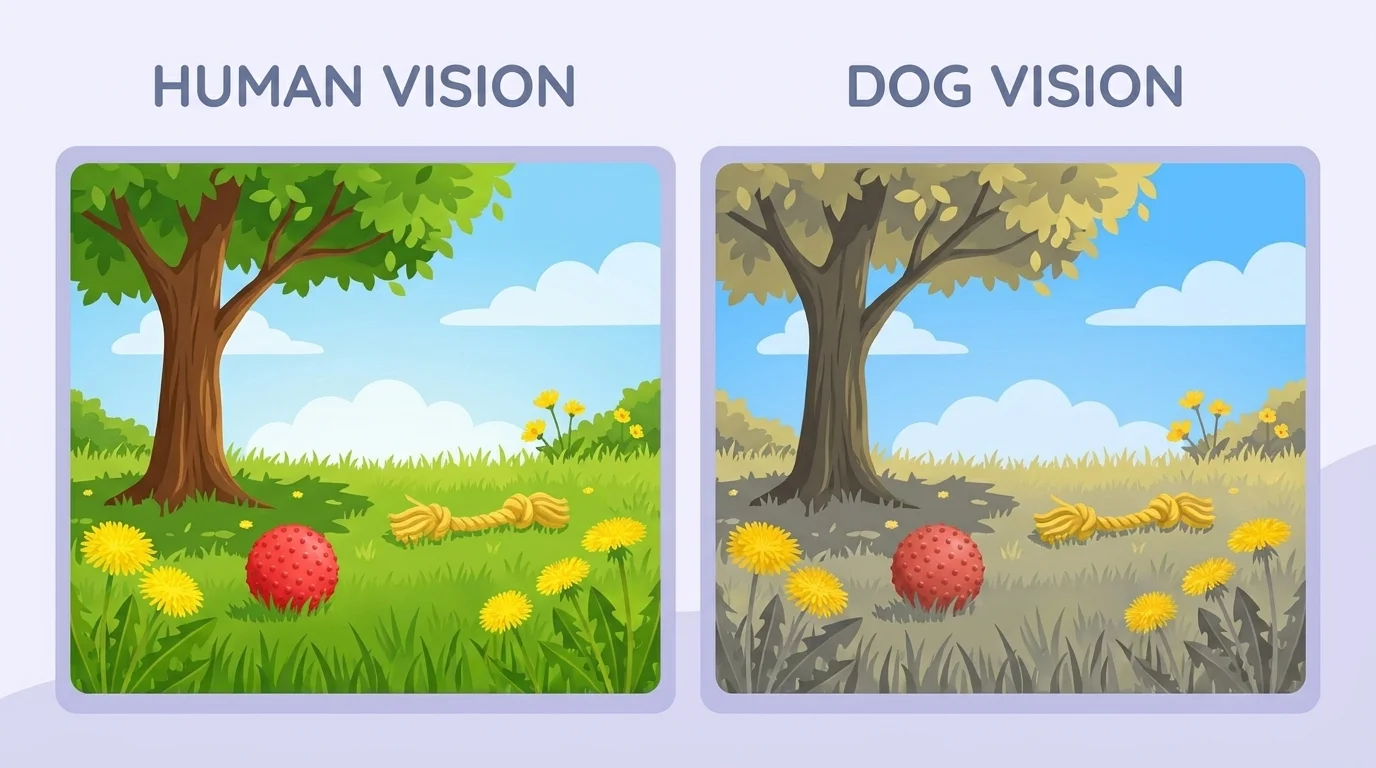
What colors cats actually see — and what the internet gets wrong
The cat side of this conversation deserves its own correction, because the most popular articles ranking on Google for "what colors can cats see" are repeating a factual error.
A widely-shared claim — including on at least one top-ranking competitor — is that cats are trichromatic, like humans. They are not. Electrophysiology going back to Daw 1973 and Loop 1979, replicated through the 2010s, shows that cats have two functional cone classes — an S-cone peaking near 450 to 460 nm (blue-violet) and an ML-cone peaking near 560 nm (yellow-green) — with a neutral point near 505 nm. Cats are functionally a blue-yellow dichromat: the same broad palette as dogs, slightly shifted in the blue range. Independent work on the blue-cone function in the cat retina corroborates the two-cone model.
This is not a small error to fix. It changes what kind of toy will catch your cat's attention, what kind of laser-pointer beam stands out against carpet, and which "cat-friendly" colour recommendations are actually grounded in feline biology versus borrowed wholesale from advice written for humans. Pink reads as a desaturated grayish hue to cats. Red wand-toys are visible by contrast against a darker floor, but not because the cat is responding to "red" — they are responding to the contrast. Yellow-green and blue toys are where the cat's two cone classes do most of their actual work.
If you take away one thing from this section: the next time you read that "cats see colors like humans do," you can update the source's credibility downward in your head. Most of the cat-vision internet still gets this wrong.
Night vision: rods, the tapetum, and what color does at dusk
The dichromatic story is the daylight story. Both dogs and cats have evolved retinas that prioritise low-light sensitivity over colour resolution, and that trade-off is the reason your dog sees better than you do in your dim hallway at 4 a.m.
Both species have rod-dominant retinas — far more rod photoreceptors per unit area than humans — and both have a tapetum lucidum, a reflective layer behind the retina that bounces incoming photons back through the photoreceptor layer for a second pass. The combined effect: dogs can detect movement and form in roughly one-fifth the ambient light a human requires, and cats need roughly one-sixth the light we do. The eye-shine you see when you photograph a dog or cat in the dark with a flash is the tapetum doing its job.
The catch — and the reason "what colors do dogs see at night" is a real but quietly answered question — is that low-light vision is overwhelmingly rod-mediated. Rods do not encode colour. Once the ambient light drops below the cone-activation threshold, both species' worlds shift toward grayscale, exactly the way human vision does in a dimly lit room. Colour vision in dogs and cats is a daytime tool; the night-vision tool is a different sensor entirely.
What the internet gets wrong about pet color
Now the part most articles in this category avoid. The reason you keep finding "color psychology for pets" articles and "chromotherapy for your dog's anxiety" pages on Google is not that the evidence supports those claims. The evidence does not.
Chromotherapy — the practice of assigning therapeutic meaning to specific colours and treating health conditions by exposing the person to those colours — is a pseudoscience. Wikipedia, RationalWiki, and the broader scientific community all describe it as a discredited human alternative-medicine practice with no clinical evidence supporting its claims. RationalWiki's summary is blunter: "color therapy" is "a form of alternative medicine," with the strongest available evidence not supporting any of its therapeutic claims. Applying a human pseudoscience to dogs and cats compounds the error in two ways. First, the human framework was never valid to begin with. Second, the colours chromotherapy assigns "therapeutic meaning" to are largely colours your pet either cannot perceive (most reds, oranges, pinks, purples) or perceives very differently from the way the framework assumes (greens and yellows blending toward each other).
The related claim — that "warm colours like red and orange stimulate excitement" in pets — fails the same biology test. A dog cannot stimulate prey drive by seeing red. The colour does not enter their perceptual world as red. If they appear excited by a red toy, it is overwhelmingly likely they are responding to motion, scent, your delivery, or the contrast of the toy against the background — not the hue.
The honest version: paint colour on a wall will not change your pet's mood. Environmental enrichment, predictable routine, daily exercise, species-appropriate husbandry, and (when the case warrants it) work with a veterinary behaviorist or board-certified DACVB on a force-free behaviour plan will. If you are reading this article because you are trying to help an anxious dog or cat, please put the paint chips down and pick up one of those interventions instead.
What this means for your toys and training
This is the section the pure-vision-biology articles tend to skip, and it is the section that justifies the rest of the article existing.
If your dog sees in blue and yellow, then a red rubber ball on green grass is functionally invisible to your dog. They are tracking it by motion, scent, and your line of sight — not by seeing it. This is one of the most common failures in fetch training: owners use a colour we love (red is high-contrast for us) on a background that erases it for the dog. Switch to a blue or yellow toy on green grass and your dog will routinely find the toy faster, with less frustration, and with the visual independence we want them to have.
The same logic applies to high-visibility gear. An orange hunting vest looks yellow to a dog, which is still high-contrast against most outdoor backgrounds — so the orange vest still does its high-visibility job from the dog's perspective. A blue collar against snow is highly visible. A pink collar against grass is not.
For cats, the dichromatic palette skews enough toward the blue end to suggest blue and yellow-green wand toys against a contrasting floor are the most visually engaging options. Most "cat-favourite colour" infographics on the internet are circulating without behavioural evidence behind them; treat them with the same scepticism you treat any other "pets love colour X" claim. The honest finding from a 2025 replication of canine colour-preference trials — extending Kasparson et al.'s earlier work — is that dogs choose yellow over blue when brightness is controlled. The corresponding feline replication has not yet been done with the same rigour. Visibility, against the actual background the toy will be used on, matters more than hue preference either way.


The honest version
Andrea repainted the bedroom anyway — she liked the sage green for her own reasons — and we worked on Boone's noise-aversion through a force-free desensitisation plan with his veterinarian's input. The plan is what helped. The paint was wallpaper for the human.
This is the shape of the answer for anyone who came to this article from a search for "what colors can dogs see" or "what colors can cats see" with a more practical question underneath it. Dogs and cats live in a blue-yellow world. They see fewer colours than we do, see them differently from each other, and rely on rods, motion, scent, and learned cues far more than on hue for the work their eyes actually do. The toy that works is the one they can see against the background you are throwing it on. The "calming colour scheme" that does not work is the one the chromotherapy guide sold you. And the pet who looks calm after you repaint the bedroom is calm because of something else you did at the same time.
That is the science. It is more interesting than the pseudoscience, and it lets you spend the three hundred and forty dollars on something that will actually help the dog.
Frequently Asked Questions
No. Dogs are dichromatic — they have two functional cone types instead of the three most humans have — which is the same condition as red-green-colorblind humans. Dogs see blues and yellows clearly but cannot distinguish red from green; those wavelengths look grayish or yellow-brown. The 2017 Royal Society Open Science Ishihara study confirmed this behaviorally.
Blue and yellow. Canine cone peaks sit at approximately 429 nm (blue-violet) and 555 nm (yellow), so toys in those colours stand out against most backgrounds. A red toy on green grass is functionally invisible to a dog.
Yes — but the internet routinely overstates how much. Cats are dichromats, not trichromats: two functional cone types peaking near 450 nm (blue) and 560 nm (yellow-green), with a neutral point around 505 nm. Reds and pinks shift toward gray-green; blues and yellows are vivid.
Not as pink. Pink wavelengths fall in the red end of the spectrum dogs cannot resolve, so pink toys typically look pale yellow-gray.
Most greens overlap with the yellow part of the dog's discriminable spectrum and read as a desaturated yellow-gray. A bright green tennis ball on green grass is one of the lowest-contrast combinations available to a dog.
Orange reads as a slightly different shade of yellow to a dog. That is why orange hunting vests still work as high-visibility gear from a dog's perspective — they show up clearly against most outdoor backgrounds.
Similar to dogs — pink reads as a desaturated grayish hue rather than true pink. A bright pink toy can still be visible by contrast against a darker background, but the colour itself is not perceived as pink.
At low light levels, both dogs and cats rely almost entirely on rod photoreceptors and the tapetum lucidum reflector behind the retina. Rods do not encode colour, so the world shifts toward grayscale below the cone-activation threshold. Dogs can see in roughly one-fifth the light a human needs; cats in roughly one-sixth.
No. Chromotherapy is a discredited human pseudoscience with no clinical evidence, and applying it to pets is compounded by the fact that dogs and cats cannot perceive most of the colours chromotherapy assigns therapeutic meaning to. Wall paint colour will not change your pet's mood; environmental enrichment, exercise, predictable routine, and — when the case warrants — a veterinary behaviorist will.
Blue and yellow, or any high-contrast colour against the play surface. A 2025 replication of canine colour-preference trials found dogs choose yellow rubber toys over blue when brightness is controlled — but in practice, visibility against the actual background you use matters more than preferred hue.