Artistic Expressions: Unveiling the Influence of Pets in Creative Works


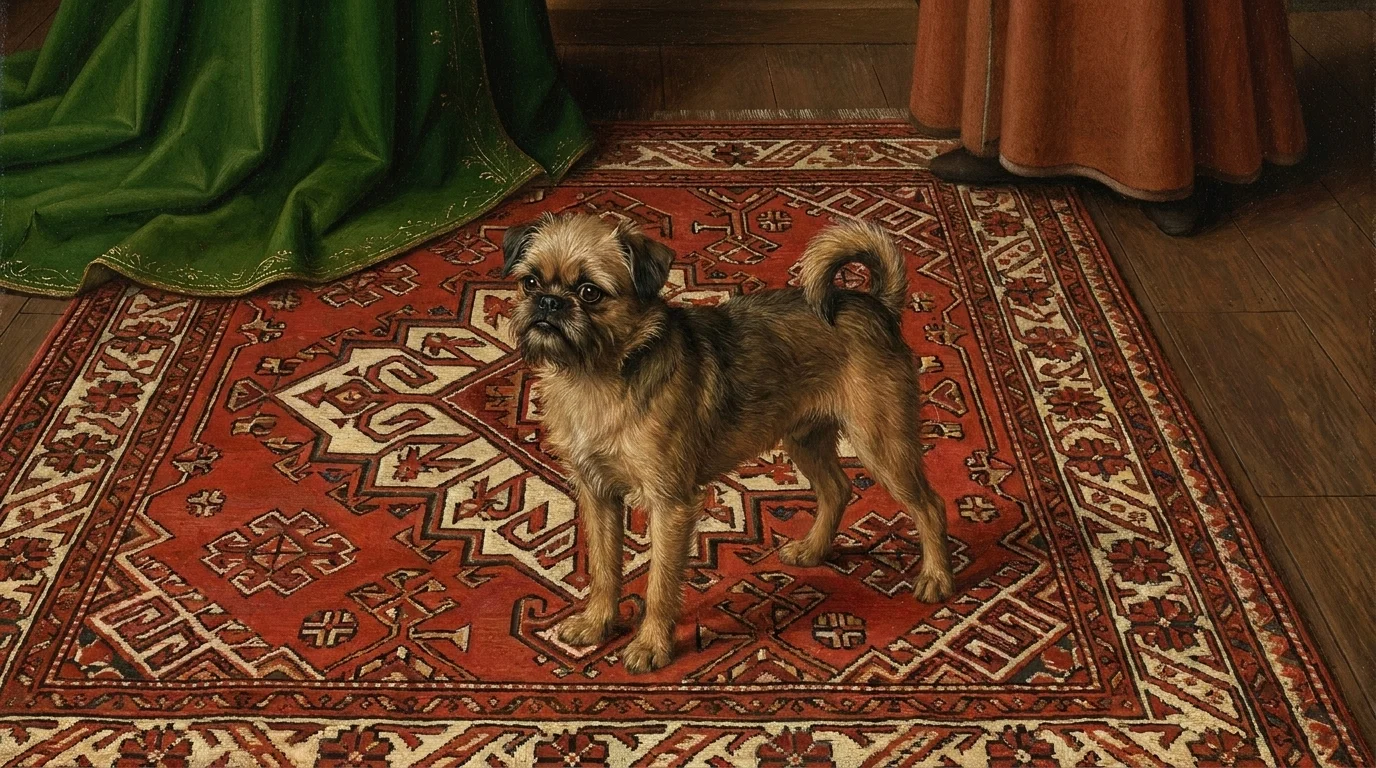
Pets in art are not a niche subject. There is a small painting in the National Gallery in London — Jan van Eyck's Arnolfini Portrait, completed in 1434 — that I have stood in front of more times than I can count. The room is dim, the panel is the size of a serving tray, and most of the visitors are leaning in to see the convex mirror or the Latin inscription above it. The figure I always come back to is the dog. He is a small Brussels griffon-type, painted with the same fidelity to fur and shadow that van Eyck gave the brocade on Mrs. Arnolfini's gown, standing between his owners' feet, looking directly out at the viewer. He has a name, in some readings: he is a stand-in for the painting's whole argument about marriage and loyalty. He is also, very obviously, somebody's dog.
That is what pets in art have been for almost as long as we have had art: not symbols, not metaphors, but somebody's dog, somebody's cat, somebody's parrot, painted into the frame because the painter knew what the animal meant to the household and refused to leave it out. The reason "pets in art" is still one of the most-searched cultural phrases on the internet — about 1,900 searches a month on Google in early 2026, according to current keyword data — is not that art collectors are looking for trophy paintings. It is that 94 million US households now live with at least one pet, and most of those households want to know that the artists and writers they love saw the same thing they see across the room every morning. They did. Here is a tour of where, when, and how.
Pets in art history: from the Arnolfini dog to Frida Kahlo's monkeys
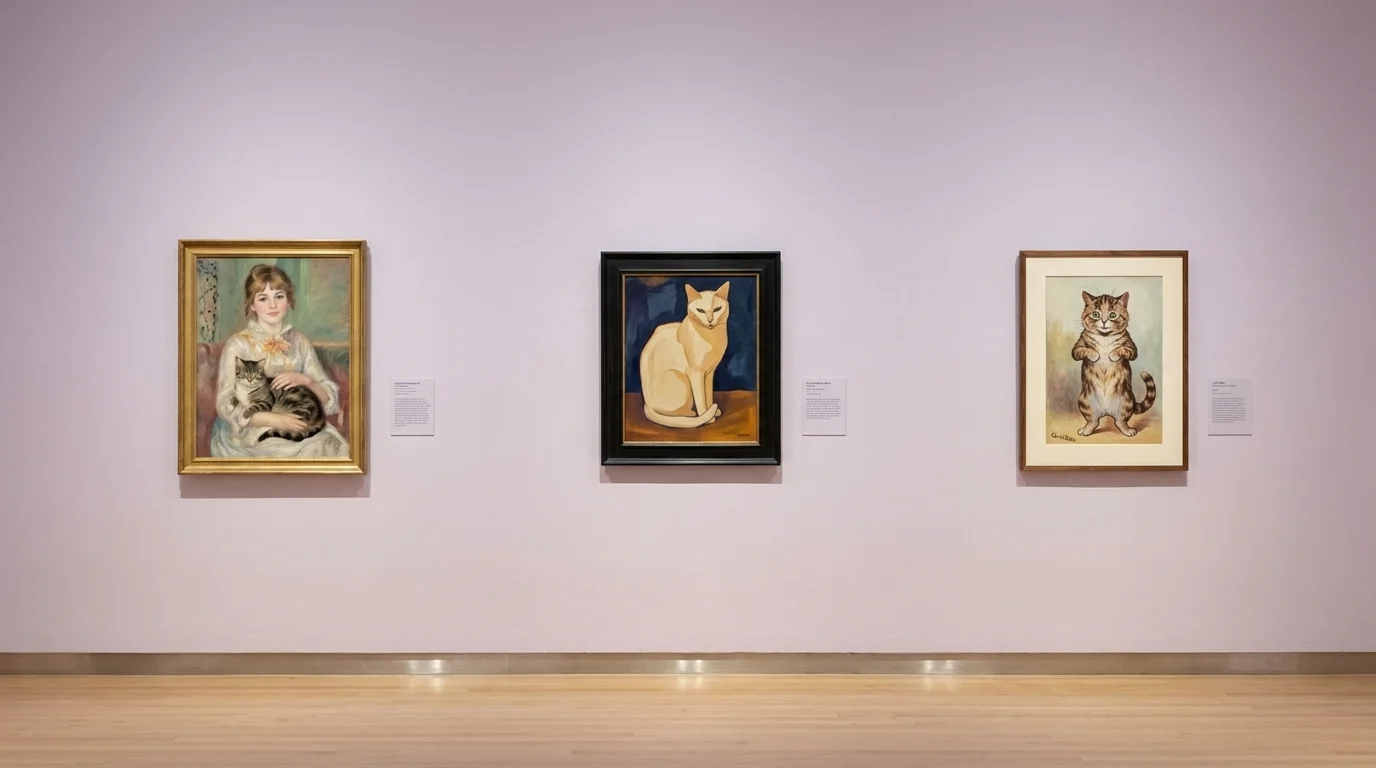
The history of pets in painting is a longer continuous tradition than the history of most other domestic subjects. Beyond van Eyck's 1434 dog, Titian painted his patron Federico Gonzaga with a small Maltese in the 1520s; Renoir painted a tabby cat curled in the lap of a young Julie Manet in 1887 (today held by the Met and Musée d'Orsay collections); Pierre-Auguste Renoir's Julie Manet with Her Cat is one of the works that established cats as a serious portrait subject rather than a still-life prop. The Expressionists pushed further: Franz Marc's The White Cat (1912) at the Kunstmuseum Moritzburg Halle reads almost like a saint's icon, and Bart van der Leck's The Cat (1914) at the Kröller-Müller Museum makes the same animal a study in primary-colour geometry.
Modern and contemporary artists kept the tradition obvious and personal. Pablo Picasso painted his dachshund Lump into his variations on Las Meninas, and made the 1939 etching Cat Catching a Bird (Musée Picasso, Paris). Frida Kahlo featured her own animals — monkeys, parrots, deer, a fawn called Granizo — in 55 of her 143 paintings. Andy Warhol produced an entire artist's book called 25 Cats Named Sam and One Blue Pussy, in homage to a household where most of the cats were, in fact, named Sam. Salvador Dalí kept and painted his ocelot Babou. Henri Matisse worked his cats Coussi, Minouche, and La Puce into the colour fields of his domestic interiors. Louis Wain, the English illustrator institutionalized for schizophrenia in the 1920s, produced thousands of anthropomorphic-cat drawings that have only grown more critically respected since.
What you see across this 600-year sweep is consistent: when an artist who lived with animals could choose what to paint, the animals showed up. The work that lasts is the work that does not stage them.
Medieval and Renaissance pets: from bestiaries to viral memes
If you have spent any time on TikTok or Instagram in the last two years, you have seen the medieval dogs. They are the long-eared, googly-eyed, oddly-proportioned creatures sitting at the feet of saints in illuminated manuscripts, the spaniels with vacant grins in fifteenth-century hunting scenes, the lapdogs in early Renaissance portraits whose faces appear to be melting. Search interest in "medieval dog paintings" rose roughly 175% year over year through 2025, on volumes around 880 monthly searches, with related "renaissance dogs" queries adding another 590 a month. There is now an Ugly Dogs in Renaissance Paintings calendar that has shipped 2024 and 2025 editions on Etsy and TikTok Shop, and at least three recurring TikTok series dedicated to "what is wrong with this dog" close-ups from European museum collections.
The reason the dogs look strange is not that medieval painters could not see dogs. It is that, as Hyperallergic has documented, most of those depictions came from bestiaries — encyclopedic books that used animals as theological lessons, not field guides. A dog in an illuminated manuscript meant fidelity, or watchfulness, or the soul recognizing its master. The image had to be recognizable as a dog; it did not have to be anatomically right. By the High Renaissance, observed naturalism caught up — Titian, Veronese, and later Velázquez painted dogs that look like specific living dogs — but the bestiary tradition lingered in religious painting for another century, and the "wrong" dogs that survive in museum collections are a fossil record of that older visual logic.
The contemporary meme is, in a strange way, the most affectionate reception medieval pet imagery has received in 800 years. Most of the people sharing it are pet owners who recognize, correctly, that the strangest of these dogs has the same alert, slightly worried expression their own dog has. The medieval painter was working in a different visual vocabulary. The dog was paying attention.
Related Article: Cultural Connotations: Exploring How Different Colors Hold Diverse Symbolism in Pet Care Around the World
Cats in art history
For most of the history of European painting, cats had a worse press than dogs. Christian iconography of the early medieval period associated cats with independence, sensuality, and — in some readings — witchcraft, which is part of why dogs symbolize fidelity in the Arnolfini Portrait while cats more often signal moral ambiguity in the same period's work. The cat had to wait for the secular still-life and portrait traditions to be rehabilitated as a subject, and when that happened, the rehabilitation was thorough.
The named highlights of cats in art history begin earlier than most people think. Egyptian tomb paintings include cats at the feet of seated couples as far back as the 18th Dynasty. Géricault and Manet both painted cats — Manet's Olympia (1863, Musée d'Orsay) places a startled black cat at the foot of the bed where a small dog would have sat in a Renaissance composition, deliberately scrambling the symbolic reading. Renoir's Julie Manet with Her Cat, mentioned above, is the canonical Impressionist treatment. Pierre Bonnard painted his own dachshund Black and his cats obsessively across his interiors. Théophile Steinlen made the cat his graphic-design signature, most famously in the 1896 Le Chat Noir poster for the Montmartre cabaret. Suzanne Valadon and her son Maurice Utrillo both painted their household cats. Tsuguharu Foujita's white-cat compositions sit in collections at the Centre Pompidou and the Musée d'Art Moderne de la Ville de Paris. And Louis Wain's increasingly abstract anthropomorphic cats, painted across his decades of institutionalization, have been re-exhibited at galleries from London to Tokyo through the 2020s.
Search demand for the phrase "cats in art history" rose about 50% year over year through 2025, on volumes of around 210 per month — a small but unambiguously rising signal. Cats are, finally, getting the studied art-historical attention dogs have had since the fifteenth century.
Animal symbolism: loyalty, mystery, and the bestiaries
The deeper layer underneath both the dog and cat traditions is the symbolic one — the long, slow accumulation of meaning that lets a single painted dog stand for a marriage or a single painted cat stand for a moral choice. Erwin Panofsky and Craig Harbison's scholarly readings of the Arnolfini dog remain the canonical reference: the dog signals conjugal fidelity, but also wealth, also lifestyle, also membership in a household that could afford a small lapdog rather than a working hound. Titian's Portrait of Federico Gonzaga (c. 1529, Museo del Prado) uses the duke's tiny Maltese the same way — to soften, to humanize, and to mark him as a man whose private life included a small white dog.
Cats in the same centuries do the opposite work. Where dogs were painted as fidelity, cats were painted as the question of fidelity — sometimes domestic comfort, sometimes sensuality, sometimes (in Dutch Golden Age morality scenes) a small visual signal that not everything in the room was as virtuous as it looked. Modern art shed most of the moralizing, but the inherited symbolic charge is still there in the way a contemporary illustrator decides whether to put a dog or a cat in a portrait. The choice is rarely accidental. It is a piece of fifteenth-century vocabulary that has stayed in the language.
Famous pets in literature: from Argos to the Cheshire Cat
The literary tradition is older than the painted one. Argos, the dog who waits twenty years for Odysseus to come home in Homer's Odyssey, is the founding scene of literary pet companionship: he wags his tail, recognizes his master, and dies. Almost every literary dog since works in his shadow. The canonical roster of famous dogs in literature typically includes Argos; Buck and White Fang from Jack London's novels; Lassie from Eric Knight's Lassie Come-Home; Toto from L. Frank Baum's Wizard of Oz; Nana, the Newfoundland nursemaid in J. M. Barrie's Peter Pan; Old Yeller from Fred Gipson's 1956 novel; Greyfriars Bobby, the Edinburgh Skye terrier whose vigil at his owner's grave became a children's-book staple; Marley from John Grogan's Marley & Me; and Montmorency, the fox terrier in Jerome K. Jerome's Three Men in a Boat.
Literary cats run a parallel track. Lewis Carroll's Cheshire Cat appears and disappears around Wonderland leaving only a grin. Dr. Seuss's Cat in the Hat arrives uninvited and rearranges the household. T. S. Eliot's Old Possum's Book of Practical Cats — Macavity, Mr. Mistoffelees, Old Deuteronomy — turned into the basis for the longest-running musical in West End history. Bagheera, the black panther in Kipling's Jungle Book, is the closest thing in classical English children's literature to a working cat character. Bill Watterson's Hobbes, the tiger who is real to Calvin and a stuffed toy to everyone else, is the late-twentieth-century touchstone. Judith Kerr's Mog the Forgetful Cat and Patricia Highsmith's strange, sympathetic short stories about cats fill out the modern canon, and Book Riot's contemporary catalog keeps adding entries — Crookshanks from Harry Potter, Church from Stephen King's Pet Sematary, the unnamed cat in Murakami's Kafka on the Shore.
What unites them across centuries is the same thing that unites the painted pets: they are written by people who paid attention to actual animals. Argos's wagging tail is observed, not invented. Hobbes's posture when he is pretending to be a stuffed tiger is observed. The literary tradition is, mostly, accurate.
Pet films are not what they were two decades ago
The cinematic tradition the original version of this piece anchored on — Old Yeller, Lassie Come Home, Finding Nemo — is decades out of date. The pet-and-animal canon kept building. 2024 alone added DreamWorks' The Wild Robot, in which the central animal cast does the emotional work the human cast cannot; Paddington in Peru, the latest installment in the franchise that has, against most expectations, become the most consistently moving family animal film of the decade; and the brief, viral Dogpool appearance in Deadpool & Wolverine. 2025 added Dog Man, Zootopia 2, and Pets on a Train, plus a steady supply of streaming pet documentaries.
The shift in recent decades is less about subject matter than craft. Animation budgets routed to The Wild Robot allow facial micro-expressions on a robot and a gosling that earlier decades could not render. Live-action pet films now lean on professional animal-actor trainers and on-set welfare monitors at a level the Old Yeller production never had. Dogs Playing Poker — C. M. Coolidge's series of dogs at a card table, often cited as the canonical pop-culture pet image — is still printed on dorm-room posters, but it has been displaced, in cultural currency, by the medieval-dog meme cluster discussed above. The center of gravity for pet imagery has moved.
Related Article: Chronicles of Cultural Diversity in Pet Care Practices Worldwide: Tracing Ancestral Roots and Modern Innovations Across Cultures
Pets in the social-media era: Instagram muses and AI portraits
The largest shift since this article was first published in 2024 is not in painting or film. It is in the medium that has, by raw volume of pet imagery, eclipsed both: social media. There are now approximately 2 million dedicated pet accounts on Instagram, with around 40 billion aggregate followers. Pet-creator posts hit an average engagement rate of about 5%, roughly two to five times the rate of general lifestyle influencers, and the average sponsored pet-post value between March 2024 and March 2025 was $1,719. 63% of pet owners now report following at least one pet account.
This is, by any honest accounting, the dominant creative medium for pet imagery in 2026. The Arnolfini dog took van Eyck a year to paint. A 90-second TikTok of someone's elderly beagle slowly climbing the stairs reaches more people in a week than the Arnolfini has reached in any month of its public display history. The two are doing different work — the painted dog is a long, durable record; the recorded dog is a brief, immediate one — but the cultural lineage is continuous. The human impulse to point at the animal and say this one, this one specifically has just acquired faster tools.
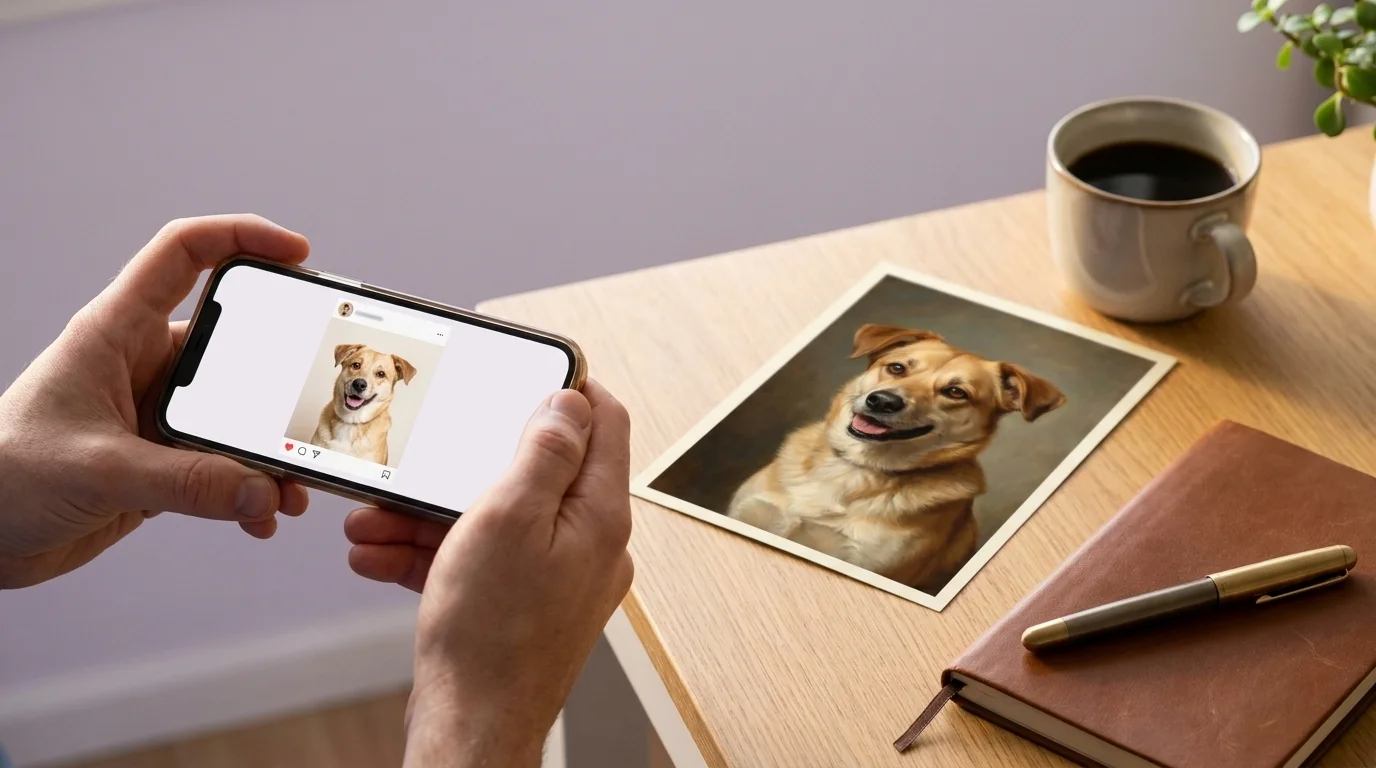
The same period saw AI-generated pet portraiture become a mainstream consumer product, and museums have begun showcasing AI portraits alongside classical works. Some of the output is good. Most of it is the algorithmic equivalent of a sentimental late-Victorian dog painting — competent, sweet, and not particularly observed. The question worth asking, when an AI portrait of your dog comes back from the generator, is the same question the dog asks: who, in this image, is paying attention?
Where this leaves us
The pet population that supports all this — painted, written, filmed, posted, AI-generated — is larger than at any prior point in human history. The American Pet Products Association projects US pet industry spending at roughly $157 billion in 2025, and 51% of US pet owners now describe their pet as a full-fledged family member. The 2025 HABRI/Chewy human-animal bond research made the strongest empirical case yet that this is not sentimentality but a measurable emotional and psychological anchor. The art and the literature and the films and the Instagram posts are downstream of a relationship that has only grown.
The relationship is also, still, the same one van Eyck saw between Mr. and Mrs. Arnolfini and the small dog at their feet in 1434: somebody's animal, somebody's household, somebody worth painting because the painter understood what the animal meant inside the room. The medium changes. The frame does not.
Frequently Asked Questions
Dogs in Renaissance and early Flemish portraits — most famously Jan van Eyck's Arnolfini Portrait (1434) — typically symbolize loyalty and conjugal fidelity, with art historians like Erwin Panofsky and Craig Harbison reading them as part of the painting's 'disguised symbolism.' The dog at the Arnolfinis' feet also signaled the household's wealth and aristocratic lifestyle: small lapdogs were not working hounds but markers of a private domestic life worth painting.
Medieval depictions of dogs and other animals usually weren't aiming for anatomical accuracy. They were drawn from bestiaries — encyclopedic books that used animals to teach theological lessons — so the goal was symbolic recognition (loyalty, watchfulness, the soul recognizing its master), not realism. By the High Renaissance, observed naturalism caught up in works by Titian and Velázquez, but the bestiary tradition lingered in religious painting and is the reason so many medieval dogs go viral as memes today.
Frequently cited canonical literary cats include Lewis Carroll's Cheshire Cat (Alice in Wonderland), Dr. Seuss's Cat in the Hat, Mr. Mistoffelees and the cast of T. S. Eliot's Old Possum's Book of Practical Cats (later staged as the musical Cats), Bagheera in Rudyard Kipling's The Jungle Book, Bill Watterson's Hobbes (Calvin and Hobbes), Judith Kerr's Mog, Crookshanks in the Harry Potter series, and Church in Stephen King's Pet Sematary.
Pablo Picasso painted his dachshund Lump into his variations on Las Meninas and made the etching Cat Catching a Bird (Musée Picasso, Paris). Frida Kahlo featured her own animals — monkeys, parrots, deer — in 55 of her 143 paintings. Andy Warhol made the 1954 artist's book 25 Cats Named Sam and One Blue Pussy. Salvador Dalí kept and painted his ocelot Babou. Henri Matisse worked his cats Coussi, Minouche, and La Puce into his colourful interiors, and Louis Wain dedicated his entire career to anthropomorphic cats.
Search interest in 'medieval dog paintings' has risen roughly 175% year over year through 2025, and there is now an Ugly Dogs in Renaissance Paintings calendar that has shipped 2024 and 2025 editions on Etsy and TikTok Shop. The meme works because medieval painters were working in a symbolic visual vocabulary — bestiary illustration — rather than aiming for anatomical accuracy. Modern pet owners recognize, often correctly, that the strangest medieval dogs have the same alert, slightly worried expression as the dog asleep on their own sofa.
There are now roughly 2 million dedicated pet accounts on Instagram with around 40 billion aggregate followers, and pet-creator posts hit average engagement rates around 5% — two to five times the rate of general lifestyle influencers. 63% of pet owners now follow at least one pet account, and AI-generated pet portraiture has become a mainstream consumer product. Social media is, by raw volume, the dominant creative medium for pet imagery in 2026, sitting in a cultural lineage that runs back through Frida Kahlo, the Arnolfini dog, and the medieval bestiaries.