The Art of Pet Massage: Enhancing Bonding and Well-being Through Therapeutic Touch


The dog who tightens her hip flexors every time she gets up from her bed is usually not the dog her owner thinks she is. Owners describe her as "slowing down," "getting older," "less playful" — and the underlying picture, more often than not, is early osteoarthritis. A 2024 Nature Scientific Reports study found that 39.8% of young dogs already show radiographic osteoarthritis in at least one joint, with clinical signs visible in 16.3–23.6% of them (Anderson et al. 2024). The senior-dog framing of canine pain is the one consumers have been taught. Dog massage — properly framed as a home-tier physiotherapy adjunct, not a spa indulgence — is where the clinical picture has been moving for the better part of a decade.
This is a guide to dog massage as a home-tier physiotherapy adjunct — which is the framing that current veterinary rehabilitation literature has converged on, rather than the spa-day framing of older articles. The peer-reviewed evidence in dogs specifically is real but circumscribed: a 2021 cross-sectional study by Riley and colleagues in Veterinary Record, working with 527 dogs across 65 practitioners and 71 breeds, found significant reductions in all five major pain indicators (gait, posture, daily activity, behaviour, performance) at p < 0.001, alongside significant improvements in quality-of-life scores after a series of massage treatments (Riley et al. 2021, Veterinary Record). That is the strongest single piece of dog-specific evidence we have. The human-RCT literature on massage is much larger, but extrapolation has to be done carefully. Where I cite mechanisms below, I label which ones are well-supported and which ones are reasonable inference.
Pet massage is also a real and growing service category — the pet-grooming market is forecast to grow from $19.5B in 2026 to $46.7B by 2036 (a 9.1% CAGR), with the massage and spa sub-segment growing at the fastest rate of any sub-category (Future Market Insights, 2026). Most readers asking about dog massage in 2026 are not asking for a spa-day suggestion. They are asking how to help their middle-aged dog get up off the floor in the morning.
What the evidence says — and what it does not
The benefit list older articles repeat ("stimulates blood flow, releases endorphins, reduces anxiety, fear, and aggression") is partially supported and partially extrapolated. Here is the honest tier list.
Well-supported in dogs:
- Reduced pain scores and improved quality-of-life ratings after a course of professional massage in dogs with chronic musculoskeletal pain (Riley et al. 2021, n=527, p < 0.001 across all five pain indicators).
- Inclusion of massage as a recognized home physiotherapy tier for canine osteoarthritis (Mille, McClement & Lauer 2022 Physiotherapy Pyramid — environmental modification → exercise → OA-specific home exercises including massage → professional treatment) (PMC9863568).
- Endorsement of massage and passive range-of-motion as owner-deliverable components of multimodal OA care by the AAHA Mobility Matters guidance (AAHA Mobility Matters).
Reasonable extrapolation from human or analogous evidence:
- Improved local circulation and lymphatic flow over the treated area; reduced muscle tension and increased passive range of motion.
- Parasympathetic activation — slower heart rate, lower respiratory rate — during sustained, low-pressure contact, particularly with Tellington TTouch (VCA Hospitals — TTouch Therapy; IVC Journal).
Anecdotal but consistent across clinicians:
- Reduction in behavioral arousal in fearful or shelter-stressed dogs after T-Touch sessions.
- Improved owner-pet bond and easier veterinary handling after sustained gentle-touch training (the clinical observation here is more durable than the trial data).
What dog massage is not: a substitute for veterinary diagnosis, a substitute for pain medication when a dog is in clinical pain, a treatment for cancer, or an "alternative" to surgical or pharmacological therapy. It sits alongside those interventions. The Riley et al. dogs were already under veterinary care.
Techniques — using the right vocabulary
Most consumer pieces call every kind of touch "kneading" and stop there. The actual technique vocabulary matters because each stroke does a different thing and has a different indication.
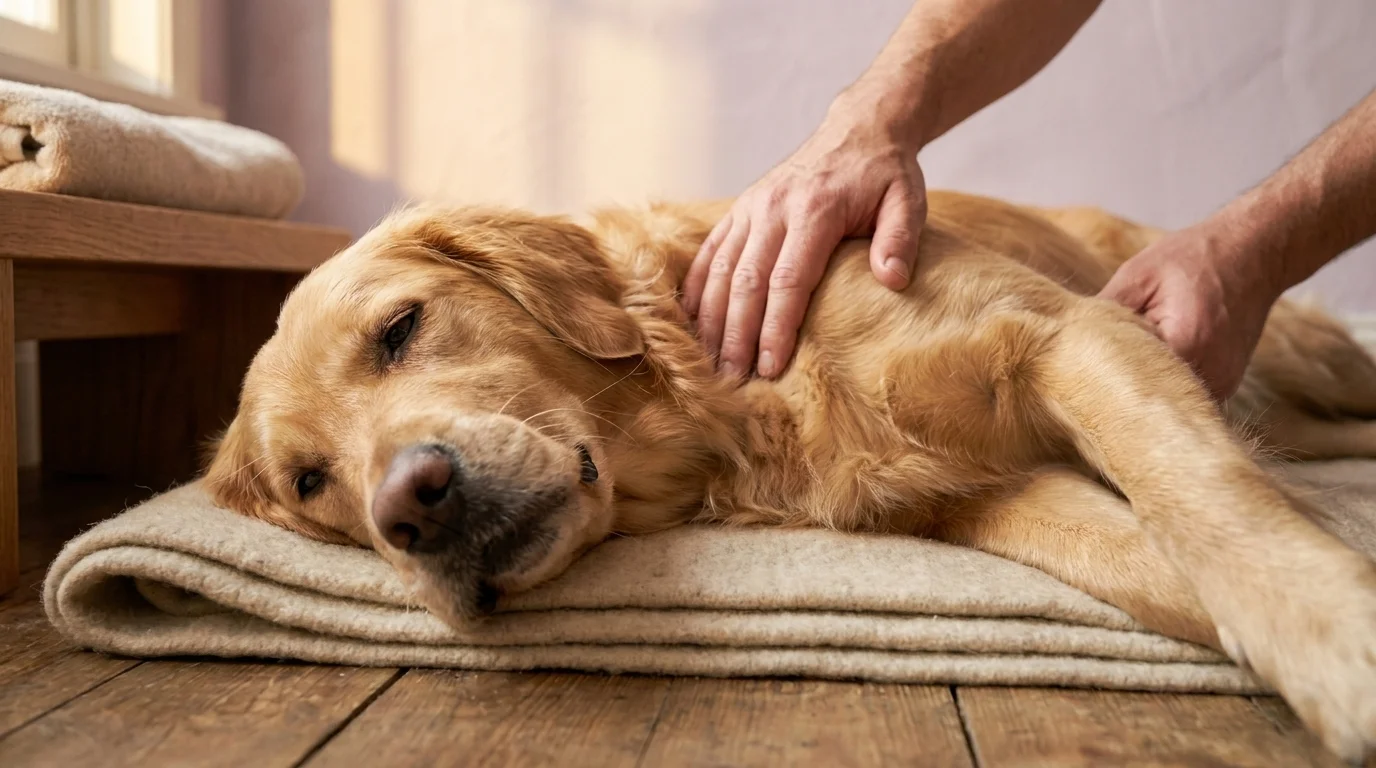
Effleurage is the long, gliding stroke. Light pressure, follows the muscle fiber direction, used to warm tissue at the start and cool it at the end of a session. The opening and closing move of every Swedish-style protocol.
Petrissage — what most articles loosely call "kneading" — is the deliberate lifting and rolling of muscle tissue between the fingers and thumb, applied to the muscle belly, never directly on a joint or a bony prominence. Petrissage is the middle of the session and is where most of the local-circulation and muscle-relaxation effect happens.
Circular friction is small, controlled circles applied to a localized area of tightness — used after petrissage has warmed the tissue, never as a starting move.
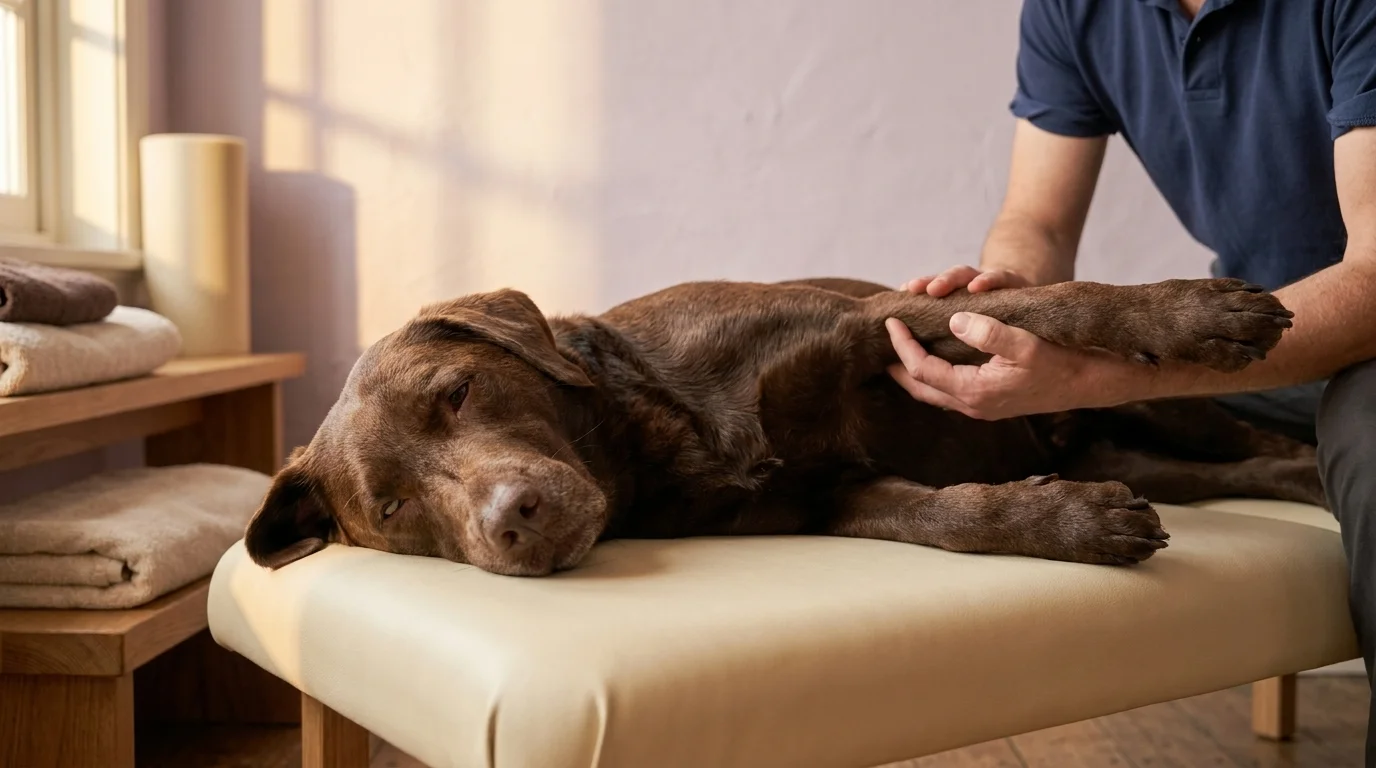
Passive range of motion (PROM) is not strictly massage but is the standard partner to a home OA protocol. The handler supports the limb at the joint above and below the target joint and moves the limb gently through its pain-free range only. PROM is the most likely source of injury if done past the dog's comfort point — stop the moment the dog tenses, withdraws, vocalizes, or licks the area.
Acupressure is a separate modality (Traditional Chinese Veterinary Medicine) that targets named meridian points. It is sometimes integrated into canine bodywork but has its own evidence base and its own credentialing pathway; treat it as adjacent to, not a sub-type of, Swedish-style massage.
Tellington TTouch has its own paragraph below — it is a named, registered method and deserves credit by name.
A simple at-home session structure for a healthy adult dog: 10–15 minutes total, starting with three to five minutes of effleurage along the back and shoulders to warm the tissue, followed by petrissage on the muscle bellies of the thigh, shoulder, and along the spine (avoiding the spine itself), and closing with two to three minutes of effleurage. Keep your hand contact continuous; lift one hand at a time, not both. Watch the dog — if she leans into you, you have the pressure right; if she shifts away or licks her lips repeatedly, the pressure is too much or the location is wrong.
Related Article: CBD for Pets: The Comprehensive Guide to Uses, Benefits, and Risks
Tellington TTouch — credit by name
Linda Tellington-Jones developed the Tellington TTouch Method in the 1970s, originally as a horse-handling discipline and subsequently extended to dogs, cats, and a broader range of companion animals. The foundational stroke is the 1¼-circle clockwise, applied with light enough pressure to move the skin rather than press into the underlying tissue — the technique is intentionally distinct from Swedish-style massage in that regard.
The clinical literature on TTouch is smaller than on Swedish massage but consistent. VCA's clinician-facing page describes TTouch as engaging the parasympathetic nervous system through repeated patterned skin movement, with applications in reducing chemical-restraint need during veterinary handling, easing ear- and mouth-area work, and lowering arousal in fearful dogs (VCA Hospitals; IVC Journal). For shelter dogs and rescues with body-handling sensitivity, TTouch is often the first effective approach because it does not require the dog to accept sustained deep contact — light skin movement is much more tolerated.
You can integrate TTouch with a Swedish-style massage session: 30–60 seconds of TTouch circles on the ear leather, the cheek, or along the spine at the start of a session can take a body-sensitive dog from "tolerating" to "leaning in."
Do not massage if…
Every general dog-massage article should have this section, and most do not. Stop and call your veterinarian if any of the following apply:
- Fever — any massage redistributes blood flow and is contraindicated when the dog is fighting acute infection.
- Post-surgical sites until the surgeon clears them (typically two weeks for routine soft-tissue surgery, longer for orthopedic).
- Open wounds, hot spots, or active infectious skin disease (dermatophytosis, demodex, sarcoptic mange).
- Known or suspected fracture, ligament tear, or acute musculoskeletal injury.
- Suspected blood clot or DVT (rare but real in some breeds and post-surgical contexts) — local massage can mobilize a clot.
- Bloat or any acute abdominal pain — abdominal massage is contraindicated; GDV (gastric dilatation-volvulus) is a surgical emergency.
- Undiagnosed lumps or masses — get the lump aspirated before massaging over it.
- Advanced or active cancer — discuss with the oncologist; massage is not categorically contraindicated, but the answer depends on the cancer type, location, and treatment phase.
- Pregnancy — avoid the abdomen entirely; light effleurage elsewhere is usually fine, but ask your vet.
- Shock, severe dehydration, or any animal who is collapsed or non-responsive — emergency veterinary care, not massage.
If the dog tenses, withdraws, vocalizes, or repeatedly licks the area you are working on, stop. Mid-session lip-licking, yawning, and turning the head away are all displacement signals — they mean the dog is uncomfortable, not relaxed.
Massage for dogs with arthritis — a 5-step home protocol
Osteoarthritis is more common, and earlier in onset, than the older lay literature recognises. UK primary-care data put OA prevalence at approximately 20% of dogs over one year of age, with clinical diagnosis (2.5–6.6%) lagging the actual disease burden (PMC review). The Anderson 2024 data, restated, found radiographic OA in nearly 40% of young dogs sampled. Massage is one component of multimodal OA care, alongside pharmacology (your veterinarian's call), weight management, low-impact exercise, environmental modification (non-slip rugs, ramps), and PROM.
A 5-step home protocol, drawn from the Mille et al. Physiotherapy Pyramid (level 3 — owner-deliverable home physiotherapy) (PMC9863568) and the AAHA Mobility Matters multimodal-care framework (AAHA):
- Warm-up effleurage (2–3 minutes). Long gliding strokes along the back and shoulders, both sides. Soft pressure. The goal is to warm the tissue and signal "this is a calm session."
- Muscle-belly petrissage above and below the affected joint (3–4 minutes). For hip OA, work the gluteal and hamstring muscle bellies. For elbow OA, the triceps and biceps brachii. Never directly on the joint itself. Petrissage releases the secondary muscle tension that builds up around a sore joint.
- Gentle compression around (not on) the joint (1–2 minutes). The whole hand placed gently around the joint, with light, sustained pressure — not rubbing or kneading. This is comfort contact, not deep work.
- PROM through the dog's pain-free range (1–2 minutes, only if the dog accepts it). Support the limb at the joints above and below the target. Move slowly. Stop at the first sign of resistance, withdrawal, or vocalization. PROM past the pain-free range causes injury; this step requires honest reading of the dog.
- Cool-down effleurage (1–2 minutes). Same as the warm-up, ending the session on a calm note.
Total session: 10–15 minutes. Two to three times per week is a reasonable starting cadence for a dog already under veterinary care for OA. The first session should be done after a veterinary appointment in which you have explicitly asked your vet whether home massage is appropriate for this dog at this stage of disease. Some dogs with severe OA, or with referred neurological pain, do better with professional rehabilitation than with home work.
For the back-legs-specifically search (how to massage dogs back legs, +67% trending), the same protocol applies with the focus on the gluteals, the hamstrings (the long muscle group on the back of the thigh), and the gastrocnemius (the calf). Work the muscle belly, not the bony prominences of the hip, stifle (knee), or hock (ankle).
Massage for cats — short, specific, and not the same as dogs
Cats are not small dogs in any clinical context, and this is one of them. The most common error in consumer pet-massage articles is to apply dog-style sustained-contact massage to a cat, who will tolerate roughly 90 seconds of it before lodging a complaint.
A practical cat-massage approach:
- Sessions are short. Five minutes is the upper bound for most cats. Two to three minutes is plenty.
- Focus on the head, cheek, chin, and shoulders. Cats engage in mutual grooming (allogrooming) primarily on the head and neck. That is the zone they recognize as social contact. Belly massage is not in their behavioral vocabulary.
- No restraint, ever. A cat who walks away from a massage session is communicating clearly. Do not pick her up; let her come back when she wants to.
- Slow strokes, with the fur, never against it. Petting against the fur direction is irritating to most cats and reads as confrontation in some.
- No aromatherapy — addressed in detail below. The cat-massage situation is the one where the aromatherapy advice in most older articles is actively dangerous.
- Watch the tail. A loose, slow tail movement is contentment. A flicking tail, especially a tail thumping the ground, is "you have crossed the line." Stop the session.
Cat acupressure exists as a separate modality but is best left to credentialed practitioners; the home-massage value for cats is calm, predictable, social contact on the cat's terms, not a clinical protocol.
Aromatherapy and pet massage — the safety correction
This is the section of every general pet-massage article that needs the most careful handling, and I am going to be direct: the recommendation common in older articles — that you diffuse or apply lavender and chamomile around cats and dogs during a massage session — is wrong for cats, and unsafe even for dogs at concentrations that meaningfully aromatize a room.
The mechanism is settled. Cats lack adequate hepatic glucuronyl-transferase activity to metabolize most essential-oil phenols and monoterpenes, the chemical classes that give essential oils their potency. The ASPCA Animal Poison Control Center specifically names tea tree (melaleuca), citrus, peppermint, eucalyptus, ylang-ylang, pine, and wintergreen as toxic to pets, with concentrated tea tree producing toxicity at as few as 7–8 drops (ASPCA, Essential Oils Around Pets). Clinical signs include unsteadiness (ataxia), depression, low body temperature, vomiting, and diarrhea — and these can appear after inhalation alone, not only after topical application or ingestion.
Lavender and chamomile are less acutely toxic than tea tree, but "less toxic" is not "safe at any concentration around a cat," and the older "calming oils for pets" framing is one of the cleanest cases of human extrapolation gone wrong. A cat groomings concentrated lavender oil out of her fur is not getting the human-aromatherapy effect; she is getting a dose of phenolic compounds her liver cannot clear.
A safe approach to olfactory environment during dog or cat massage:
- Run the diffuser before the pet enters the room, and not during the session. Or simply don't use one.
- Open a window. Quiet, fresh, untreated air is the appropriate olfactory baseline.
- If you specifically want pheromone-based calming, ask your veterinarian about Feliway (cats) or Adaptil (dogs) — these are non-essential-oil synthetic pheromone analogues with veterinary safety data, not aromatherapy products.
- For dogs with high anxiety, the music evidence is real (the Bowman et al. RSPCA kennel-music work, and the Through a Dog's Ear bioacoustic research) — low-tempo classical, reggae, or soft rock at low volume in the room are reasonable; no oils required.
If you suspect essential-oil exposure: ASPCA Animal Poison Control: (888) 426-4435. They can advise on whether the exposure is significant and what to do.
How to find a credentialed canine massage practitioner
The animal-massage profession in the United States is real, regulated in many states, and credentialed by a small set of recognized bodies. If you decide to bring in a professional, the credentials to look for:
- NBCAAM — the National Board of Certification for Animal Acupressure & Massage. The leading certifying body for animal massage in the US, with a practitioner directory.
- IAAMB — the International Association of Animal Massage and Bodywork. Membership organization with a practitioner directory and continuing-education infrastructure.
- CCRT — Certified Canine Rehabilitation Therapist, awarded through the Canine Rehabilitation Institute. Veterinary-rehabilitation credential typically held by DVMs, RVTs, and licensed physical therapists.
- CCRP — Certified Canine Rehabilitation Practitioner, through the University of Tennessee program. Similar scope.
State law varies. Some US states (New York, Ohio, and Florida have explicit Veterinary Practice Act language) require veterinary supervision or referral for animal massage; others permit independent practice with appropriate certification. Verify local requirements before booking — and ask the practitioner directly which certifications they hold. "Trained in massage" is not a credential.
For arthritis, post-surgical recovery, or any condition that warrants more than a wellness session, a CCRT or CCRP working in collaboration with your primary-care veterinarian is usually the right choice. NBCAAM or IAAMB practitioners are appropriate for general wellness work.
Related Article: The Rise of Exotic Pets: Care Tips for Unconventional Companions
When to call your veterinarian
A short decision rule:
- A dog who flinches, withdraws, or licks the same spot repeatedly when touched — pain workup with your vet, not a deeper massage.
- A dog whose movement quality has changed in the last two weeks (stiffer in the morning, slower on stairs, reluctant on jumps) — vet appointment first. The Anderson 2024 data argue strongly that "she's just getting older" is the wrong frame for most stiffness in dogs under seven.
- Acute lameness, swelling, heat in a joint, or a clearly painful response — same-day veterinary visit. Massage is contraindicated until you know what is going on.
- A cat who stops grooming her hind end, becomes reluctant to jump, or hides more — feline osteoarthritis is wildly underdiagnosed in cats over 10. This is a vet conversation, not a massage one.
The honest summary on dog massage in 2026: the evidence base is modest but real, the techniques have names and indications that matter, the safety contraindications matter more than the techniques do, and the aromatherapy advice you may have read elsewhere is the one piece of older content I would ask you to update first. If you take one thing from this article, take that: lavender and chamomile around a cat is not calm. It is exposure.
Frequently Asked Questions
Use a 5-step home protocol (10–15 min total): warm up with effleurage along the back, knead the muscle bellies above and below the affected joint with petrissage, apply gentle compression around (not on) the joint, move the limb through its pain-free range of motion (PROM), and cool down with effleurage. Stop immediately if your dog tenses, withdraws, vocalizes, or licks the area. Start at 2–3 sessions per week, after asking your vet whether home massage is appropriate at the dog's current stage of disease.
The strongest peer-reviewed evidence is Riley et al. 2021, a cross-sectional study of 527 dogs across 65 practitioners and 71 breeds that reported significant reductions in all five pain indicators (gait, posture, daily activity, behaviour, performance) at p < 0.001 and significantly improved quality-of-life scores. The Mille et al. 2022 Physiotherapy Pyramid for canine osteoarthritis names massage as a level-3 home physiotherapy component. Other benefits (improved circulation, parasympathetic engagement, reduced muscle tension) are reasonable extrapolation from human-RCT data.
Around cats, no. Cats lack adequate hepatic glucuronyl-transferase activity to metabolize most essential-oil phenols and monoterpenes, so even diluted application can be toxic. The ASPCA names tea tree, citrus, peppermint, eucalyptus, ylang-ylang, pine, and wintergreen as particularly hazardous; concentrated tea tree is dangerous at as few as 7–8 drops. For dogs, undiluted topical application is not recommended; if you want olfactory enrichment, ask your veterinarian first and use a passive low-concentration diffuser, not topical oils. ASPCA Animal Poison Control: (888) 426-4435.
Look for credentials from the National Board of Certification for Animal Acupressure & Massage (NBCAAM), the International Association of Animal Massage & Bodywork (IAAMB), or veterinary rehabilitation credentials such as CCRT (Canine Rehabilitation Institute) or CCRP (University of Tennessee). NBCAAM and IAAMB maintain practitioner directories. State law varies — some US states (New York, Ohio, Florida) require veterinary supervision or referral for animal massage, so verify local requirements before booking. 'Trained in massage' is not a credential.
No. Cats tolerate touch differently: sessions should be 2–5 minutes maximum, focused on the head, cheek, chin, and shoulders (the allogrooming zones cats recognize as social contact), with slow strokes in the direction of the fur. Avoid belly work, never use restraint, and skip aromatherapy entirely. A cat who walks away is communicating clearly — let her come back when she wants to. Watch the tail: a flicking or thumping tail means stop.
Do not massage if your dog has fever, an open wound or hot spot, a post-surgical site that has not been cleared, a known or suspected fracture, suspected blood clot, bloat or acute abdominal pain, an undiagnosed lump, active or advanced cancer without oncologist clearance, or any sign of shock or collapse. Pregnancy: avoid the abdomen and ask your vet about the rest. Mid-session displacement signals (lip-licking, yawning, turning the head away, lifting the upper lip) mean stop now.