
Technology's Role in Shaping Global Pet Care Practices: Innovations, Challenges, and Risks


The global pet technology market was $15.6 billion in 2025, will reach $19.1 billion in 2026, and is projected to hit $52.9 billion by 2035. Those are the numbers a Bloomberg fund manager sees on a screen. The numbers a pet owner sees at the checkout counter are a $899 connected litter box (Whisker's Litter-Robot 5 Pro), a $250 GPS health collar plus a monthly subscription (Tractive, which acquired its largest competitor, Whistle, in July 2025), a $30-to-$90 video consult with a remote veterinarian (Vetster), a $24-a-month telehealth membership bundled inside a Walmart+ subscription (Pawp), or, for the household that wants to skip the premium tier, a $14 puzzle ball from a regional brand at a big-box pet store. Same category, two different worlds.
The pet technology that has actually shipped in the last two years is more interesting, more specific, and more uneven in who can afford it than the 2023-era "wearables and apps" framing usually admits. What follows is a 2026 audit of what is real, what is real but overhyped, what is real and underpriced, and what the rest of the pet-tech industry would rather you not ask about the data your connected feeder is sending home.
Wearables 2.0: from location to vitals
The pet wearables category was, until about 2023, a three-horse race between Fi, Tractive, and Whistle for the GPS-tracker market — small, expensive devices that told you where your dog was. That race ended last summer. Tractive acquired Whistle in July 2025, and Whistle's app support was discontinued in August 2025, collapsing the consumer GPS-collar space into a two-horse race between Fi (Series 3) and Tractive — with a long tail of regional brands underneath. The acquisition got minimal coverage in the consumer-tech press. It is the kind of consolidation a business reporter notices because it tends to precede price increases, subscription-tier reshuffles, and a quiet shift in which features get prioritized for whose business case.
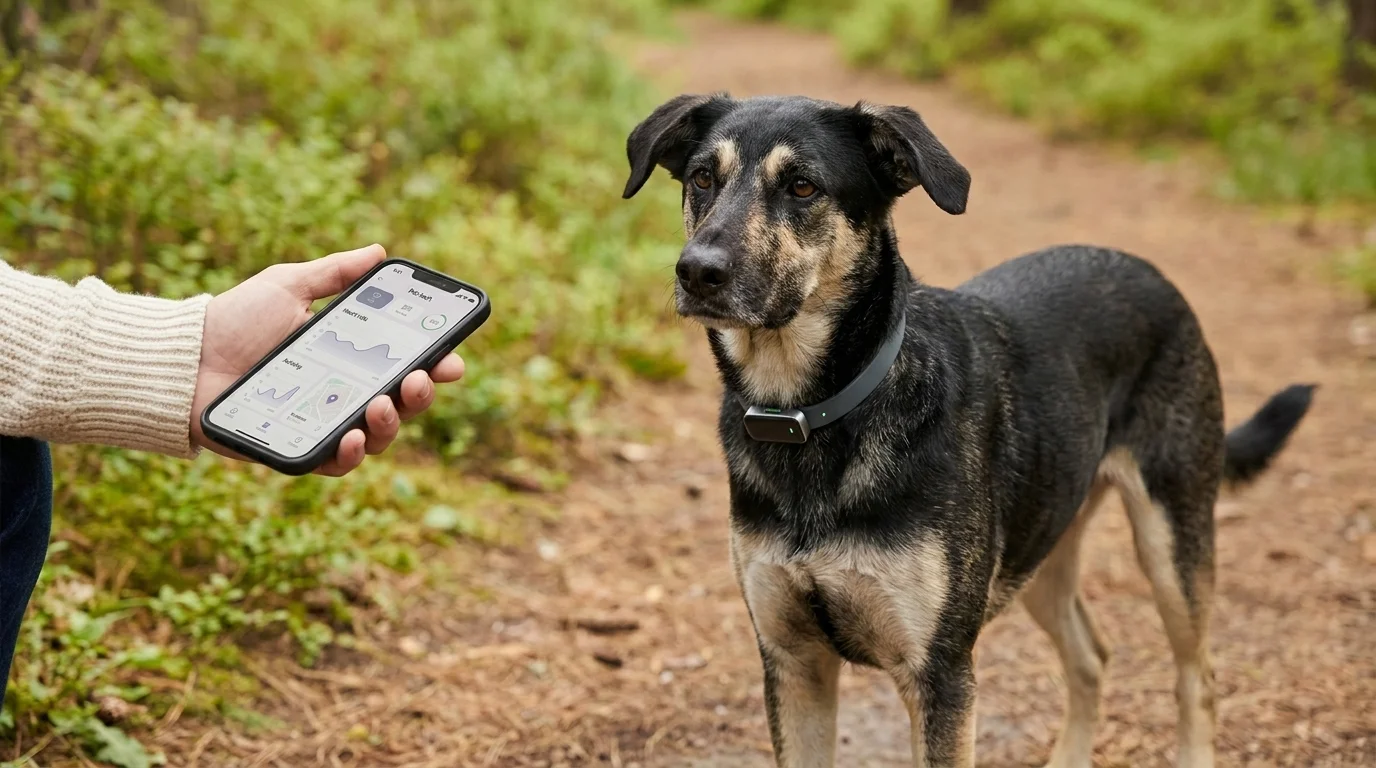
The other thing that happened in that same window is more substantive than the consolidation. Tractive added resting-heart-rate, respiratory-rate, scratch, and bark monitoring to its GPS collars, pushing the wearables category past pure location and into continuous vital-signs telemetry. PetPace has been doing health-collar telemetry for years; what's new is that the volume players (Tractive in GPS, Fi in fitness) are now both shipping vitals data, which means the category's pricing logic has shifted. Customers are no longer paying $150 for a GPS-only device and a separate $200 for a health monitor — they are paying $250-plus for a single device that does both, plus a $5-to-$15 monthly subscription to keep the cellular link alive.
The pet wearables market, valued at $3.27 billion in 2023, is projected to reach $11.25 billion by 2032. The category-leading "smart dog collar" search term sits around 9,900 monthly searches; "dog gps collar" pulls 27,100; "gps pet tracker" 8,100 and growing 22% year over year. The growth is real. The question worth asking at the checkout — and the question very few of the product roundups online will ask for you — is whether you actually want a third party storing your dog's heart rate and walking routes on their servers, and what happens to that data if Tractive itself is acquired in the next cycle. Whistle's app shutdown gave its 2025 users about thirty days of notice.
Smart feeders become the breakout category
Of every pet-tech subcategory tracked by US Google search data, smart pet feeders are the breakout: search volume up roughly 233% year over year against a 1,600/mo baseline, and US automatic-feeder sales surged 66% year over year on the consumer-electronics side. The category is now $1.56 billion in 2025 with consensus projections pointing to $2.35 billion by 2030 at an 8.46% compound annual growth rate; the more aggressive analyst models project closer to $3.5 billion by 2030 at a 12.3% CAGR.
What is different about the 2025-2026 smart feeder is not the dispensing mechanism. It is the integration. PETKIT, Whisker, Petlibro, and Sure Petcare's Wi-Fi-connected feeders all now pair with the same brand's water fountain, camera, or litter box; pet biometrics (weight, body condition, age) drive AI-personalized portion-size suggestions; and at CES 2026 the category-defining announcement was PETKIT's "wet-food revolution" — chilled wet-food smart dispensers as a new product class, targeting the segment of the dry-food-dominant US market that has been gradually shifting to fresh and wet food over the last five years.
For the household with two cats on different prescription diets, a smart feeder with per-pet RFID or facial-recognition access control solves a real problem. For the single-cat household that already feeds twice a day, the premium connected feeder solves a problem the basic mechanical timer already solved. The category is genuinely useful where it is useful, and the marketing makes it look universally useful, which it is not.
Vet telehealth as access infrastructure, not convenience
The way most consumer-tech sites cover pet telehealth — Vetster, Pawp, Dutch, Airvet — is as a convenience play for busy owners who would rather not drive to the clinic. The number that should reframe that conversation is from a 2025 industry report: 129 million Americans live in what veterinary access researchers call "vet deserts" — geographic areas with little or no in-person veterinary access, often rural or peri-urban, where the nearest after-hours emergency clinic can be a 90-minute drive. For the substantial share of US pet owners who live inside those vet-desert geographies, telehealth is not a convenience layer on top of an existing vet relationship. It is increasingly the only realistic access layer.
The market data tracks the reframe. The US veterinary telehealth market was $92.33 million in 2024 and is projected to grow at a 20.58% compound annual growth rate to $600 million by 2034 — one of the fastest-growing segments in the entire vet-care economy. Pricing makes the access argument tangible. Vetster runs $30 to $90 for a 20-minute video consult, charged per visit. Pawp runs $24 a month for unlimited 24/7 chat, plus a $3,000 emergency-care fund covering up to six pets in the household, once Pawp's vet team confirms a life-threatening issue. Distribution is moving from startup direct-to-consumer to retail bundling: Walmart now includes Pawp telehealth in its Walmart+ subscription, and Chewy crossed 1 million virtual vet consults in March 2025.
The fine print that does not appear in most pet-telehealth product reviews: telehealth services handle triage, follow-ups, mild dermatological issues, behavioral consults, and prescription refills well. They cannot diagnose or treat acute emergencies, and Pawp's $3,000 emergency fund is paid out only after a Pawp veterinarian has confirmed the case is genuinely life-threatening and the pet owner has used a Pawp-affiliated emergency clinic. Telehealth complements the in-person clinic. It does not yet replace it. The 2026 telehealth question worth asking your service provider, before you subscribe, is what their emergency-handoff protocol is in your specific zip code.
AI vet diagnostics: what it can and can't do yet
The fastest-growing keyword cluster in pet-tech search at the start of 2026 is "ai veterinary," with search interest up roughly 50% year over year off a small base, and the AI-powered veterinary diagnostics market is projected to reach $4.05 billion by 2029. The accuracy headline that the AI-vet vendors lead with is also real: commercial AI radiology platforms now report 95% or higher accuracy versus board-certified veterinary radiologists for common radiographic findings on standard canine and feline imaging tasks. The technology has, by every honest measure, arrived.
The fine print buried inside the peer-reviewed literature is the part the vendor marketing usually skips, and it is the part owners should ask about before they trust an AI radiology result delivered through a clinic portal. A 2025 review in Wiley's Veterinary Clinical Pathology and a 2025 review in Frontiers in Veterinary Science both arrive at the same nuanced conclusion: current commercial AI matches or exceeds board-certified human radiologists at identifying normal studies and at flagging specific, well-trained-on findings, but it is not yet sufficient for differential diagnosis on complex, multi-pathology, or rare-presentation cases. A head-to-head comparison published through the National Center for Biotechnology Information compared commercial AI software to veterinary radiologists across canine and feline studies and found the same pattern: AI is excellent at the parts of the work that are pattern-recognition-heavy and standardized, and inadequate at the parts that require clinical judgment integrating history, exam findings, and conflicting signals.
What this means for an owner sitting at the clinic when the vet says "the AI flagged something on the x-ray": the AI's output is a screening signal, not a diagnosis. Ask whether a licensed veterinarian (ideally a board-certified radiologist for non-trivial findings) has reviewed the same study. Ask which AI platform was used, and what its published accuracy is for the specific finding in question. The AI doing the screening work is real and useful. The vet in the loop is non-negotiable, and the peer-reviewed literature is unanimous on that point.
The connected pet ecosystem becomes the 2026 framing
The story the pet-tech industry was telling in 2022-2024 was about smart gadgets. The story it began telling at CES 2026 is about ecosystems. PETKIT debuted an AI ecosystem at CES 2026 that ties feeders, water fountains, litter boxes, and cameras together into a single pet profile and aggregates "long-term data on each pet's hydration, nutrition and litter box behavior" — the explicit pitch is predictive, not reactive. The device that flags a sudden drop in your cat's water intake last Tuesday is doing the same job, structurally, that a continuous glucose monitor does in human health: catching the drift before the symptom.
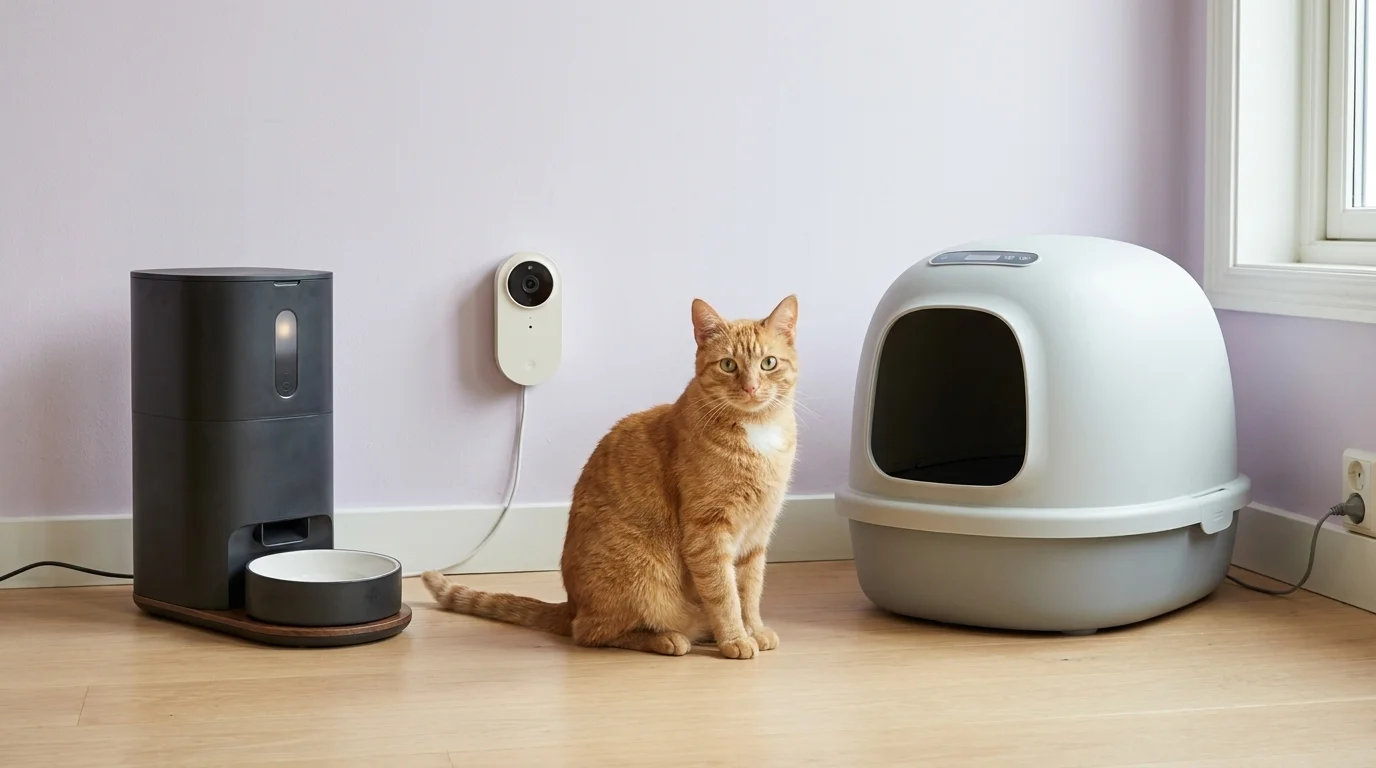
Whisker — the parent company behind Litter-Robot — made the same architectural pivot a year earlier with the Litter-Robot 5 lineup, priced at $599 (EVO), $799 (5), and $899 (5 Pro). The 5 Pro is the device worth pausing on. It ships with two AI cameras — one for per-cat facial recognition, one for an interior litter-bed view — plus WasteID waste classification (urine vs feces, plus volume estimation). For a single-cat household, this is a $899 self-cleaning litter box. For a multi-cat household where one cat is being monitored for early kidney disease, it is the first mainstream consumer device that turns litter behavior into a continuous clinical data stream. Same hardware, two different value propositions, separated by which cat lives in your home.
Consumer search interest in "pet technology companies" — small in absolute volume but up roughly 29% year over year through 2025 — reflects the shift readers are making from "which gadget should I buy" to "which platform should I commit to." The ecosystem question is the right one to ask, because every device that joins an ecosystem is a device whose data you are committing to a single vendor's cloud. Which brings us to the next section.
Privacy, data ownership, and the regulatory gap
Most pet-tech privacy coverage in the consumer press treats the topic in a generic "data is sensitive" register that does not distinguish between the categories of data being collected and who actually controls them. The honest version, drawn from the Frontiers in Veterinary Science 2026 review on the ethics of AI in veterinary medicine, is that there are three overlapping questions, and the answers vary by device and by jurisdiction.
The first question is who owns the data your connected feeder, GPS collar, or AI radiology session generates. The default answer in most consumer-grade pet-tech terms of service is that the manufacturer does, with a license back to you to use the device's app. The second question is what happens when the manufacturer is acquired, goes out of business, or pivots: Whistle's August 2025 app shutdown is the clean recent example — the data those users had accumulated was retrievable for a thirty-day window, and after that, it was gone. The third question is whether the data ever flows back to your veterinarian's medical record, and the answer for almost all consumer-grade pet-tech is no — your vet sees what you choose to show them, manually, in the appointment. There is no interoperability standard between consumer pet-tech and veterinary practice-management software, and there is no regulatory body that requires there to be one.
For the AI-vet diagnostic systems used inside clinics, the data-ownership picture is different and clearer: the clinic's electronic medical record system holds the data, the AI vendor processes it under a business associate agreement, and the pet owner has documented disclosure rights under most state veterinary practice acts — meaning the owner can ask the clinic in writing whether an AI was used in their pet's diagnosis. Most owners never ask. They are entitled to.
The regulatory framework around pet-tech privacy is, in the most polite possible reading, evolving. Until the framework catches up, the practical guidance is to read the terms of service before connecting a new device to the family Wi-Fi, and to assume that any data your pet generates is, at minimum, available to the manufacturer for analytics, product development, and potential sale to third parties under "anonymized" labels whose anonymization standards are themselves unaudited.
Related Article: Harnessing Technology: Smart Solutions for Pet Care and Monitoring
The pet-tech affordability gap nobody is naming
Every pet-tech roundup that ranks on the first page of Google in 2026 treats the category as if affordability were a personal-budget question. It is also a structural one, and it is widening fast. Premium GPS health collars run $100 to $300 in hardware plus $5 to $15 monthly service fees. Premium connected litter boxes run $599 to $899 in hardware plus optional membership tiers. AI vet telehealth runs $24 a month at the budget tier and $30-90 per visit at the pay-per-use tier. The cumulative cost of a fully connected pet-tech setup — feeder, water fountain, litter box, GPS collar, telehealth subscription — clears the four-figure mark in hardware and runs into hundreds of dollars a year in recurring fees.
Outside the United States, the gap is more visible. In Brazil — the world's second-largest dog population — 68% of pet owners surveyed prioritize affordability as their primary purchase factor, and the cheapest interactive pet toys retail in the $14-to-$20 range while premium AI gear sits at $300-plus. The structural reality is that the wellbeing benefits the pet-tech industry markets — early disease detection, better nutritional adherence, reduced stress through environmental enrichment, faster access to a veterinarian — are increasingly real, and increasingly concentrated in the household income brackets that can afford the hardware-plus-subscription bundle. The pet-tech industry is producing genuine clinical value. The distribution of that value is not equitable, and the affordability gap is the part of the story the marketing departments would rather you not put in the headline.
The under-asked question for the next several years of pet-tech policy and regulation is whether veterinary-grade pet-tech features — continuous vital monitoring, AI-flagged diagnostic screening, telehealth access — should remain priced as consumer luxury goods or be regulated, subsidized, or insurance-covered the way comparable human-health tech increasingly is. The HSA/FSA eligibility conversation around veterinary care is the early version of that question. It will get larger.
Where this leaves the 2026 pet owner
The state of pet technology at the close of the first quarter of 2026 is genuinely impressive, genuinely uneven, and genuinely under-scrutinized. The wearables are smarter, the feeders are bigger business, the telehealth is moving toward access infrastructure rather than convenience, the AI diagnostics are real but require a vet in the loop, the ecosystems are consolidating around two or three platform vendors, and the affordability gap is widening at the same time as the clinical value is growing.
The receipts a careful pet owner should keep in 2026, in order of decreasing urgency, are these: read the terms of service before connecting any pet-tech device to your home network and find out who owns the data. Confirm with any AI-using clinic that a licensed veterinarian has reviewed every AI-flagged finding before treatment decisions are made. Ask any pet-telehealth service for its specific emergency-handoff protocol in your zip code before you subscribe, not after. And keep in mind that the technology that does the most for your animal — the technology of the daily walk, the hand on the side of the rib cage to check for breathing rhythm, the visual scan of the litter box every morning — predates the entire $19.1 billion market and is still free.
Frequently Asked Questions
The global pet tech market is projected at $19.1 billion in 2026, up from $15.6 billion in 2025, and is on track to reach $52.9 billion by 2035 according to Global Market Insights. Growth is concentrated in four subcategories: smart feeders (up roughly 233% year over year on search volume, $1.56B market size projected to reach $2.35B by 2030), GPS health collars (the category that absorbed the standalone health-monitor segment after Tractive acquired Whistle in July 2025), AI veterinary diagnostics (projected $4.05B by 2029), and vet telehealth (US market growing at a 20.58% CAGR to $600M by 2034).
Commercial AI radiology platforms report 95% or higher accuracy versus board-certified veterinary radiologists for common radiographic findings. However, 2024-2025 peer-reviewed reviews in Wiley's Veterinary Clinical Pathology, Frontiers in Veterinary Science, and through the NCBI are unanimous that a licensed veterinarian is still required for differential diagnosis and complex multi-pathology cases. AI matches humans on identifying normal studies and on pattern-recognition tasks it was trained on; it is not sufficient for cases that require clinical judgment integrating history, exam findings, and conflicting signals. AI augments the vet's work — it does not replace it.
A connected pet ecosystem links multiple smart devices — feeders, water fountains, litter boxes, cameras, GPS collars — into a single AI-driven view of a pet's hydration, nutrition, activity, and waste patterns. PETKIT's CES 2026 AI ecosystem and Whisker's Litter-Robot 5 Pro lineup (with WasteID waste classification and per-cat facial recognition) are the two clearest 2026 examples. The architectural shift is from single gadgets to predictive multi-device health intelligence — the same logical pattern as a continuous glucose monitor in human health, catching the drift before the symptom appears.
No, not directly. Pet telehealth services (Vetster, Pawp, Dutch, Airvet) handle triage, follow-ups, behavioral consults, and prescription refills well. They cannot diagnose or treat acute emergencies. Pawp's $3,000 emergency-care fund is paid out only after a Pawp veterinarian confirms a life-threatening case AND the owner uses a Pawp-affiliated emergency clinic. Telehealth is increasingly important as access infrastructure — 129 million Americans live in 'vet deserts' with little or no in-person veterinary access — but in-person emergency clinics remain the only solution for acute crises. Ask any pet-telehealth service for its specific emergency-handoff protocol in your zip code before subscribing.
Most consumer-grade pet tech ships with terms of service that grant the manufacturer ownership of the data the device collects, with a license back to the owner. There is no interoperability standard between consumer pet tech and veterinary medical records, and the data does not flow back to the clinic unless the owner manually shares it. The cleanest recent example of the risk is the Tractive acquisition of Whistle in July 2025 — Whistle's app was discontinued in August 2025, and accumulated user data was retrievable for thirty days before being deleted. The 2026 Frontiers in Veterinary Science review on AI ethics flagged data ownership, transparency, and regulatory gaps as the three biggest open problems in the category.
Premium GPS health collars run $100-$300 in hardware plus $5-$15 monthly service fees. Connected litter boxes run $599-$899 (Whisker's Litter-Robot 5 lineup is the category reference). AI vet telehealth runs $24/month at the budget tier or $30-$90 per visit. A fully connected setup — feeder, water fountain, litter box, GPS collar, telehealth subscription — clears $1,500 in hardware and approaches $400/year in fees. Globally the gap is starker: in Brazil, 68% of pet owners prioritize affordability and the cheapest interactive toys retail at $14-$20 while premium AI gear sits at $300+. The clinical benefits pet tech markets are real; their distribution is not equitable, and the HSA/FSA-eligibility conversation around veterinary care (via the proposed People and Animals Wellbeing Act) is the early version of the policy question that follows.