


Premium is the most expensive word on a bag of cat food, and it is the only word on the bag that nobody has to earn. There is no legal definition of premium cat food. No agency certifies the word. No standard sets a bar it has to clear.
Let me be straight about my seat at this table. I am a cat behavior consultant, not a veterinary nutritionist. I do not formulate diets, and I will not pretend to tell you which protein percentage buys your cat another year. What I have is years of reading labels across people's kitchen counters, usually while the cat in question sits on the bag, magnificently indifferent to what it cost.
The timing is worth noting. Cat ownership reached 39% of US households in 2025 — roughly 53 million homes, up 8.2% in a year, led by Millennials and Gen Z. Google's own search data has interest in this term running near three times last year's level. An enormous number of people are upgrading their cat's dinner right now, and almost nobody is telling them that the word driving the upgrade means nothing on its own.
So: the skill first, then the picks. By the end of this you should be able to judge any bag in the aisle without me standing next to you.
What Is Considered Premium Cat Food?
Premium cat food is moisture-rich, built on named animal proteins and organ meats with no artificial fillers or by-products — but "premium" isn't a legal label.
That is the definition the market has converged on, and it is worth knowing because it is the one you are being sold. Google's AI summary of this query describes premium food as moisture-rich, high-protein animal ingredients and essential organ meats, excluding artificial fillers and by-products, then points at Ziwi Peak, Orijen and Tiki Cat as its reference points. Cats.com, which actually tested its picks rather than ranking them from a desk, frames the same idea as high-quality protein because cats are obligate carnivores, low carbohydrate, adequate moisture, and no animal by-products or vaguely-specified "meat and bone meal."
Call it premium, call it luxury cat food, call it super-premium. The words are doing marketing work, not regulatory work.
Here is the part that matters, and the reason this article exists: every word of that definition is aspirational. It describes what premium food tends to look like when the manufacturer means it. It is not what the label is required to mean. Nothing forces the word and the contents to match, which is why a genuinely excellent bag and a mediocre bag can carry the same claim at the same price and you cannot tell them apart from the front panel.
You tell them apart from the back panel. That is a skill, it takes about sixty seconds, and it is more useful than any brand list I could hand you — including the one further down this page. For more on the fundamentals underneath it, our feline nutrition guides go deeper.
Why "Premium" Isn't a Legal Label — What Actually Makes Food Premium
Most people assume AAFCO — the body whose name appears in small print on nearly every bag — is standing behind that word. It isn't, and it says so itself. From AAFCO's own consumer guidance:
"AAFCO does not regulate, test, approve or certify pet food. It establishes model language that states and other governing bodies may adopt into law."
That is AAFCO describing its own role, on its own website. It writes model language. States adopt it. Nobody in that chain is grading your cat's dinner against the word on the front.
Forbes Vetted puts the sharper edge on the same point: "AAFCO does not differentiate between nutrient sources." Sit with that one. The standard counts the nutrient, not where it came from. Two foods can hit an identical protein minimum from very different starting material and the standard treats them as equals. The label bar is a floor. It was never a quality ranking, and it was never meant to be read as one.
So what actually separates premium food from premium-priced food? Four things, and they are all legible from the back of the bag:
- A named meat as the first ingredient. Not "meat," not "poultry" — chicken, turkey, rabbit, tuna.
- High animal protein, low carbohydrate. Cats are obligate carnivores: solitary hunters built to eat many small animal-protein meals a day, not grazers built for starch.
- Adequate moisture. My read of the ethology — offered as that, not as a citation — is that a cat is built to take most of its water in its prey rather than from a bowl beside it.
- Organ meats, and no vague meals. Named organs are a good sign. "Meat and bone meal" tells you the manufacturer either doesn't know or won't say.
None of that is my invention — it is the criteria set cats.com and the better guides converge on, and I am reporting it rather than ruling on it. What I will rule on is the framing: judge the bag, not the buzzword. Every guide in this category hands you a list of brands to trust. Almost none teaches you the test, which is strange, because the test outlives the list.
How to Read a Cat Food Label
Turn the bag around. Three panels matter, in this order.
The ingredient list. AAFCO's label guidance is explicit: "Ingredients must be listed in descending order according to their weight. The first ingredient listed is the one that accounts for the most weight in a product." So the first ingredient is not a marketing choice, it is a measurement. If it is a named meat, the bag is telling the truth about what it mostly is. If position one is corn, the picture on the front is decorative.
The guaranteed analysis. Four guarantees are required: minimum crude protein, minimum crude fat, maximum crude fiber, maximum moisture. Note the words minimum and maximum. These are boundaries the food promises not to cross, not a nutritional portrait — and for high quality cat food, the protein minimum is the number worth comparing across bags.
The nutritional adequacy statement. This is the fine print that does the heaviest lifting, and it deserves its own section.
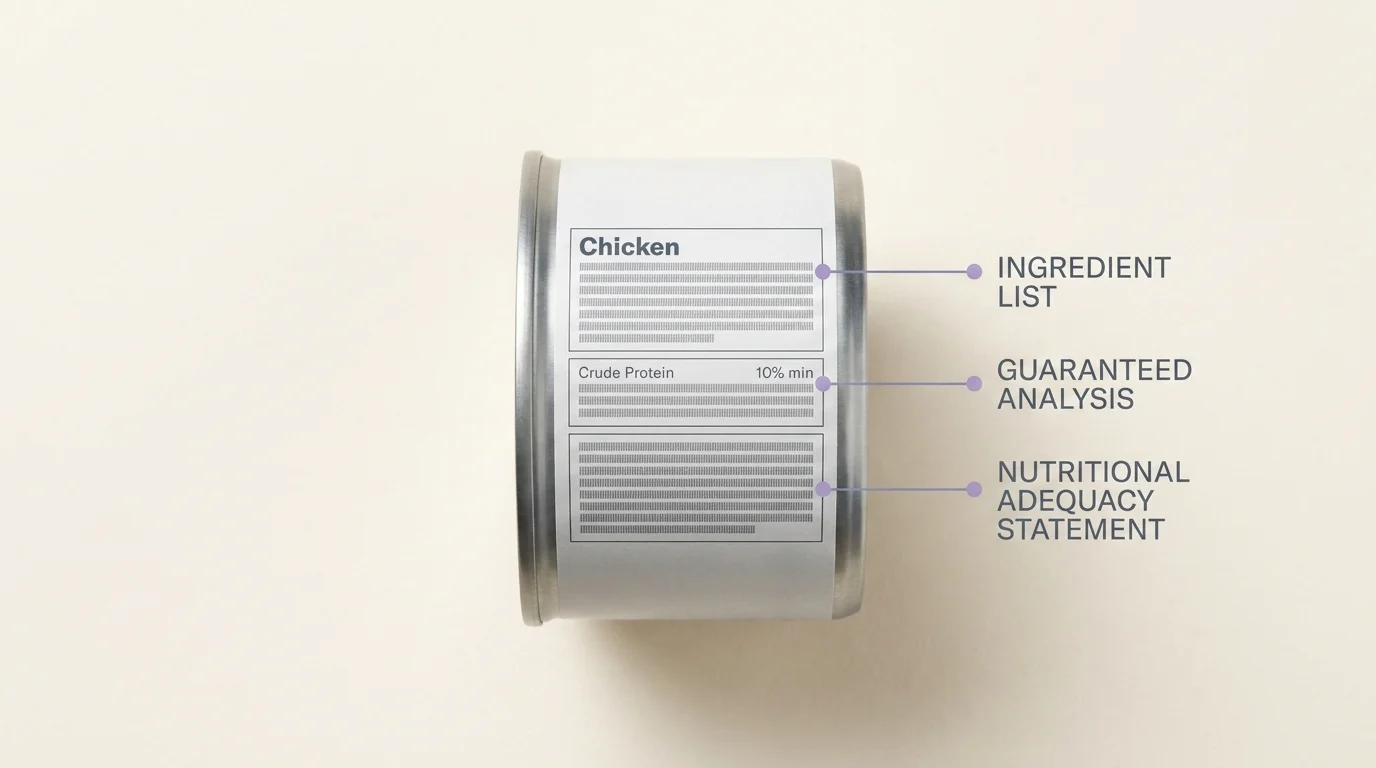
The AAFCO "complete and balanced" statement — what it does and doesn't promise
AAFCO defines the terms narrowly: "complete" means the product contains all the nutrients required, and "balanced" means those nutrients are present in the correct ratios. The statement also names a life stage, and AAFCO recognises four — gestation/lactation, growth, maintenance, and all life stages — because "different quantities and ratios of nutrients are necessary for different life stages."
What it promises: this food will not leave your cat short of a required nutrient, for the life stage named.
What it does not promise: quality, sourcing, digestibility, or that the food is worth its price. Forbes Vetted is admirably plain that its recommendations are "certified to meet the guidelines... set by the Association of American Feed Control Officials (AAFCO)... meaning they meet the minimum standards." Minimum standards. Passing the floor is a pass, not a distinction.
So the sixty-second checklist: named meat first, protein minimum you can compare, complete-and-balanced statement matching your cat's actual life stage. Then the red-flag scan — unnamed by-product meal, corn and wheat and soy carrying the bulk, artificial colours. In that order.
Brands & Ingredients to Avoid — and the 2026 Recall-Safety Check
The standard avoid-list runs: unnamed by-product meal, corn/wheat/soy fillers, artificial colours and preservatives like BHA and BHT, and thickeners like carrageenan.
Now let me label the evidence on it honestly, because nobody else in this category will. The case against unnamed by-product meals and heavy carbohydrate load rests on something real — cats.com's criteria are built on obligate-carnivore physiology, and "we won't tell you what animal this came from" is a sourcing answer, not a nutrition one. The case against carrageenan and BHA/BHT looks weaker to me than the internet's confidence suggests — my read is that it's consensus running ahead of published evidence, and I'll flag that as my read rather than dress it up as a finding. I avoid them and I would not argue hard with someone who doesn't, and you should be suspicious of any guide that presents those two tiers of claim at the same volume.
You will notice I have not given you a brands-to-avoid blacklist, and I am not going to. The brand is not the unit of analysis. The formula is. The same manufacturer will sell you a superb named-meat pâté and a corn-first bargain line under one logo, and the worst wet cat food in the aisle is usually not a villainous brand — it is a cheap formula from an ordinary one.
But there is a second axis the buyer's guides ignore entirely, and it is the one I would actually check.
Fresh, frozen and refrigerated food made up about 7% of dog and cat food sales in 2025 and is projected to grow 15–20% a year — the fastest-growing corner of "premium." It is also the tier 2026's recalls hit hardest. Go Raw LLC expanded a February 17, 2026 voluntary recall to add lots of Quest Cat Food Chicken Recipe for low thiamine — vitamin B1, which matters because cats cannot synthesise enough of it themselves. The FDA logged three further pathogen-related recalls (Salmonella and E. coli) across raw and minimally processed pet food in 2026.
If your cat has been eating a recalled lot, that is a phone call to your veterinarian today — not a question for a forum, and not something this article can assess. AAFCO says the same thing about itself, incidentally: its officials "are not practicing veterinarians," and it tells owners of sick pets to seek veterinary care immediately. I am not one either. A buyer's guide can help you shop. It cannot examine your cat.
How to check a brand's FDA recall history in 60 seconds
Go to the FDA's Recalls & Withdrawals listing for animal and veterinary products and search the brand name. That is the whole procedure.
One honest caveat, because it changes how much the answer is worth: the FDA's listings stay live for about three years before moving to its archive, which you can search by product, company and year. So "never recalled" is a claim almost nobody can actually verify from the public record — what you can verify is recently clean. Treat any guide that prints a confident lifetime "never recalled" badge, this one included, as telling you less than it appears to.
Best Premium Cat Food by Type (2026 Picks)
Here is what these picks are, and what they are not. I have not tested these foods. I am a behavior consultant — the honest thing I can offer is a synthesis of the sources that did test, plus who says so, so you can weigh the recommendation against its origin. Every one of them still has to pass the back-panel test above, on the specific formula you pick up.
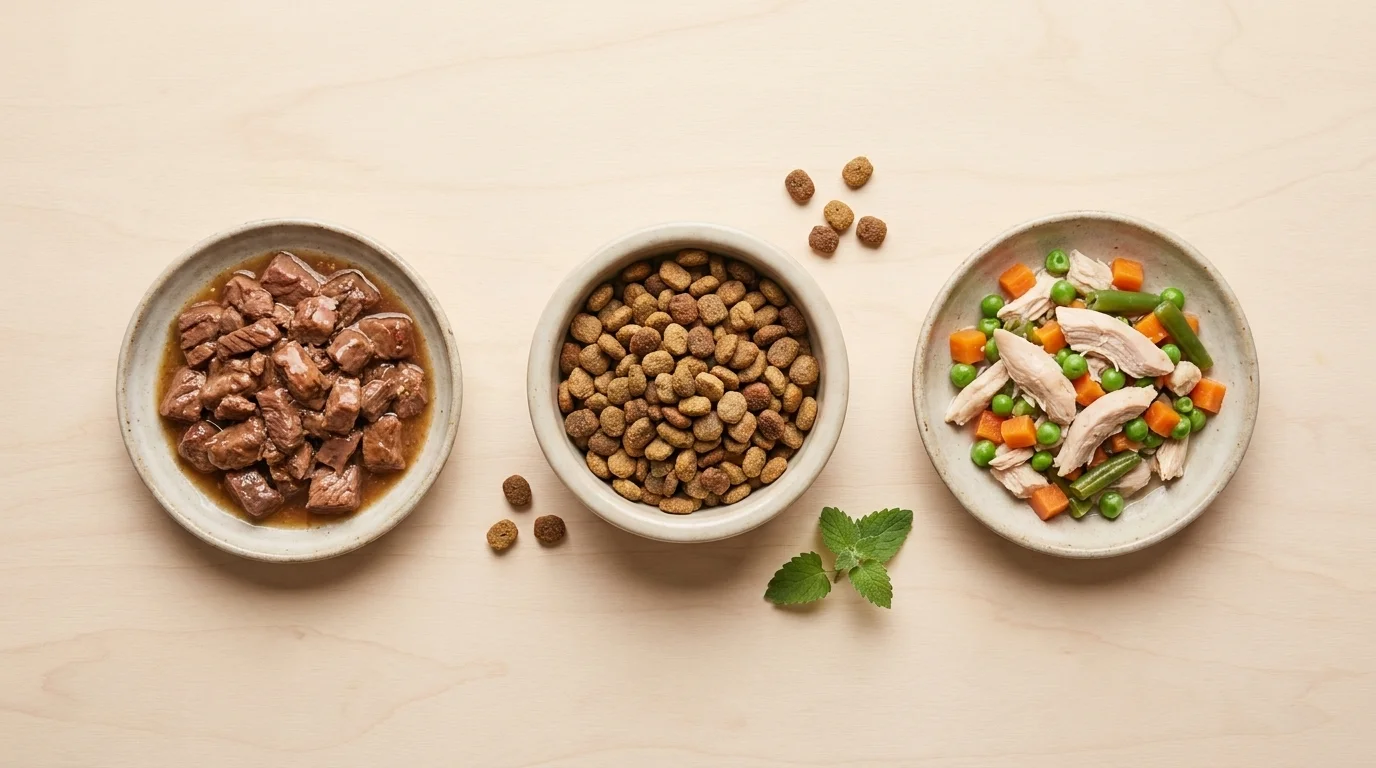
Best premium wet cat food
Tiki Cat — named in Google's AI summary alongside Ziwi and Orijen, carried on Chewy's premium list, and one of the two names that recurs in r/CatAdvice threads. Weruva — also on Chewy's premium list. Wellness CORE — recurs across essentially every guide in this category. Moisture is the reason this format leads: it is the one nutritional argument where the ethology and the marketing happen to point the same direction.
Best premium dry cat food
Orijen — Forbes Vetted's named pick, on Chewy's premium list, and named in the AI summary. Instinct — worth knowing that thecatfoodguy ranks its wet food first, so the brand's reputation crosses the wet/dry line. Solid Gold — a recurring name on the table-stakes lists. Premium dry buys convenience and cost-per-day. It does not buy moisture, and no amount of price fixes that.
Best premium fresh / air-dried cat food
Ziwi Peak — air-dried, and cats.com's number one after hands-on testing. Smalls — cats.com's fresh callout, and the brand one rival premium guide builds itself around. Raised Right and The Honest Kitchen also recur in this tier. Read the previous section before you buy here: this is the fastest-growing premium format and the one 2026's recalls concentrated in. That is not a reason to avoid it. It is a reason to check the lot.
Best premium kitten food
I am not going to name a kitten brand, because the research behind this article doesn't support one and the criterion is the answer anyway. Turn the bag over and read the life stage on the nutritional adequacy statement. It must say growth or all life stages. If it says adult maintenance, it is the wrong food for a kitten no matter what the front says or what it costs. A brand is not a formula — check the tin in your hand.
Best premium food for indoor cats
Tiki Cat Born Carnivore Indoor Health is the natural anchor here, and it is genuinely under-served in the premium lane. But this is my actual field, so let me be blunt: "indoor" is a marketing segment before it is a nutritional category. An indoor cat's usual deficit is not the recipe — it is a missing predatory outlet, no vertical territory, and food that arrives in a bowl without ever being worked for. A hunting-style feeder and ten honest minutes of wand play most evenings will do more for an indoor cat than switching to the indoor formula of the same food.
Premium Cat Food Comparison Table
A note on what is missing from this table, because the omission is the point. I have not printed first ingredients or protein percentages, because formulas change and the only number that counts is the one on the bag in your hand today. I have not printed per-brand daily costs, because the sourced figures behind this article are a category range, not a per-brand spec sheet, and I would rather leave a cell empty than fill it with a plausible number. And the recall column reports what my sources establish — not a lifetime guarantee the FDA's own three-year archiving window makes uncheckable.
| Brand | Format | Why it recurs | Recall record in these sources |
|---|---|---|---|
| Ziwi Peak | Air-dried | cats.com's #1 after hands-on testing; named in Google's AI summary; recurs on r/CatAdvice | Listed by Catster among cat foods never recalled |
| Orijen | Dry | Forbes Vetted's named pick; Chewy premium list; named in the AI summary | Not established here — check FDA |
| Tiki Cat | Wet | Named in the AI summary; Chewy premium list; recurs on r/CatAdvice | Not established here — check FDA |
| Smalls | Fresh | cats.com's fresh callout; the anchor brand of a rival premium guide | Not established here — check FDA |
| Open Farm | Fresh / dry | Recurring name across the guides | Listed by Catster among cat foods never recalled |
| Wellness CORE | Wet | Recurs across essentially every guide | Not established here — check FDA |
| Weruva | Wet | Chewy premium list | Not established here — check FDA |
| Hill's Science Diet · Purina Pro Plan · Royal Canin | Wet / dry | Chewy premium list; the vet-clinic shelf staples | Not established here — check FDA |
Is Premium Cat Food Worth It?
Premium cat food costs about 2.5–3x budget food — roughly $4.33 a day against $1.64. It's worth it when the label backs the price.
Those numbers are cats.com's own: its picks run from a budget option at $1.64 a day to a premium one at $4.33. Over a year that spread is real money, and it is the question every competitor leaves politely unanswered.
The market has already voted. US cat food sales went from $24.87B in 2025 to $26.39B in 2026, a 6.1% CAGR, and Nestlé said in 2026 that cat nutrition was its strongest growth driver in PetCare, with wet food leading share gains in the Americas. Premiumisation is the industry's engine. That tells you where the money is going. It does not tell you whether it should.
My verdict, for what a behaviorist's verdict is worth here: premium is worth it when the extra spend buys named-meat protein, real moisture and a recall record you checked yourself. It is not worth it when it buys a matte bag and a serif font. A budget food with an honest label beats a premium food with a bad one, every time, and that trade goes the way the back panel says — not the way the price does.
And one thing the price cannot buy at all. In the multi-cat homes I work in, the food is rarely the problem. Three cats sharing one bowl in a corridor, next to the litter box, is a resource problem, and it will not be solved by upgrading what is in the bowl. Spread the resources out — one more bowl than you have cats, in separate places — before you spend three times as much filling them.
The Word Is Not the Promise
Premium is a promise the label has to keep, not a word you pay for. You now have the test: named meat first, a protein minimum you can compare, a complete-and-balanced statement matching your cat's real life stage, and a recall check that takes a minute. That test works on any bag, in any aisle, long after this year's premium cat food rankings have gone stale.
Do it tonight, on the bag already in your kitchen. You will either feel better about it or learn something. Then browse the rest of our feline nutrition guides to go deeper — and re-check the recall listing before you buy, because a clean record is a fact with an expiry date.
Frequently Asked Questions
The names that recur across the tester, guide and retailer rankings are Ziwi Peak, Orijen, Tiki Cat, Smalls, Wellness CORE, Open Farm and Weruva, plus the clinic-shelf staples Hill's Science Diet, Purina Pro Plan and Royal Canin. Catster lists Ziwi Peak and Open Farm among cat foods never recalled — but check any pick against the FDA's own recall listing before you buy, and judge the specific formula on its label rather than trusting the brand.
Only if the ingredients back it up. "Premium" has no legal definition — AAFCO states plainly that it does not regulate, test, approve or certify pet food. So a named meat as the first ingredient, a protein minimum you can compare between bags, and an AAFCO "complete and balanced" statement matching your cat's life stage all matter far more than the price tier or the word on the front.
Skip unnamed "meat/poultry by-product meal," corn, wheat and soy fillers, artificial colours and preservatives like BHA/BHT, and thickeners like carrageenan. Be honest about the evidence, though: the case against unnamed by-product meals and heavy carbohydrate load rests on obligate-carnivore physiology, while the case against carrageenan and BHA/BHT is closer to consensus than to proof.
There is no fixed five. The picks that recur across the tester and guide rankings — Ziwi Peak, Open Farm, Tiki Cat, Wellness CORE and Smalls — share the same traits rather than a shared ranking: a named-meat first ingredient, an AAFCO complete-and-balanced statement for the right life stage, and a recall record you have checked yourself.
Wet food's higher moisture suits an obligate carnivore that, in my read of the ethology, is built to take most of its water from prey rather than a bowl. Premium dry buys convenience and a lower cost per day, but no price fixes its moisture. Many owners feed both. Either way, prioritise named-meat protein — and if your cat has a medical condition, that choice belongs to your veterinarian, not a buyer's guide.