
Ethics and Responsiveness: Balancing Promotional Narratives with Accountable Pet Marketing


The bag on the shelf at my local pet store last weekend said "veterinarian formulated," "premium," "natural," and "AAFCO approved." Three of those four phrases mean almost nothing under current US pet food labeling law. One of them is not a real designation at all — AAFCO, the Association of American Feed Control Officials, has stated publicly and on its own website that it does not regulate, test, approve, certify, or endorse pet food. There is no such thing as AAFCO-approved pet food. The phrase exists on packaging anyway, and it sells very well.
This piece is what I wish I had been handed the first time I went to buy food for an animal I had committed to feeding for the next twelve to fifteen years. It is a translation of pet food labeling — what the words on the bag legally mean, who actually regulates them, which enforcement actions have been brought against which brands in the last twenty-four months, and what to look for instead. There are no brand recommendations here. There are receipts.
A note before we start: nothing in this piece is veterinary advice for your individual animal. If you are working through a confirmed food allergy, a chronic condition, or a supplement question, please talk to your veterinarian or, when the case warrants it, a board-certified veterinary nutritionist. What follows is consumer-protection journalism, not clinical guidance.
The terms on a pet food bag, decoded
The most common claims on a pet food bag have legal definitions that almost no shopper is given a chance to read. Here is what they actually require.
"Natural." AAFCO defines "natural" as a feed or ingredient derived solely from plant, animal, or mined sources, with processing limited to physical, heat, enzymatic, or fermentation steps that are not "chemically synthetic." AAFCO explicitly states there is no requirement, and the term carries no implication, that natural feeds are safer than synthetic ones. Most pet food ingredients already meet the definition. "Natural" tells you very little about what is inside the bag.
"Human-grade." This is the strictest claim on the list, which is why most brands using it cannot actually meet it. AAFCO's Human Grade Standards require that every ingredient, and the finished product, must be stored, handled, processed, and transported in compliance with 21 CFR Part 117 — the FDA's preventive-controls rule for human food. The production facility must be registered as both an FDA food facility and an FDA feed facility, and the finished product must be edible by humans at the point of manufacture. AAFCO's December 2024 operational guidance confirms the standard. Raw foods cannot legally be called human-grade, because raw meat is not human-edible until cooked. Most products marketed as "human-grade" do not meet the dual-registration requirement; the watchdog publication Truth About Pet Food has documented this gap in published exchanges with Purina.
"Veterinarian formulated." The legal standard requires that one veterinarian be documented as having had a hand in the formulation. "Veterinarian recommended" requires a statistically valid survey of veterinarians. "Veterinarian approved" is, as a matter of feed law, illegal — only state regulators can approve a feed. The next time you see "veterinarian formulated" on a bag, the legally required count is one.
"AAFCO approved." This one does not exist. AAFCO is a model-rule body, not a regulator. State feed-control officials enforce; AAFCO writes the rules states may adopt. A pet food can carry an AAFCO nutritional adequacy statement (which is meaningful — it certifies that the food meets the AAFCO nutrient profile for a specific life stage), but the food cannot be "AAFCO approved." Anyone using that phrase on a pack is using it as marketing language. The closest legitimate claim is the nutritional adequacy statement printed in eight-point type on the back.
"Made in USA." The Federal Trade Commission's standard, codified in the FTC Made in USA Labeling Rule, is "all or virtually all" — all significant parts, processing, and labor must be of US origin. Made-in-USA class actions against pet food brands surged in 2025: Tyson Foods (Nudges treats), Big Heart Pet Brands (Milo's Kitchen, which contains tapioca derived from cassava that is not commercially grown in the United States), and Nestlé Purina all faced suits over claims that allegedly failed the FTC standard. Pet Food Safety News has tracked the broader wave of these class actions. "Made in USA" is a regulated claim with real legal weight, but the enforcement gap is wide enough to drive a class action through.
"Premium" / "gourmet" / "super-premium." No legal definition. None. These are pure marketing terms, and AAFCO does not regulate their use. A "premium" bag may or may not differ in any meaningful way from a "value" bag from the same manufacturer.
"Limited ingredient." The phrase has no AAFCO definition. Peer-reviewed research has documented that the marketing claim does not match the lab result. Multiple studies, summarised by PetMD and corroborated in peer-reviewed work indexed on PubMed Central, find that 33 to 83 percent of nonprescription "limited ingredient" diets contain undeclared ingredients. The cross-contamination data on canine and feline dietetic limited-antigen wet diets is documented in PMC. If you are managing a confirmed food allergy, the prescription versions of these diets have lower contamination rates — but the decision to use one belongs with your veterinarian, not the supermarket shelf.
"Guaranteed Analysis." AAFCO mandates only four numbers in the Guaranteed Analysis panel: minimum crude protein, minimum crude fat, maximum crude fiber, and maximum moisture. The numbers are reported on an "as-fed" basis, with water included, which makes wet-food and dry-food comparisons misleading unless you do a dry-matter conversion. "Crude" refers to the laboratory method used to measure the nutrient, not to ingredient quality. Tufts Petfoodology, the consumer-facing veterinary nutrition publication of the Cummings School of Veterinary Medicine, has the cleanest English-language explainer on what the GA does and does not tell you. The actual protein and fat content of a food can be substantially higher than the minimums shown.
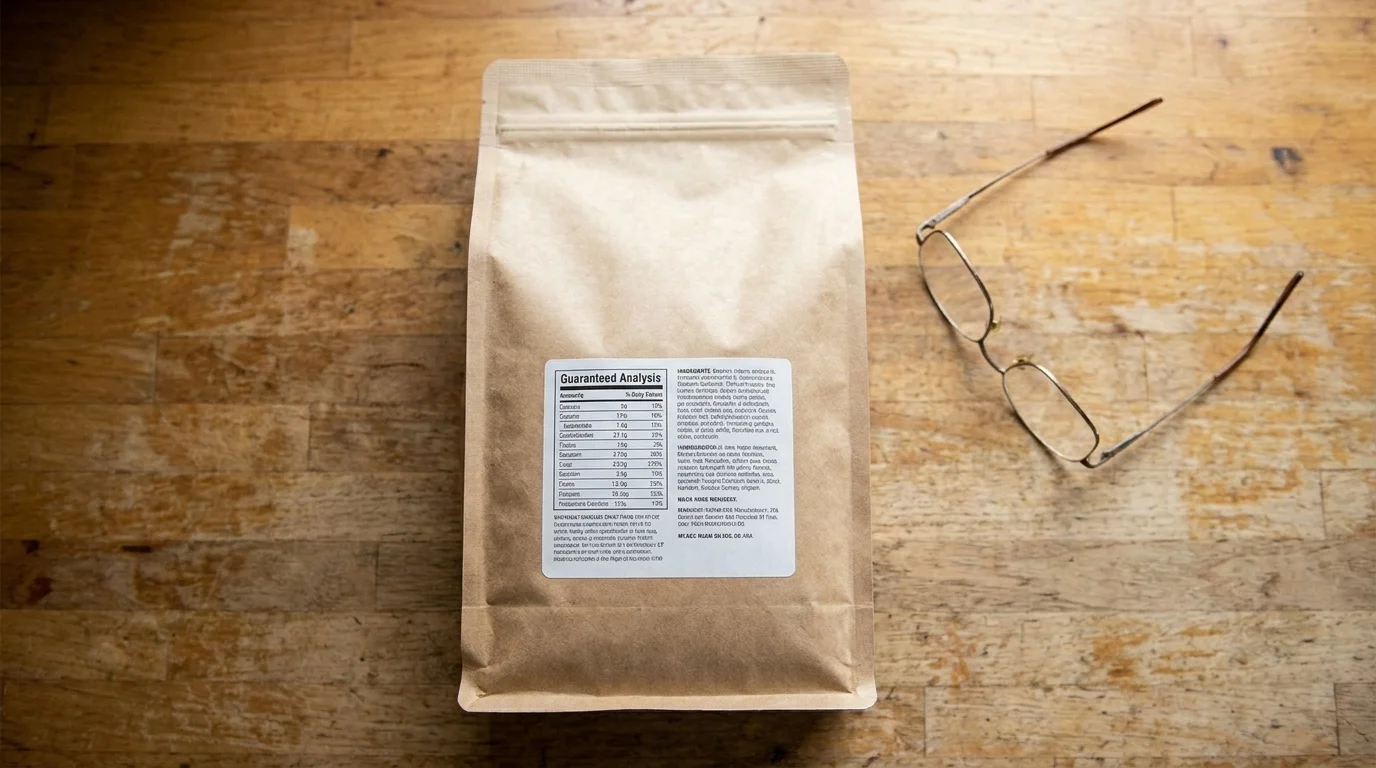
AAFCO does not approve pet food. Here's who does.
The regulatory picture is straightforward and almost never explained.
Pet food in the United States is regulated by the Food and Drug Administration's Center for Veterinary Medicine. The FDA covers ingredient safety, labeling truthfulness, and unapproved animal-drug claims. State feed-control officials, operating under state feed laws, do the day-to-day enforcement: ingredient registration, label review, inspection. The AAFCO is an organisation of those state officials, and AAFCO publishes the model regulations that states may choose to adopt — making "AAFCO compliance" a real shorthand for "meets the state rule that adopted the AAFCO model."
What AAFCO does not do, and has stated publicly on its own consumer-facing landing page, is regulate, test, approve, certify, or endorse pet food. Brands are not "AAFCO approved." A bag can carry an AAFCO nutritional adequacy statement — which is meaningful and is what you should be looking for — but not an AAFCO approval.
A related regulatory bookkeeping fact worth knowing: the FDA–AAFCO Memorandum of Understanding expired on October 1, 2024, which means the FDA, not AAFCO, now owns pre-market pet food ingredient approval going forward. This does not change what is on today's bags. It does change which agency is writing the next round of guidance.
Related Article: Regulatory Navigation: Harmonizing International Pet Care Standards and Regulations
Receipts: what the FDA and FTC have actually done about pet-food claims
This is the section that distinguishes pet food labeling journalism from pet food labeling marketing. There is a record. It is short, but it is concrete.
Mars Petcare / Eukanuba (FTC, 2016). Mars claimed a "10-year study" showed Eukanuba dogs lived 30% longer than expected. The FTC's August 2016 press release on the consent order ruled the claim false and unsubstantiated, and the "scientifically proven" framing also false. The FTC's December 2016 final order bars Mars from repeating this or any similar unsubstantiated longevity claim. This is, as of writing, the canonical FTC enforcement action against a major pet food brand on substantiation grounds.
April 2025 FDA warning letters to four CBD and mushroom pet supplement makers. On April 7, 2025, the FDA posted warning letters to CBD Dog Health (House of Alchemy LLC), MycoDog (Hamet Love LLC), Bailey's CBD (Bailey's Wellness LLC), and HolistaPet (Holista LLC) for marketing unapproved new animal drugs. The FDA cited specific social media posts and website copy as evidence of disease-treatment claims. The American Veterinary Medical Association's coverage adds the veterinary-professional framing. The context: in February 2024, the FDA's Center for Veterinary Medicine withdrew Program Policy 1240.3605, its longstanding narrow interpretation of permissible structure/function claims on animal food, opening the door for broader supplement-style claims. The April 2025 warning letters are the enforcement edge of the same policy shift.
Answers Pet Food / Lystn LLC (FDA, June 2025). The FDA issued a warning letter on June 18, 2025, after detecting Salmonella and Listeria monocytogenes across four lots of finished product, with July 2024 environmental swabs finding L. monocytogenes on seven food-contact surfaces with genetic matches to the contaminated finished product.
Mid America Pet Food (FDA, November 2024). The warning letter was issued November 22, 2024, after three 2023 Salmonella recalls — September, October, and November — affecting the Victor, Eagle Mountain, Wayne Feeds, and Member's Mark brands. This is a useful illustration of how a recall pattern, not a single event, eventually triggers a federal warning letter.
This is the documented enforcement landscape in pet food advertising over the last two and a half years. It is not a long list, which is also worth saying out loud. The thinness of the enforcement record is part of why the consumer literacy work matters: most marketing claims are never tested by a regulator.
What the research says about what's actually in the bag
Peer-reviewed DNA analysis of commercial pet food has produced findings worth knowing if you are choosing a food on the strength of its protein-source claim.
A 2024 DNA mini-barcoding study published in PubMed Central reported a 28.99% mislabeling rate in canned cat food sampled in Taiwan — "true" tuna was frequently substituted with Auxis and Euthynnus species, and metabarcoding analysis found undeclared ingredients in every canned product examined. A 2023 South Korean DNA-barcoding case study using PCR and Sanger sequencing found that 4 of 10 commercial pet food products had the labelled species undetected in the actual food. Both studies are open-access on PubMed Central.
This is not a US-specific finding, and US testing data at comparable scale is limited. But the structural problem — the protein source on the bag does not always match the protein source in the bag — is documented in the international peer-reviewed literature, and there is no published reason to assume it stops at a national border.
If your animal has a confirmed food sensitivity or allergy, this is the section to take to your veterinarian. The combination of "limited ingredient" diets with 33–83% undeclared-ingredient rates and protein-source mislabeling makes a clinical-grade approach to elimination diets meaningfully different from grocery-shelf shopping. Talk to your vet, especially if a confirmed allergy is the reason you are shopping in this category.

Related Article: E-commerce in Pet Care: Navigating Opportunities and Challenges
What's changing in 2025–2030: AAFCO Pet Food Label Modernization
For the next several years, US shoppers are going to see a confusing mix of old and new pet food labels on the same shelf, often within the same brand line. The reason is regulatory.
The AAFCO Pet Food Label Modernization (PFLM) was published in the 2024 Official Publication — the first major pet food labeling overhaul in more than 40 years. The new rules add four major changes to the back panel: a Nutrition Facts Box modeled on the FDA's human Nutrition Facts panel, a restructured Intended Use Statement, a clearer Ingredient Statement, and mandatory Handling and Storage Instructions. AAFCO's membership formally approved the new model regulations in 2024.
The phase-in is the part shoppers are about to notice. AAFCO has recommended that states use enforcement discretion for six years from the 2024 OP publication. That means consumers will see both old and new label formats in stores through roughly 2030, with no formal mechanism to flag which is which from the front of the pack.
For a shopper, the practical version of this is: if two products from the same manufacturer have visibly different back-panel layouts during the next five years, neither is necessarily incorrect — one has updated and one has not.
What to actually look for
The shorthand at the end of all of this is short.
On any bag, check these in order:
- The AAFCO nutritional adequacy statement — usually in small type on the back. It tells you whether the food is formulated for, or has been tested for, a specific life stage: adult maintenance; growth and reproduction; all life stages. The "all life stages" claim is the broadest. Match the food to the animal in front of you. This is the closest thing to an actual regulatory signal on the bag.
- The full manufacturer name and address, not just "Distributed by." If the bag only lists a distributor, the manufacturer is one step further removed from the recall and quality conversation.
- The Guaranteed Analysis — the four AAFCO-required numbers, with the dry-matter conversion done if you are comparing wet to dry. Use the Tufts Petfoodology explainer if you have never done a dry-matter conversion before.
- The manufacturer's recall history. The FDA maintains public recall and warning-letter records. A brand with a clean record is meaningful; a brand with a Salmonella recall cluster in the last 24 months is also meaningful.
- Skip the marketing adjectives. "Premium," "gourmet," and "super-premium" carry no legal definition. "Natural" carries an extremely broad one. "AAFCO approved" is not a real thing.
If you are making a decision that materially affects your animal's health — a switch onto a prescription diet, a CBD or supplement decision, an elimination diet for a suspected allergy — make it with your veterinarian, not with a marketing tag and not with this article. The label literacy here is meant to help you read the bag honestly. The clinical decisions still belong with the licensed clinician who has examined your animal.
The bag does not know your dog. The label is one input into a longer conversation. Read the eight-point type. Ask the questions a label cannot answer.
Frequently Asked Questions
No. AAFCO has publicly stated it does not regulate, test, approve, certify, or endorse pet food. Approval authority sits with state feed-control officials under each state's feed law. AAFCO writes model rules states may adopt; the term 'AAFCO-approved' on a label is a marketing claim, not a regulatory status. The legitimate AAFCO claim to look for is the nutritional adequacy statement on the back panel.
Every ingredient — and the finished product — must be stored, handled, processed, and transported in compliance with 21 CFR Part 117, the FDA's preventive-controls rule for human food. Production facilities must be registered as both an FDA food facility and an FDA feed facility, and the finished product must be edible by humans at the point of manufacture. Raw foods do not qualify because raw meat is not human-edible until cooked.
No. AAFCO defines 'natural' as derived from plant, animal, or mined sources without chemical synthesis — but explicitly states there is no requirement, and the term carries no implication, that natural feeds are safer than synthetic ones. Most pet food ingredients already meet the definition.
One. AAFCO's framework requires only that a single veterinarian's involvement in the formulation be documented. 'Veterinarian-recommended' is a different and stricter claim that requires a statistically valid survey of veterinarians. 'Veterinarian-approved' is illegal because only state regulators can approve a feed.
Only four things: minimum crude protein, minimum crude fat, maximum crude fiber, and maximum moisture. 'Crude' refers to the lab method, not the quality. The numbers are reported on an 'as-fed' basis with water included, so wet and dry foods cannot be compared without a dry-matter conversion. Actual protein and fat levels are often well above the minimums shown.
No, but enforcement is rare. The FTC requires substantiation for health and benefit claims. The 2016 Mars Petcare consent order — barring Eukanuba from repeating unsubstantiated 30%-lifespan-extension claims — remains the canonical FTC enforcement against a major pet food brand. The FDA acts on safety and unapproved-drug claims; recent examples include April 7, 2025 warning letters to four CBD and mushroom pet supplement makers (CBD Dog Health, MycoDog, Bailey's CBD, and HolistaPet).
AAFCO published Pet Food Label Modernization in the 2024 Official Publication — the first major overhaul in 40+ years. New rules cover the Nutrition Facts Box, Intended Use Statement, Ingredient Statement, and Handling and Storage Instructions. States are using enforcement discretion for six years, so consumers will see both old and new label formats in stores through roughly 2030, often within the same brand line.
The AAFCO nutritional adequacy statement (and the life stage it applies to — adult maintenance vs growth/reproduction), the full manufacturer name (not just 'distributed by'), the Guaranteed Analysis with a dry-matter conversion if you are comparing wet to dry, and the manufacturer's recall history with the FDA. Skip the marketing adjectives. For diet decisions that materially affect your animal's health — switching to a prescription diet, an elimination protocol for a suspected food allergy, supplement choices — talk to your veterinarian, not a marketing tag.