


There is a moment at the gate at every major airport — Pearson, JFK, LAX, the one you have been in — that anyone who has spent time traveling with pets knows: the soft-sided carrier comes out from under the seat for the last bathroom break before boarding. The dog inside is a five-year-old whippet named Sable. Her owner, a paralegal named Adrienne, has been preparing for this two-hour flight for six weeks. There is a vet-signed health certificate in the folder, a measured dose of trazodone administered ninety minutes ago, a familiar-smelling blanket folded into the carrier, and a printed Center for Pet Safety certificate Adrienne does not actually need at the airport but brought anyway, because the carrier she bought is the one the dog will travel in for the rest of her life and she wanted to know it was the right one. Sable does not look stressed. Sable looks like a dog who has done this before. The reason is the six weeks of preparation, not the trazodone, and Adrienne will tell you so if you ask.
This is what traveling with a pet has become in 2026. The category has gone from a soft-corner of pet-care content — "tips for stress-free adventures" — to a regulated domain with named federal rules, named airline fee schedules, named medications you specifically should not give, and an explicit safety-engineering standard for the carrier itself. 78% of US pet owners now travel with their pets each year. 74% of dog parents have flown with their dog in the past twelve months, up from 68% in 2023. Roughly two million pets board US flights annually (APPA 2025 Dog & Cat Report; Hepper, 2026 pet travel statistics roundup; Always Pets, 2025).
The piece you are reading is built for that 2026. It assumes you know what a leash and a water bowl are; it spends its words on the things older guides leave vague.
What changed in 2024 (and 2026) for re-entering the US with a dog
If you are flying internationally with a dog and bringing her back to the United States — and many readers of this article will be doing exactly that — the rules changed on August 1, 2024. They are not optional, and they have not been integrated into most consumer pet-travel articles still on the open web.
Every dog entering the US, including US-resident dogs returning home, must now:
- Travel with a CDC Dog Import Form (DIF) receipt, which the dog's responsible adult fills out online before travel and which the airline will check at boarding. The web system was redesigned on 2026-02-05, but the CDC has stated explicitly that "there are no changes to importation requirements" — the form itself is new-looking; the underlying rules are the same (CDC Dog Import Form and Instructions).
- Be at least six months old. A puppy younger than six months cannot enter the United States. This rule alone has rewritten what's possible for owners adopting puppies abroad.
- Be microchipped to an ISO-compatible standard (134.2 kHz, 15-digit). A US chip from before 2024 may or may not meet the standard — if you are unsure, talk to your veterinarian before booking the flight.
- Appear healthy on arrival. Sick or injured dogs at port of entry can be denied entry or referred to quarantine at the owner's expense.
For dogs returning from rabies-high-risk countries, the additional requirement is a Certification of U.S.-Issued Rabies Vaccination form completed by a USDA-accredited veterinarian before departure (CDC Bringing a Dog into the U.S.). Dogs from high-risk countries who have not been vaccinated against rabies cannot enter the US at all.
The DIF receipt is valid for six months for low-risk countries (multiple entries from the same country) — convenient if you and your dog travel back and forth to, say, Mexico or Canada — and single-entry only for high-risk countries. Plan accordingly.
For travel out of the US to a destination that requires a health certificate (most of Europe, Japan, Australia, and increasingly Asia), you will need two separate documents: a state-level Certificate of Veterinary Inspection (CVI) signed by your veterinarian, and a USDA APHIS export endorsement typically issued within ten days of departure. The terms are not interchangeable, and many destinations will refuse the CVI alone without the APHIS endorsement on top. There is no formal "US pet passport" — the term in American usage means the CVI + APHIS endorsement package together. The EU's actual Pet Passport is a separate document for EU-resident pets.
Cats: as of writing, CDC's import rules apply primarily to dogs; cat importation is a less rigorous federal regime, though states (notably Hawaii) and destination countries have their own requirements that can be substantial. Read both the state-of-arrival and the destination-country rules.
Flying — the 2026 airline matrix
A direct table because the navigational queries that drive the most volume in this category ("delta pet policy," "american airlines pet policy," "united pet policy," "alaska airlines pet policy" — combined search volume north of 45,000 per month) are about specific numbers. The numbers, as of May 2026, drawing primarily on the Sniffspot 2026 in-cabin guide (Sniffspot, May 2026) and the Travel Ready Pets fee tracker (Travel Ready Pets, 2026):
| Airline | In-cabin fee (one way) | Carrier dimensions | Pet + carrier weight cap | Minimum age | Notes |
|---|---|---|---|---|---|
| Alaska | $100 | Carrier-dependent | 20 lb typical | 8 weeks | 107,042 pets transported in 2020 with no incidents on record |
| American | $125 | 19 × 13 × 9 in | 20 lb (pet + carrier) | 8 weeks | Domestic only; check current breed restrictions before booking |
| Delta | $95 (US) / $200 intl | Soft carrier, under seat | Weight at gate agent's discretion | 10 weeks | Lowest US-domestic fee among major carriers |
| JetBlue | $125 | 17 × 12.5 × 8.5 in | 20 lb | 8 weeks | Carrier dimensions tighter than most |
| Southwest | $95 | 17 × 10 × 9.5 in | Carrier-dependent | 8 weeks | No international; no Hawaii routes |
| Spirit | $125 | Carrier-dependent | 40 lb (pet + carrier) | 8 weeks | Soft-sided carrier required |
| United | $125 | 18 × 11 × 11 in (hard sided) | Carrier-dependent | 8 weeks | One-way fee |
| Frontier | $99 | 18 × 14 × 8 in | Carrier-dependent | 8 weeks | One-way |
| Hawaiian | $100 (NA↔HI) / $35 interisland | Carrier-dependent | Carrier-dependent | 8 weeks | Fee restructured down from $125 on 2026-01-02 — a counter-trend against fee inflation |
A few observations the table cannot show:
- Cargo travel for pets is far more restricted in 2026 than it was a decade ago. Most major US carriers no longer fly pets in cargo holds outside of a small set of routes and seasons, and several have ended cargo pet transport entirely. If your dog is over 20–25 pounds, the practical options are a private charter, a ground-transport service, or a road trip.
- Brachycephalic breeds are banned from cargo across nearly every major US carrier. See the dedicated section below.
- Service dogs (DOT task-trained) fly free in cabin under the Air Carrier Access Act framework, regardless of size. Emotional support animals are no longer recognized — the 2021 DOT rule formally ended that accommodation. ESAs now fall under standard pet policy with size limits and fees (Sniffspot, May 2026).
- Book the pet ticket at the time you book your own seat. Most carriers cap the number of in-cabin pets per flight (typically two to six) on a first-booked basis. Calling later and hoping is the most common way owners get separated from their pet's intended flight.
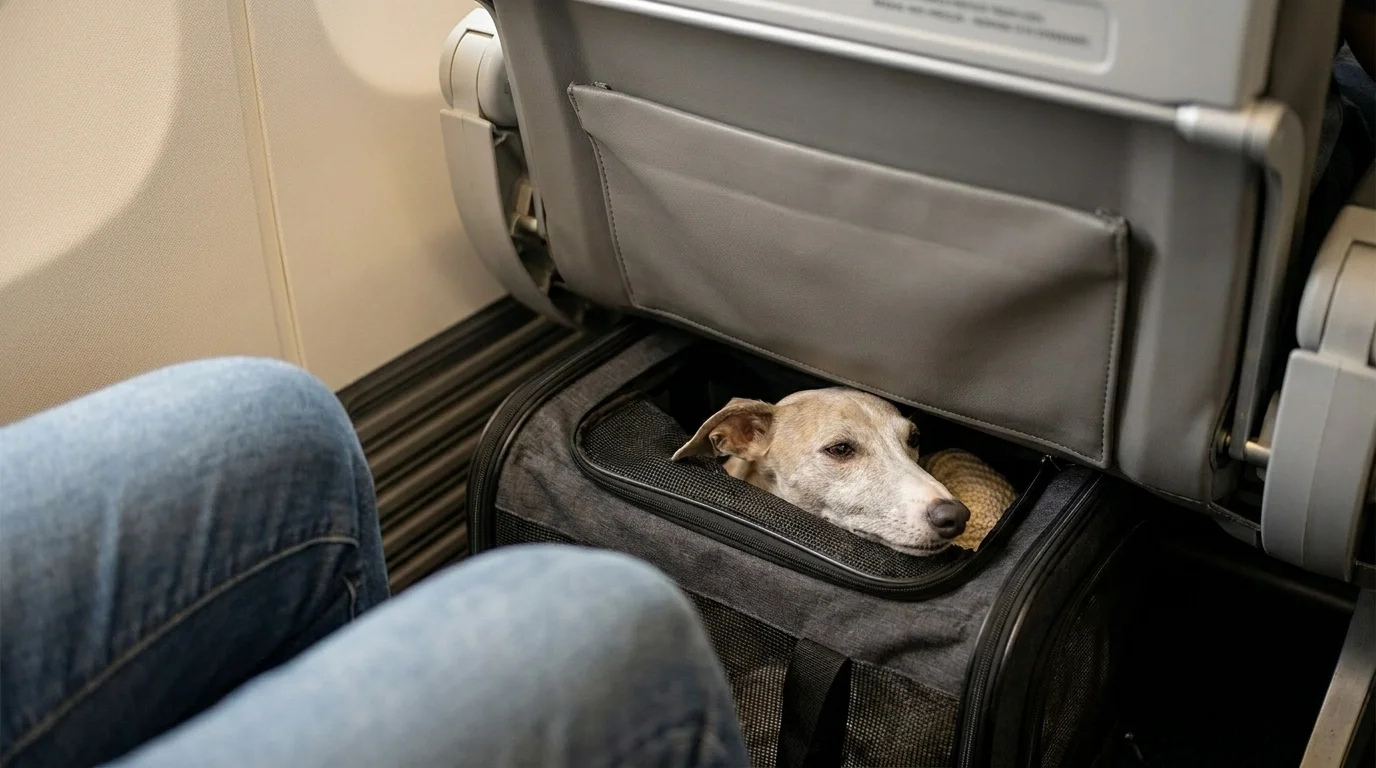
Should I sedate my dog or cat before a flight?
The clean answer, drawn from the American Veterinary Medical Association's published guidance and the underlying clinical literature: no, you should not pre-flight sedate your pet with the drugs most older articles suggest, and especially not with acepromazine. A summary of the relevant Journal of the American Veterinary Medical Association data, surfaced in Tailwind Global Pet's review, is unambiguous: excessive sedation is the most frequent cause of animal death during air travel.
The mechanism is not subtle. Acepromazine — the tranquilizer veterinarians prescribed for decades for travel anxiety — impairs cardiac function, lowers respiratory rate, and disrupts thermoregulation. At altitude, where cabin and cargo air pressure and oxygen tension are lower than at ground level, those impairments compound. A sedated dog cannot pant effectively to cool herself, cannot reliably reposition in the carrier, and cannot communicate distress.
The current veterinary-anxiety toolkit for travel, which your veterinarian may prescribe in advance after evaluating your specific pet:
- Trazodone — a serotonin modulator that produces mild calming without the cardiovascular suppression of acepromazine.
- Gabapentin — particularly effective for cats; reduces anxiety in carrier-transport situations.
- Pheromone analogues — Adaptil (dogs) and Feliway (cats) — non-pharmacological calming agents that work for some animals and not others.
- Gradual carrier acclimation — the most underrated intervention in the entire conversation. A pet who has spent six weeks eating breakfast inside a familiar carrier in a familiar kitchen is meaningfully calmer at the airport than a pet who saw the carrier for the first time the day of the trip.
What I will not do in this article is tell you which drug to give your dog. That conversation belongs to your veterinarian, in person, with your specific animal in front of them. What I will tell you is that "consult your vet about medications" — the standard line in older pet-travel articles — is not enough. The specific request to bring to that appointment is: "I am flying with my dog/cat on this date. What are my options that are not acepromazine?" The conversation should be that explicit.
Brachycephalic breeds — the cargo bar
The snub-nosed breeds — the ones whose appeal is precisely the foreshortened muzzle that makes their respiratory anatomy fragile — are documented to have higher in-flight mortality than other breeds in cargo holds. Most major US carriers either bar them entirely from cargo or prohibit them during summer temperature months.
The named-breed list, common across carrier policies in 2026:
- Dogs: English Bulldog, French Bulldog, Pug, Boxer, Boston Terrier, Pekingese, Shih Tzu, Cavalier King Charles Spaniel, Brussels Griffon, Bullmastiff, Chow Chow, Lhasa Apso, certain mixed breeds with prominent brachycephalic phenotype.
- Cats: Persian, Himalayan, exotic Shorthair, Burmese (variable by airline), Scottish Fold (variable).
A small brachycephalic dog who fits the in-cabin size and weight limits can usually still fly in the cabin, where air pressure and temperature are controlled and the owner is present. A larger brachycephalic dog has, in practice, limited options: a road trip, a charter, or a ground-transport service designed for the trip in question. None of these are bad choices; they are just the realistic ones.
Road trips — and crash-tested crates
For 87% of dog owners who have travelled with their dog in the past year, the trip was by car, not by air (APPA 2025). The safety conversation in cars has moved further than most consumer pet content has noticed.
The single standard worth knowing is Center for Pet Safety (CPS) certification, which crash-tests carriers and harnesses to a standard derived from child-safety-seat testing methodology. The current CPS-certified list runs to roughly half a dozen brands of crates and a similar number of harnesses, all explicitly tested at vehicle-collision forces. The list is publicly available on the CPS site. A crate or harness that has not been CPS-certified may or may not perform — there is no way to tell without the testing.
What this means in practice:
- Do not let dogs ride loose in the back seat or cargo area. In a frontal collision, an unrestrained 50-pound dog becomes a 1,500-pound projectile. The animal's safety is the headline; the human passengers' is also at stake.
- A seat belt clipped to a regular harness is not a crash-tested system. Use a CPS-certified harness, or a CPS-certified crate.
- Cargo-area crates for SUVs and station wagons should be the certified model for the dog's size, secured to the vehicle anchor points, not free-floating.
- For air-traveled crates that double as road-trip crates, look for IATA CR-82 (the airline cargo crate standard) alongside CPS certification.
A few practical road-trip notes that compound the safety system:
- Plan stops every two to three hours. Bathroom break, water, light walk. Long-haul human truck-driver routines do not work for dogs.
- Never leave a pet alone in a parked car. Internal temperature climbs catastrophically in minutes — even on cool days, even with windows cracked. The AVMA and most state veterinary boards classify this as a welfare violation.
- Carry a printed copy of the pet's current vaccine records. Some state lines, and many border crossings into Canada and Mexico, require proof.
Traveling with a cat
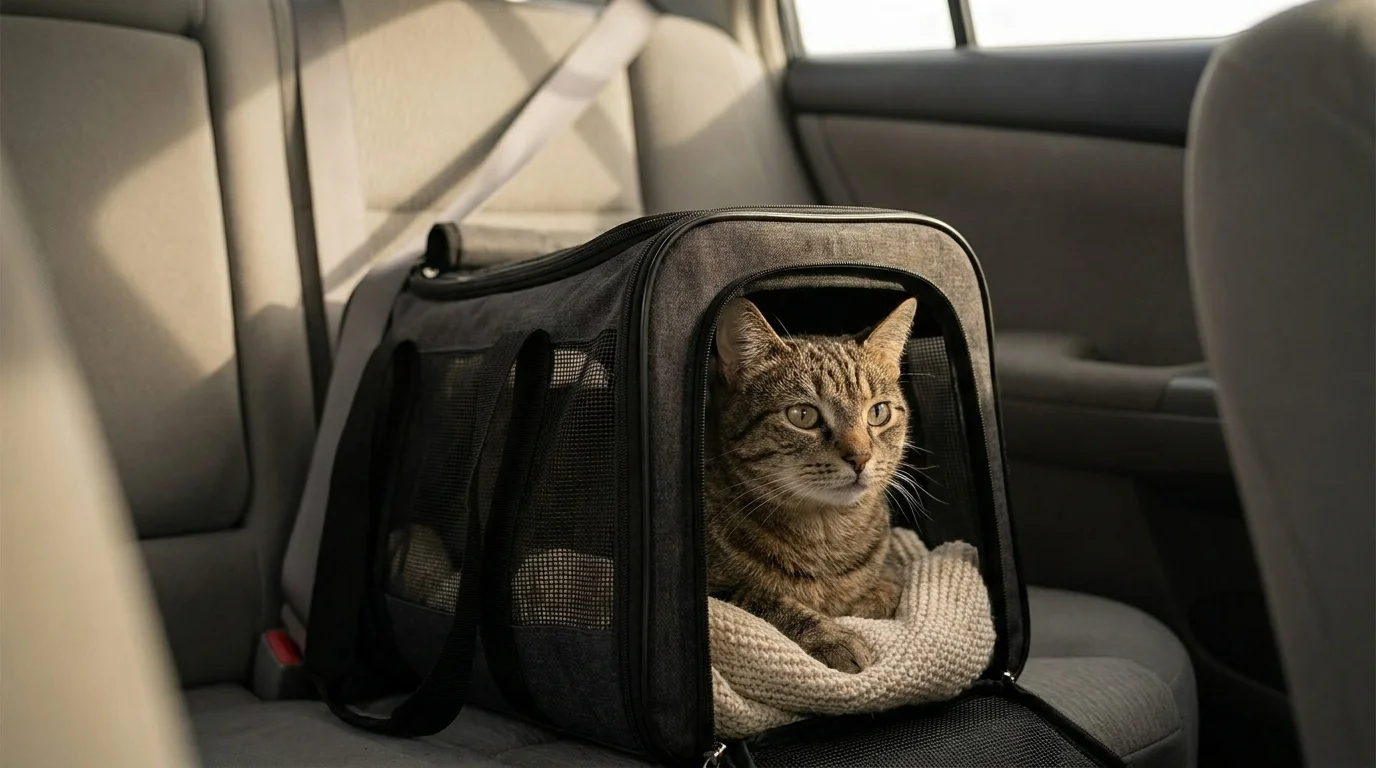
I will say this directly, because the older travel content tends to soft-pedal it: traveling with a cat is, broadly, a bad idea, and I say that as someone who has done it three times. Cats are territorial in the most literal ethological sense — their sense of safety is stitched into a specific physical space — and moving them across a border, even to a familiar second home, strips that stitching out. A cat who tolerates a trip is enduring it, not enjoying it. The difference matters because it should change what you do.
If you must travel with a cat, the ethical minimum, in my view:
- Carrier acclimation starts at least two weeks before the trip. Leave the open carrier in the room she sleeps in, with a familiar-smelling blanket inside, and let her use it as furniture. Feed her near it. Eventually feed her inside it. The carrier becomes a known quantity, not a kidnapping device.
- Talk to your vet about gabapentin specifically. It works particularly well for feline travel anxiety, more reliably than the equivalent options in dogs.
- A single quiet carrier, not a multi-cat carrier. Even bonded cats handle confinement better separately.
- A familiar-smelling blanket inside, and a worn t-shirt of the human she likes most. Olfactory continuity is most of what calms a cat in transit.
- Litter strategy at security: a small disposable shallow pan with a small amount of the cat's own litter, accessible after the carrier comes through the X-ray and before re-confining. If she will not use a strange litter box, do not force the issue — most cats hold reliably for the duration of a domestic flight.
- Skip aromatherapy entirely. Lavender, chamomile, tea tree, citrus, peppermint — none of them are safe at meaningful concentration around cats. The ASPCA's pet-safety guidance is clear, and most "calming sprays" marketed for travel are not formulated for the cat's hepatic biology.
For airlines, Delta's 10-week minimum age is more permissive than most carriers' 8-week standard, which matters if you are travelling with a young kitten on a short notice. Otherwise the airline matrix above applies the same way to cats as to dogs, with the practical note that most cats simply do not exceed the 20-pound carrier-and-pet limit for in-cabin travel.
Pet-friendly hotels and stays
The accommodation side of pet travel has shifted more than the regulatory side. The American Hotel & Lodging Association reports that 75% of US hotels — across luxury, midscale, and economy tiers — now allow pets (Hepper, 2026 summary). The market caught up with the demand somewhere around 2022.
A short list of operators with consistent pet programs, useful as starting points rather than as exhaustive:
- Kimpton Hotels — perhaps the longest-standing genuinely-pet-friendly chain in the US; no size limit, no fee at most properties.
- La Quinta Inn & Suites — broadly pet-friendly, lower-cost tier, usually no fee.
- Red Roof Inn — pet-friendly at most properties, no fee.
- Choice Hotels (Quality Inn, Comfort, Sleep Inn brands) — variable by property; check ahead.
- Hyatt — pet-friendly across most brands with a modest fee.
- Marriott — variable; the Aloft and Element brands are usually pet-friendly.
For booking, the canonical consumer directory is BringFido, which aggregates pet-policy data across hotels, vacation rentals, restaurants, and parks. Use it as the directory; verify the specific property's current policy with a phone call to the front desk before booking — independently-managed franchises can override chain-level pet policies.
A note on Airbnb and Vrbo: pet-friendliness is host-by-host, which is both a feature and a problem. The "pets allowed" filter is reliable; the actual condition of the rental for an animal (no fencing, slippery floors, accessible toxic plants, valuable rugs) is not. Read the listing description carefully and message the host with specific questions.
When the trip is over
The framing I want to leave you with is the one I keep coming back to with pet travel, the one I think most stress-free-adventure guides miss: most pets do not experience travel as adventure. They experience it as displacement, often endured for the company of a person they love. Adrienne's whippet at the gate, calm at boarding after six weeks of preparation, is not having a good time the way Adrienne is having a good time. She is doing something difficult, well, because she trusts Adrienne to have arranged it.
The implication is not that you should not travel with your pet. Two million animals will board US flights this year, and most of them will be fine. The implication is that the standard for "fine" is the animal's standard, not the owner's. A dog who arrives at the destination tired but uninjured, who eats and drinks within a few hours, who sleeps that first night, has done well. A cat who comes out of the carrier in the new room, finds the new litter box on her own within twelve hours, and resumes grooming, has done very well.
If your animal does not meet those marks — if she will not eat for forty-eight hours, if she hides in a single spot for three days, if she shows new aggression or sustained vocalisation — the trip cost her more than she could afford. The fix on the next trip is more preparation, a different mode of transport, or no trip at all.
Practical numbers, addresses, and references for the road:
- ASPCA Animal Poison Control (24/7, ~$95): (888) 426-4435 — keep this in your phone before you leave.
- Pet Poison Helpline (24/7, ~$85): 1-800-213-6680.
- CDC Dog Import questions: cdc.gov/importation/dogs/index.html.
- USDA APHIS pet travel — country by country: aphis.usda.gov/pet-travel.
- Center for Pet Safety certified products: centerforpetsafety.org.
- BringFido: bringfido.com.
Pack the folder before you pack the bag. The dog will figure out the rest.
Frequently Asked Questions
No — the CDC Dog Import Form is required when bringing a dog into the U.S. from another country, including U.S. citizens returning home with their dogs. For purely domestic flights, you don't need one. The form has been required since August 1, 2024; the web system was redesigned on 2026-02-05 but the underlying rules have not changed.
The AVMA recommends against pre-flight sedation. A study summarized in JAVMA found that excessive sedation is the most frequent cause of animal death during air travel — common tranquilizers like acepromazine interfere with cardiac function, respiratory drive, and thermoregulation at altitude. Discuss alternatives like gabapentin, trazodone, or pheromone analogues (Adaptil, Feliway) with your veterinarian, and do not self-medicate.
As of May 2026, Southwest and Delta tie at $95 each way for the lowest in-cabin fees among major US carriers; Alaska is $100; Frontier is $99 one-way; American, JetBlue, Spirit, and United range $125–$150 each way. International fees are higher (Delta charges $200 international). Hawaiian Airlines reduced its North America-to-Hawaii fee from $125 to $100 effective January 2, 2026, with interisland service at $35.
Most major US airlines prohibit brachycephalic (snub-nosed) breeds — English Bulldogs, French Bulldogs, Pugs, Boxers, Boston Terriers, Pekingese, Shih Tzus, Persian cats, Himalayan cats, and similar breeds — from cargo holds because of documented respiratory mortality risk at altitude and under temperature stress. Smaller brachycephalic dogs may still travel in the cabin where they meet the carrier weight and dimension limits.
A Certificate of Veterinary Inspection (CVI) is a state-level health certificate from your veterinarian. For international travel out of the US, that CVI must additionally receive a USDA APHIS export endorsement, typically within ten days of departure. Most destination countries require both. The US has no formal 'pet passport' — the term in American usage means the CVI + APHIS endorsement package together.
A CPS-certified crate or harness has passed crash-testing modelled on child-safety-seat methodology. Roughly half a dozen crate brands and a similar number of harnesses currently hold CPS certification; the list is public on centerforpetsafety.org. A standard seat-belt-clipped harness is not equivalent. For road trips, a CPS-certified system is the current safety standard; for crates that may also fly cargo, look for the IATA CR-82 standard alongside CPS certification.