The Everlasting Innovation of Pet Microchipping: Tracing Its Historical Impact and Future Implications


Pet microchipping looks unglamorous on the receipt and decisive in the moment that matters. A friend of mine in Montreal lost her seven-year-old long-haired chihuahua, a small black dog named Émile, on a Saturday afternoon in October 2024. He bolted through an unlatched gate while she was bringing in groceries. By Sunday morning she had walked twelve neighborhood blocks, posted in three local lost-pet groups, and slept four hours. By Monday afternoon she had received a phone call from the Montreal SPCA. Émile had been picked up by a stranger in Mile End, brought into the shelter, scanned with a handheld reader that read off a fifteen-digit ID number, and that number — entered into a public meta-search tool — had returned a contact in HomeAgain's registry that connected to my friend's cell phone within twenty minutes. The whole process, from scan to reunion, took about ninety minutes. It was made possible by a glass-encased rice-grain-sized passive RFID tag implanted between Émile's shoulder blades years earlier, for a small one-time fee at her veterinary clinic.
Only about 22% of lost dogs entering US shelters are returned to their owners — but the rate jumps to over 52% when the dog is microchipped, according to the American Veterinary Medical Association. For cats, the contrast is starker still: only roughly one in fifty shelter cats is returned to its owner, while nearly 40% of microchipped cats are reunited. And about one in three pets becomes lost at some point in life, making microchipping the single highest-leverage piece of veterinary technology a household can purchase. This article is the version of "everything an American pet owner needs to know about microchipping in 2026" that does not assume you already know the difference between a chip and a GPS tracker, does not bury the cost, and does not skip the cat. Émile is home because the system worked. What follows is how.
Microchips are not GPS — here's what they actually do
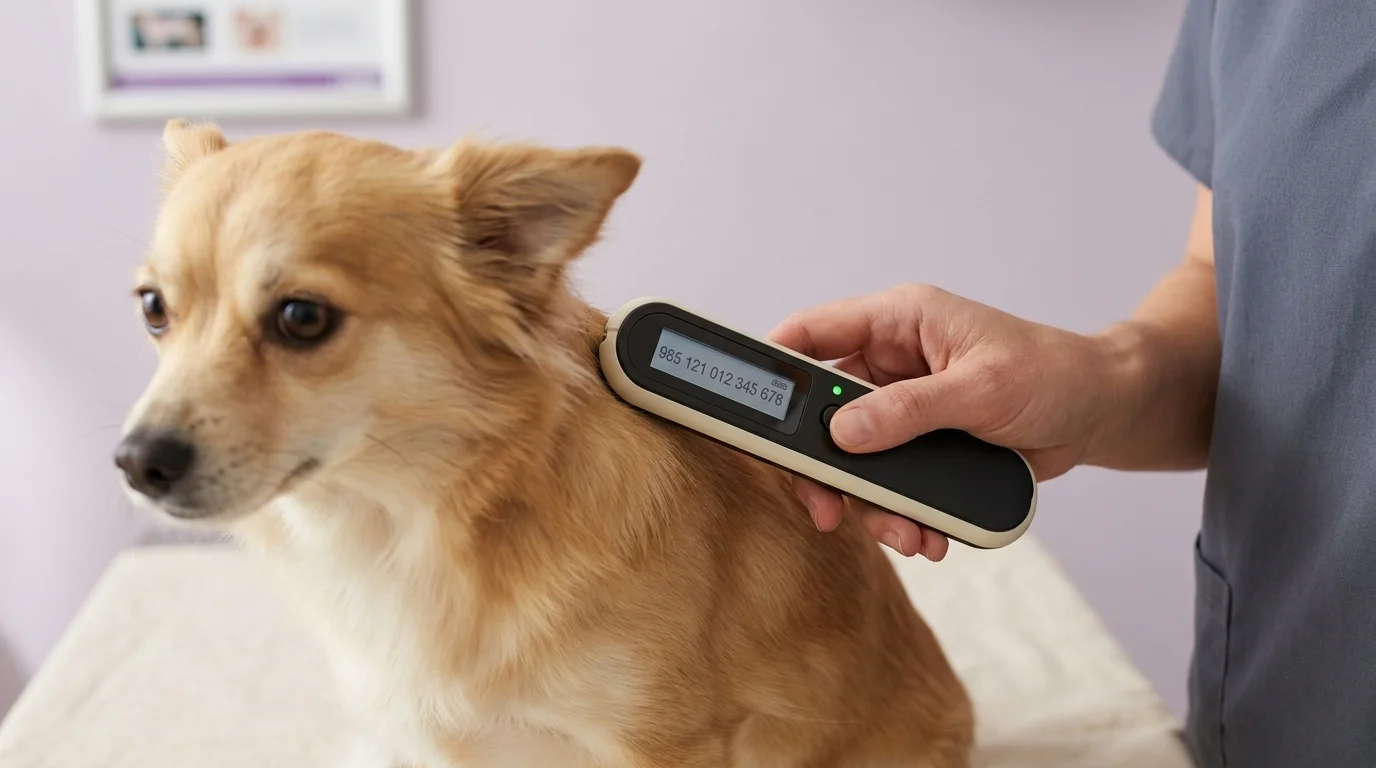
This is the single most important sentence in the entire piece, and the one most internet content gets wrong: a pet microchip is not a GPS tracker. It is a passive radio-frequency identification (RFID) tag. It has no battery. It does not transmit a signal. It cannot tell anyone where your pet is, ever. It has only one function: when a compatible scanner is held within a few inches of the implant site, the chip uses the scanner's radio energy to return a unique fifteen-digit identification number. That number is then looked up in a registry to find the owner's contact information. There is no real-time tracking, no app that pings your phone, no map view. None of those features are physically possible on the power available to a passive RFID tag the size of a grain of rice.
If you want to know where your pet is at any given moment, you need a separate device — a GPS collar, which has a battery, a cellular or satellite link, and a monthly service subscription. Those are an entirely separate category of pet technology, covered in detail in our pet technology guide. The chip and the GPS tracker do completely different jobs. The chip is for the day your pet ends up in a stranger's hands or at a shelter intake counter — it is the irrevocable, battery-free identification that survives the loss of a collar. The GPS tracker is for the day you want to know which neighbor's yard the dog dug into. Most veterinary advice in 2026 recommends both, because they solve different problems.
How a pet microchip actually works
The implant itself is a tiny cylindrical capsule of biocompatible glass, roughly the diameter of a pencil lead and about a centimeter long, containing a passive RFID coil and an integrated circuit. Modern US and global pet microchips operate at the ISO 11784/11785 134.2 kHz standard, which means they are readable by any universal scanner used by veterinary clinics, shelters, and animal-control officers worldwide. The implant is delivered by a veterinarian using a single-use sterile applicator that looks like a slightly oversized vaccination needle, injected subcutaneously between the shoulder blades. The procedure takes roughly the same time as a routine vaccine — seconds — and most dogs and cats react about the same way they react to a vaccine, which is to say, briefly and not much.
The chip itself never wears out and never needs recharging — there is nothing to recharge. Its only failure mode is what veterinary literature calls "migration," in which the chip drifts a few centimeters from its original location over years and becomes harder to find with the scanner. A trained reader will sweep the entire animal, not just the standard implant site, which is why a chip that has migrated is still almost always located on a competent scan.
The fifteen-digit ID returned by the scan is meaningless on its own. The system only works if that ID is registered in a database connected to your current contact information, which is where almost everything in the microchip-reunion chain actually breaks down.
Related Article: Pet Tech Revolution: Gadgets Galore for Modern Pet Parents
How much microchipping costs in 2026
The cost question is where AVMA's authoritative FAQ unhelpfully ranks poorly, because it does not give the per-venue numbers. Here are the actual ranges, drawn from current US pricing surveys (CareCredit, U.S. News, PetPlace).
| Venue | Typical cost (US, 2025-2026) | Notes |
|---|---|---|
| Veterinary clinic | $50–$70 | National average ~$48; most clinics charge $50–$70 |
| PetSmart Banfield clinic | $30–$50 | Bundled discounts common with wellness plans |
| Petco vaccination clinic | ~$25 | Cheapest mainstream retail option |
| Municipal animal-services clinic | $0–$25 | Many cities offer free chip events year-round |
| Shelter adoption | $0 (included) | Standard practice across most US shelters |
| Cat-specific (any venue) | $50–$65 | Most clinics around $60 |
The single highest-value piece of cost advice for a budget-conscious owner: search for "free dog microchipping near me" in your municipality's animal-services portal. Most US cities run periodic free or near-free chip clinics, often paired with rabies vaccination drives, and the chip you receive is the same ISO-standard chip as the one you would pay $70 for at a private vet. The implant procedure itself is genuinely the same; the venue is what varies the price.
A note on what the $25-to-$70 fee does and does not include: in most cases it covers the chip, the implantation procedure, and a one-time enrollment in the chip manufacturer's default registry. It usually does NOT cover ongoing registry updates or premium registry features. The registry-cost picture is below.
Is microchipping safe? What the data actually says
The two most common safety concerns owners raise — sometimes well-meaning, sometimes lifted from anti-chip blog posts — are about adverse implant reactions and about the rodent-tumor literature. The data on both has been compiled, and the honest answers are clearer than the noise around them.
According to current veterinary safety literature and the World Small Animal Veterinary Association's formal safety review, the most common adverse event is chip migration — the chip drifts a few centimeters from its original location under the skin, accounting for roughly 56% of all reported adverse events. Migration almost never has clinical consequences for the animal; it only means the scanning vet needs to sweep a wider area. The second-most-common event is infection at the implant site, accounting for about 6% of reports, and almost always resolves with a short course of antibiotics. Both are rare, and both are well within the range of acceptable adverse-event rates for routine veterinary procedures.
The tumor concern derives almost entirely from laboratory-rodent studies, in which mice and rats with microchips implanted at fetal or neonatal age developed subcutaneous tumors at meaningfully elevated rates. The crucial distinction the rodent literature does NOT translate to companion animals: those rodents are bred for cancer susceptibility, lived in highly controlled experimental conditions, and were chipped at developmental stages no veterinary clinic would ever chip a dog or cat. The companion-animal data is reassuring. The British Small Animal Veterinary Association's Microchip Adverse Reactions Group, which receives mandatory UK adverse-event reports, has documented just 2 tumors total across 10 years of UK data covering millions of chipped dogs. There are no verified cases of microchip-induced tumors in cats in the veterinary literature at all.
The honest summary, in language a careful owner can act on: microchipping is a routine veterinary procedure with an extremely low adverse-event profile, the most common adverse event has no clinical impact, the tumor concern is genuine in lab rodents but has not translated to companion animals at any meaningful rate, and the upside — a 52% reunion rate for chipped dogs versus 22% unchipped — is one of the largest interventional asymmetries in companion-animal medicine. The safety calculus is not close.
Related Article: Technology's Role in Shaping Global Pet Care Practices: Innovations, Challenges, and Risks
Microchipping cats: the indoor-cat objection
The most common objection cat owners raise to microchipping is the indoor-only one: "She never goes outside, so she does not need a chip." The data does not support the objection. Cats escape — through propped-open doors during moves, through window screens torn by storms, through contractors' open work doors, through visitors who do not know the household rules — and indoor cats who escape are, in most cases, less prepared to navigate the outside world than the outdoor-acclimated ones. The reunion statistics do most of the rhetorical work here: roughly one in fifty unchipped shelter cats is returned to its owner; roughly 40% — nearly two in five — of microchipped shelter cats make it home. The chip is not just for the cat who escapes regularly. It is, more importantly, for the cat who escapes once.
The 2024 UK regulatory move is worth flagging as the global-momentum signal. Effective June 10, 2024, England made cat microchipping legally mandatory and added a parallel mandatory adverse-event reporting requirement — the first major national jurisdiction to do so. The resulting public dataset will be one of the largest sources of cat-microchip safety information in the world. US regulators have not followed England's lead at the federal level, but the cat-specific data and welfare science underneath the UK decision is the same data that supports US veterinary recommendations.
Cat-specific cost is essentially identical to dog cost — $50 to $65 at most clinics, $60 at a typical vet, free or near-free at municipal clinics — and the implantation procedure and chip are the same.
Which registry should you use? A comparison
The chip itself is half the system. The registry — the database that maps the fifteen-digit ID to your contact information — is the other half. And only about 6 in 10 microchipped pets are actually registered. That gap is the single largest failure mode in the entire reunion chain.
There are several major US pet microchip registries, and they do not maintain a single shared database. Choosing one (or two) and keeping the contact information current is the registration step that turns a passive RFID implant into a working reunion system.
| Registry | Initial cost | Annual fee | Update fee | Notes |
|---|---|---|---|---|
| AKC Reunite | $19.50 one-time | None | None | Lowest long-term cost; free contact-info updates for life |
| HomeAgain | $19.99 base lifetime | $26.99 (Premium) | $6 (free tier) | Premium tier adds 24/7 vet hotline + lost-pet poster service |
| 24Petwatch | Bundled in paid plan | Varies | Varies | Bundled with broader protection-plan offerings |
| Free Pet Chip Registry | $0 | $0 | $0 | Registers any brand of chip at no cost; lifetime |
| Found Animals / 24Petwatch free national portal | $0 | $0 | $0 | Free lifetime registry for any ISO chip |
| Pawbase | $0 | $0 | $0 | Free; integrated into AAHA universal lookup |
Sources for the above pricing: HomeAgain fee breakdown, Pawbase registry comparison, Free Pet Chip Registry, Found Animals free-registry directory.
The practical recommendation: register with whichever registry the chip implanter defaults to (you do not need to use the manufacturer's branded registry — any registry is fine as long as the chip ID is recorded somewhere), and then ALSO register the same chip with one of the free national portals (Free Pet Chip Registry, Pawbase, or the Found Animals portal). Multiple registrations cost nothing on the free tier and meaningfully increase the chance a finder will reach you. Whichever registries you choose, keep the contact information current — when you move, change phone numbers, or rehome, update every registry within a week.
What happens when a stray is scanned
This is the part of the system most owners do not understand and most finders do not understand either, and the confusion costs reunions. Here is the actual flow, end to end.
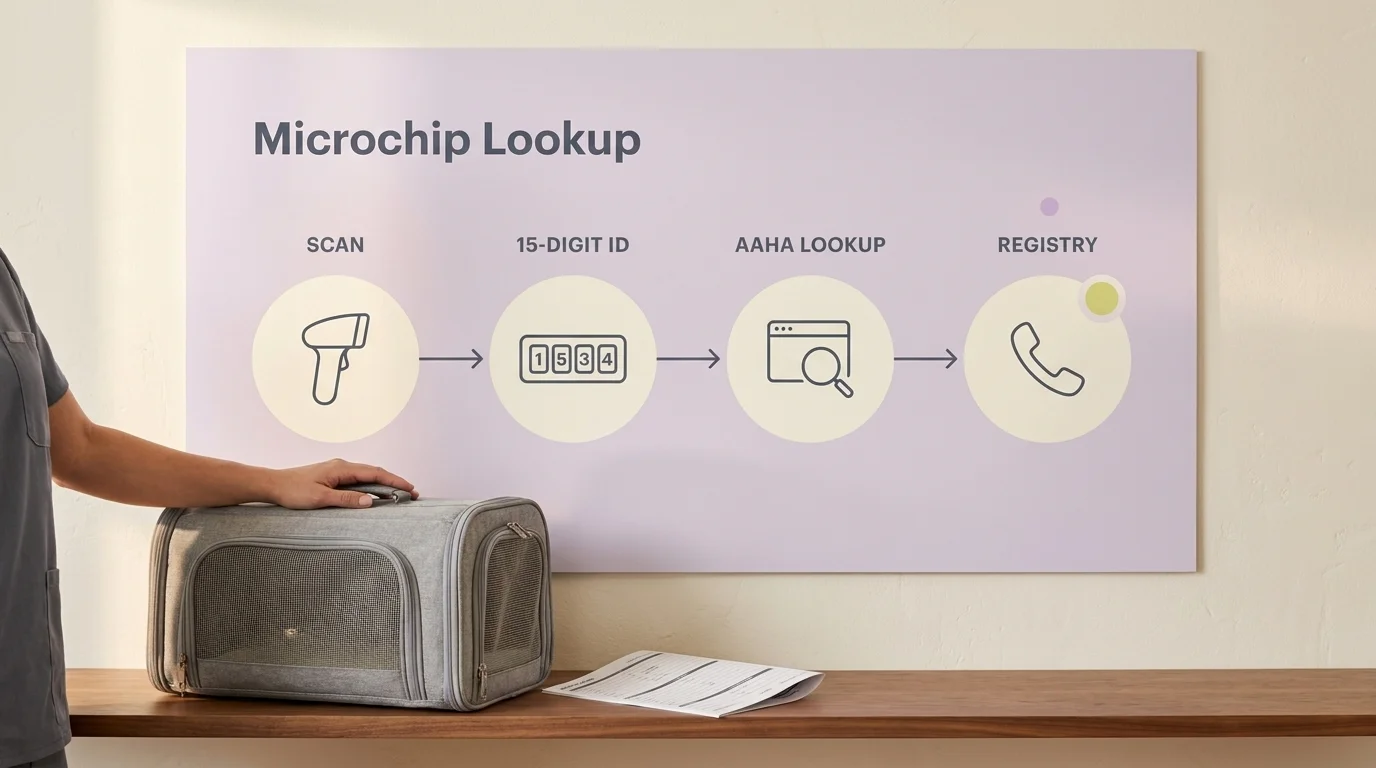
A finder brings the lost pet to a veterinary clinic, shelter, or animal-control officer. A staff member runs a universal scanner over the animal's shoulder area, neck, and (if no hit) the rest of the body. The scanner displays a fifteen-digit ID number. The staff member opens the AAHA Universal Pet Microchip Lookup tool at petmicrochiplookup.org and enters the ID.
Here is the part almost no consumer guide explains clearly: AAHA does NOT maintain its own database of owner contact information. The AAHA tool is a meta-search engine that queries every participating US chip registry and returns the list of registries that have a record of that specific chip ID, in chronological order by most-recently-updated record. The finder or shelter staff then has to contact each returned registry individually to retrieve the actual owner contact information. Most registries have 24-hour recovery hotlines specifically for this call.
The implication for owners: if your chip ID returns a result from a registry whose contact information is years out of date, that is a dead end in the chain. The reason the AAHA tool sorts by most-recent-update is to surface your most-current registration first. If your most-current registration is the free one you added six months ago with your new phone number, the finder reaches you within an hour. If your only registration is the one auto-generated by the vet clinic years ago with your old email address, the finder is calling a number that does not work. The technology is doing its job; the contact-info maintenance is the part that has to come from the owner.
The history of pet microchipping (the corrected version)
The pet RFID microchip system as it exists today was developed and commercialized by Dr. Hannis L. Stoddard and the team at AVID Identification Systems, founded in 1985. AVID's Animal Identification System, which still operates the PETtrac recovery service today, became the first widely deployed US pet microchip platform and established the engineering template that Destron Fearing, Trovan, Datamars, and the other major chip manufacturers built on. By the early 2000s the ISO 11784/11785 standardization had unified the major manufacturers' chip formats, enabling the universal-scanner ecosystem that makes today's reunion chain possible.
In aggregate market terms, the global veterinary microchip market reached approximately $695 million in 2024 and is projected to grow at a roughly 6% compound annual growth rate to about $1.4 billion by 2034. The drivers of that growth are the expanding national mandatory-chipping rules in Europe and Asia, the consistent expansion of US shelter scanning policies, and the emergence of biosensor variants that fold additional clinical readings into the same standard chip footprint — which is the next section.
A short note on the US regulatory landscape: Hawaii (2021) remains the only US state with a state-level mandatory pet microchipping law for owned pets. Twelve states plus the District of Columbia require shelters and pounds to scan incoming animals for chips, which is the policy that does most of the work for reunion-rate statistics. New York State Senate Bill S5488 (2025) is pending — it would require rescue organizations to be listed as a secondary contact on the chips of pets they adopt out. Most other US chip-policy expansion through 2025-2026 has been municipal, not statewide.
The 2025-2026 next generation: temperature-sensing chips
The genuinely new development in pet microchipping over the last three years is not GPS — which, as established above, is physically impossible on passive RFID. It is the integration of a temperature biosensor into the same standard-footprint chip. Merck/MSD Animal Health launched HomeAgain Thermochip in November 2022, which pairs the standard fifteen-digit identification with a subcutaneous temperature reading at scan time. AKC Reunite followed with its own temperature-sensing microchip launched in October 2025, readable through the AKC Reunite ProScan +Temp scanner.
The clinical use case is straightforward: shelter intake teams and busy clinic workflows can now take a basic temperature reading during the same scan that confirms the animal's identity, replacing the slower and more invasive rectal-thermometer procedure for routine baseline checks. The reading is not a continuous monitor — it captures the temperature at the moment of the scan, and only when the dedicated reader is held against the implant site — but for the specific workflows of shelter intake, low-stress wellness checks, and post-procedure recovery monitoring, it is a meaningful upgrade. Expect the temperature-biosensor variant to become a competitive baseline feature across the major US chip platforms through 2026-2027, the same way ISO standardization became universal in the early 2000s.
The other plausible next-generation feature most owners ask about — glucose or pH biosensing — remains in research, not commercial product. The power and signal constraints on passive RFID make non-trivial sensor integration genuinely difficult. Temperature was the clean first case because it requires minimal additional energy. Anything more complex will need either a hybrid active/passive architecture or a separate sensor entirely, and the existing GPS-collar and continuous-glucose-monitor categories are where that work is happening.
Where this leaves the 2026 pet owner
Émile is asleep on a chair in my friend's apartment as I write this, eighteen months after the Mile End reunion, blissfully unaware of the fifteen-digit number under his shoulder blades that did most of the actual work of bringing him home. The technology is small, durable, unglamorous, and one of the highest-value veterinary purchases any household will ever make. The cost is between zero and seventy dollars. The implant takes seconds. The registry update is a five-minute web form. The reunion rate the system enables is roughly two and a half times higher for dogs and twenty times higher for cats than the unchipped baseline. There is essentially no policy or technological objection that survives the simple arithmetic of those numbers.
The single piece of operational advice worth repeating, because it is the part that breaks: register the chip, then register it again in a free national portal, and update the contact information every time anything in your life changes. The technology is doing its half of the work continuously and silently for the entire life of the animal. The other half is the five minutes a year of household administration that keeps the registry record current. Émile is on a chair because somebody did both.
Frequently Asked Questions
No. Pet microchips are passive RFID tags — no battery, no signal, no location tracking. They only return a unique 15-digit ID when a scanner is held within a few inches of the implant site. To track your pet's location in real time, you need a separate GPS collar device with a battery and cellular or satellite link. The microchip and the GPS tracker do completely different jobs: the chip is for the day your pet ends up in a stranger's hands or at a shelter intake counter (the irrevocable, battery-free identification), and the GPS tracker is for the day you want to know which neighbor's yard your dog dug into. Most veterinary advice in 2026 recommends both.
The US national average is around $48, with most veterinary clinics charging $50-$70. PetSmart's Banfield clinics typically run $30-$50, Petco vaccination clinics are around $25, and municipal animal-services clinics and shelter adoptions often include the chip for free or at a heavily reduced rate. Cat-specific pricing is essentially identical to dog pricing — $50 to $65 at most clinics, $60 at a typical vet, free or near-free at municipal clinics. The implant procedure and the chip itself are the same across venues; what varies is the price.
Yes. The implant procedure takes seconds and the most common adverse event is mild chip migration under the skin — accounting for roughly 56% of all reported reactions, almost never with clinical significance for the animal. Infections account for about 6% of cases and respond to a short course of antibiotics. There are no verified cases of microchip-induced tumors in cats in veterinary literature, and the British Small Animal Veterinary Association's UK Microchip Adverse Reactions Group has documented just 2 tumors total across 10 years of mandatory UK reporting covering millions of chipped dogs. The reunion-rate benefit (52% for chipped dogs versus 22% unchipped) makes the safety-versus-benefit calculus straightforward.
Use the AAHA Universal Pet Microchip Lookup tool at petmicrochiplookup.org. Enter your pet's 15-digit chip number (no spaces) and the tool returns a list of participating registries that hold a record of that specific chip, in chronological order by most-recently-updated record. AAHA does NOT store owner contact information itself — it is a meta-search engine that points you to the registries that do. You then contact the listed registries individually to retrieve the actual owner contact information. Most major registries have 24-hour recovery hotlines specifically for this call.
AKC Reunite ($19.50 one-time, no annual fees, free updates for life) is the lowest long-term cost. HomeAgain ($19.99 base, $26.99/year Premium tier, $6 per contact update on the free tier) bundles lost-pet alerts and a 24/7 vet hotline at the Premium level. Free Pet Chip Registry and 24Petwatch's free national portal register any brand of chip at zero cost. The practical recommendation: register with whichever registry the chip implanter defaults to, and ALSO register the same chip with at least one of the free national portals — multiple registrations cost nothing and meaningfully increase the chance a finder reaches you. Whichever registries you choose, keep the contact information current — when you move or change phone numbers, update every registry within a week.
The pet RFID microchip system as it exists today was developed and commercialized by Dr. Hannis L. Stoddard and the team at AVID Identification Systems, founded in 1985. AVID's Animal Identification System became the first widely deployed US pet microchip platform and still operates the PETtrac recovery service. By the early 2000s, ISO 11784/11785 standardization had unified the major manufacturers' chip formats (Destron Fearing, Trovan, Datamars, AKC Reunite, and HomeAgain among them) into the universal-scanner ecosystem that makes today's reunion chain possible at any clinic or shelter worldwide.