


"Vet recommended pet food" is not a certification. No agency defines the phrase, no body audits it, and no manufacturer has to earn it before printing it on a bag. It sits in the same drawer as "premium" and "holistic": words with marketing value and no regulatory teeth.
That matters more than it used to, because owners are now bringing a second question to the shelf. In a survey of 1,066 US pet owners published in Frontiers in Veterinary Science in February 2026, 70.1% rated environmental sustainability as "very" or "extremely" important in their pet-food choices, and 81.1% said the same about animal welfare. Then the gap: 61.7% did not know that eco-certifications for pet food exist at all. And 69.4% said they trust their veterinarian on the subject.
So here is what this guide does. It explains what the phrase legally means, what test actually separates one manufacturer from another, who owns the brands that pass it, and what you can and cannot verify about a bag's footprint before you buy it.
What does "vet recommended" actually mean?
It means a veterinarian was involved somewhere, at some point, to some degree. That is the whole of it.
Compare that to the sentence on the back of the same bag, in eight-point type: the AAFCO nutritional adequacy statement. AAFCO is a private, non-profit organization that sets US nutrient profiles, and its statement tells you two things a marketing phrase never will — which life stage the food is formulated for, and whether that claim was substantiated by formulation (a recipe that meets the profile on paper) or by feeding trials (the food was fed to actual animals under protocol). Those are not the same standard, and only one of them costs the manufacturer real money. If you want the panel-by-panel walk-through of how to read a pet-food label, we have covered that separately; here I am only after the part that settles the "vet recommended" question.
Tufts University's Cummings School of Veterinary Medicine has been blunt about where the useful signal lives. Its Petfoodology team recommends using "more objective information for this important decision about what to feed your pet, such as nutritional expertise, quality control, and other important factors about the manufacturer."
Read that again, because it relocates the question. You are not evaluating a recipe. You are evaluating a company.
The WSAVA questions vets actually ask
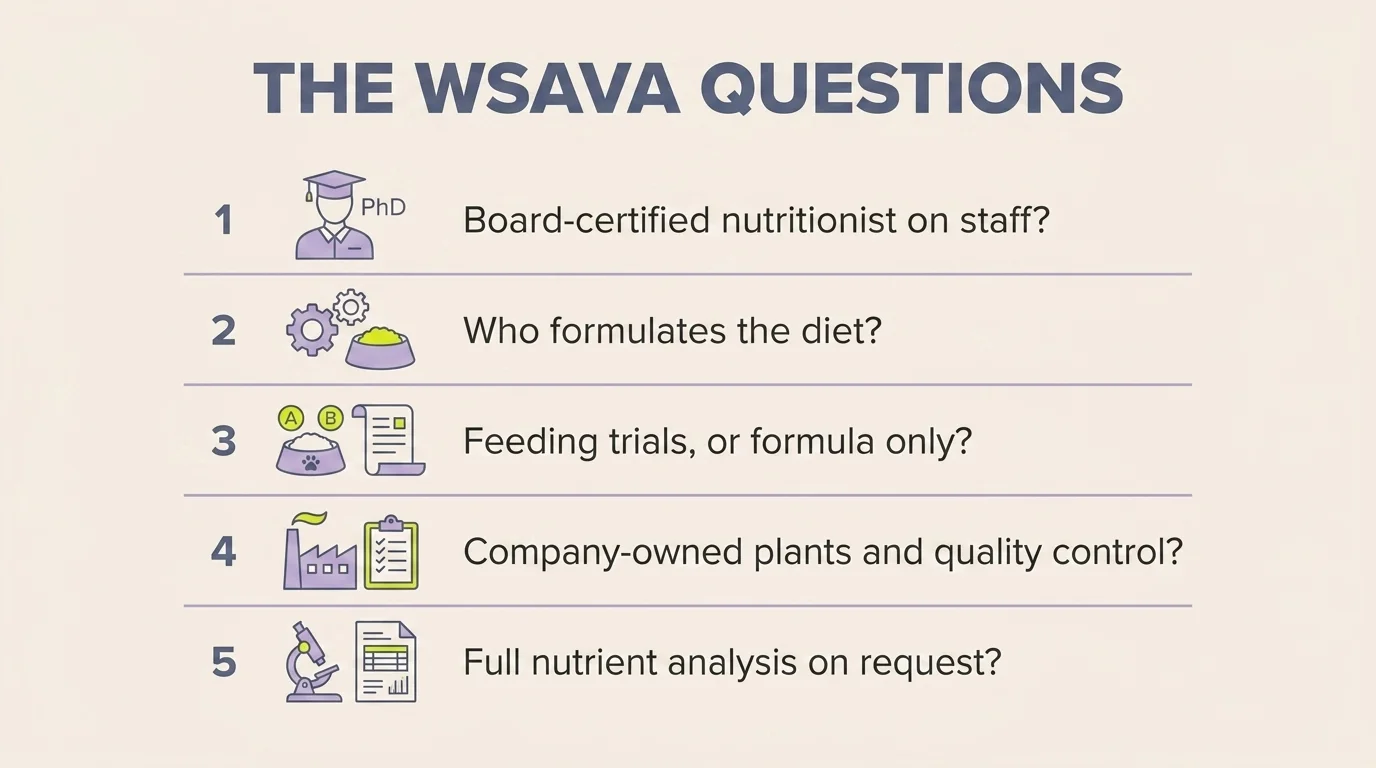
The World Small Animal Veterinary Association publishes the tool that does this. Its Global Nutrition Toolkit hands owners a short list of questions to put to a manufacturer:
- Do you employ a full-time qualified nutritionist — and is it a board-certified veterinary nutritionist (a DACVN or the European equivalent), or someone with a nutrition-adjacent job title?
- Who formulates your diets, and what are their credentials?
- Are your diets substantiated by AAFCO feeding trials, or by formulation alone?
- Do you own your manufacturing plants, and what quality-control measures do you run on ingredients and finished product?
- Will you provide a complete nutrient analysis for a specific product on request?
The critical detail, and the one that gets misreported constantly: WSAVA does not approve, endorse, or certify any brand. There is no such thing as "WSAVA approved dog food," strictly speaking. The guidelines focus on how to evaluate a company's credibility, nutritional expertise, and manufacturing transparency — the questions are the product, and the answers are yours to collect. A brand advertising itself as WSAVA-approved is telling on itself.
So the hierarchy is: AAFCO is the nutrient floor a food must clear to be sold as complete. WSAVA is the credibility bar above it, aimed at the manufacturer rather than the recipe. "Vet recommended" sits below both, on the front of the bag, where the marketing goes.
Related Article: Sustainable Practices in Pet Grooming Services: Eco-Friendly Innovations for Fur Salon Operations
Can vet recommended pet food also be sustainable?
Sometimes. But you almost certainly cannot verify it from the bag, and that is the actual story.
Start with why anyone is asking. The footprint is not marginal: dog and cat diets account for roughly 25–30% of the environmental impacts of US livestock production, and pets consume around 20% of all livestock animals in the country, according to a review published in Frontiers in Sustainable Food Systems in May 2025. The same review puts one dog's diet at about 7% of the annual climate impact of an average EU citizen. Whatever you think of the framing, these are not rounding errors.
Now the disclosure problem. Recall the Clark figure from the top: 61.7% of owners are unaware that pet-food eco-certifications exist. It is tempting to read that as a consumer-education failure. I would read it the other way. Owners are unaware these certifications exist in large part because they are not on the bags they are looking at. You cannot fail to notice a claim that was never made.
Which brings the two halves of this article together. An unsubstantiated eco claim is the same species of animal as "vet recommended": a phrase with no definition, no auditor, and no consequence for being wrong. "Eco-friendly," "sustainably sourced," and "responsibly made" are not certifications. MSC and ASC — the certified-fish schemes — are, because they involve a third party, an audit trail, and a chain of custody. The test is identical to the WSAVA test: is there someone independent behind this word, or just a copywriter?
What a "sustainability profile" covers
Three things, and each one is checkable in principle:
- Protein footprint. What the food is mostly made of. Poultry sits below beef; insect protein sits below both. Over 2025 and 2026, black soldier fly larvae moved from an allergy-only niche to a premium ethically-sourced staple, and more brands began sourcing only MSC/ASC-certified fish.
- Sourcing transparency. Not "we care about our planet." A named certification (MSC, ASC) with a chain of custody, or a named origin you could actually check.
- Packaging recyclability. Whether the bag is recyclable in practice, in your municipality — not whether the manufacturer has a recycling partnership press release.
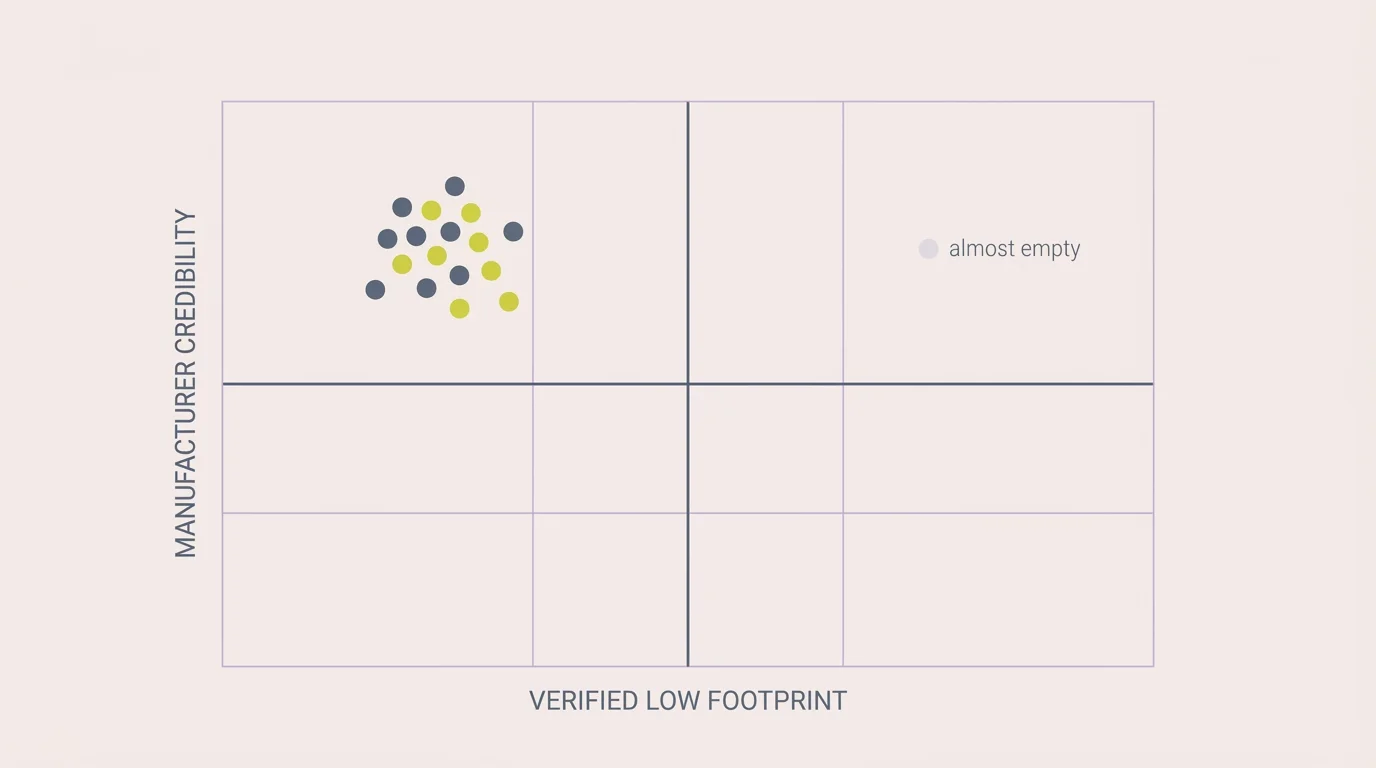
Apply that lens to the vet-grade shelf and the result is uncomfortable: the brands that most convincingly pass the WSAVA manufacturer test are not, on their own public-facing materials, making third-party-certified sustainability claims about the food itself. They publish corporate sustainability commitments. That is a different object. A corporate net-zero target is not a certification on the bag in your hand, and it should not be priced like one.
Cost is where this collides with reality. In the same 2026 study, 67.4% of owners named cost as the obstacle to buying sustainability-focused pet food — the single largest barrier. Any guide that tells you to simply buy the greener bag is not taking your budget seriously. It is a real trade-off, and it belongs in the pet sustainability conversation stated plainly rather than buried in a footnote.
The Big Three vet-recommended brands (and why they earn it)
Ask a veterinarian what they feed their own animals and three names come back: Purina Pro Plan, Hill's Science Diet, and Royal Canin. Each employs board-certified veterinary nutritionists, substantiates selected recipes through AAFCO feeding trials, and answers the WSAVA manufacturer questions.
The consensus is well-founded. Here is the part the roundups leave out: these three are not three independent companies. They are divisions of three of the largest consumer-goods corporations on earth, and the reason they pass the WSAVA test is inseparable from that fact. A full-time DACVN on payroll, company-owned plants, and multi-year feeding trials are fixed costs — affordable at sufficient scale, and not below it.
So the WSAVA test, applied honestly, is partly a test of corporate scale. That does not make it the wrong test: it is still the best one available to an owner, and the animals eating the food do not care who signs the checks. But you should know what you are measuring.
Purina Pro Plan
Parent company: Nestlé. The Swiss group lists Nestlé Purina PetCare among its businesses on its own corporate site. Pro Plan is the line vets most often name, on the strength of nutritionist formulation, feeding-trial substantiation, and company-owned manufacturing.
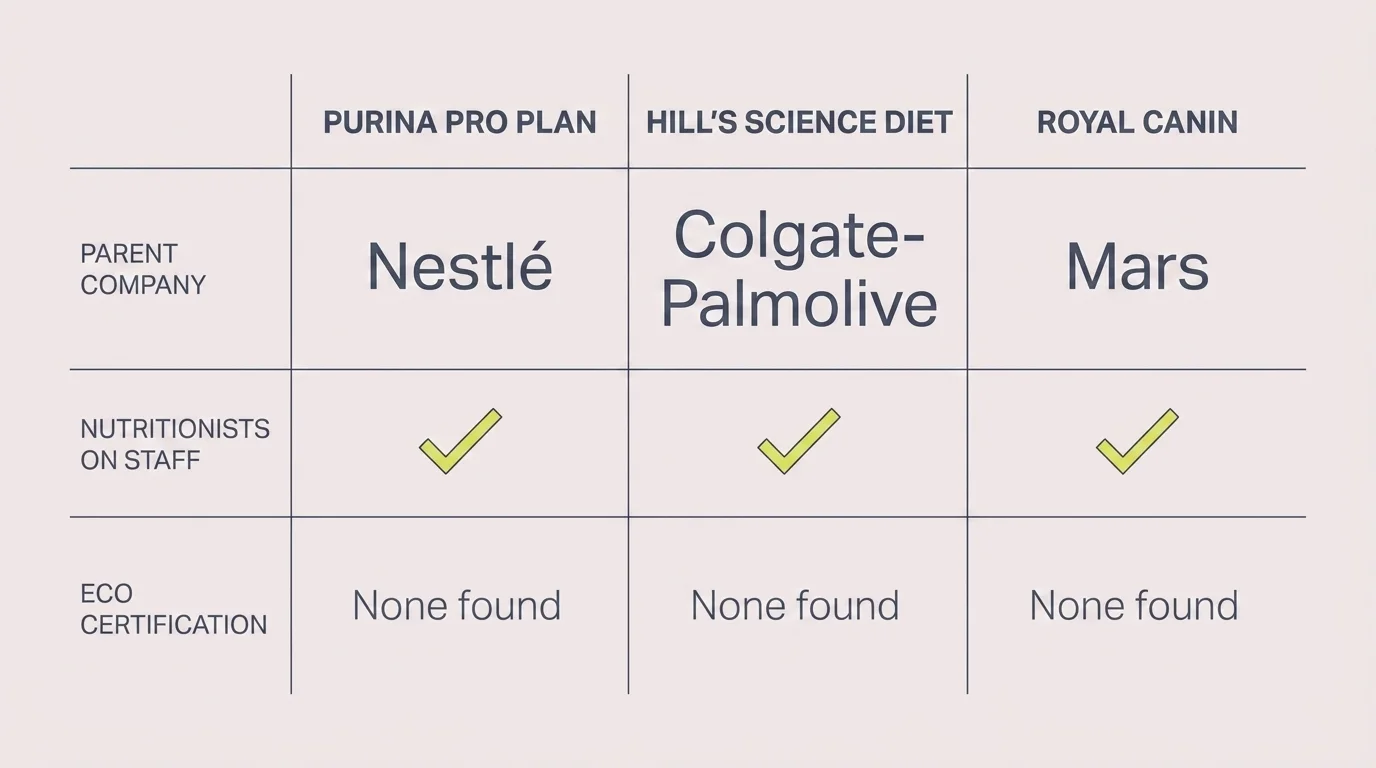
Sustainability profile: Nestlé publishes group-wide environmental commitments. I found no third-party eco-certification claim attached to the Pro Plan food itself. Corporate target, not a bag certification.
Hill's Science Diet
Parent company: Colgate-Palmolive — the toothpaste company. Hill's does disclose this, though you have to want it: on its own About Us page the ownership appears in footer text, folded into a sustainability line — "As a Colgate-Palmolive Company, our core values are the foundation of our commitment to sustainable development." Ownership disclosed as a virtue signal is still ownership disclosed, and it beats the alternative.
Hill's is also the most specific of the three about the WSAVA test, which is worth credit. Its own materials state it employs four diplomates of the American College of Veterinary Nutrition plus two veterinarians residency-trained in clinical nutrition, and runs a Global Pet Nutrition Center with 200-plus scientists and 900-plus dogs and cats. That is a checkable answer to question one, published without being asked. Most brands do not do that.
Sustainability profile: corporate sustainable-development commitment, per the line above. No third-party food certification found.
Royal Canin
Parent company: Mars, Incorporated. Mars lists Royal Canin among its Mars Petcare brands on its corporate site — so the ownership is public and not in dispute. It is simply not on Royal Canin's own US About Us page, where an owner would actually look: I reviewed that page on 16 July 2026 and found no visible-text mention of Mars. Royal Canin's pitch is breed-, size-, and life-stage-specific formulation, backed by nutritionist involvement and an endowed chair in small-animal clinical nutrition at Texas A&M — which Royal Canin itself paid for, committing $500,000 in June 2025 to establish the Royal Canin Small Animal Clinical Nutrition Endowed Chair at the university's veterinary college, and announcing the gift in its own press release.
That disclosure has to travel with the credential every time it is cited, because the credential is usually deployed as though a university had independently vouched for the brand. It has not. None of this impugns the chair's holder or Texas A&M's nutrition service — industry-endowed positions are ordinary in veterinary academia, and the work they fund is real work. But run it through this article's own test — is there someone independent behind this word, or just a copywriter? — and the honest answer is that the independent party was funded by the interested one. That is a conflict to disclose, not a credential to bank.
What it does illustrate, precisely, is the scale point above. Endowing a chair in perpetuity is a Mars-sized expense. The capacity to buy standing inside the academy is one more fixed cost that separates the Big Three from the rest of the shelf — which tells you something true about the company, and nothing at all about the food in the bag.
Sustainability profile: no third-party eco-certification claim found on the brand's own public materials.
| Brand | Parent company | Parent named on the brand's own About page? | Dog & cat lines | Nutritionist credentials published | Third-party eco certification on the food |
|---|---|---|---|---|---|
| Purina Pro Plan | Nestlé | Disclosed via Nestlé's corporate site | Both | DACVNs employed (reported) | None found |
| Hill's Science Diet | Colgate-Palmolive | Yes — footer, in the sustainability line | Both | Yes — 4 ACVN diplomates, self-published | None found |
| Royal Canin | Mars, Incorporated | Not in visible text; Mars discloses it corporately | Both | Nutritionist involvement, unquantified; endowed chair at Texas A&M is Royal Canin-funded | None found |
A note on that last column, because precision matters: "none found" means no third-party certification claim appeared in the brand's own public About-page materials as reviewed on 16 July 2026. It is not proof that no certification exists anywhere in a supply chain. But a certification the buyer cannot find is doing no work for the buyer.
Vet-recommended dog food: picks by need
Beyond the Big Three, the fresh and gently-cooked tier is now a standard inclusion in vet round-ups — JustFoodForDogs, Freshpet, Nom Nom, and The Farmer's Dog all appear regularly. Any search for the best vet recommended dog food will surface them within the first screen.
What I cannot tell you is whether any of them clears the WSAVA bar. The sourced material behind this guide establishes that answer for the Big Three and nowhere else: I found nothing documenting a full-time board-certified nutritionist, feeding-trial substantiation, or company-owned plants for the fresh tier, and I am not going to assert it because a round-up implied it. That is a gap in the public record, not a verdict against the food. It is also the exact question to put to those brands directly, using the five questions above — and how they answer is itself the answer.
Before you read that list as an escape from corporate pet food, check the ownership again. Nom Nom appears on Mars's own brand list — the same list as Royal Canin. So do Orijen, Acana, Eukanuba, Iams, and Nutro. The fresh-food aisle looks like a rebellion against the Big Three. Some of it is a Big Three subsidiary with better photography.
This is the reflex worth building: when a brand is positioned as the independent alternative, find out who owns it before you accept the framing. It takes about ninety seconds and it changes what you are actually choosing between.
On format, and specifically on the best dry dog food vet recommended question: dry kibble is the cost- and footprint-efficient option, and it is what most veterinarian recommended dog food lists center on for exactly that reason. Fresh and gently-cooked food is more resource-intensive per calorie and generally more expensive per day. If the 67.4% cost barrier is your barrier, dry food from a manufacturer that passes the WSAVA questions is a completely defensible answer, and no one should make you feel otherwise.
Match the pick to the animal in front of you: activity level, body condition, any diagnosed sensitivity, and what your dog will reliably eat. A food with immaculate credentials that your dog refuses is not nutrition. The everyday dog nutrition questions — the AAFCO panel, the calorie math, what a supplement claim is actually worth — sit underneath the brand question, and they are worth settling first.
Vet-recommended cat food: the underserved shortlist
Cats get less editorial attention than dogs, and it is not because owners are not asking. Go looking for vet recommended cat food and the question comes back answered mostly by pages about dogs — PetMD's round-up is exclusively canine, and the clinic listicles skew to puppies. The cat question gets a fraction of the editorial attention the dog question does.
The good news is that the framework does not change. The WSAVA questions are species-neutral, and all three of the Big Three run cat lines: Hill's Science Diet, Royal Canin, and Purina Pro Plan. When people ask for vet recommended cat food brands, those are the ones that clear the same manufacturer bar, chosen by life stage and any prescribed therapeutic need.
Two things are genuinely different for cats.
First, water. The wet-versus-dry conversation carries more weight for cats than it does for dogs — the reasoning being that cats are indifferent drinkers who take much of their water in food — and it carries most weight for animals with a history of urinary problems. That is a clinical judgement, not a shopping preference — if your cat has any urinary or kidney history, this is a conversation for your veterinarian, not a comparison table.
Second, fish. Cat diets lean on fish far more heavily than dog diets, which makes marine sourcing the one place a sustainability profile is most concretely checkable. MSC and ASC certification exists precisely for this, and more brands are sourcing certified fish. If you are going to check one certification on one product for one animal in your household, make it the fish in the cat's bowl. It is the claim most likely to be real and most likely to matter.
Prescription and life-stage diets: puppy, kitten, and therapeutic
Therapeutic / prescription diets
Therapeutic diets — renal, urinary, hepatic, hydrolysed-protein allergy formulas, prescription weight management — are a different category, and the WSAVA framework is not the deciding tool here. These foods are formulated to manage a diagnosed condition, they are dispensed under veterinary direction, and the reason they are gatekept is that feeding the wrong one to the wrong animal can cause harm. A renal diet is restrictive by design; that restriction is therapeutic in a cat with kidney disease and inappropriate in a healthy one.
Which is the moment for the disclaimer this article has earned the right to make plainly. I am a reporter. I read labeling law, corporate filings, and disclosure documents, and everything above is about what companies tell you and what the rules require of them. None of it is a diagnosis, and none of it can be. If your animal has a chronic condition, the food decision belongs to your veterinarian, who can examine the animal — and the correct use of this article is to help you ask them sharper questions, not to substitute for the visit.
The sustainability lens does not get a vote here either. If a therapeutic diet is keeping an animal alive, its footprint is not the deciding variable. Say so honestly rather than pretending every purchase is an ethical referendum.
Puppy and kitten (growth-stage) foods
Growth is the other place the eight-point type earns its keep. Vet recommended puppy food and kitten food need an AAFCO nutritional adequacy statement naming growth or all life stages — not "adult maintenance." A food formulated for adults will not meet a growing animal's requirements, and the bag will tell you which it is if you turn it over.
For large-breed puppies there is a further line to look for, and it is label law rather than a marketing tier. Since 2016, a growth or all-life-stages statement has had to specify whether the food is suitable "including growth of large-size dogs (70 lbs or more as an adult)" — or except for them. Two words, and they change the answer completely. Tufts' clinical nutrition service explains why the rule exists: large- and giant-breed puppies "are more sensitive to an excess or shortage of calcium while their bones are growing," so the permitted calcium range is narrower for them. That is a board-certified veterinary nutritionist's judgement, not mine. My half of it is narrower and duller: the distinction is required on the label, it is printed on the bag you are already holding, and reading it costs nothing. All three of the Big Three publish life-stage and large-breed growth lines for dogs, and kitten lines for cats.
Red flags: brands vets say to approach with caution
The red flags are the WSAVA questions, inverted. No board-certified nutritionist on staff. No feeding trials — formulation only. No company-owned plants, or no answer at all about quality control. A brand that will not give you a nutrient analysis for a product it is selling you has told you something, and a brand that answers "vet approved dog food" when you asked who formulates its diets has told you more.
The grain-free question deserves precision, because it is routinely mangled in both directions.
Here is what is true. In July 2018 the FDA opened an investigation into reports of dilated cardiomyopathy in dogs eating diets — many labelled grain-free — that were high in peas, lentils, other legume seeds, and potatoes, including in breeds with no known genetic predisposition to the disease. The agency has not established causation, and it has said it will issue further public updates only when there is meaningful new scientific information. A 2025 narrative review in Veterinary Sciences puts the current state carefully: "Current evidence supports an association between grain-free diets and the development of DCM in dogs," while "the influence of diet on observed cases of DCM remains not fully understood."
Association, under investigation, mechanism unresolved. That is weaker than "grain-free food causes heart disease" and considerably stronger than "it was debunked." Both of those sentences are being sold to you by someone. If your dog has no diagnosed grain allergy, there is no nutritional case for grain-free in the first place — which makes the risk calculus straightforward regardless of how the science lands, and the dog food brands to avoid list writes itself from the manufacturer questions rather than from the ingredient panel.
And the greenwashing flag, which belongs in the same list for the same reason. An "eco" claim with no MSC, no ASC, and no recyclability substantiation is exactly as empty as "vet recommended" with no nutritionist behind it. Same failure, different aisle. Both are words printed by the party who profits from you believing them, with no third party in the room.
The bottom line
"Vet recommended pet food" only means something once you apply the test underneath it: a board-certified nutritionist on staff, feeding trials rather than formulation alone, quality control the company will describe, and an AAFCO statement that matches the animal you actually own. Start with the manufacturers that pass, route to your species and life stage, and hand any chronic condition to your veterinarian.
Then add the two questions this guide exists to give you. Who owns this brand — and does the brand say so? And is that sustainability claim a certification with an auditor behind it, or a sentence someone wrote?
Ask those at the shelf, and at your next appointment. You will not get a straight answer every time. The pattern in who declines to give you one is itself worth reading — and if you want to bring your household's footprint down without touching the nutrition, that work is in our pet sustainability coverage, not on the front of a bag.
Frequently Asked Questions
Often, but the price isn't the point — the manufacturer test is. "Vet recommended" is an unregulated phrase you can print for free, so what you should be paying for is a board-certified veterinary nutritionist on staff, AAFCO feeding trials rather than formulation alone, and quality control the company will actually describe. Some picks that pass are mid-priced. Cost is the top barrier owners cite (67.4% name it for sustainability-focused food), and dry food from a manufacturer that answers the WSAVA questions is a defensible answer on a budget.
AAFCO sets the US nutrient-profile floor and defines how a food substantiates its claim — by formulation (meets the profile on paper) or by feeding trials (fed to animals under protocol). WSAVA sits above it and evaluates the maker rather than the recipe: nutritionist on staff, feeding trials, quality control, manufacturing transparency. Importantly, WSAVA endorses no brands and certifies nothing, so there is no such thing as a genuinely "WSAVA approved" food — the guidelines are questions you ask, not a seal a brand can buy.
Most are cautious, and the accurate version matters. The FDA opened an investigation in 2018 into canine dilated cardiomyopathy (DCM) in dogs eating diets high in peas, lentils, legumes and potatoes — many labelled grain-free — but it has not established causation. A 2025 review in Veterinary Sciences concludes current evidence supports an association while the influence of diet on DCM "remains not fully understood." Association, unresolved mechanism. Unless a grain allergy is diagnosed, there's no nutritional case for grain-free anyway.
The same manufacturer test applies to cats, and all three of the Big Three run WSAVA-compliant cat lines — Hill's Science Diet, Royal Canin, and Purina Pro Plan — chosen by life stage and any prescribed therapeutic need. Two things differ for cats: hydration makes the wet-versus-dry question weightier, especially with any urinary history (a veterinary conversation, not a shopping one), and cat diets lean on fish, which makes MSC or ASC certification the one sustainability claim most likely to be both real and relevant.
It's usually black soldier fly larvae — digestible, complete when formulated to an AAFCO profile, and lower-footprint than beef. Once an allergy niche, it moved to a premium sustainable staple across 2025–2026. Apply the same scrutiny you'd apply anywhere else: check the AAFCO nutritional adequacy statement on the back for the life stage you're feeding, and treat "eco-friendly" with no named third-party certification behind it as marketing rather than evidence.