

You are three minutes into a scroll you did not plan, and somewhere around the fourth round-faced kitten your chest does something involuntary. This is usually the point where an article about cute cats hands you two hundred photos and walks away.
I would rather tell you what just happened to you.
That reaction is not silly, and it is not random. It is a response to a specific and measurable set of facial proportions — and the genuinely remarkable part, the part I still turn over after years of doing this work, is that cats living alongside humans have changed shape in a direction that makes the response stronger. Not learned. Changed.
So you get both halves here. Below is the scroll you came for: adorable cats, a kitten gallery, and the cutest cat breeds worth knowing in 2026. Underneath it is the why — the baby-schema research, the 2022 study that measured cat faces against their wild ancestors', and a slow-blink trick you can test on your own cat tonight.
Cute Cats, Curated — A Gallery Worth the Scroll
Here is the part you came for. I have not ranked them, because ranking cuteness is a mug's game and I would lose that argument to my own three cats before breakfast.
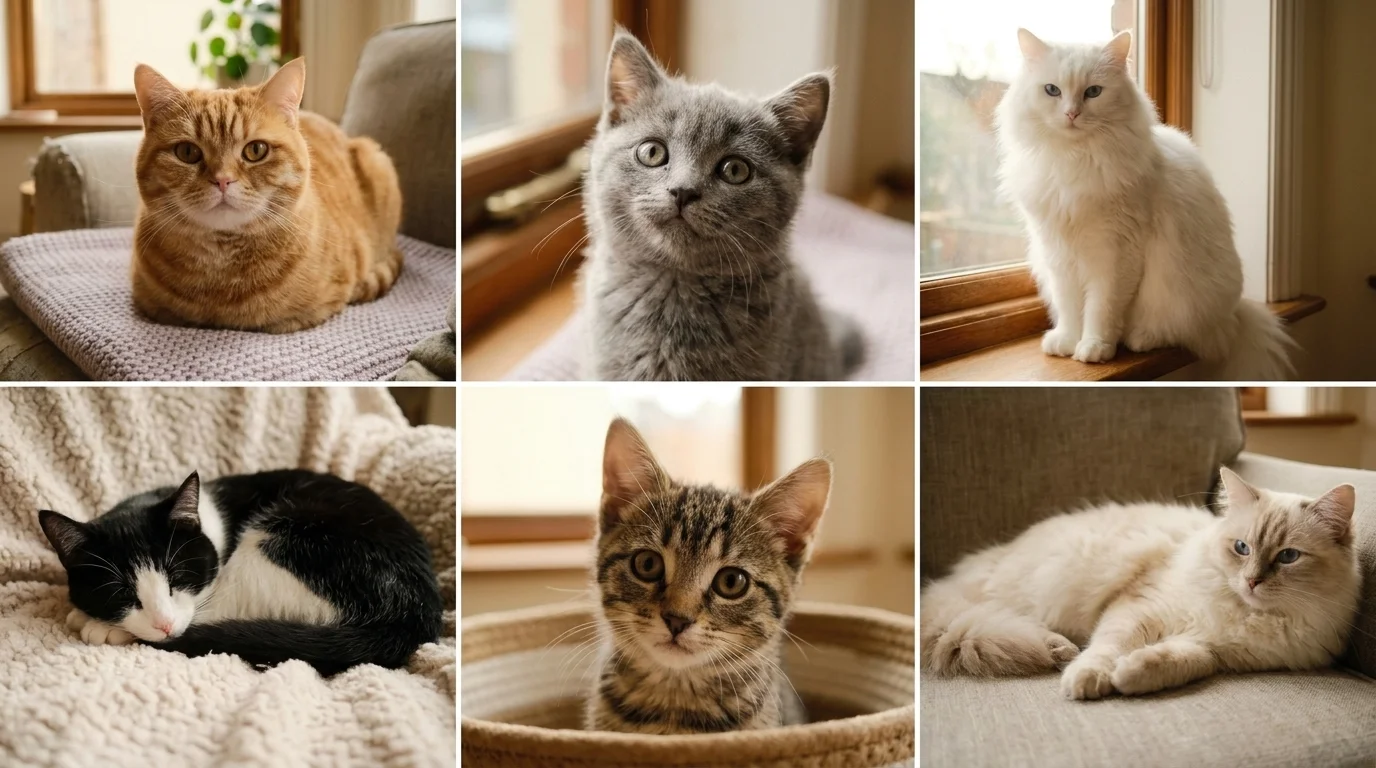
What I would ask you to notice is where your eye lands. Not the coat. Not the pose. It goes to the eyes first, then drops to the short distance between the eyes and the nose, and it does that before you have consciously decided anything at all.
That is the whole trick, and it is why a curated run of adorable cats is not the same thing as a folder of beautiful cat pictures. Aggregators can give you volume — thousands of cute cat photos, endlessly, forever. What they cannot tell you is what you are reacting to.
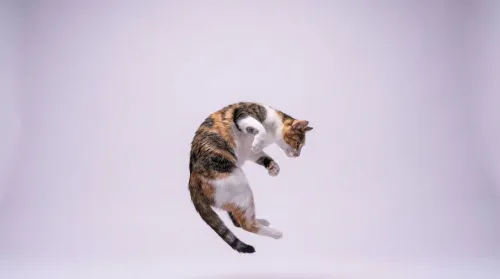
So, briefly, wearing my working hat. When a cat flattens into a loaf, the legs vanish and the body reads rounder and smaller than it actually is, which is to say closer to a kitten's proportions. When a cat looks slightly up at you, the forehead dominates the frame and the eyes sit lower in the face — precisely the geometry the research further down says we are tuned to. When the ears are large relative to the skull, the head reads younger than it is.
None of this makes the cats less lovely. It makes them more interesting. You are looking at a cluster of features that reliably does something to the mammalian caregiving system, worn by an animal whose face has measurably changed inside our houses.
Scroll. Melt. Then stay, because the why is better than the photos. If this is the kind of reading you want more of, more feline behavior is where I keep it.
Why Are Cats So Cute? The Behavior Science
Cats trip almost every "baby schema" cuteness trigger — big eyes, round face, small nose — and a 2022 study suggests they have evolved to do it even more.
Baby schema — the cuteness blueprint
The ethologist Konrad Lorenz gave the thing a name in 1943: Kindchenschema, the baby schema. Borgi and colleagues, who went on to test it, define the cluster precisely — a large head and a round face, a high and protruding forehead, large eyes, and a small nose and mouth, found in human and animal infants alike. The proposal is that the cluster works as a releaser for caregiving. You do not decide to find it cute. You find it cute, and then you build a reason afterwards.
What matters here is that the effect is not fussy about species. Borgi and colleagues put it directly in the title of their 2014 paper in Frontiers in Psychology: baby schema in human and animal faces induces cuteness perception.
The cat, though, did not grow those features for us. My reading — ethology, not a study I can hand you — is that a solitary hunter needs large forward-facing eyes for depth, and that the rest is a compact predator's skull with a short muzzle. Cats backed into the baby schema sideways, on their way to being very good at killing small things. Then we turned up and read a hunter's face as an infant's.
Cats have literally evolved cuter faces
This is the finding I put in front of anyone who thinks cat cuteness is just vibes.
Researchers analysed 3,295 photographs across three groups: African wildcats, feral domestic cats, and owned domestic cats. Owned cats had significantly shorter noses and rounder eye angles than the wildcats. And, separately, faces with shorter noses were rated as cuter.
On its own that is a correlation, and I would not lean on it. What makes the study worth your attention is the control group. The feral cats — same species as the owned cats, living without human households — showed no meaningful shift away from the wildcats. The change tracks living with humans, not being a domestic cat.
Then the detail that made me sit up. The effect was not correlated with how many years a cat had lived with its owner. So this is not a cat's face softening over a lifetime in your company. It is transgenerational. Whatever happened, happened across generations of cats in our houses, and it is written into the population rather than the individual.
There is a softer data point that gets passed around alongside it: domestic cats' brains run roughly a quarter smaller than their wild ancestors', and smaller skulls shift proportions toward the rounder, compact look we read as cute. I will label that one honestly — I have it from a summary rather than the primary literature, so treat it as texture, not evidence.
The headline stands without it. We did not simply notice cute cats. We made them.
The slow-blink "cat kiss" — try it tonight
The slow blink is not folklore, and it is the one part of this article you can go and test in the next ten minutes.
A University of Sussex team ran two controlled experiments and published them in Scientific Reports in 2020. In the first, cats were more likely to slow-blink back when their own owner slow-blinked at them. In the second, cats were more likely to approach a stranger who had slow-blinked at them than one holding a neutral face.
Two experiments, under controlled conditions. A small finding in a small corner of feline science — and I say that as someone who cares about it enormously. It matters not because it is large but because it is tested, and most of what gets said about cats is still clinical experience and careful observation in a confident voice.
How to actually do it — which the paper does not cover, and which I am giving you from practice rather than from data. Do not stare. A hard unblinking gaze is not a friendly signal in cat, whatever it means across a dinner table. Catch your cat's eye, let your lids drop slowly, half-mast is plenty, hold it a beat, then look softly away. The looking away is not optional. That is the polite part.
If she blinks back, you have had a conversation. If she does not, that is not a rejection either — that is a cat declining to answer, which is entirely her business.
The study's lead author, Dr. Tasmin Humphrey, and her co-authors frame the value of this sort of work as a welfare question: understanding "specific ways in which cats and humans may interact positively, such as through eye narrowing movements, can enhance public understanding of cats and feline welfare".
Note the hedges in that sentence. Specific ways. May interact. That is what careful looks like, and it is a large part of why I trust the finding at all.
Cute aggression — so cute it hurts
You know the feeling. The kitten is simply too much, your hands want to squeeze, and some appalled corner of you wonders what exactly is wrong with you.
Nothing is wrong with you. It has a name — cute aggression — and an EEG study behind it. Katherine Stavropoulos and Laura Alba put electrode caps on 54 participants aged 18 to 40 and showed them images; cuter animals correlated with heightened activity in emotion- and reward-related regions of the brain.
The interpretation is the good part. Stavropoulos described it as the brain hauling itself back from the edge of uselessness: "A baby can't survive alone, but if you're so overwhelmed by how cute it is and how much you love it, then you can't take care of it."
Read that twice, because it inverts the whole thing. The small violent flicker is not a failure of your caregiving response. It is your caregiving response, throttling itself so that you stay functional around something fragile. The squeeze urge is care, wearing a strange coat. If this is your sort of thing, the science of cat behavior is most of what I write about.
Does Being "Cutest" Actually Help a Cat Get Adopted?
Surprisingly, no clear boost: an Irish shelter study found a kitten's "baby-schema" cuteness did not reliably shorten how long it waited for a home.
I spent six years running a shelter cat program on the west coast of Ireland, mostly with the long-stay residents — the undersocialised ones, the cats who had been there long enough that the volunteers had quietly stopped photographing them. So I have a stake in this next finding, and it is not the one I expected.
Jack and Carroll set baby-schema scores against length of stay in an Irish shelter and published the result in Animals in 2022. If cuteness were the currency everyone assumes it to be, the round-faced ones would go home first and fastest. That is not cleanly what the data showed: baby-schema scores did not reliably predict a shorter wait.
One study. One shelter. One country. I am not going to tell you that cuteness counts for nothing on an adoption floor, because I have watched a kitten clear a building in an afternoon. But the tidy story — the one where the cutest cat wins — does not survive contact with the numbers.
Which squares with what the long-stay cats taught me anyway. What moves a cat out of a shelter is more often a story someone can hold on to, a personality that shows itself inside a ten-minute visit, and a staff member who can say something true and specific about who this animal actually is. The cats who wait longest are rarely the plain ones. They are the ones who do not perform well under fluorescent light and stranger noise, which is not remotely the same thing.
So look past the round face. Not instead of it. Past it.
The Cutest Cat Breeds in 2026
The cutest cat breeds pair baby-like features with signature quirks — think the Ragdoll's size, the Scottish Fold's folded ears, and the Munchkin's tiny legs.
One honest note before the list, because I would not be doing my job if I skipped it. Some of the features below are cute because they are unusual, and a few are unusual because of mutations affecting cartilage, bone, or the shape of an airway. Folded ears, very short legs, and very flat faces all sit in that group. The cats are not one bit less lovely for it and I will not pretend otherwise. But I would rather you know what you are looking at, and I would rather you talk to a vet about the breed you are drawn to before you talk to a breeder. That is my position as a behavior consultant. It is not a finding I can hand you a study for, and I would rather tell you which is which than blur the two.
The dozen cute cat breeds Catster settles on for 2026 are the ones you would probably predict, this one included:
- Ragdoll. Big, silky and blue-eyed, and known for going limp when lifted. The size is the joke — an enormous cat wearing a kitten's face.
- Scottish Fold. Folded ears round the head into something almost owl-like, which is exactly why the breed reads cute. See the note above; the fold is cartilage, and it was never only an ear thing.
- Maine Coon. Enormous, shaggy, lynx-tipped ears. The cuteness here is not baby schema at all — it is scale, plus an unusually amiable way of handling people.
- Devon Rex. Huge low-set eyes, enormous ears, a wedge of a face, soft curly coat. Almost cartoonishly infantile proportions — the schema at its most literal.
- Munchkin. Very short legs on an otherwise normal cat, which keeps the silhouette low and kittenish for life. Another conformation worth reading that note about.
- Persian. The flat face is the entire aesthetic: round skull, big round eyes, barely a nose. It is also the flattest airway on this list, and I would not choose one without a long conversation with a vet first.
- Birman. Silky, blue-eyed, white-gloved at the paws. A softer, less structural cuteness — mostly colour and expression.
- Norwegian Forest Cat. Built for weather: dense coat, tufted ears, heavy ruff. Cute the way a small bear is cute, which is to say by being simultaneously large and round.
- Siberian. Triple-coated and sturdy, with a round face hiding under all that fur. Big-cat frame, kitten's expression.
- Abyssinian. The outlier. Lean, ticked coat, huge alert eyes and ears, no baby face whatsoever. Cute for being ridiculously interested in everything in the room.
- Singapura. One of the smallest breeds going, eyes and ears oversized against a tiny head. Pure proportion — the schema achieved by simply staying small.
- American Curl. Ears curling backwards give a permanently surprised, open expression. A quirk mutation rather than a baby-schema feature.
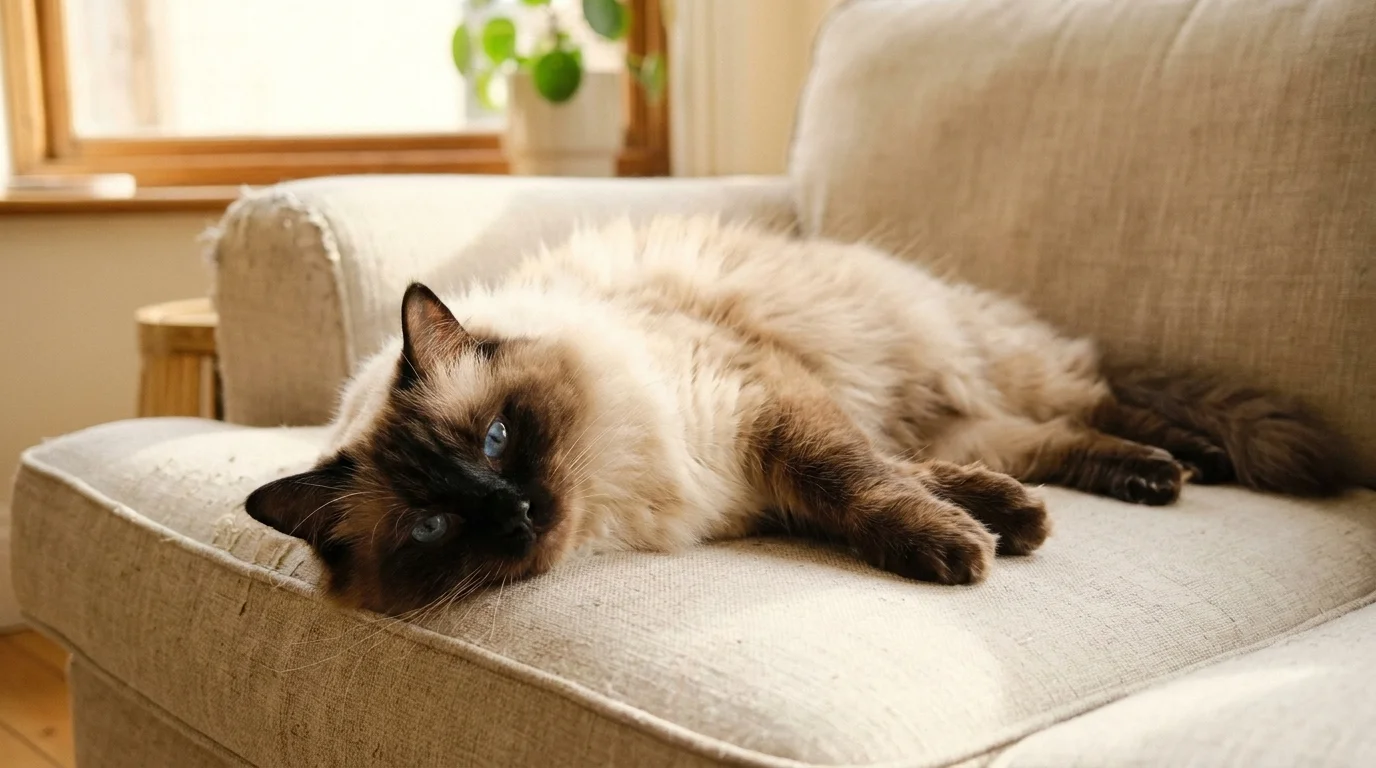
And one more thing, since we are here. Every breed on that list turns up in shelters and in breed-specific rescue, Ragdolls and Persians included. If a particular face is what pulls you, that is fine — it is what this entire page is about. Just check the rescues before you assume you need a breeder.
Cute Kittens — Baby Schema at Its Peak
Kittens trigger the strongest cuteness response because their oversized eyes, domed foreheads, and tiny bodies are baby schema turned up to maximum.
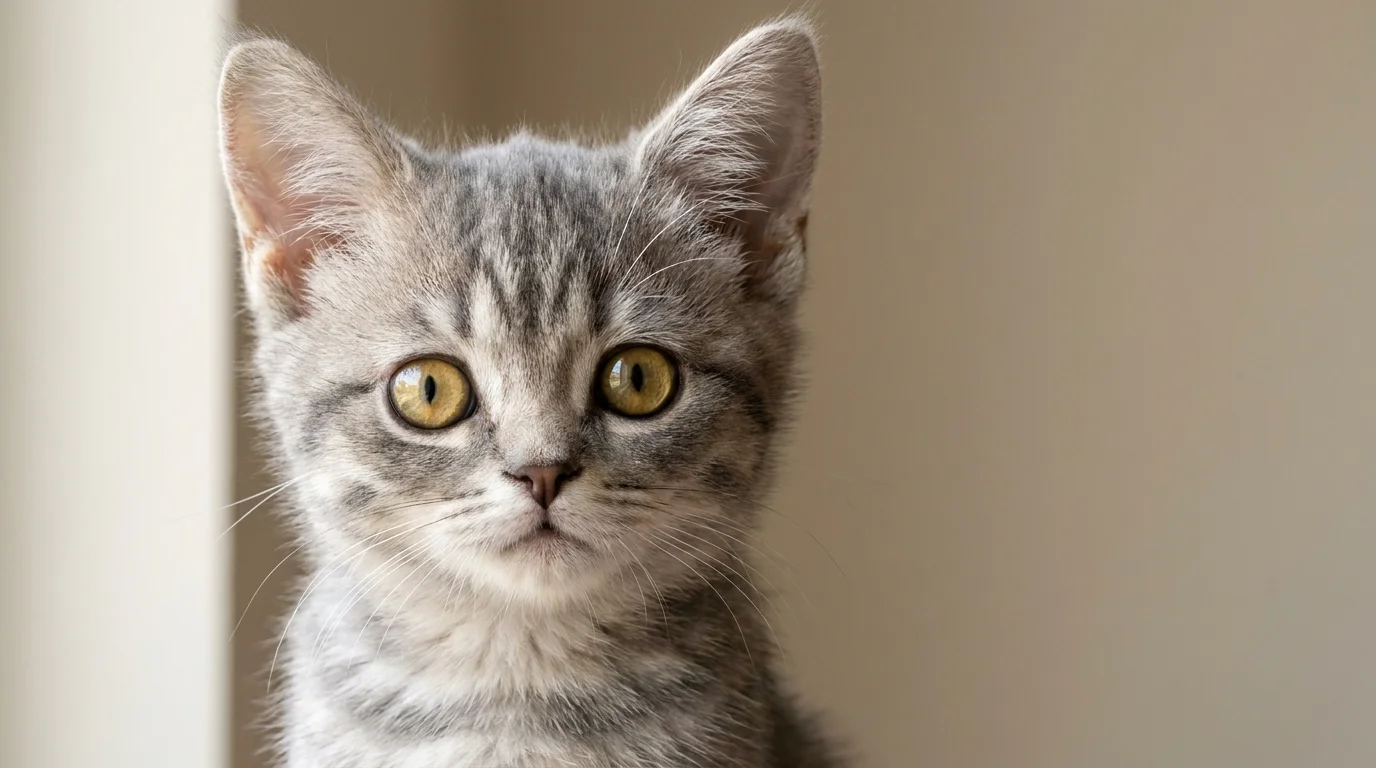
If the schema is the mechanism, cute kittens are the mechanism with the dial pushed all the way over. Everything it keys on, a kitten has in surplus. The eyes sit oversized in the face. The forehead domes. The nose is barely present. The head is large and the body is not, which is the classic infant ratio — Borgi's feature list, more or less item for item.
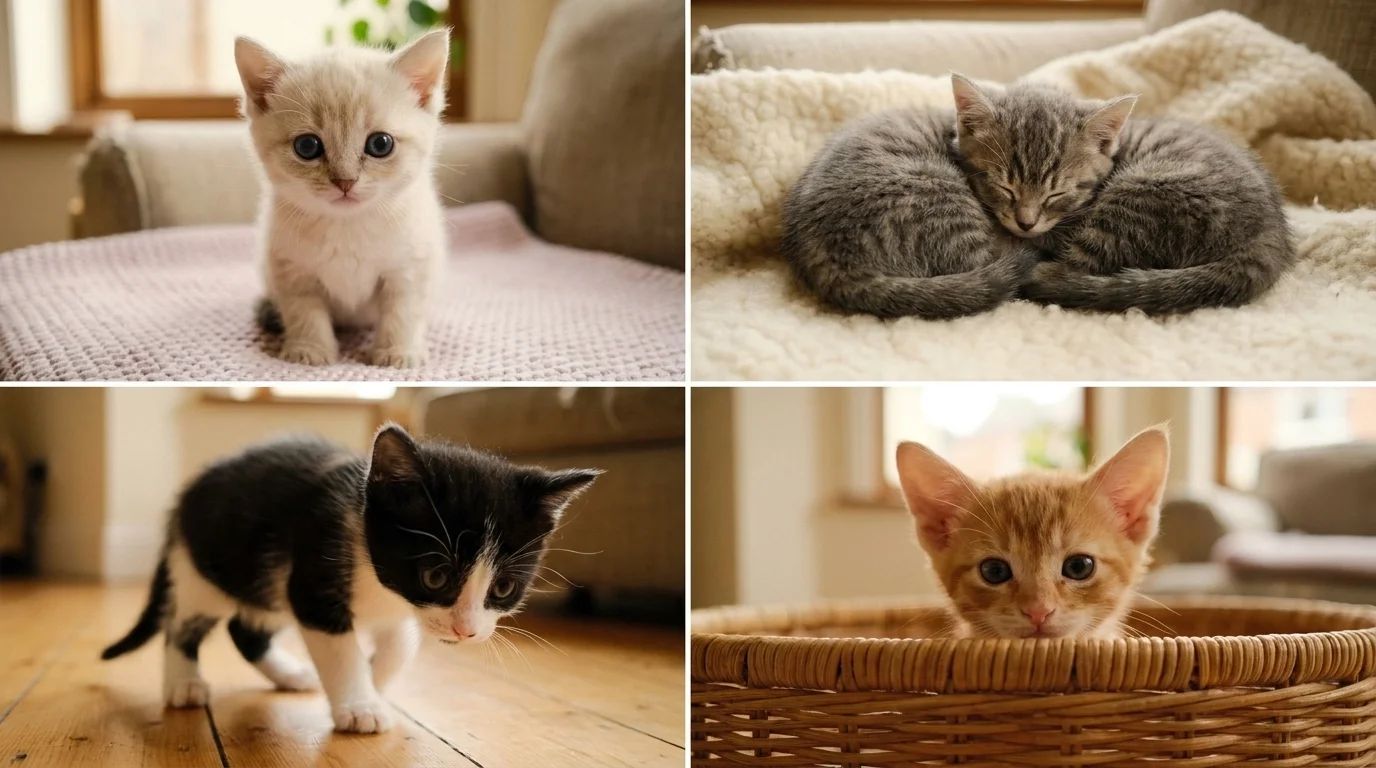
Then add the cue a photograph cannot carry: kittens move badly. They misjudge jumps. They fall off things they were extremely confident about a half-second earlier. Clumsiness reads as youth too — and my hunch, offered as a hunch, is that it is doing more work in your reaction than you would guess.
The veterinarian Dr. Amanda Takiguchi makes the adjacent point about cats generally — that they hold on to "a lot of infantile personality traits, like playfulness, curiosity, coyness, occasional clumsiness, and above all, affection". Kittens are that with no adult layer over the top yet.
A note I cannot help making, because it is my actual job. The kitten window is short, and it is not only a photography opportunity. It is also when a cat works out what counts as normal — hands, noise, other animals, being picked up and put down. What happens in those early weeks tends to follow a cat for the rest of its life. So if there is a very cute kitten in your house right now, the most useful thing you can do with that ache in your chest is spend it on gentle, unhurried socialisation: short handling sessions, new textures, visitors who understand the word no. And on choosing a name, which will take you far longer than you expect and matter rather less than you fear.
The window closes. The cats stay wonderful. It just stops being quite so loud about it.
Cutest Cat Videos & Where Cuteness Goes Viral
Still photographs undersell cats, and the search behaviour agrees — cute cat videos pull steady demand of their own, and video results sit near the top of this search for a reason.
My honest opinion, labelled as opinion: motion is where cat cuteness actually peaks, because motion carries what a still cannot. The clumsiness. The over-committed pounce that ends in a skid across the floorboards. The full predatory sequence — stalk, chase, pounce, grab — run with total gravity by an animal the size of a slipper, against a bottle cap. A photograph gives you the face. Footage gives you the mismatch between how seriously a kitten takes itself and how comprehensively it is failing, and that mismatch is most of the comedy and a decent share of the tenderness.
Which is roughly why the internet went the way it went. I have no data on virality and I am not going to invent any. But if the baby schema does what the research says it does, and movement stacks a second layer of infant cues on top of it, then fifteen seconds of a kitten sliding off a sofa is an efficient delivery system for both at once.
And if it is laughs you are after rather than science, that lane lives over here — the internet's obsession with cats is a whole subject of its own, and a fair bit more fun than mine.
The Short Version
You came here to look at cute cats. I hope you did, and I hope the scroll did its job.
You are leaving with more than that, though. The round face and the big low eyes are not a coincidence and not a marketing decision — they are what the baby schema keys on, and 3,295 photographs say cats living with humans have drifted further into that shape than their wild relatives ever did. Cuteness is not only something we noticed about cats. It is partly something that happened to cats, because of us.
So try the slow blink tonight. Catch her eye, let the lids fall slow, look away. If she answers, that is the two-way version of everything above — not a face you are looking at, but a cat looking back.
More of this whenever you want it, over in feline behavior.
Frequently Asked Questions
Popular picks are the Ragdoll, Scottish Fold, Maine Coon, Devon Rex, and Munchkin — chosen for round faces, big eyes, folded ears, or tiny stature. In my view as a behavior consultant — and this is my position, not a finding I can point you to a study for — it is worth talking to a vet about any breed you are drawn to before you talk to a breeder.
There's no single winner, but the Ragdoll, Scottish Fold, and Munchkin recur across 2026 'cutest breed' roundups for their baby-like faces and small, round features.
It's 'cute aggression' — a harmless surge researchers link to the brain's reward system. An EEG study of 54 participants found cuter animals correlated with heightened activity in emotion- and reward-related brain regions, which researchers think helps us re-balance and keep caring for something fragile.
A slow blink is often called a cat's 'kiss'. University of Sussex research published in Scientific Reports in 2020 ran two controlled experiments and found cats were more likely to slow-blink back at their own owners, and more likely to approach a stranger who slow-blinked first. The paper frames the slow blink as an indicator of positive emotion in cats.