Tailored Tails: Creating Inclusive and Accessible Pet Products for All


By the time most owners go looking for dog mobility aids, the marketing has already done its job. Search "disabled dog products" and you get a wall of carts, ramps, and harnesses sold on the promise that the right gear gives your dog its old life back. Some of it will. Most of the decision, though, happens earlier and quieter than the checkout page — at the vet desk, when a dog that used to take the stairs in one bound starts taking them one at a time.
Here is the number that should frame this entire conversation: roughly 80% of dogs over the age of eight are affected by osteoarthritis, according to veterinary pain-management guidance compiled by the American Animal Hospital Association. Mobility loss is not a niche disability product category. It is the statistically normal back half of a dog's life. The useful question is not "is my dog disabled?" but "what does my dog's body need help doing, and what actually delivers that?"
Start before your dog is "disabled enough"
The most expensive misconception in this category is that mobility aids are rescue equipment — something you buy after a dog can no longer walk. The current veterinary frame is the opposite. The American Kennel Club's vet-reviewed guide, authored with Dr. Mandi Blackwelder, DVM, CCRP, organizes aids as a ladder of escalating support — toe grips and traction first, then braces, then support harnesses and slings, then wheelchairs — and stresses early intervention before a dog reaches complete paralysis.
Osteoarthritis is not just an old-dog problem, either. Peer-reviewed prevalence estimates put OA in 20% to 37% of dogs over the age of one, with one study of more than 450,000 dogs finding a 2.5% annual rate (PMC). That is the case for treating a ramp not as a wheelchair's poor cousin but as joint insurance: cutting the cumulative impact of a dog launching off the couch a dozen times a day. The 2026 trend coverage now pitches ramps and joint support as "a proactive step toward preventing mobility issues down the line" for dogs of all ages (iHeartDogs) — which is a fair frame, as long as you remember it is also a frame that sells more ramps.
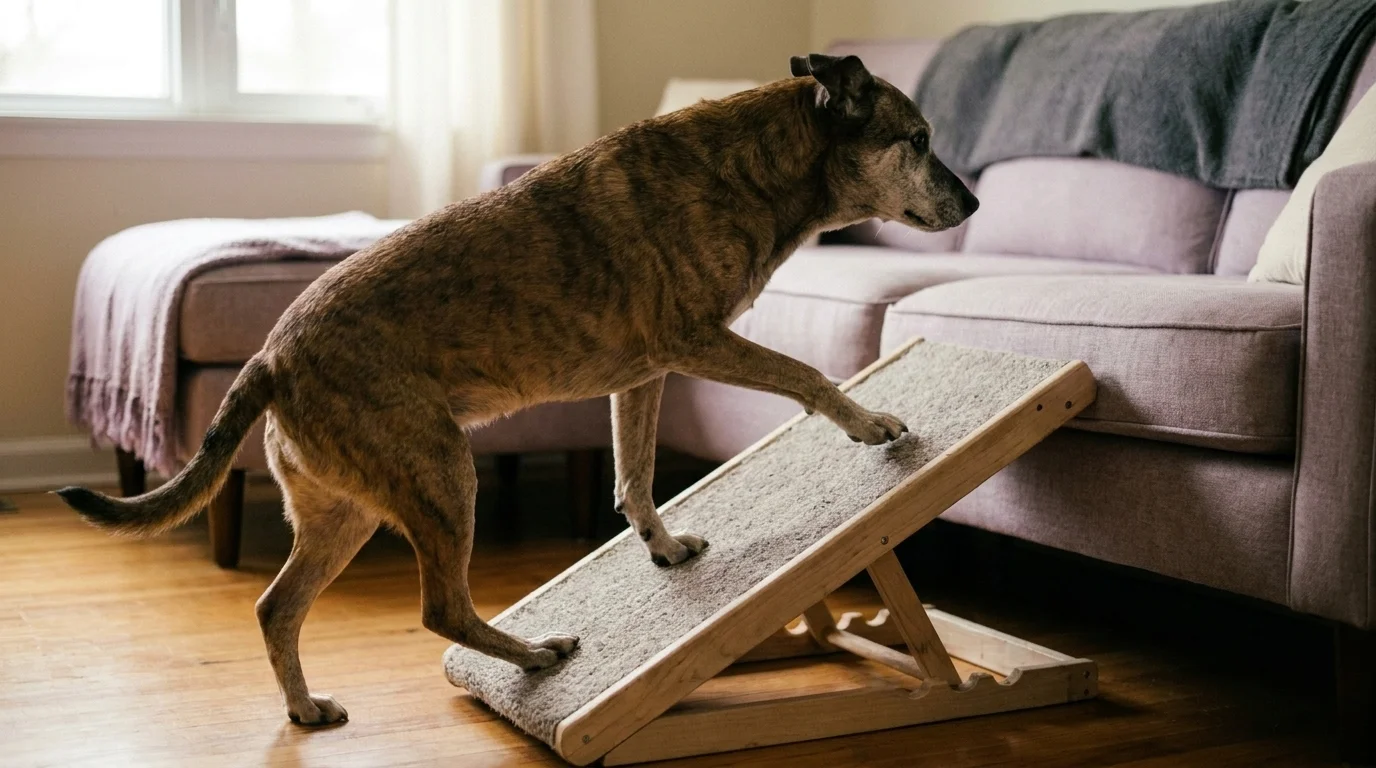
The aging dog: where the demand — and the spending — actually is
If you own a senior dog, the single most useful product is the one least likely to be marketed as a "mobility aid": an orthopedic bed. Senior dogs rest 16 to 20 hours a day (thepetvet.com), and a supportive bed is pressure-point relief for joints that spend most of the day bearing weight against a hard floor. It is also the cheapest entry point in a category where the highest-volume search by far is "orthopedic dog bed."
For the same dog, two more items earn their keep before any cart does: a ramp or set of dog stairs to take the jolt out of getting onto furniture or into the car, and toe grips or non-slip socks for traction. Owners search "products for senior dogs" expecting something exotic; the honest answer is usually a bed, a ramp, and traction — escalating to a support harness only when standing up becomes the hard part.
A word on the bed marketing, because it is where the money quietly leaks: "orthopedic" has no regulated definition in pet bedding. A bed earns the label by having a supportive foam core, not by printing the word on the tag. Press on it. If your thumb hits the floor, you are paying for the word, not the foam.
Wheels, harnesses, and the paralysis myth
The wheelchair section of this topic is where buyers make the most emotional — and most avoidable — errors. "A common misconception is that a dog must be paralyzed to use a wheelchair," Dr. Blackwelder told the AKC. A cart can keep a dog with rear-leg weakness active and preserve the muscle it still has rather than waiting for it to waste away. "We are there just as the balancer," she explained, "so they can continue to use their muscles appropriately" (AKC).
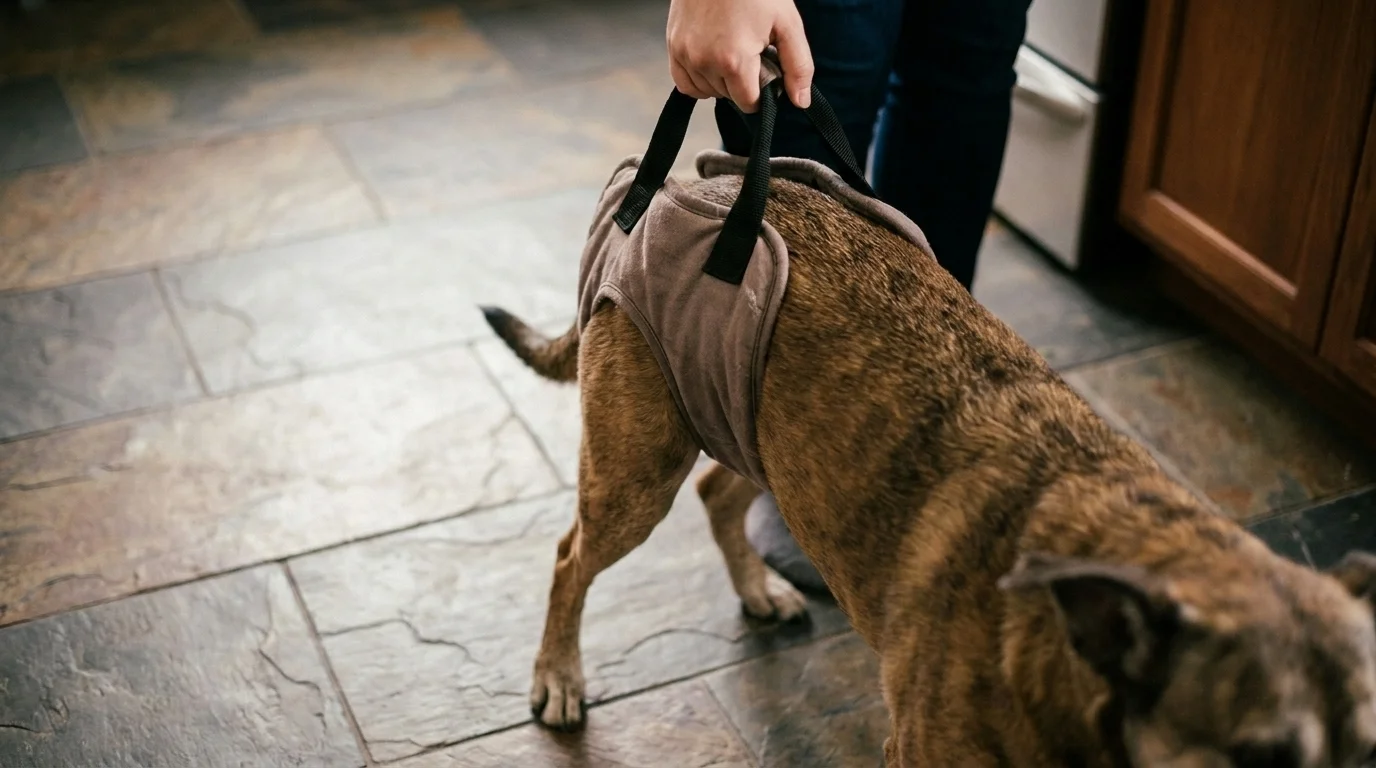
That reframes the spending decision. A harness for a disabled dog — a sling or lift harness — is often the right first purchase, not a downgrade from a wheelchair: it supports a dog through the months when it can still walk with help, and it costs a fraction of a cart. A "dog wheelchair" (a 22,000-searches-a-month category, and notably one that has declined about 18% year over year — a saturated market, not a growth story) is the escalation, not the default. Buy down the ladder before you buy up it.
Feeding your pet without bending over
Here is the part of "inclusive design" the product marketing almost never addresses, because the disabled party is the human. If back pain, a wheelchair, or limited mobility makes floor-level feeding hard, no-bend bowls with long, extendable handles let you fill, lift, and place food and water from a standing position. Dedicated retailers now sell them explicitly "for seniors, disabled animal owners, or back pain relief" (nobendpetbowls.com).
This is a real, shippable product segment that almost no mainstream pet guide mentions — and it is "pet products for diverse owners" meaning something concrete instead of being a slogan. If you or someone in your household struggles to crouch, this is the search worth running.
Sensory loss deserves the same plain treatment: blind-dog gear (halo bumpers, scent and texture markers) and gentle vibration collars for deaf dogs exist, carry modest but real search demand, and are worth knowing about — without being oversold as miracle fixes.
Gear is one pillar, not the whole roof
A product guide owes you this caveat: mobility hardware is one part of managing joint disease, not the treatment. Veterinary consensus holds that a multimodal approach — appropriate nutrition, weight control, and vet-directed rehab alongside any gear — "can slow disease progression, decrease signs of pain, and potentially increase an animal's life span" (Veterinary Medicine at Illinois). A wheelchair will not fix a dog carrying ten extra pounds. The ramp helps most when the vet visit happens first.

The question to ask
Inclusive pet products are not a philosophy; they are a set of specific objects with specific jobs, sold in a market that profits from blurring the line between "helpful" and "necessary." Before you buy, take the question to the people who don't earn a commission on the answer. At the next vet visit, ask: Given my dog's joints and stage of life, what is the one aid that buys the most function right now — and what can wait? The honest answer is rarely the most expensive cart on the page. Sometimes it is a bed, a strip of traction, and a ramp you build yourself.
Frequently Asked Questions
Not necessarily. Wheelchairs help dogs with rear-leg weakness or paralysis, but a dog doesn't have to be fully paralyzed to use one. Many dogs use a cart to stay active and preserve muscle, and a support harness is often the right first step before a full wheelchair.
Most aging dogs benefit first from an orthopedic bed for pressure relief, a ramp or stairs to avoid jumping, and toe grips for traction on slippery floors — escalating to a support harness only when standing up becomes difficult.
No-bend bowls with long, extendable handles let owners with back pain or limited mobility fill, lift, and place food and water from a standing position, without crouching to floor level.
Toe grips and non-slip socks add traction to nails and paws, giving arthritic or weak-legged dogs the confidence to walk on tile, hardwood, or laminate. They are the lowest-cost mobility aid and often the highest-value.
Earlier than most owners think. Roughly 80% of dogs over eight have osteoarthritis, and vets recommend early support — like ramps and traction to cut joint strain — well before a dog loses mobility, rather than waiting for paralysis.