Navigating the Digital Ecosystem: The Revolution of Pet Blockchain for Identity and Health Records


A cat slips out the back door during a delivery. No collar — she's an indoor cat, so why would she need one? Three days later she turns up two streets over, and a neighbour brings her to the local shelter. Whether she sleeps in her own bed that night comes down to one quiet question: is there a way to connect this specific animal back to you? That is the entire job of pet identification, and in 2026 there are more answers than ever — some genuinely transformative, some pure marketing. I spent six years scanning chips at a shelter's intake table, so let me walk you through what actually works, in the order that the evidence supports.
Start with the sobering number: in the US, fewer than 23% of lost pets are reunited with their owners (Dogster, 2026). That figure is the reason this whole category exists — and the reason the method you choose matters.
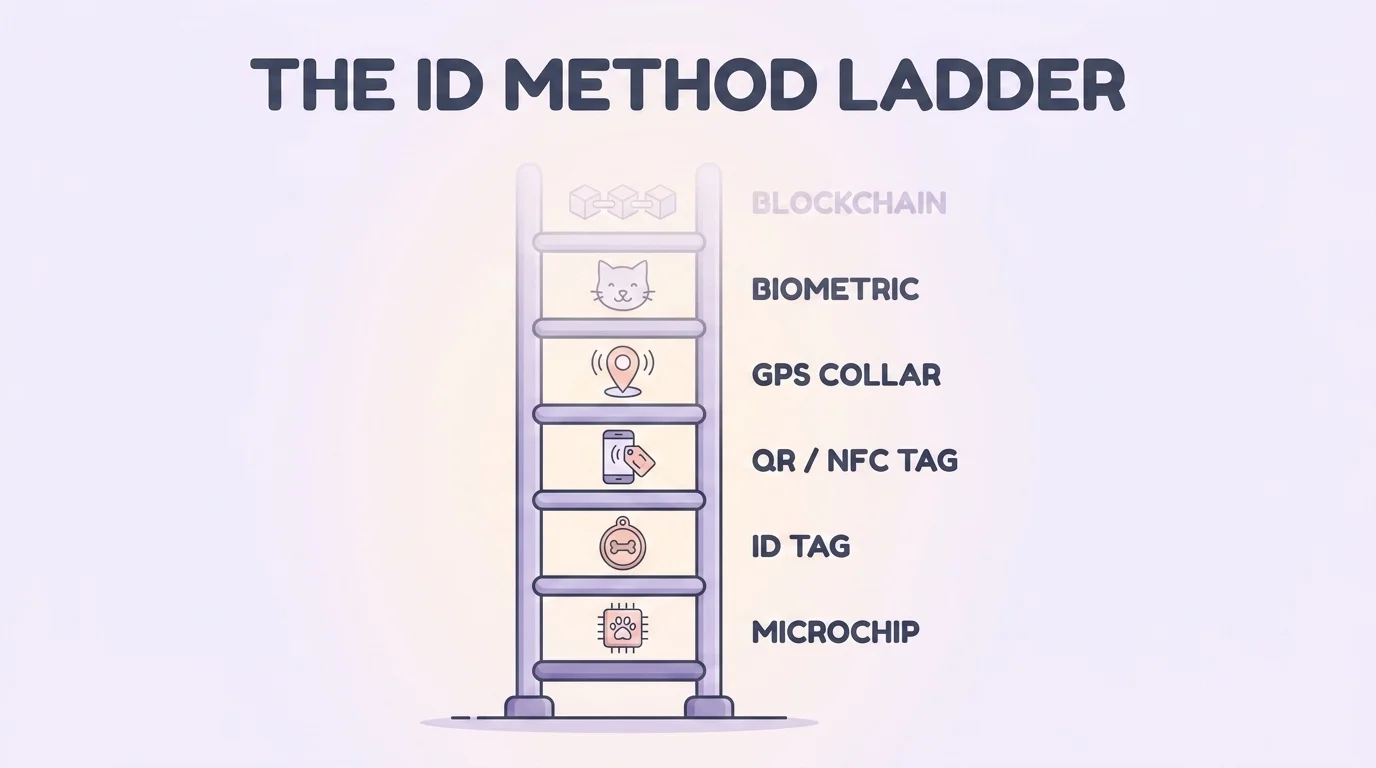
The pet identification method ladder
There is no single best tool; there's a ladder, and the smart approach uses more than one rung. Here's the honest comparison before we go method by method.
| Method | What it does | Cost | Gets a lost pet home? |
|---|---|---|---|
| Engraved ID tag | Instant contact info, readable by anyone | Low, one-off | Fast — but only if worn and current |
| QR / NFC tag | Phone-scannable, updatable contact data | Low, one-off | Fast and live — if the finder scans it |
| Microchip + registry | Permanent ID number linked to your details | ~$25–$60 + ~$20 registration | The proven backbone (≈3x more likely) |
| GPS / Bluetooth collar | Locates the pet in real time | Device + subscription | Locates, doesn't identify |
| Biometric / blockchain | Emerging — facial ID, decentralised records | n/a | Not yet, in practice |
Tags and QR codes: instant, but losable
A collar tag is the only form of ID a stranger can read without any equipment, and that immediacy is its whole value — a neighbour reads your phone number and rings you before the shelter is ever involved. The modern upgrade is the QR-code tag, now a standard feature rather than a novelty: a finder scans it with a phone and reaches contact details you can update online without re-engraving anything (Woofie's, 2025).
The limitation is obvious to anyone who has watched a cat shed a breakaway collar under the sofa: a tag only works while it's being worn. For indoor cats especially — the ones owners assume don't need ID — the collar is often off, which is exactly why a tag alone is never enough.
Microchips and registries: the proven backbone
If a tag is the front door, a microchip is the deadbolt. And here the evidence is unusually clear, which I appreciate, because most of what gets said about pet tech is asserted rather than measured. Microchipped pets are roughly three times more likely to find their way home: an analysis by Human Animal Support Services put reunification at 52.2% for chipped dogs versus 21.9% for unchipped, and — this is the figure that should stop every cat owner — 38.5% for chipped cats versus a heartbreaking 1.8% for unchipped (HASS, 2025). Cats are the animals our identification habits fail most badly, and the chip is what closes that gap.
It's worth being precise about what a chip is, because the misconceptions cause real harm. As the American Animal Hospital Association explains, a microchip stores only a 9-, 10-, or 15-digit ID number, which is registered with a registry service that holds your contact information (AAHA). Implanting one costs roughly $25–$60, and a lifetime registration runs about $20–$23 (Woofie's; Pawbase).
Does a microchip track my pet's location?
No — and this is the single most common thing owners get wrong. A microchip is not GPS. It holds an ID number a scanner reads at a clinic or shelter; it cannot tell you where your pet is right now. Microchips and tags identify; GPS and Bluetooth collars locate. If you want live tracking, that's a separate device — pair them, don't confuse them.
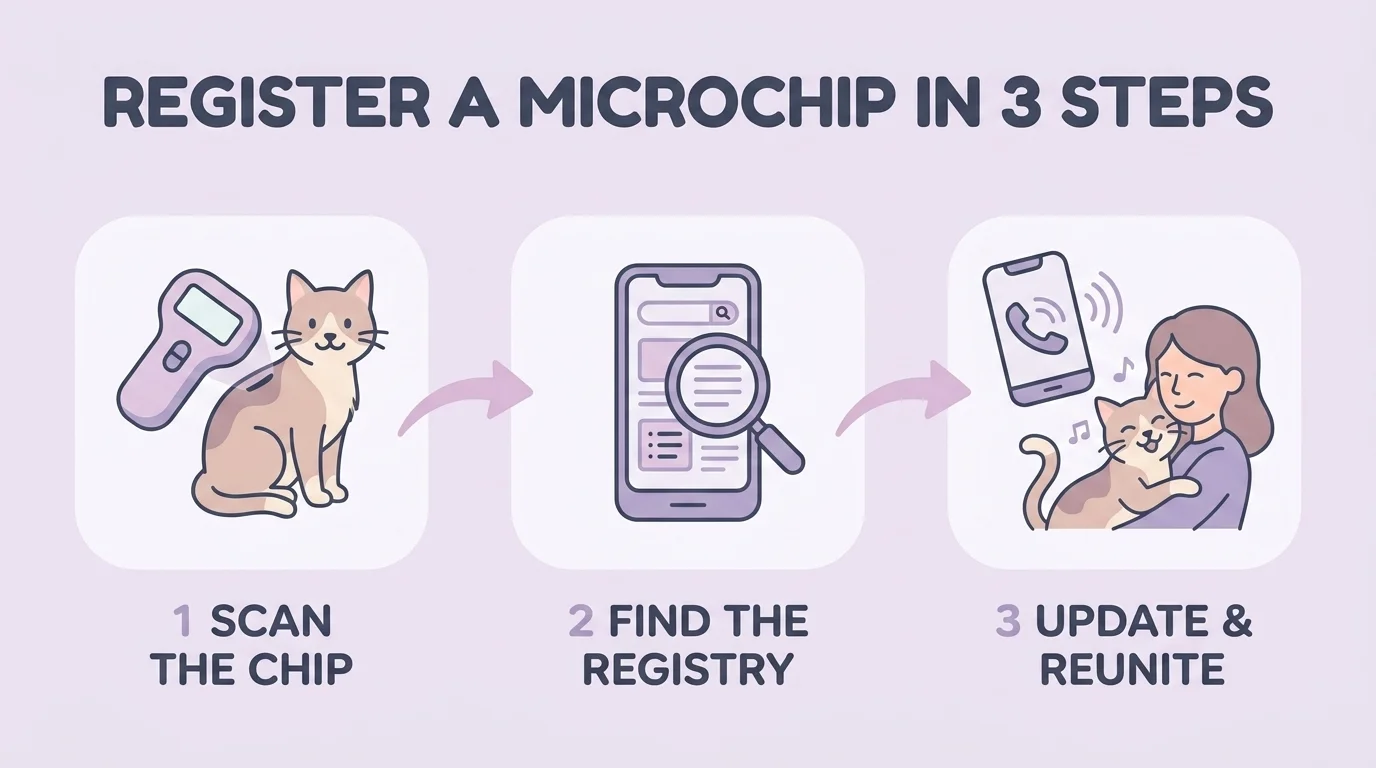
How to look up and register a microchip
A chip that isn't registered is just a number nobody can use. If you've adopted a pet, found one, or simply can't remember whether your chip details are current, the process is straightforward:
- Get the number. Any vet or shelter can scan the pet and read out the 9/10/15-digit ID — bring your own pet in if you're not sure it's chipped.
- Find the registry. Enter that number in the AAHA Universal Pet Microchip Lookup, which tells you which registry the chip belongs to (it doesn't show your personal data, just the registry).
- Register or update. Go to that registry and make sure your phone number and address are right. This is the step everyone skips.
Why so many pets still don't get home
Here is the synthesis no buyer's guide will give you, and it's the part my shelter years drilled into me: the bottleneck is not the technology. It's registration. Only about 18% of stray pets arrive at intake carrying a microchip at all, and of the pets that are chipped, only around 60% have it actually registered with current contact details (HASS, 2025). I have scanned chips that lit up beautifully and led to a phone number disconnected five years ago. The chip did its job; the human hadn't done theirs.
So before you go shopping for the next clever gadget: the most powerful thing you can do today is free. Confirm your pet is chipped, and confirm the registry has your current number. Across North America, recovery programs returned an estimated 317,000 dogs and cats to their owners in the first half of 2025 alone (DocuPet, 2026) — and the difference between being in that number and not is almost always whether the paperwork was current.
Related Article: Harnessing Technology: Smart Solutions for Pet Care and Monitoring
Your pet's ID is the key to their health records
Identity isn't only about getting lost pets home; it's also the thread that ties a pet to their portable medical history. A handful of apps now let owners keep vaccination dates, medications, and records in one place, so a new vet — or an emergency clinic at 2 a.m. — can see continuity of care rather than starting from a blank page. The same ID number that reunites a stray is, in principle, the key that unlocks their history. (As always, the medical decisions themselves belong with your veterinarian; the record just makes sure they have the full picture.)
The emerging tiers: NFC, biometrics, and blockchain
This is where the original promise of "the future of pet ID" lives — and where I want to be honest about how near or far that future actually is.
NFC tap-tags are real and arriving now. Austin deployed NFC-enabled pet tags that anyone can tap with a phone to view a pet's info and that owners update from their mobile; the city reported a 55% improvement in lost-pet recovery times (Animal Watch 365). This is the credible middle ground between a dumb tag and a speculative ledger.
Biometric recognition is closer than you'd think. At CES 2026, a smart pet feeder reportedly hit 99.9% cat-recognition accuracy using edge-AI facial mapping — a sign that "your pet's face is the password" is a nearer-term frontier than the blockchain hype suggested.
Blockchain pet ID is not here yet, and I won't pretend otherwise. The original version of this article called blockchain profiles "unhackable" and described them in the present tense, as if you could enroll your cat tomorrow. You can't. Every blockchain-for-pets project I could find is a hackathon entry, an academic paper, a GitHub repository, or an early-stage app — none with real adoption to report (GlobalPETS). The honest word is "tamper-resistant," not "unhackable," and the industry's own assessment is blunt: a blockchain for pets is "too much of a radical departure from current manual processes" to be practical at scale right now. It's a plausible decade-out idea, not a 2026 buying decision.
What to actually do this week
If you take one thing from all of this, make it the boring, proven thing: a registered microchip is the rung of the ladder with the data behind it, and a worn tag is the instant layer on top. Pair the two, keep the registry current, and you've done more for your pet's odds of coming home than any frontier technology will offer for years. Then — if it brings you peace of mind — add a GPS collar to locate, knowing it's a complement to identification, not a replacement for it.
Your cat doesn't know what a registry is. That part is entirely on us.
Frequently Asked Questions
No. Microchips are read by a special RFID scanner at a vet clinic or shelter, not by a phone. Only NFC or QR-code tags can be scanned with a phone.
No — a microchip is not GPS. It stores only an ID number that a scanner reads, linking to your contact details in a registry. For live location you need a separate GPS collar, per AAHA guidance.
Have a vet or shelter scan the pet to get the 9-, 10-, or 15-digit number, enter it in the AAHA Universal Pet Microchip Lookup to find the registry, then register or update your contact details with that registry.
Use both: an ID tag (or QR/NFC tag) for instant contact, plus a registered microchip as the permanent backup. Microchipped pets are roughly three times more likely to be reunited with their owners.
Implanting a microchip typically costs about $25–$60, and a lifetime registration runs around $20–$23 (for example, HomeAgain at $19.99 or Pawbase at $22.95). Registration is the step most owners skip.
Not in practice. Blockchain pet-ID exists only as early apps, academic projects, and pilots — no platform reports real adoption. Industry experts consider it too costly and fragmented to be practical at scale today.
Fewer than 23% of lost pets in the US get home, and the main reason isn't missing technology — it's missing registration. Only about 18% of strays are chipped at intake, and just ~60% of microchipped pets have current registry details.