

The pet tech category in 2026 is roughly an eighteen-billion-dollar industry growing toward fifty by 2035, and the way it is sold to pet owners has changed faster than the way pets themselves have changed — which is to say, not at all. A cat in 2026 still navigates the world through the same sensory and social rules a cat in 1990 used. The question is not whether technology can help us care for our animals; the question is which devices are welfare-positive for the animal in front of you, which are welfare-neutral, and which are welfare-risky in ways the marketing will not flag. This is a behaviourist's read of the smart-pet-tech landscape — what the literature supports, what the catalogues over-sell, and what to ask before you buy.
A note on scope. I work with cats, so I lean on the feline literature where I can; I cite the dog evidence carefully, but I'll route hardware specifics back to the relevant veterinary or technical authority. The framing throughout is the same one I use in consultations: every behaviour we observe in our animals is a resource, medical, or environmental question first. Tech earns its place when it helps us answer one of those questions, and not before.
How a behaviourist evaluates a pet-tech product
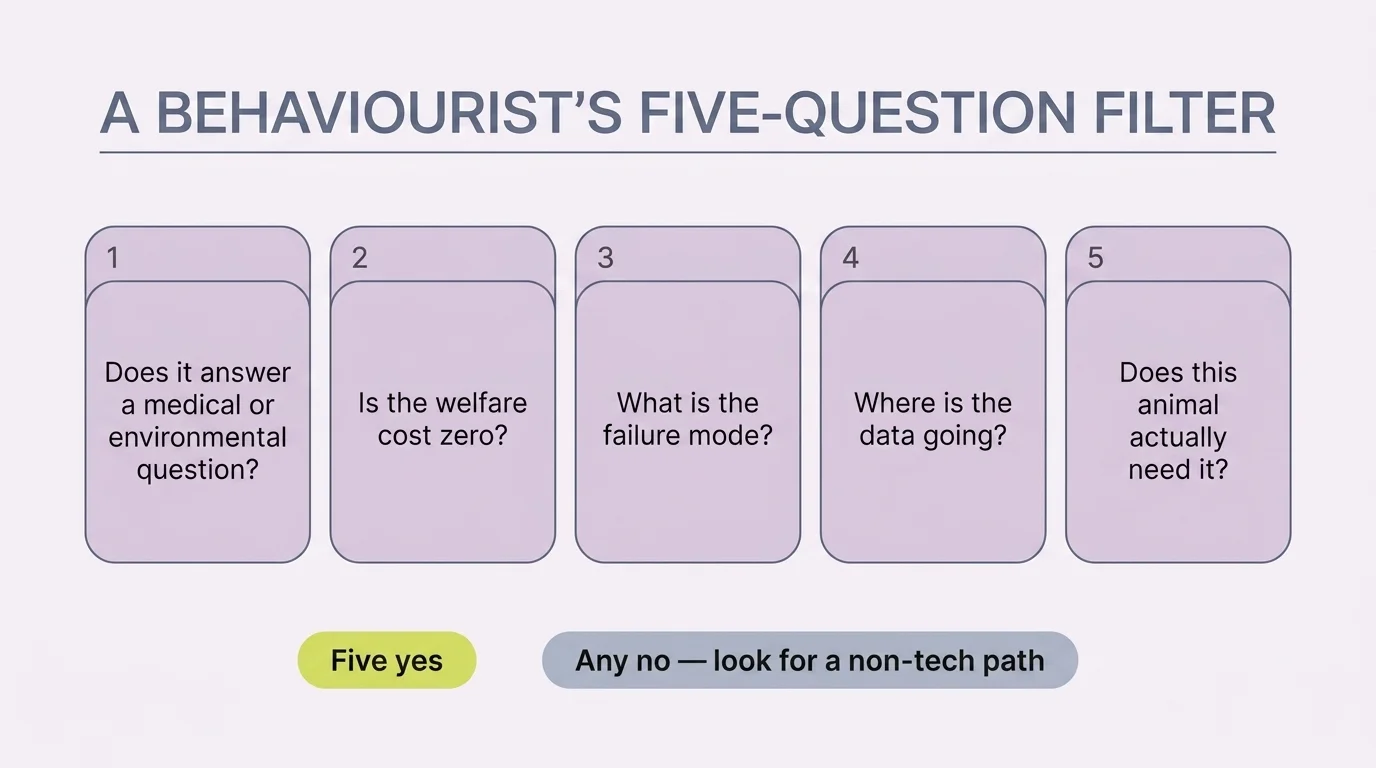
There are five questions I ask of any device a client brings to a consultation:
- Does it answer a medical or environmental question I would ask anyway? A litter-box monitor that catches changes in elimination patterns is doing my job with me. A laser pointer that triggers chase behaviour without prey-completion is doing the opposite of my job.
- Is the welfare cost to the animal zero, or are we paying with their nervous system? A passive collar is welfare-neutral. A two-way audio camera that lets a stressed owner remotely scold a barking dog is welfare-actively-bad — and yes, that happens.
- What is the failure mode? Smart feeders jam. Batteries die. Subscriptions lapse. Companies are acquired and devices brick. (We'll come back to that one.)
- Where is the data going? "Smart" usually means "uploads to a server." Whose? Encrypted? Shared with whom?
- Does the animal in front of me actually need this? This is the question every catalogue assumes is already answered, and I am here to assume it isn't.
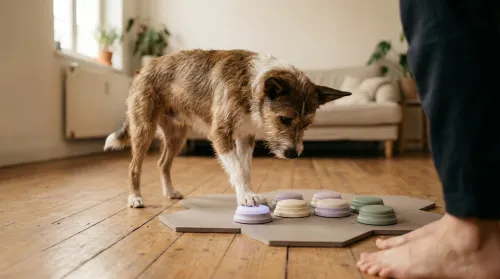
A note on training collars before we go further. Devices that deliver electrical stimulation, sharp tones, or sprays as a corrective tool — the "remote-controlled feedback" the marketing language carefully avoids calling shock — are positive-punishment training. The American Veterinary Society of Animal Behavior and the American College of Veterinary Behaviorists have for years discouraged their use in favour of force-free, reinforcement-based methods. I will not recommend them in any framing, and they are not in this guide. Smart toys that engage and reward — puzzle feeders, treat-dispensing balls, prey-completion games for cats — are a different category and welfare-positive when used well.
With those filters in place, here is what is actually worth considering in 2026.
Pet Health Wearables and Smart Litter Boxes
This is the category where the science has caught up most quickly with the marketing, and where the cat-specific case is now strong enough that I lead with it.
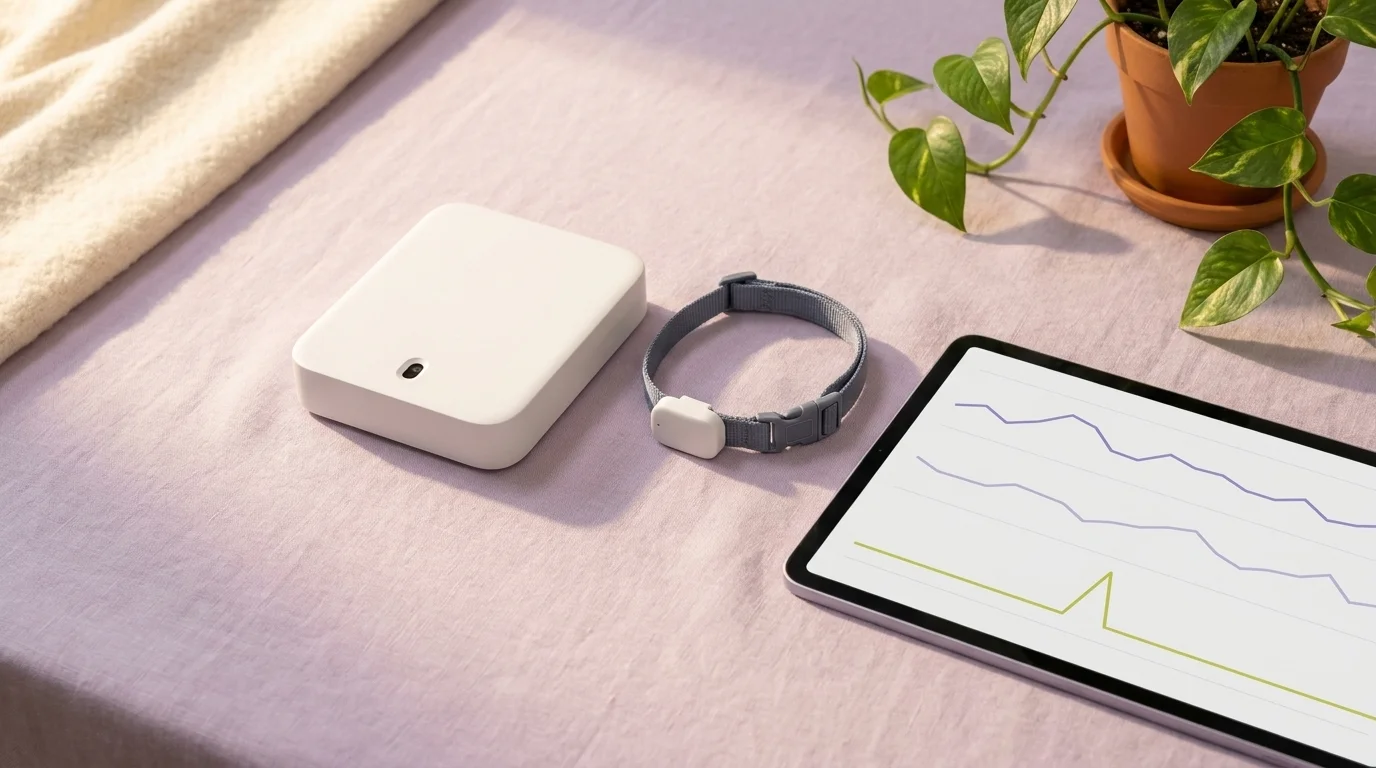
In October 2025, Applied Animal Behaviour Science published a Nestlé Purina analysis of more than 300,000 litter-box visits from 191 cats. The team built an "ethogram" — a behavioural catalogue — of 39 distinct feline bathroom behaviours, mapped against blood work and clinical exams, and demonstrated correlations with diabetes, obesity, kidney disease, hyperthyroidism, and urinary tract infections. The clinical relevance is stark: feline kidney disease is undetectable to owners until renal function loss exceeds roughly 80%, by which point the cat is in the late stages and the treatment options narrow. A device that flags subtle changes in trip frequency, duration, or weight on the litter box — weeks or months before a behavioural symptom appears — is doing real veterinary work.
The two products in this niche I'd put on a shortlist: the Petivity Smart Litter Box Monitor (Purina; the device behind the Applied Animal Behaviour Science work) and the PETKIT PuraMax 2 with the brand's AI ecosystem. Both function around an existing litter setup or as integrated boxes; both upload visit data and weight to a phone app and flag deviations. Pricing sits in the roughly $200–$350 range as of spring 2026, with optional subscriptions for more granular analytics on some platforms.
Two things to note as a behaviourist. First, this technology is most valuable in single-cat homes and in homes where you can use AI vision (the PETKIT and Cheerble ecosystems now identify individual cats by face) to attribute visits to the right animal. In a multi-cat household with shared, untracked boxes, the data noise often overwhelms the signal. Second, the device is not a substitute for routine veterinary care — it is an early-warning supplement. A cat flagged by the monitor still gets a vet visit. A cat with no flags can still develop subclinical disease the device misses.
For dog wearables, the 2025–2026 generation has matured from step counters into multi-sensor health platforms. PetPace 2.0 and the Satellai Collar Go integrate gait analysis, temperature, heart-rate variability, respiration, and posture sensors. PetPace's collaboration with the Veterinary Health Research Centers' DOGMA initiative (started November 2023, ongoing) is using collar biometrics to study canine cognitive decline as an Alzheimer's analogue — a notable shift from consumer gadget to research instrument. I'd put these on the shortlist for senior dogs, post-surgical recovery, or known chronic conditions; for healthy young dogs, the data signal is rarely worth the price.
Related Article: Navigating the Digital Ecosystem: The Revolution of Pet Blockchain for Identity and Health Records
Smart Pet Feeders: Useful, with Failure Modes Nobody Lists
The market for smart pet feeders has grown roughly 233% year-over-year by search volume, and the 2025–2026 generation is genuinely better than what existed when this site first wrote about pet tech in 2024. The headline change is multi-pet recognition. The Cheerble Match G1 (launched at CES 2026) and the PETKIT range use on-device computer vision to identify individual pets by face — without a collar, without an RFID tag — and dispense the right portion to the right animal. For households with one cat on a renal-supportive diet and another on weight-management food, this solves a real problem that physical separation does not.
Workhorses worth mentioning in 2026:
- PetLibro Granary and Granary Camera — established mid-tier brand; reliable scheduling; the camera variant adds a video feed.
- Cheerble Match G1 — the multi-pet Face ID feeder; 2026 release; check release-region availability before buying.
- PETKIT FRESH ELEMENT family — long-running smart feeder line; integrates with PETKIT's broader app ecosystem.
The catalogues won't tell you about the failure modes. Smart feeders jam — kibble bridges in the hopper, the auger stalls, and the next scheduled meal silently fails. Batteries die at inconvenient times; many of these devices need a wall-power backup if you intend to depend on them while travelling. Firmware updates occasionally change feeding schedules in ways the app doesn't always make obvious. The rule I give clients: never let a smart feeder be the only line of defence for a pet whose meal cannot be missed (a diabetic on insulin, a cat with hepatic lipidosis risk). Have a neighbour with a key.
A welfare note. A feeder that allows you to dispense multiple small meals through the day for a cat is welfare-positive — cats are designed to be small-prey hunters who eat eight to twelve times a day, and the typical bowl-twice-a-day model is not what their physiology wants. A feeder that allows an owner to "skip a meal" remotely as discipline, or to over-feed via reward triggers without seeing the animal, is the welfare-risky use of the same tool. Same hardware, very different ethic.
Pet GPS Trackers: What's Actually Useful, and What the Whistle Story Taught Us
A GPS tracker is welfare-positive for a known escape artist or an off-leash hiker, and welfare-neutral for an indoor-only cat or a small dog who never leaves the back garden. It is, in my consultations, often over-prescribed — bought as anxiety-soothing for the owner more than as a useful tool for the animal. That is fine if the owner knows that's what they're doing.
The two dominant 2026 trackers are Tractive Dog 6 (and Tractive Cat) and Fi Series 3. Both are cellular-network devices, both require a monthly subscription, and both work — when the company is still in business and the subscription is paid.
The Whistle bricking event of August 2025 is the buyer-education story this category has not absorbed yet. Tractive acquired Whistle from Mars Petcare in July 2025 and, six weeks later, permanently deactivated every Whistle device worldwide. Owners with active multi-year subscriptions and working hardware woke up to bricked collars. Tractive offered subscription-time transfer and free replacement devices, which was decent, but it does not change the lesson: a device with a cellular modem and a vendor-side service contract is, in a meaningful sense, only yours until the vendor decides otherwise.
The cost picture is also more honest than the catalogues let on. Total five-year cost of ownership at 2026 list prices:
| Device | Hardware | Subscription | 5-year total |
|---|---|---|---|
| Fi Series 3 | $99 | $9.99/month | $699 |
| Tractive Dog 6 | $149 | $7.99/month | $629 |
| Microchip + ID tag (no GPS) | $40–$70 (chip + tag) | $0 | $40–$70 |
The microchip-plus-ID-tag combo is not the same product — it gets your pet home if someone scans them, it does not show you a real-time map of where they wandered — but if "I want my dog to come home if she gets out" is the actual question, a chip is the answer most owners are over-paying to ignore. The five-year subscription math is the conversation buyers should have with themselves before, not after, the purchase.
For cats, GPS trackers are a niche product. Lightweight collar-clip designs (the Tractive Cat is the realistic option in 2026) work for outdoor-roaming cats, but I'd encourage anyone considering one to also be reading about the welfare and ecological case for indoor or supervised-outdoor catio life — the GPS tracker is solving a symptom, not a cause.
Related Article: Pet Tech Revolution: Gadgets Galore for Modern Pet Parents
Smart Pet Cameras: Useful If You Use Them Well
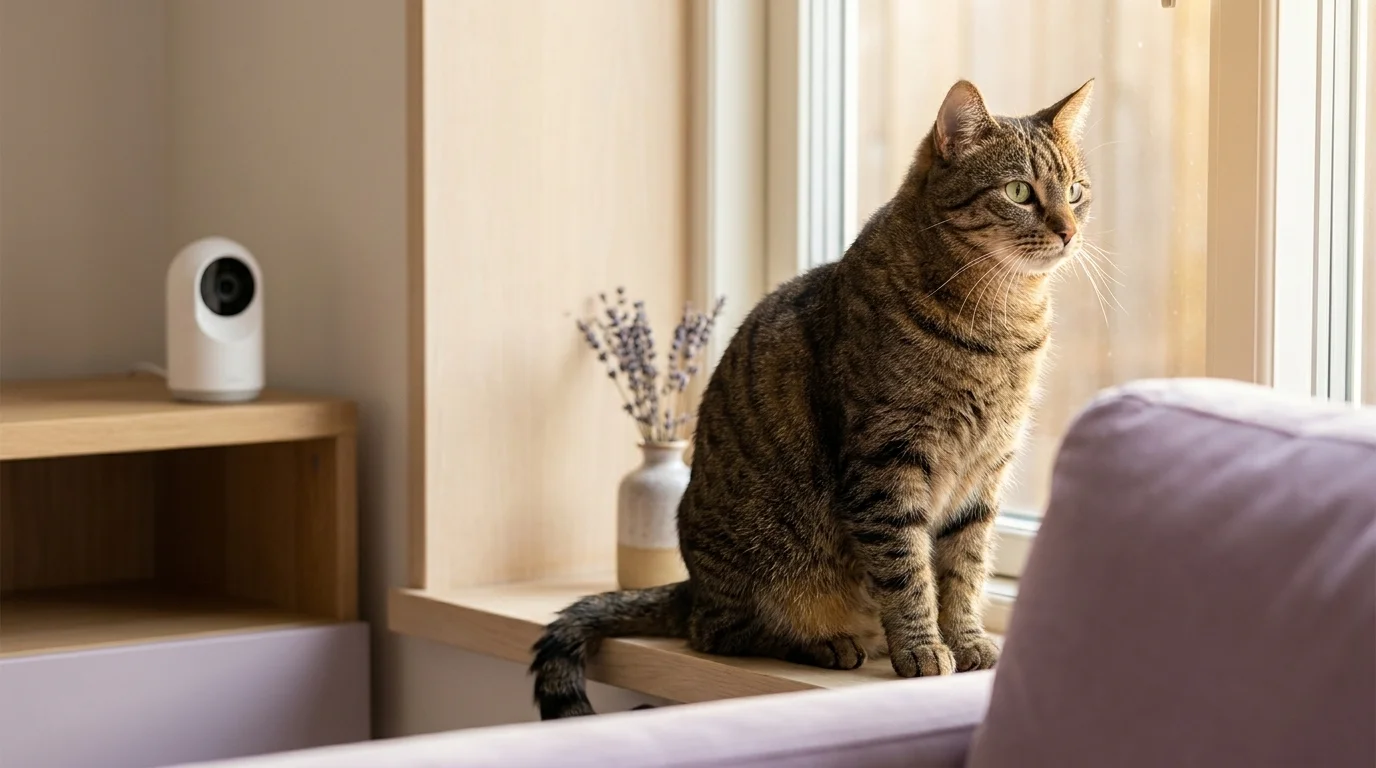
This is the fastest-growing category by search volume — the smart pet camera market is forecast to grow from $3.6B in 2026 to $6.47B by 2030. Search demand for "smart pet camera" rose roughly 25× year-over-year leading into 2026.
Workhorses worth a shortlist:
- Furbo 360° — the established treat-dispensing pet camera; a feature-rich product with a corresponding subscription requirement for many of its more useful features.
- Eufy Pet Cameras — local-storage option (no mandatory cloud subscription), a meaningful privacy advantage.
- PetLibro Scout — multi-pet AI recognition; bundles camera with smart-feeder ecosystems.
- Aqara G3 — a general-purpose smart-home camera that performs well as a pet camera at a lower price tier than dedicated pet brands.
Welfare guidance, since this is where I see most owner missteps:
- Two-way audio is a sharp tool. Some pets find a familiar voice from a speaker reassuring. Many — especially cats and anxious dogs — find a disembodied voice with no body to look at deeply confusing. If your animal looks for you and cannot find you when you speak, the device is making their separation harder, not easier.
- The treat-toss feature is operant conditioning. It works, in both directions. A dog who learns the treat comes when the camera "watches" can develop performance behaviours for the camera. Use sparingly.
- A camera on an anxious pet is a diagnostic, not a therapy. Watching them pace doesn't help them stop pacing. If the camera reveals separation distress, the next step is a behaviourist or veterinary behaviourist, not more camera time.
We'll come back to cameras in the privacy section, because what the camera sees is also what the manufacturer sees.
Pet Telehealth: Useful Where Legal, with State-by-State Limits
The original framing of "virtual vet consults" as a universal solution overstates the legal reality in the United States. As of April 2026, most states still require an in-person physical examination to establish the veterinarian–client–patient relationship (VCPR) that is the legal prerequisite to diagnosis, treatment, and prescription. Alabama, Texas, and Illinois remain in-person-only. Arizona, Vermont, New Jersey, and Florida have moved to allow synchronous-video VCPR with limits — Florida, for example, caps initial telehealth prescriptions at 14 days and excludes controlled substances. Ohio, Colorado, and several others are mid-rulemaking. The FDA's published position is that a valid VCPR cannot be established solely through telemedicine for extralabel or controlled drugs.
Translation: virtual vet visits are excellent for triage, behavioural consultations, recheck conversations, and minor or chronic concerns where your vet already has a relationship with your pet. For acute diagnostics, controlled-substance prescriptions, or first-visit care in most states, you still need an in-person appointment.
Established services in this space include Vetster, Pawp, and Dutch, alongside the telehealth offerings now bundled into many pet insurance policies. The current map of which states allow what is maintained by the Veterinary Virtual Care Association and is worth checking before you sign up.
For non-medical questions — feline behaviour, training, nutrition guidance — virtual consultations with credentialled professionals (CCBC, CDBC, CTC, IAABC, KPA-CTP, certified veterinary nutritionists) are an excellent and underused resource and are not subject to the same VCPR rules.
Related Article: Technology's Role in Shaping Global Pet Care Practices: Innovations, Challenges, and Risks
Privacy and Data Ethics: What Your Pet Tech Knows About You
This is the section the catalogues skip. A pet camera on your kitchen wall is also a kitchen wall camera. A GPS tracker on your dog's collar is also a tracking record of where you walk every morning. A smart feeder with a microphone is recording the room. The question for 2026 is no longer "is this device useful," it is "what is the manufacturer doing with the data, and on what infrastructure."
A 2023 audit published in the ACM Digital Library examined the security posture of 20 popular pet-tech apps. Two exposed login or account details over non-encrypted traffic. Fourteen communicated with third-party trackers before users could meaningfully consent. Subsequent reviews through 2025 have not shown the category meaningfully improving.
The newer privacy story is AI-driven surveillance creep. In February 2026, Ring launched "Search Party for Dogs", an AI computer-vision feature that scans Ring camera footage across the network for lost pets. The lost-pet use case is sympathetic; the underlying technology is AI-driven scanning of video from millions of consumer cameras pointed at public space. The pet community has not yet had the conversation other communities had years ago about what it means to opt the neighbourhood into AI scanning by buying the device.
A practical buyer's checklist:
- Prefer local-storage or edge-AI cameras (Eufy with local storage; Cheerble's on-device pet recognition) over cloud-only cameras for any room you care about.
- Read the data-retention clause before subscribing. "We retain video footage for 30 days" is different from "indefinitely."
- Look for end-to-end encryption in the marketing materials; if it isn't mentioned, it usually isn't there.
- Use a lens cover when the camera is not in use. Most pet-camera designs do not include one; a strip of opaque tape is fine.
- Microphones can be disabled on most smart cameras and feeders. Default-off is reasonable.
The right tradeoff between welfare convenience and household surveillance is yours. Make the trade knowingly.
Do You Actually Need This? A Behaviour-First Decision Tree
A short framework I use in consultations, adapted to the 2026 catalogue:
| Buy this... | If... | Skip if... |
|---|---|---|
| GPS tracker | Known escape artist, off-leash hiker, outdoor-roaming cat | Indoor-only, microchipped, never leaves the property |
| Smart litter monitor | Senior cat (8+), known kidney/UTI/diabetes history, single-cat household | Healthy young multi-cat household; data noise > signal |
| Multi-sensor health collar (PetPace, Satellai) | Senior dog, post-surgical recovery, known chronic condition | Healthy young dog with no clinical questions |
| Multi-pet AI feeder | Two animals on different prescription diets sharing a household | Single pet on a standard diet who eats reliably |
| Smart pet camera | You want to see how your pet behaves alone for a defined diagnostic question | You'd watch the feed compulsively or use two-way audio to scold |
| Pet telehealth subscription | Existing vet relationship, chronic-recheck or behaviour-consult use case, your state allows it | Your only access to care; you need first-visit diagnostics |
| Training collar with shock/stim | Never | (Force-free training methods are the standard of care.) |
A Brief Closing Note
The honest summary: pet tech in 2026 is more useful, more expensive, more capable, and more entangled with the privacy economy than it was when most consumer pet-tech listicles were written. The good news is the welfare science has caught up in places where it hadn't — the litter-box ethogram work is real, the multi-sensor wearables for senior pets are genuinely informative, and edge-AI processing has given privacy-conscious buyers options that did not exist before.
The bad news is the same as it has been: a device cannot substitute for paying attention to the animal in front of you. The Petivity is excellent at flagging changes in litter-box behaviour, and so is sitting on the floor at 11 p.m. with the cat. The Tractive shows you where your dog wandered, and so does walking him on a long lead. The Furbo gives you a window into the kitchen while you're at work, and so does coming home a little earlier.
Tech earns its place when it answers a question you'd be asking anyway. Buy with that test in hand, read the cost math before you read the feature list, and assume your animal will outlast at least one of the companies that made the device.
Last reviewed 2026-04-29 by Saoirse Ni Bhriain, CCBC.
Frequently Asked Questions
A Fi Series 3 totals roughly $699 over 5 years ($99 hardware + $9.99/month for 60 months). A Tractive Dog 6 totals roughly $629 ($149 + $7.99/month). A microchip with an ID tag — the lowest-cost alternative if your goal is simply 'get my pet home if they're found' — runs $40–$70 with no subscription. The five-year math is the conversation buyers should have before, not after, the purchase.
It can flag the early behavioural changes that suggest a vet visit is warranted. A 2025 Applied Animal Behaviour Science study analysed 300,000+ litter-box visits from 191 cats and built an ethogram of 39 behaviours correlating with diabetes, obesity, kidney disease, hyperthyroidism, and UTIs. Feline kidney disease is undetectable to owners until renal function loss exceeds 80%, so early-warning signals — changes in trip frequency, duration, weight on the box — are clinically meaningful. The device is an early-warning supplement, not a substitute for veterinary care.
Pet-tech security is uneven. A 2023 ACM audit of 20 popular pet-tech apps found 2 exposed login details over non-encrypted traffic and 14 communicated with third-party trackers before users could meaningfully consent. Prefer cameras with local storage (e.g., Eufy) or edge-AI processing over cloud-only models, look for end-to-end encryption in the marketing materials, read the data-retention clause before subscribing, and use a lens cover when the camera is not in use.
It depends on your state. As of April 2026, most US states (Alabama, Texas, Illinois) require an in-person physical exam to establish the veterinarian–client–patient relationship (VCPR) before prescription. Arizona, Vermont, New Jersey, and Florida allow synchronous-video VCPR with limits — Florida caps initial telehealth prescriptions at 14 days and excludes controlled substances. The FDA's position is that a valid VCPR cannot be established solely through telemedicine for extralabel or controlled drugs. The Veterinary Virtual Care Association maintains a current state-by-state map.
The hardware can stop working. In August 2025, Tractive (which had acquired Whistle from Mars Petcare in July 2025) permanently deactivated every Whistle device worldwide six weeks after the acquisition. Owners with active multi-year subscriptions and working hardware lost service overnight. Tractive offered subscription transfer and free replacement devices, but the principle is now part of the buyer's calculation: a cellular GPS device with a vendor-side service contract is yours only as long as the vendor keeps the service running.
Training collars that deliver electrical stimulation, sharp tones, or sprays as a corrective tool are positive-punishment training. The American Veterinary Society of Animal Behavior (AVSAB) and the American College of Veterinary Behaviorists (ACVB) discourage their use in favour of force-free, reinforcement-based methods. Smart toys that engage and reward — puzzle feeders, treat-dispensing balls, prey-completion games — are a different category and welfare-positive when used well.
Most don't need GPS or trackers. A smart litter monitor can be useful for a senior or single cat with a known kidney/UTI/diabetes risk, where the early-warning signal outweighs the data noise. A multi-pet AI feeder is useful in households where animals are on different prescription diets. A camera is useful for a defined diagnostic question — checking for separation distress, for example — but not for compulsive remote watching, which usually serves the human and not the cat.