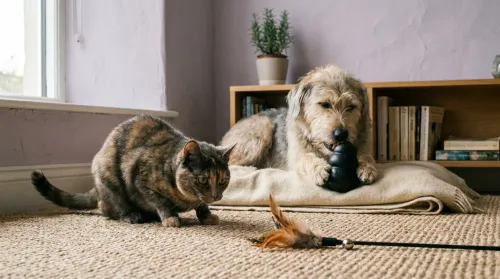
Indoor Pet Entertainment: Enrichment Ideas for Mental Stimulation


Before you fix a behavior, name its function. Mental stimulation for dogs (and structured enrichment for cats) starts there. The Labrador chewing the kitchen baseboards while you are at work, the rescue mix who shreds the cushions twenty minutes after you walk in the door, the cat who tears down the curtain at 6 a.m. — none of these animals is doing anything random. The behavior is getting the animal something (a release of pent-up motor activity, a moment of self-soothing, a successful hunting sequence, your attention even when it is the wrong kind of attention) or helping the animal avoid something (boredom, a routine that does not meet their species-typical needs). Once you can answer "what is this behavior doing for the dog," the intervention almost writes itself.
The intervention, for most of the behaviors above, is enrichment — not more obedience training, not more leash corrections, and certainly not "showing the dog who is in charge." The dominance model of dog training came out of a 1940s wolf-pack study that the original researcher, David Mech, has spent decades publicly retracting. Your dog is a social animal who has learned which behaviors work in your specific household; she is not staging a coup. The fix is patient, science-literate enrichment that gives her something better to do.
This guide is built around the AAHA five-domain enrichment framework, the 2024 Veterinary Record study on food-enrichment feeding, the 2025 Frontiers practitioner survey on canine cognitive dysfunction, and the AAFP/ISFM Five Pillars of Feline Environmental Wellbeing. It is meant to be read tactically — a working set of ideas you can deploy this week — rather than philosophically.
Why mental stimulation matters — the vet evidence
A useful frame for owners who have been told enrichment is a nice-to-have: it is increasingly the standard recommendation from the veterinary community. A 2025 cross-sectional survey of 318 US veterinarians, published in Frontiers in Veterinary Science, found that 97.2% of practitioners had diagnosed Canine Cognitive Dysfunction Syndrome (CCDS) at some point in their careers, and 79.5% formally recommended environmental enrichment as part of CCDS management (Frontiers Vet Sci 2025). Enrichment now sits third in the veterinary treatment hierarchy for CCDS — behind supplements (88.8%) and pharmaceuticals (83.9%), and ahead of diet change (63.5%) and exercise (48.4%). Senior-dog enrichment is not a lifestyle choice; it is geriatric care.
The same evidence base supports enrichment as a behavior intervention earlier in life. Heys and colleagues, writing in the British Veterinary Association's Veterinary Record in 2024 ("Bowls are boring"), surveyed 1,750 dog owners and found that over 85% now use food-delivery toys, and approximately half feed their dog exclusively via enrichment devices rather than a bowl (Heys et al. 2024; The Science Dog summary). Owner-perceived benefits of enrichment feeding: mental stimulation 98%, boredom prevention 96%, owner enjoyment 89%, separation-anxiety prevention >85%, increased activity 80%. The bowl, increasingly, is an artifact of how we used to feed dogs.
The American Animal Hospital Association's own consumer resource on enrichment lays out a framework that the rest of this guide will follow (AAHA, Enrichment: Supporting your pet's mental and emotional wellbeing at home).
The AAHA five-domain enrichment framework
Enrichment is not a single thing. It is five things, and a dog or cat who is meeting their species-typical needs is getting some of each, most days. The domains:
1. Social enrichment. Interaction with conspecifics (other dogs for dogs, other cats for cats — or not, depending on the individual) and with humans, in the form the animal actually wants. For most dogs, this includes play with people, structured time with appropriately matched dog friends, and the relaxed presence of humans they trust. For most cats, it is much shorter, predictable, and on the cat's terms. The "social" hour for a cat looks like ten minutes of wand play, not an hour of being held.
2. Occupational enrichment. Work — in the species-typical sense. A Border Collie was bred to do a job; a working terrier was bred to do a different job. Training sessions, agility, scent work, herding work, treibball, lure coursing for sighthounds, and even simple "find it" games count. The goal is not exhaustion; it is the engagement of the brain that the animal was selected to engage.
3. Physical / environmental enrichment. The physical structure of the animal's environment — climbing surfaces, hiding spots, vertical territory for cats, varied substrate underfoot, novel objects on a rotation. Cats in particular need vertical access (cat trees, window perches, top-of-bookcase routes) and at least three resting zones at varied heights. Dogs benefit from outdoor novelty: a new park, a new sniff route, a different surface to walk on.
4. Sensory enrichment. Sights, sounds, smells, textures, tastes. For dogs, this is heavily weighted toward olfactory work because dogs have approximately 300 million olfactory receptors versus 6 million in humans (TPLO Info). For cats, it is weighted toward visual and olfactory — bird-feeder views, prey-mimic wand toys, the cat's own scent profile maintained on bedding and resting spots.
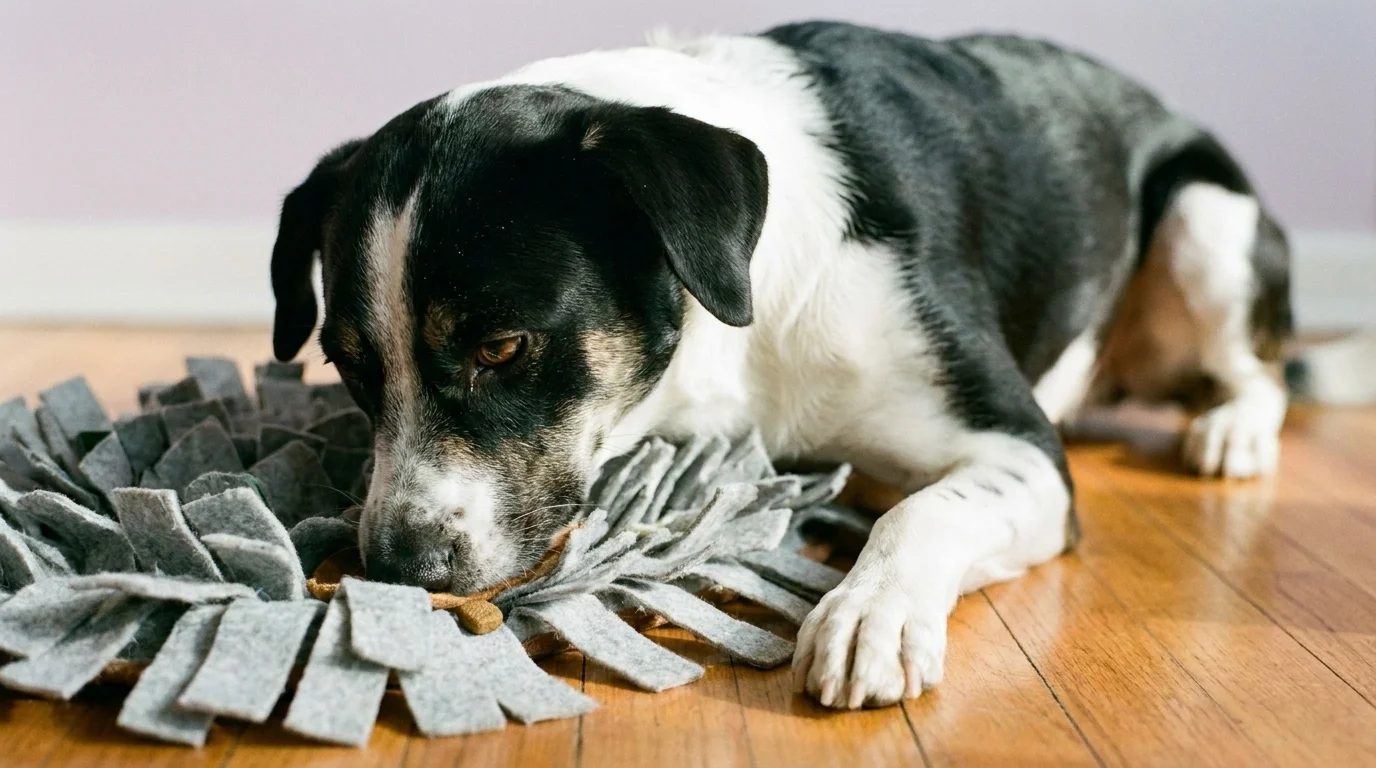
5. Food / nutritional enrichment. Slow feeders, snuffle mats, food puzzles, scatter feeding, frozen Kongs, lick mats. The category that has expanded fastest in the last three years, and the one I want to spend the next section on.
Food enrichment — and the case for ditching the bowl
The single highest-leverage change most owners can make to their dog's daily life is to stop feeding from a bowl. The Heys 2024 data make the case empirically; the practical case is even simpler.
A typical dry-food meal poured into a bowl takes a dog ninety seconds to consume. The same meal delivered through a snuffle mat takes ten to twenty minutes; through a Kong, fifteen to thirty; through a layered frozen Kong, forty-five to ninety. The meal already exists in the dog's daily calorie budget. The enrichment is free.
A practical comparison of named food-enrichment tools, ranked roughly by difficulty (easy → hardest) so you can match the tool to your specific dog's experience level:
| Tool | Difficulty | Best for | Notes |
|---|---|---|---|
| Snuffle mat | Easy | All dogs new to food enrichment; senior dogs | Felt mat with strips dogs sniff through to find kibble. DIY easily (see below) |
| LickiMat Soother | Easy | Anxious dogs, post-bath calming, slow-feeding wet food | Silicone mat with textured grooves; dishwasher-safe |
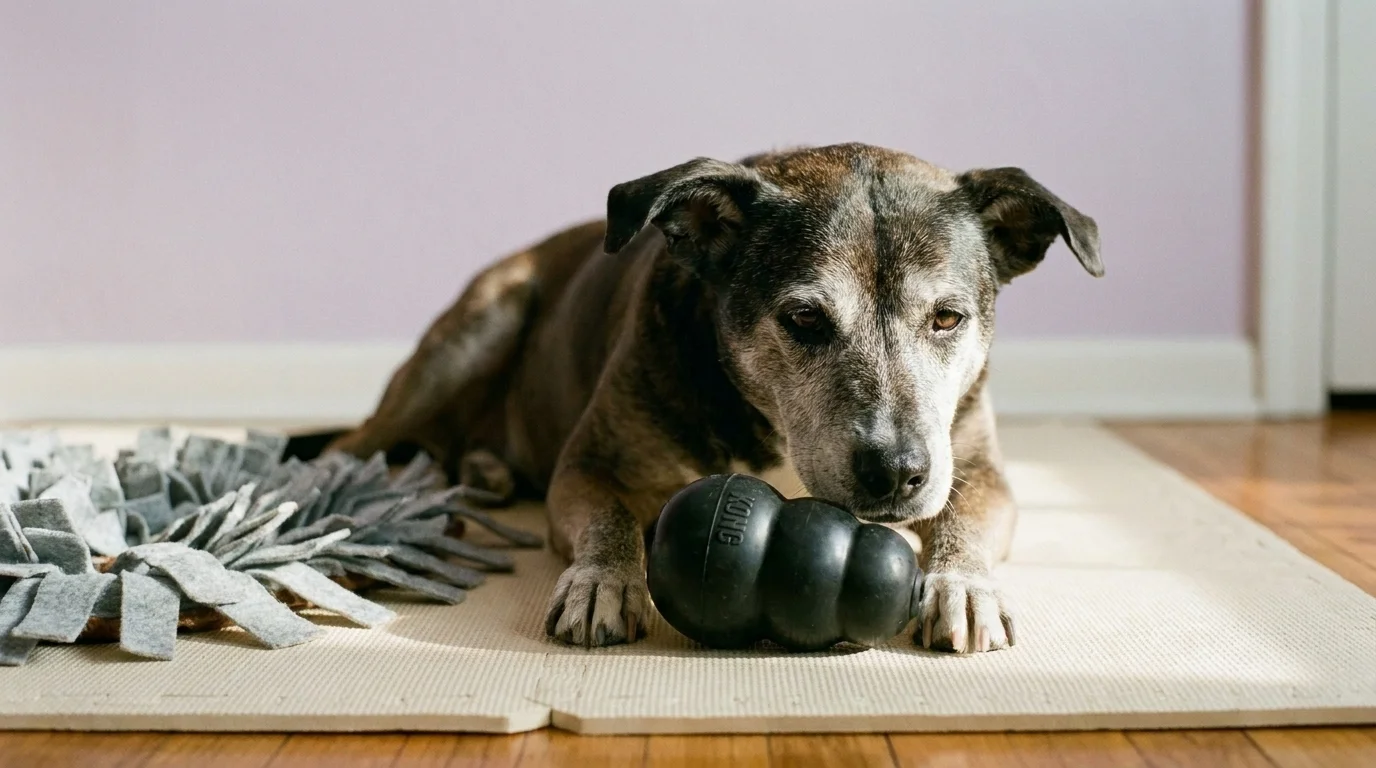
| Kong Classic (rubber) | Easy → hard | All dogs; the universal food puzzle | Stuff with kibble + wet food, freeze for harder difficulty; widely available in five sizes |
| West Paw Toppl | Easy → moderate | Strong chewers; dogs that destroy soft puzzles | Made of Zogoflex (more durable than Kong rubber); two sizes interlock |
| Outward Hound Nina Ottosson puzzles, Levels 1–4 | Progressive | Dogs ready to graduate from snuffle/Kong | Sliding-tile and lever puzzles; start at Level 1 |
| PetSafe Busy Buddy treat toys | Moderate | Power chewers; energetic dogs that work fast | Various puzzle shapes; durable |
| Kong Wobbler | Moderate | Dogs ready for movement-based puzzles | Weighted dispenser; dog knocks it around to release kibble |
| Snufflemat XL or frozen-Kong combo | Hard | Senior dogs needing longer engagement; high-arousal dogs needing wind-down | Frozen Kong takes 45+ min; pairs well with calmer settling |
Frozen-Kong recipe most clients have success with: kibble base in the bottom one-third, a tablespoon of plain unsweetened yogurt or pumpkin in the middle, a small bit of wet food sealed at the top with a single blueberry or kibble piece in the very tip. Freeze 6+ hours. Difficulty scales with how cold the contents are.
Two notes on safety for the food-enrichment category:
- Match the tool size to your dog. Kongs come in five sizes; an undersized Kong is a choking hazard. A correctly-sized Kong should not fit fully inside your dog's mouth.
- Supervise the first few sessions with any new puzzle to learn whether your dog is a "chew through the toy" type or a "work the puzzle" type. The former will demolish soft puzzles; the latter will work them indefinitely.
A DIY snuffle mat for households on a budget: get a rubber sink mat with holes, tie strips of polar fleece (cut from old fleece blankets) through the holes until the mat is fully tufted. Scatter your dog's kibble through the tufts. Assembly takes about thirty minutes and is indistinguishable from a commercial snuffle mat in function.
Scent work — and the dosing reframe
The most under-used enrichment modality is also the one with the strongest case to make. Scent work — the deliberate use of the dog's olfactory system for problem-solving — produces a level of mental fatigue that no equivalent amount of physical exercise produces.
The dosing reframe that has become standard in 2025–2026 practitioner content: a 20-minute sniff walk, where the dog sets the pace and is allowed to stop at every interesting smell, produces roughly the same level of mental fatigue as a 45-minute power walk (PetMD 2026 update). The "tired dog = good dog" framing of the early 2010s has been replaced by something closer to "mentally fatigued dog = good dog," and the difference matters for joints, recovery, and behavior.
A practical progression for an at-home scent-work routine:
Stage 1 — Scatter feed (week 1–2). Take a handful of your dog's daily kibble and scatter it across the grass or carpet in an area roughly the size of a yoga mat. Cue "find it" and let the dog work. Three to five minutes; one to two times per day.
Stage 2 — Hidden-treat search (week 3–4). Put your dog in a sit-stay in the next room. Hide three to five treats around the living room — under cushions, behind chair legs, on low surfaces the dog can access safely. Release with "find it." Five to ten minutes.
Stage 3 — Container puzzles (week 5–6). Take three to five identical cardboard boxes or plastic containers. Hide a treat in one. Place them in a line. The dog learns to indicate the correct container. Build difficulty by adding distractor boxes, varying the container type, increasing the search area.
Stage 4 — AKC Scent Work introduction (month 2+). If your dog enjoys the work, AKC Scent Work introduces target odors (birch, anise, clove, cypress) and formalizes the indication behavior. Many local trainers offer "intro to scent work" classes; the NACSW (National Association of Canine Scent Work) maintains a credentialing path for owners and dogs who want to compete.
For senior dogs and dogs with mobility limitations, scent work is the right primary enrichment modality precisely because it taxes the brain without taxing the joints.
Cat enrichment — the AAFP/ISFM Five Pillars
Cats are not small dogs, and their enrichment framework is its own discipline. The American Association of Feline Practitioners and the International Society of Feline Medicine published the Five Pillars of Feline Environmental Wellbeing in 2013 (Heath, Rodan, Sundahl), updated in subsequent years, and these are still the canonical framework for cat households (AAFP/ISFM Environmental Needs Guidelines, PMC).
Pillar 1 — A safe place. Every cat needs at least one location where she cannot be reached or interrupted. A cardboard box on a high shelf, a covered cat bed in a quiet room, a cat tree platform — the specifics matter less than the predictability. A cat without a safe place is a cat under chronic low-grade stress.
Pillar 2 — Multiple and separated key environmental resources. Food, water, litter box, scratching post, resting and sleeping zones, play areas. Distributed across the home, not stacked in one corner. The +1 rule for litter boxes — one more than you have cats — is the most-quoted version of this principle and the most reliably effective intervention for multi-cat household tension.
Pillar 3 — Opportunity for play and predatory behavior. Cats are obligate carnivores wired for short, intense hunting sequences. The canonical hunting sequence — stalk-chase-pounce-grab-bite-consume — should be completable in every play session. Wand toys with prey-mimic motion work; laser pointers without a tangible terminal target leave cats frustrated. End sessions with a small "kill" reward: a treat, a scatter of kibble, a puzzle feeder.
Pillar 4 — Positive, consistent, and predictable human-cat social interaction. Cats are social-feeders but solitary hunters; their tolerance for sustained social contact is real but capped. Two to three minutes of focused interaction at predictable times is worth more than fifteen minutes of intermittent engagement.
Pillar 5 — An environment that respects the cat's sense of smell. Cats orient by scent. Forcing them into novel scent environments (new bedding, scented diffusers, frequent cleaning of resting spots) produces measurable stress. Keep her scent footprint stable; let her face-rub the new furniture before you put it in a permanent location.
Practical cat enrichment ideas, by domain:
- Vertical territory — cat tree with multiple levels, window perches, top-of-bookcase routes. Older cats with arthritis need lower, easier-access perches; younger cats benefit from height.
- Puzzle feeding — slow feeders, food puzzles (Catit Senses, Trixie 5-in-1, DIY toilet-paper-roll dispensers).
- Wand play — 5–10 minute sessions twice daily; vary the wand-toy texture (feather, fur, fabric); end with a small treat reward.
- Cardboard box rotation — the lowest-cost enrichment in companion-animal care. Cardboard boxes are stress reducers in shelter cats; the principle scales to homes.
- Window viewing with bird feeder — the original "cat TV." Position a bird feeder visible from a window perch.
- Scent enrichment — a fresh piece of cardboard with catnip; a new (washed) cardboard box; silvervine or valerian for cats who don't respond to catnip.
The cat-enrichment time budget is shorter than the dog-enrichment time budget because cats' arousal-and-rest cycles are shorter. Two five-to-ten-minute wand sessions plus a puzzle-fed meal plus scent rotation is a full enrichment day for most indoor cats.
Senior pet enrichment — as cognitive intervention
The framing matters because most owners under-deliver enrichment to their senior pets at exactly the moment the evidence base argues they should be increasing it.
Canine Cognitive Dysfunction Syndrome (CCDS) is more common than most pet owners realize. Landsberg's prevalence data put CCDS at roughly 28% of dogs aged 11–12 and 68% of dogs aged 15–16. The Frontiers 2025 practitioner survey confirmed that 79.5% of US veterinarians now formally recommend environmental enrichment as part of CCDS management, and that 64.4% of vets most often diagnose CCDS in dogs aged 13–15.
The DISHA-AL screening framework — Disorientation, Interaction changes, Sleep / wake disturbances, House-soiling, Activity changes, Anxiety, Learning and memory — is the structure veterinary behaviorists use for early CCDS recognition. If your senior dog shows changes across two or more of those domains, it is worth a vet visit before more progress is lost.
Practical enrichment adaptations for senior dogs:
- Shorter, more frequent sessions. Two 5-minute scent-work sessions are better than one 15-minute session.
- Lower physical demand. Snuffle mats and lick mats are better than Wobblers or rolling puzzles for dogs with arthritis.
- Predictable routine. Senior dogs benefit from consistency; novel environments can be disorienting if introduced too quickly.
- Cognitive games that match her capacity. A senior dog who used to do Level 3 Nina Ottosson puzzles may now find Level 1 satisfying.
- Scent work as primary modality. Olfactory processing remains relatively preserved in CCDS while other cognitive functions decline.
For senior cats, the parallel framework is mobility-adjusted: lower window perches, ramps to favourite resting spots, shorter wand-play sessions, predictable feeding times, scent stability. Feline cognitive dysfunction exists too and is wildly underdiagnosed in cats over ten — the screening is largely the same as DISHA-AL adapted for feline behavior.
A daily enrichment time budget
A working time budget for an average adult dog, modeled on the AAHA framework:
- 20–30 minutes of food-puzzle-fed meals (one or both daily meals delivered via Kong, snuffle mat, or puzzle feeder).
- One 5–10 minute scent-work session (scatter feed, find-it, or container search).
- Two 5-minute positive-reinforcement training reps (could be cooperative-care work for husbandry, trick training, basic obedience refresher, or impulse-control games).
- One sensory or physical-environmental rotation (a new toy from the rotation, a different sniff route on a walk, a new chew).
That is roughly 40–55 minutes of structured enrichment per day, distributed across the dog's waking hours, plus normal physical exercise. The time investment is real but not impossible; the difference in dog behavior between a household running this routine and a household feeding from a bowl and walking around the block is dramatic.
For cats, the budget compresses: two five-to-ten-minute wand sessions, a puzzle-fed meal, a scent or environmental rotation. Roughly 15–25 minutes of structured enrichment per day.
For senior dogs, the budget redistributes toward shorter sessions and more cognitive work: three to four 5-minute sessions, weighted heavily toward scent and gentle puzzle work, plus a puzzle-fed meal.
For small pets — rabbits, guinea pigs, parrots, reptiles — the species-specific frameworks vary widely. Rabbits need substantial hay-based foraging (timothy hay, willow balls, untreated wicker baskets), digging substrate, and predictable companionship — most rabbits do better in bonded pairs. Parrots need foraging puzzles, social interaction, vocalization opportunities, and structured out-of-cage time daily. Reptiles need species-appropriate basking, hiding, and behavioral-opportunity setups specific to their natural history — a bearded dragon's needs differ markedly from a leopard gecko's. For any of these, the species-specific consultation with a credentialed exotics veterinarian is the foundation.
When to call a behaviorist or veterinarian
Enrichment is the foundation. It is not the entire toolkit, and there are conditions for which enrichment alone is not the right intervention.
A short decision rule:
- A dog displaying aggression, reactivity, resource guarding, or severe separation distress — work with a credentialed force-free trainer (CPDT-KA, KPA-CTP, IAABC-associate) for the training plan, and if the behavior persists or escalates, ask your veterinarian for a referral to a veterinary behaviorist (DACVB). Some behavior cases need medication alongside the training plan; that decision belongs with a DACVB.
- A dog suddenly showing new behavior changes in middle age or older — vet visit first. Pain (most commonly from undiagnosed osteoarthritis), thyroid disease, and early cognitive decline all present as behavior change. Enrichment is not the right starting point if there is a medical layer underneath.
- A senior dog showing DISHA-AL signs — vet visit; ask specifically about CCDS workup. Enrichment is then part of the multimodal management, alongside any supplements or pharmaceuticals your vet recommends.
- A cat with sudden behavior changes — house-soiling outside the box, withdrawal, increased vocalisation, or aggression — vet visit first. Feline idiopathic cystitis, hyperthyroid disease, early renal disease, and pain all show up first as behavior change. Enrichment helps; medical workup comes first.
- Any owner using prong collars, e-collars, alpha rolls, or "show the dog who's boss" framing — please, switch trainers. The behavior science has moved past those methods, and a force-free approach using LIMA principles (least intrusive, minimally aversive) produces better outcomes with lower risk of fallout. The credential to look for is CPDT-KA, KPA-CTP, IAABC-associate, or a veterinary behaviorist. Ask your trainer directly: "How do you handle a dog who refuses to comply?" The answer should be about understanding the function and adjusting the antecedent, not about correction.
Enrichment is the part of behavior work that is most reliably under your control. Get the food-puzzle routine and the sniff walks right, and you have changed the dog's entire week. The rest builds on that foundation.
Frequently Asked Questions
Cycle through AAHA's five enrichment domains weekly. Deliver at least one meal via a snuffle mat or puzzle toy, run a 5-minute scent-work 'find it' game, do two short positive-reinforcement training reps, swap one toy from your rotation, and end with a calming sensory activity like a chew or LickiMat. Twenty to thirty minutes total beats one long session.
For most healthy adult dogs, yes. Problem-solving engages the prefrontal cortex and produces deeper rest than repetitive aerobic exercise. A 20-minute sniff walk with frequent stops is generally more mentally fatiguing than a 45-minute power walk — and gentler on joints, particularly for senior dogs and puppies still growing.
Yes — the data are unusually strong. The 2024 Heys et al. study in Veterinary Record surveyed 1,750 dog owners and found over 85% use food-delivery toys, with around half feeding their dog exclusively via enrichment devices rather than a bowl. Owners reported mental-stimulation benefit in 98% of cases and boredom prevention in 96%. Start with a snuffle mat or a Kong Classic before stepping up to multi-level puzzles.
Aim for roughly 20–30 minutes of food-puzzle-fed meals plus one short scent-work or training session for an average adult dog — about 40–55 minutes of structured enrichment distributed across the day, alongside normal physical exercise. Senior dogs benefit from shorter, more frequent, lower-physical-demand sessions. There is no single AAHA-published time figure; adjust to your dog's age, breed, and behavioural baseline.
Yes — 79.5% of US veterinarians now formally recommend environmental enrichment as part of managing Canine Cognitive Dysfunction Syndrome (CCDS), according to a 2025 Frontiers in Veterinary Science survey of 318 practitioners. CCDS affects roughly 28% of dogs aged 11–12 and 68% of dogs aged 15–16. Scent work, gentle puzzle toys, predictable routine, and shorter sessions are the most commonly cited interventions.
Cats benefit most from the AAFP/ISFM Five Pillars of Feline Environmental Wellbeing: a safe place to retreat, multiple and separated key resources (food, water, litter, scratching), play that mimics the hunting sequence (stalk-chase-pounce-grab-bite-consume, ending with a 'kill' food reward), predictable human interaction, and respect for the cat's scent landscape. Two five-to-ten-minute wand sessions a day, plus puzzle feeding and scent rotation, is a complete daily enrichment plan for most indoor cats.