The Power of Play: Enhancing Pet Health and Well-being Through Fun Activities


The cat who has not played in three days does not look like a cat in distress. She looks like a cat who has stopped trying. She sleeps eighteen hours instead of sixteen, gives the wand toy a single half-hearted swat, then walks away — and her person reads that as "she just doesn't like toys." She liked toys. She has stopped expecting the session to end the way her body is wired to expect it to end, and so she has filed the wand under "things that aren't worth the effort."
Mental stimulation for dogs and structured play for cats are not the same intervention dressed up differently — and the conversation about play in pet households almost always starts in the wrong place — with toys and breeds and "fun activities" — when the conversation that matters is about what play does in an animal's body and brain, and what happens when an animal does not get it. The Association for Pet Obesity Prevention's most recent prevalence data put 59% of US dogs and 61% of US cats in the overweight-or-obese range, and their 2024 owner-perception survey shows the gap is finally beginning to close: 35% of dog owners and 33% of cat owners now correctly classify their pet as carrying excess weight, up from 17% and 28% the year before (APOP press releases; APOP 2024 survey). The wedge has moved. The question is no longer "do owners see it?" but "what is the lever that costs nothing and works for every species in the household?" The lever is play — provided we are honest about what kind of play, how much, and for which animal.
This is a guide for dogs and cats together, because almost no consumer site treats them in one piece, and because the families who read articles like this one usually have both. I am a cat behavior consultant by training — I will be more confident on the feline side and will lean on the named authorities (AAHA, AKC, the Barnard Dog Cognition Lab) for the canine side. Different species, different problems, different solutions — and pretending otherwise is how generic pet content fails its readers.
Why play matters more than the listicles say
Play is one of three things at the same time — and which one matters depends on the animal in front of you.
For an overweight middle-aged Labrador, play is physical exercise, and the unit of analysis is calories burned and weight controlled. For an indoor cat with no outdoor access and no littermates, play is the predatory sequence, and the unit of analysis is whether the animal gets to express a hunt from start to finish. For a service-dog puppy two months out from growth-plate closure, play is impact on developing joints, and the unit of analysis is duration and surface. The same word covers all three, but the design of a good play session changes completely.
The literature on play deprivation is unkind. Mills and colleagues writing in The Veterinary Record in 2014 linked sustained play deprivation in confined dogs to escalating stereotypies and aggression. A 2014 owner survey of indoor cats (Strickler & Shull, Journal of Veterinary Behavior; n=277) found 61% of cat owners reported at least one of six selected behavior problems in their indoor cat — only 54% of those owners had spoken to a veterinarian about it. Aggression to owners (36%) and inappropriate urination (24%) led the list — both behaviors that the feline literature ties directly to under-stimulation and resource scarcity (Faunalytics summary of Strickler & Shull 2014).
A cat peeing outside the box is first a vet visit and only second a behavior case — that order does not change. But once medical causes are ruled out, the behavior case very often turns into a play case, because the animal has nowhere to put its predator.
Physical benefits — the body
For dogs, the physical case is straightforward and overdue: an adult Labrador who walks twenty minutes on the lead twice a day and otherwise sleeps on the kitchen floor is exercising at the volume of a sedentary human, and the obesity statistics reflect it. The fix is not heroic — it is more minutes, more often, varied by structured walks (lead, controlled pace), off-lead recall play in safe spaces, and short bursts of higher-intensity work like fetch and chase games. PDSA's #1-ranking duration guidance for the United Kingdom (whose breed-energy brackets I have adapted below for US readers) is the cleanest version of this advice on the open web (PDSA exercise guide).
For cats, the physical case is shaped completely differently. A cat in the wild eats ten to fifteen small prey items a day, which means she has run a short, anaerobic hunt sequence ten to fifteen times — sprint, ambush, kill, eat, groom, sleep, repeat. The cardiovascular system the domestic cat carries inherits that pattern. Long aerobic exercise is not what her body asks for; multiple short bursts of high-intensity stalk-chase-pounce is what her body asks for. A single half-hour of wand play is not what a cat means by play. Two or three sessions of five to ten minutes, at intervals across the day, is.
Mental benefits — the brain
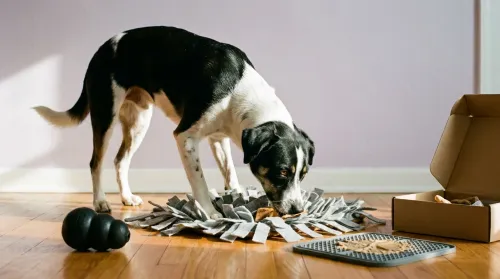
This is the section where I am leaning hardest on named research, because the most under-cited finding in the consumer pet press is Duranton and Horowitz's 2019 paper out of the Barnard Dog Cognition Lab: two weeks of daily nosework — letting dogs use their noses to search for hidden food, on their own terms, without heelwork or handler-led structure — produced a measurable positive shift in cognitive bias (an objective marker of an animal's emotional state) compared with a control group doing heelwork. A 2025 scoping review out of the same line of work reported that scent-based activity is now "incorporated in almost everything I do" by surveyed dog trainers (Duranton & Horowitz 2019; 2025 follow-up review).
The practical takeaway for dog households: sniffing beats fetching for tired-dog mental load. Five minutes of nosework, scatter-feeding in the garden, or a structured "find it" session with hidden treats around the house will leave a dog more relaxed than twenty minutes of ball chasing, and it does not pound the joints. This is the single most useful piece of mental stimulation advice for dog owners that the SERP currently buries.
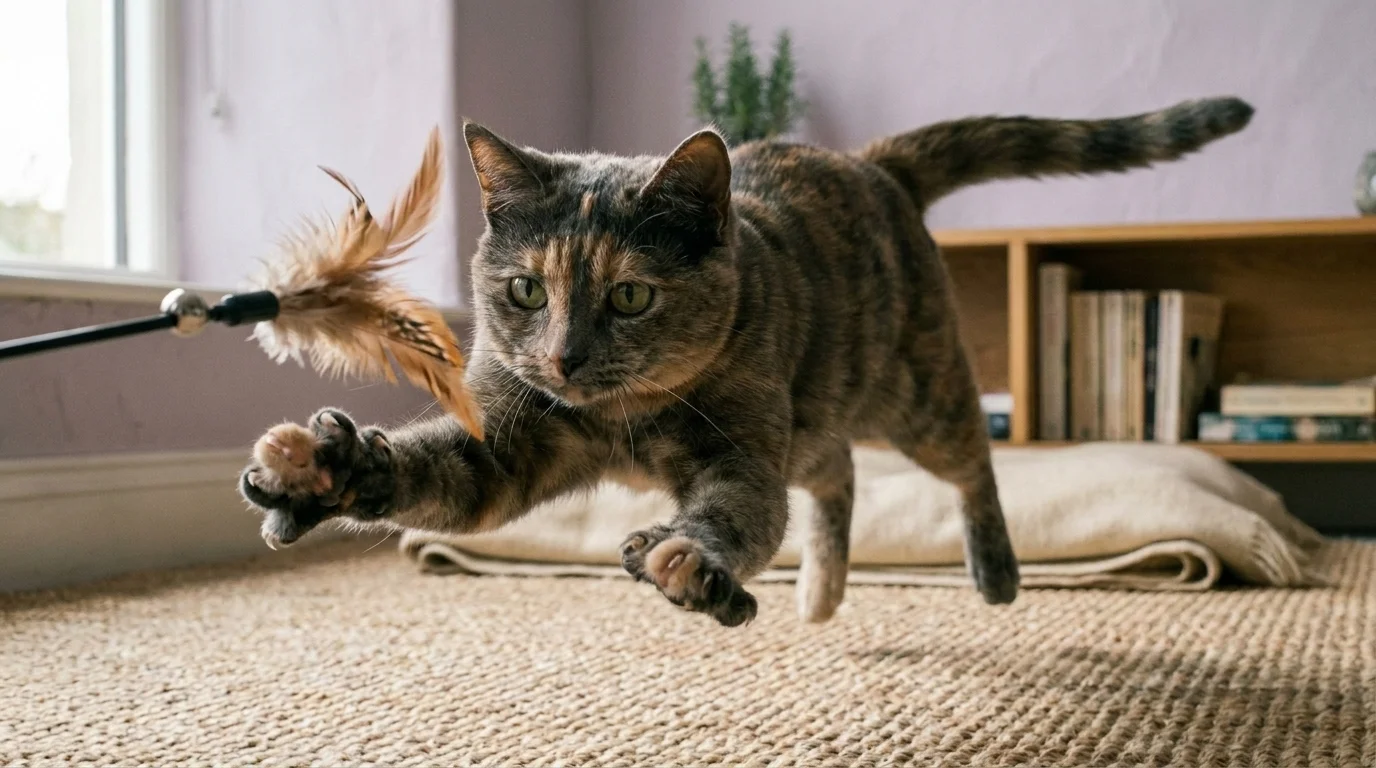
For cats, the mental-benefits case runs through the predatory sequence — and this is where most cat-play advice fails. A complete feline play session moves through six phases: stalk → chase → pounce → grab → bite → consume. The wand toy or laser pointer that ends with the human walking away to make dinner has interrupted that sequence at "grab." The cat is left with adrenaline and no completion. That is the session ending without a "kill." Repeated often enough, it produces the exact behaviors — redirected aggression, frustration vocalisation, ambushing of human ankles — that owners later describe as "she just got moody one day."
The fix is structural: end every play session with a consumption phase. A small portion of food, ideally delivered through a puzzle feeder or scatter-fed across the floor, completes the sequence the way the cat's nervous system expects. This is core AAFP/ISFM Five Pillars guidance — specifically Pillar 3, "opportunity for play and predatory behaviour" — and it is the single intervention that distinguishes adequate cat play from cat play that actually changes behavior (AAFP/ISFM Feline Environmental Needs Guidelines, PMC).
How much play is enough — dogs
The honest answer is "it depends on life stage, energy level, and breed type," but the SERP rewards a table, and a table is also how I think about it:
| Life stage / energy | Daily total activity | Of which structured (lead / controlled play) | Mental-load minutes (scent, training) | Heat cutoff (brachycephalic / thick-coat) |
|---|---|---|---|---|
| Puppy (8 wk – growth plates) | See 5-minute rule | 5 min × age in months × 2/day | Free indoor / yard play unrestricted | Skip mid-day in summer |
| Adult, low energy | 30–45 min | 30 min | 5–10 min | Stop above 80°F + 70% humidity |
| Adult, mid energy | 60–90 min | 30–45 min | 10–15 min | Stop above 80°F + 70% humidity |
| Adult, high / working breeds | 90–120+ min | 45–60 min | 15–30 min | Move walks to dawn / dusk above thresholds |
| Senior (low impact preferred) | 30–45 min | Easy lead walking | 15–30 min (scent, slow tricks) | Lower threshold; watch joint heat |
Numbers are guideposts, not prescriptions — body condition score (the rib check), recovery the next morning, and any sign of lameness are the actual feedback the dog gives you.
The 5-minute rule for puppies, honestly
The widely-quoted rule — "five minutes of structured exercise per month of age, twice daily, until growth plates close" — is a piece of folk-wisdom popularised by UK vets and The Kennel Club. It is not backed by a dedicated peer-reviewed trial. AAHA's enrichment guidance supports the underlying logic (the long-bone growth plates are vulnerable to repetitive concussive load until they fuse), but no formal trial has tested the formula itself (Vet Voices on the 5-minute rule). Several large pet sites still attribute the rule to AAHA, which is over-claiming.
The rule applies to structured exercise — lead walks, controlled play, conditioning work — not free play in a fenced yard or indoors, where the puppy self-regulates and stops when she is tired. The distinction matters because owners who try to enforce the rule on free play end up either confining a puppy who needs to move or feeling guilty when she runs around the kitchen. Free play, the puppy decides. Structured play, you decide.
Growth-plate closure timelines, from the AKC's reference material: toy and miniature breeds 6–8 months; medium breeds around 12 months; large breeds 12–18 months; giant breeds 18–24 months (AKC puppy exercise reference). A Great Dane and a Yorkshire Terrier are on completely different developmental clocks, and the same five-minute rule means very different things for each.
Senior dogs — trade impact for cognition
The old advice for senior dogs ("slow down, do less") is incomplete. What ageing dogs need is less impact and more cognition. Scent work, slow trick training, food puzzles, and "sniffari" walks — where the dog sets the pace and stops at every interesting smell — are low-load on joints and high-load on the cortex. There is real cognitive-decline pathology in older dogs (canine cognitive dysfunction), and mental engagement appears to slow it the way it appears to slow analogous decline in humans. The AAHA senior-care framework supports this trade.
How much play is enough — cats
For cats, the floor is five minutes. The most useful citable finding in the cat-play literature is again Strickler and Shull 2014: owners who reported one-minute play bouts had significantly more behavior problems in their indoor cats than owners who reported five-minute-or-longer bouts. The same survey found that 64% of cat owners played with their cat more than twice daily, and most reported bout durations of five minutes (33%) or ten minutes (25%) (Faunalytics summary). Five minutes is not a target. Five minutes is the threshold below which the session is not doing the work the cat's behavior is asking for.
Two five-to-ten-minute sessions a day, ideally one in the morning and one before the evening hunt-window (cats are crepuscular, and the late-afternoon zoomies are not random — they are her body asking when the hunt is).
The predatory sequence
Every interactive play session should walk through the sequence: stalk → chase → pounce → grab → bite → consume. The wand toy carries the first four phases. Once she has caught and "killed" the toy several times — actual grab, actual bite, fur-lining mouthed — present the consumption phase: a small portion of her daily allowance scatter-fed on the floor, or a single puzzle feeder, or a few treats hidden in cardboard. The consumption phase is what closes the loop. Without it, she is left in the activated state with no resolution.
Move the wand the way prey moves, which is not the way a person waving a stick moves: small darts, freezes, retreats away from the cat (prey almost never moves towards a predator), with hide-and-pop-out behind sofa legs and table corners. Hand-control beats laser pointers for exactly this reason — a laser dot cannot ever be caught, and the unending no-kill chase is precisely the structure that leaves cats frustrated.
Cats can fetch — yes, really
A 2023 paper in Nature Scientific Reports surveyed cat-owner reports of fetching behavior and found the behavior far more prevalent than the cat literature had assumed (Fetching felines, Nature Scientific Reports 2023). Many cats — particularly Siamese, Burmese, Bengal, and Tonkinese — spontaneously retrieve. The advice has changed: if your cat brings you a hair tie and drops it at your feet twice, you have a fetching cat. The respectful thing to do is throw it again.
Choosing toys and activities
I am going to skip the toy-by-toy listicle because the transactional SERP for "interactive cat toys" is permanently owned by Amazon and Chewy and a content site cannot helpfully compete there. What is useful is the decision framework.
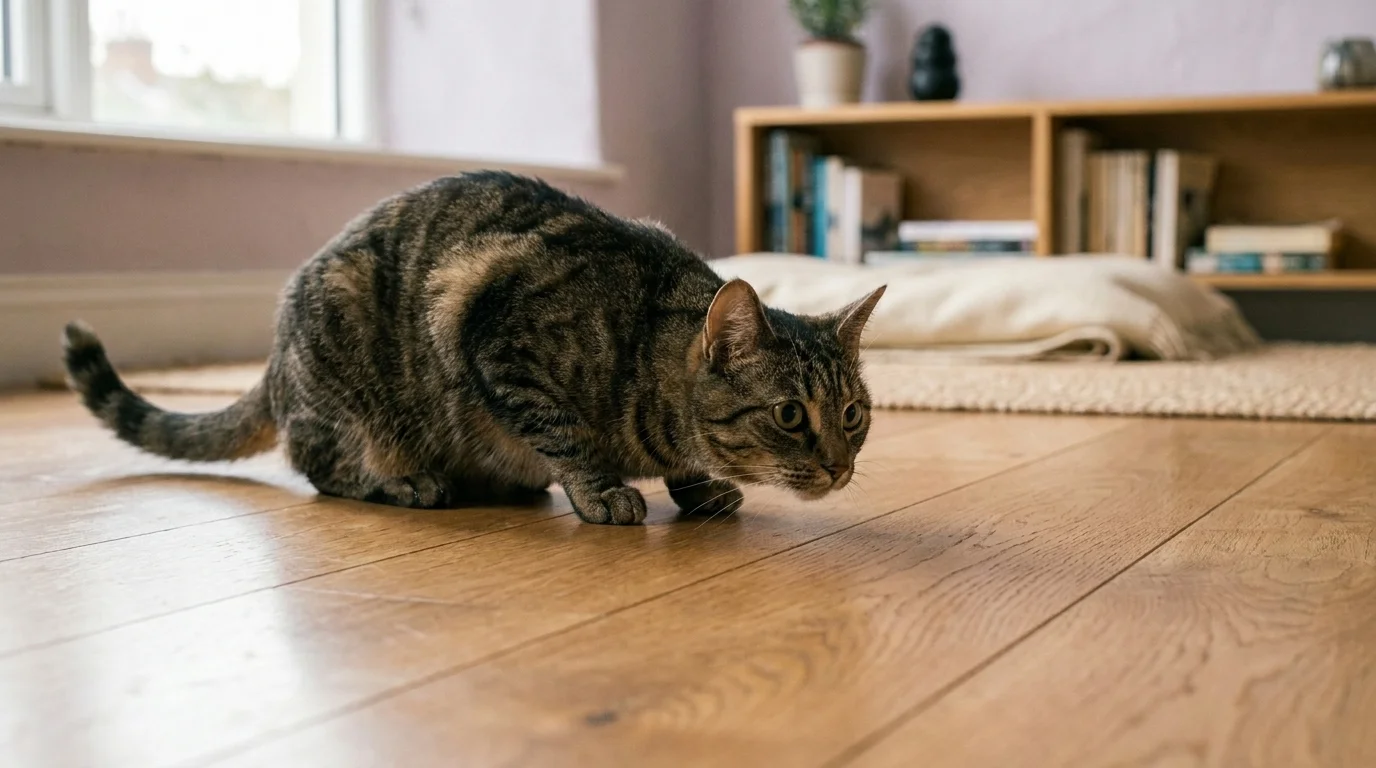
For cats, the toy must allow a complete predatory sequence. That means: it can be stalked from cover, chased across an open run, pounced on, grabbed in the mouth, and bitten without breaking. Wand toys with a feathered or fur-textured lure pass; static plush mice fail (no stalk, no chase). Battery-powered fish that flop on the floor are fine but should not replace human-handled wand play, because the cat does not learn the social-bonding signal from an autonomous toy. A food puzzle is not a play toy, but it is the consumption-phase toy — it earns its place at the end of the sequence, not in the middle.
For dogs, the toy decision branches on what the dog's body asks for. Strong chewers (Labradors, Pit-mix breeds, Bull Terriers) need toys at the top of the durability scale — Kong Black, Goughnuts, Benebone — because cheaper rubber becomes a choking hazard within hours. Scent work needs no toys at all: a handful of kibble scattered across the lawn, or a few treats hidden under cups, will outperform a £30 puzzle feeder for cognitive load. Tug toys deserve their own category and their own discussion, in the safety section below.
The variety question — "should I rotate toys?" — is yes for both species, and for the same reason: novelty drives engagement, and a toy that has been on the floor for six weeks reads as furniture rather than as prey. Rotate three or four sets on a weekly cycle.
Building a routine that sticks
The single biggest predictor of whether a household keeps up daily play is whether it is tied to an existing rhythm: the evening kettle going on, the morning coffee, the moment the laptop closes. Cats in particular do better with predictable timing because they are crepuscular hunters wired to expect activity at dawn and dusk. A wand session before the human evening meal — feeding the predatory drive before feeding the cat — is one of the cleanest behavior-modification interventions a multi-cat household can make. The cat hunts, kills, eats, grooms, sleeps. That is the order her body expects.
For dogs, the variable to optimise is distribution across the day, not total minutes in one block. An hour of off-lead play in the morning plus a five-minute scent game at midday plus a twenty-minute lead walk in the evening is better than ninety minutes once. The recovery, the cortisol curve, and the joint load all favour distribution.
Play safely — the risks no one mentions
This is the section the major pet sites consistently skip, and the section a cited piece can carry alone.
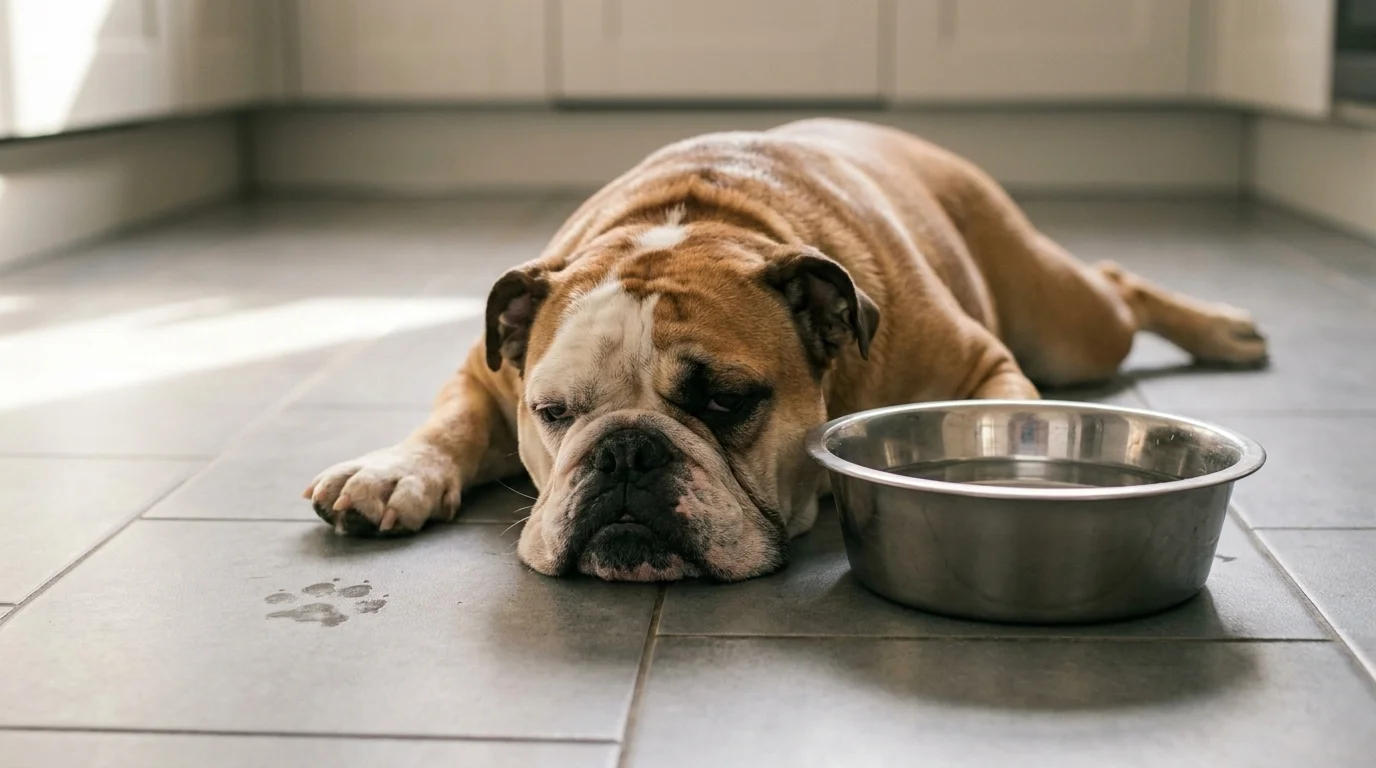
Heat stroke. For brachycephalic dogs — Bulldogs, Pugs, French Bulldogs, Boxers — the threshold is lower than people think: above roughly 80°F with humidity above 70%, vigorous exercise is a hard cutoff, regardless of how willing the dog seems. The dog will keep playing past the point her cooling system has failed. The owner has to be the one to stop. Move walks and active play to dawn or after dusk in summer. The signs (excessive panting, brick-red gums, lethargy that arrives suddenly) are veterinary emergencies — do not "wait it out."
Growth-plate damage in puppies. Repetitive concussive load — extended jogging, jumping on and off furniture, agility before twelve months in a large breed — is a known risk factor for elbow dysplasia, OCD lesions, and early hip osteoarthritis. The five-minute rule is not over-cautious; it is the cheapest insurance there is.
Fetch-related repetitive strain in herding breeds. Border Collies, Australian Shepherds, and Kelpies will fetch until they collapse. The breed selection that produced a dog who never loses focus on the moving target also produced a dog who does not know to stop. Cap fetch sessions at fifteen minutes for these breeds, and intersperse with sniff work or trick training. The repetitive cardiovascular peak plus the sudden-decel-pivot at the catch is hard on cruciate ligaments.
The tug-of-war myth. Tug does not make dogs aggressive. Rooney and Bradshaw demonstrated in 2002 that tug played with rules — the dog releases on cue, the human controls start and stop, no growling at the human, the toy belongs to the human — correlates with better-behaved dogs, not worse ones. The myth that "tug teaches dogs to bite" was based on observation of dogs playing tug without rules, which is a different intervention entirely.
Resource guarding in adolescents. Between roughly six and eighteen months, many dogs go through a phase where they start guarding toys, food, and resting spots that they did not guard as puppies. If you see stiffening, hard staring, or a low growl when you approach a high-value toy, do not "show her you're the boss." Get a certified applied animal behaviourist (CAAB) or a force-free trainer. Resource guarding handled badly becomes a serious bite case; handled with structured counter-conditioning it becomes a memory.
For cats: the no-laser rule, properly. Laser pointers are not banned — they are useful for the chase phase. The rule is: never end on the laser. End the session with a tangible target (a wand toy or thrown treat) that the cat can actually catch, grab, and bite. The laser is the chase; the wand or treat is the kill.
When to call your vet or CAAB
A cat who has stopped playing entirely — not "she only plays sometimes," but "she has not engaged with a toy in two weeks and is sleeping more than usual" — is a vet visit. Hyperthyroid disease, early kidney disease, dental pain, and arthritis (yes, cats get arthritis, and it is wildly underdiagnosed in pets over ten) all show up first as withdrawal from activity.
A dog who has stopped engaging with familiar games, or who is reluctant on stairs she used to take in stride, is also a vet visit before a behavior visit. Pain is the most common cause of behavior change in pets, and it is the easiest one to miss because animals are very good at hiding it.
For behavior cases where medical causes are ruled out, look for credentialed help — a certified applied animal behaviourist (CAAB or ACAAB through the Animal Behavior Society), a veterinary behaviourist (DACVB), or a CCBC for cats. The pet-trainer market is unregulated, and "dog trainer" or "cat behaviourist" on a website means nothing on its own. Credentials, peer-reviewed continuing education, and a force-free approach are what to look for.
The cat who stopped trying because the sessions never ended in a kill will start trying again, usually within a week of a properly structured routine. So will the Labrador whose mid-afternoon zoomies were really cortisol with nowhere to go. The fix is rarely heroic. It is usually a five-minute session, twice a day, that ends the right way.
Frequently Asked Questions
A mid-energy adult dog needs 60–90 minutes of total daily activity, with at least 30 minutes as off-leash play, structured walking, or scent work; high-energy working breeds need 90–120+ minutes; senior and low-energy breeds may need only 30–45 minutes. Heat is a hard cutoff: stop vigorous play above 80°F with 70% humidity, especially for brachycephalic breeds like Bulldogs and Pugs.
It's a widely-quoted UK-vet folk-wisdom: 5 minutes of structured exercise (lead walks, controlled play) per month of age, twice daily, until growth plates close. Closure timelines run roughly 6–8 months for toy breeds, 12 months for medium, 12–18 for large, and 18–24 for giant breeds. The rule applies to structured exercise — free indoor or fenced-yard play, where the puppy self-regulates, doesn't count against the limit.
Five minutes is the floor, not the target. Strickler and Shull's 2014 owner survey of indoor cats found 1-minute play bouts correlated with significantly more behavior problems than 5-minute-or-longer bouts. Aim for two five- to ten-minute interactive wand sessions a day, ideally before meals, and always end each session with a small 'consumption phase' — a few treats, scatter-fed kibble, or a puzzle feeder — so the cat completes the predatory sequence.
Yes — and for cognitive load it can be more tiring per minute. The Duranton & Horowitz 2019 study from the Barnard Dog Cognition Lab found two weeks of daily nosework produced measurable positive cognitive-bias shifts where heelwork did not. Five minutes of scent work or scatter-feeding will leave a dog more relaxed than 20 minutes of fetch, and it's gentle on joints — particularly valuable for puppies before growth-plate closure and for senior dogs.
No — this is a long-debunked myth. Rooney and Bradshaw (2002) showed that tug played with rules (the dog releases on cue, the human controls start and stop, no growling at the human) correlates with better-behaved dogs, not worse ones. The risk isn't the game; it's playing without rules. Tug is one of the most physically engaging things you can do with a strong dog in a small space.
Trade impact for cognition. Replace fetch and jumping with scent work, food puzzles, slow trick-training, and 'sniffari'-style walks where the dog sets the pace. For senior cats, keep wand sessions short and low to the ground, and watch for arthritis signs (reluctance on jumps, less grooming on hind end) — feline arthritis is wildly underdiagnosed in cats over ten and is a vet conversation, not a behavior fix.