Mental Enrichment for Pets: Enhancing Cognitive and Emotional Well-being


Mental stimulation for dogs and cats is a clinical concern more than a lifestyle one. The behavioural problems that fill veterinary behaviour referrals — destructive chewing, repetitive licking, vocalisation, inappropriate elimination, generalised anxiety — are very often, in retrospect, enrichment problems before they were behavioural ones. The good news is that the literature on canine and feline enrichment has matured substantially over the past decade, the frameworks the major veterinary associations endorse are concrete enough to translate into a Saturday-morning routine, and most owners are within a few hours a week of solving the boredom-driven behaviours that drove them to look for help in the first place.
A note on framing. This guide is dog-primary by structure — search demand for canine enrichment outpaces feline by roughly an order of magnitude — but the cat section is explicit about the AAFP/ISFM Five Pillars framework that defines cat welfare in a way "more toys" does not, and the senior-pet section addresses Canine Cognitive Dysfunction Syndrome (CCDS) as the genuinely under-discussed clinical concern in this space.
Signs Your Pet Needs More Enrichment
Before any specific protocol, the diagnostic question. Most owners arrive at enrichment via one of the following observations, which are also the ones I see most often in exam rooms.
In dogs:
- Destructive chewing of furniture or household items, particularly in the absence of teething (i.e., in adult dogs).
- Excessive vocalisation — repetitive barking when alone, or whining at the door.
- Repetitive behaviours — tail chasing, flank licking to a hot-spot, light or shadow chasing.
- Disengagement on walks — refusing the route, lagging behind, or by contrast pulling violently throughout.
- Hyperarousal indoors that does not settle within twenty minutes of routine activity.
In cats:
- Inappropriate elimination outside the litter box — almost always a medical, environmental, or social question before it is a "spite" one. Book the vet visit before you rearrange the furniture.
- Excessive grooming — over-grooming to the skin, particularly on the abdomen or flanks.
- Repetitive vocalisation, particularly in cats over ten or under two.
- Aggression between cats sharing resources — a Pillar 2 problem, almost always.
- Hiding for the majority of the day in a cat who used to be social.
Many of these signs have medical differentials that need to be ruled out first. A cat eliminating outside the box can be a urinary tract infection or interstitial cystitis. A dog with repetitive licking can have allergies or an underlying GI condition. The first call is your veterinarian. Once medical concerns are excluded — or addressed — the enrichment framework below is the sustained answer.
What Enrichment Actually Means: The Five Categories
The ASPCA's working taxonomy organises enrichment into five categories, and it is the cleanest scaffold I know of. The newer Five-Domains welfare model (Mellor, 2017) takes a parallel approach by foregrounding positive welfare states rather than just the absence of harm — a useful conceptual anchor, but the categories below are easier to translate into action.
| Category | What it provides | One concrete example | A common mistake |
|---|---|---|---|
| Physical | Exercise, motor-pattern outlets, body work | Daily varied walks, structured play | Substituting the same walk every day for novelty |
| Sensory | Stimulation of sight, smell, sound, touch | Sniff-led decompression walks, varied textures, audio enrichment | Over-stimulation — a busy environment is loading, not enrichment |
| Cognitive | Problem-solving, novelty, choice | Food puzzles, new training cues, novel-object introductions | Difficulty mismatch — too-hard puzzles produce learned helplessness |
| Social | Species-appropriate interaction | Structured play with familiar dogs; calm human presence; cooperative-care training | Forced affection (cats) or unmanaged dog-park visits (anxious dogs) |
| Environmental / feeding | Habitat structure, foraging opportunities | Vertical territory, snuffle mats, scatter feeding | Free-feeding from a bowl bypasses predatory and olfactory expression |
Each category compounds. A dog who gets daily varied walks (physical), with sniffing time (sensory), one food puzzle a day (cognitive), structured play with one well-matched dog friend (social), and a snuffle-fed breakfast (feeding) is not the same animal as a dog who gets a single brisk leashed walk and twice-daily bowl feeding, even if the calorie and step counts are identical.
A frequently repeated rule of thumb is that "fifteen minutes of mental work tires a dog as much as an hour of physical exercise." Behaviorally plausible, not formally measured. Take it as a useful heuristic for routine design, not as a substitute for adequate physical exercise — most working-line and high-drive breeds need both, in meaningful quantity.
Related Article: Pet Care through Different Lenses: A Neurodiversity Discussion
Dog Enrichment: A Tiered Daily Routine
The single most useful structural step an owner can take is to decide what a normal weekday actually contains, then make sure the enrichment categories are represented inside it. Three sample plans, scaled to the time the household has:
A 15-minute baseline (a household with the smallest available time budget):
- Five-minute morning sniff-led walk in the immediate neighbourhood — the dog sets the pace, you follow.
- Breakfast served in a snuffle mat or scattered across the kitchen floor, eaten at the dog's own pace (≈5 minutes).
- One five-minute training session in the evening — three known cues plus one new one, paired with a high-value treat.
A 30-minute working plan (most adult households):
- 10–15-minute morning walk, half on-leash brisk, half sniff-led.
- Breakfast as a stuffed Kong, lickimat meal, or stationary food puzzle (≈10 minutes).
- Mid-day or after-work 10-minute training or puzzle session, varied across the week (training Monday, scent search Tuesday, novel object Wednesday).
- Evening 10-minute decompression walk on a long line in a low-stimulation area.
A 60-minute plus weekend amplification (a working-line or adolescent dog):
- Morning 25–30-minute varied walk (terrain change, off-leash where safe and legal).
- Breakfast from a stationary puzzle (≈15 minutes).
- Mid-day enrichment of 10–15 minutes (novel object, training, or scent search).
- Late-afternoon training session of 10 minutes, with one new cue.
- Evening 20-minute sniff-led decompression walk.
- Weekend addition: one structured nose-work or scent-work session of 30–45 minutes (see below).
The structure matters more than the specific tools. A dog who gets 30 minutes of varied enrichment across the day is a different dog from one who gets a 30-minute fetch session at 6 p.m. — the variety prevents the difficulty mismatch and the over-stimulation that turn enrichment into nervous-system loading.
The Predatory Sequence: Why Your Dog's Breed Matters
The canonical canine predatory motor sequence runs orient → eye/stalk → chase → grab-bite → kill-bite → dissect → consume. Selective breeding has amplified or suppressed specific motor patterns by breed group: border collies are amplified at orient/eye-stalk/chase and suppressed at grab-bite; retrievers are amplified at chase/grab-bite and suppressed at kill-bite; terriers are amplified at grab-bite/kill-bite and at dissect; scent hounds are amplified at orient and chase. (The 2024 Science Advances herding-dog genomics paper extends this framework with population-genetic evidence.)
Why this matters for enrichment: a tool or activity that gives a dog the chance to complete a motor pattern produces satisfaction. A tool or activity that triggers the pattern but skips the resolution produces frustration. A flirt pole used as an infinite tease, with no bite-and-hold at the end, makes a chase-amplified breed more aroused, not less. A snuffle mat that ends in a real food reward gives a scent-hound the orient-and-consume completion that satisfies the orient amplification.
Practical matches:
- Border collies, herding breeds: long-line tracking and recall games (orient-stalk-chase); flirt poles with regular grab-bite resolution; structured fetch with put-in-mouth mechanics; not-just-physical exercise.
- Retrievers, sporting breeds: structured fetch sessions; bite-and-hold tug with rules; water retrieval; scent work for olfactory expression.
- Terriers, earth dogs: dig pits filled with sand or play media; food-stuffed cardboard tubes to dissect (supervised); flirt pole with grab-and-shake.
- Scent hounds: nose-work; long sniff-led walks; tracking lines; scatter-feeding.
- Sighthounds: lure-coursing in safe environments; flirt pole; sprint games.
- Working / guarding breeds: structured task-based work; scent discrimination; cooperative-care training.
Match the enrichment to the motor patterns the breed was built to express. The goal is satisfaction at the end of the sequence, not stimulation at the start.
Related Article: CBD for Pets: The Comprehensive Guide to Uses, Benefits, and Risks
Tools Worth Owning: A Neutral Buyer's Guide
A practical tool kit covers the categories above without becoming a closet of plastic. Five tool types, each with an introduction principle:
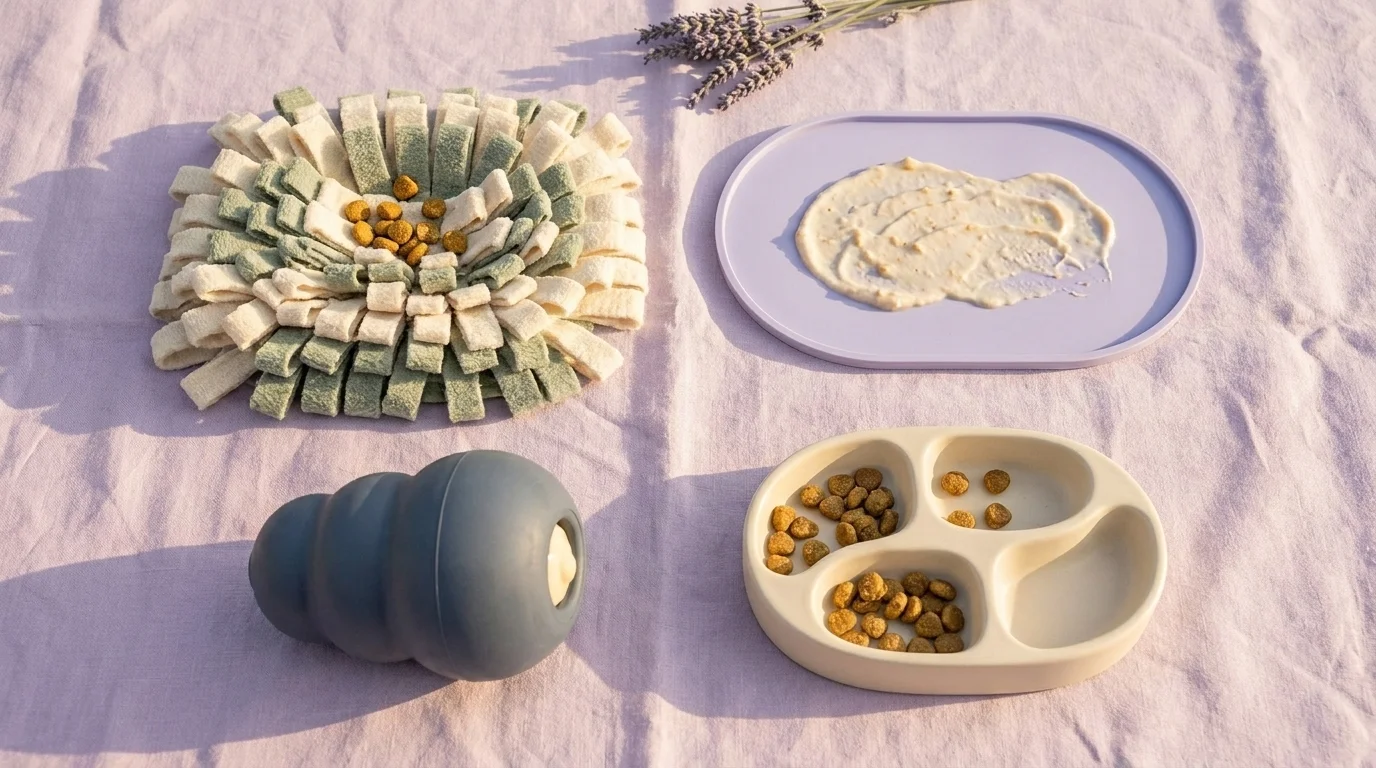
- Snuffle mat. A fabric mat with embedded pockets for hiding kibble. Cognitive + sensory + foraging in one tool. Introduce by scattering visible kibble on the surface; build to fully buried pieces over a week. Good for dogs and cats.
- Lickimat / slow-licking surface. A grooved silicone mat onto which wet food, plain yogurt, or pumpkin is spread. Calming via parasympathetic activation; useful for vet visits, fireworks, or post-walk decompression.
- Stuffable toy (Kong-style). Hollow rubber, stuffable with a soft food inside, often frozen for difficulty escalation. Introduce frozen for dogs with strong chew drive; introduce semi-soft for dogs new to puzzles. Great for chewers.
- Puzzle feeder, mobile or stationary. Mobile (rolling balls/tubes) for dry food; stationary (bases with wells) for wet or dry. Start with maximum ease — large openings, fully filled, regular food, and remove the bowl from rotation that day so the puzzle is the meal.
- Flirt pole. A long pole with a rope and a soft target. Concentrated chase and grab-bite practice. Always end with a bite-and-hold — the resolution is the satisfaction.
The introduction protocol is the part most owners skip. Start at maximum ease with whatever tool you choose, build difficulty over a week or two, and stop the session before the dog is frustrated rather than after. A puzzle that produces a quick win the first time is doing its job; a puzzle that produces a fifteen-minute battle on day one is not enrichment, it is the thing that teaches a dog to give up.
Scent Work for Dogs: Start Here
Scent work has become the fastest-growing enrichment vertical for a reason: it is welfare-positive, low-impact on the dog's joints, accessible to seniors and high-drive young dogs alike, and supported by the most consistent peer-reviewed signal in the canine enrichment literature.
The 2019 Duranton and Horowitz study in Applied Animal Behavior Science (vol. 211, pp. 61–66) randomised twenty adult dogs to two weeks of nose-work or heel-work training. The nose-work group, post-training, showed shorter latency to approach an ambiguous bowl in a cognitive-bias paradigm — interpreted as a more optimistic affective state. The 2024 scoping review by Kokocińska and colleagues found that across multiple controlled and observational studies, dogs allowed to sniff freely on walks show lower cortisol than dogs walked on tight leashes — the empirical case for the "decompression walk." A more recent canine executive-function study (published in Animals) found that nose-work-trained dogs scored higher on the Dog Executive Function Scale than untrained dogs, with the strongest effect in dogs holding formal nose-work titles.
A three-tier progression any owner can run at home:
- Beginner — find the treat in the room. Sit the dog in a stay (or in a separate room). Hide a few high-value treats in obvious places — open shelves, the floor, a low chair. Release the dog with a verbal cue ("find it!"). Reward the search and the find. Two or three short sessions a day.
- Intermediate — nose-work boxes. Three to six identical cardboard boxes, one with a treat inside, the others empty. Let the dog work the row, reward the find, rotate which box holds the treat. Build to scent-only finds (cotton swab with food residue, no actual treat in the box).
- Advanced — formal classes. NACSW (National Association of Canine Scent Work) and CWAGS in the US run accredited classes with handler progressions and titles. Most metros have at least one trainer; a one-hour class once a week generates more enrichment than most dogs receive on their best day.
Decompression walks deserve their own line. A weekly slow, sniff-led walk on a long line (4–10 metres) in a low-stimulation environment — a quiet park, a forested trail, a beach in the off-season — does more for an anxious dog than the same forty minutes of brisk leash-walking. Let the dog pick the route. Let them stop and sniff for as long as they want. The point is not the kilometres covered.
Cat Enrichment: The Five Pillars in Practice
The authoritative framework for cat welfare comes from Ellis and colleagues' 2013 AAFP and ISFM Feline Environmental Needs Guidelines in the Journal of Feline Medicine and Surgery. The Five Pillars are the framework the cat-behaviour community converges on, and they translate into practice more concretely than most consumer cat-content suggests.
- A safe place. Each cat in the household needs at least one secure retreat — typically elevated, partially enclosed, with one entrance. Carriers left out as ambient furniture serve this role and double as desensitisation tools for vet visits.
- Multiple and separated key environmental resources. Feeding, drinking, toileting, scratching, play, and resting areas should each be available in multiple locations and separated from each other and from each other's species-mates. The "n+1" litter-box rule — one per cat plus one — derives from this pillar. Two cats in a household need at least three separated litter resources, distributed across the home.
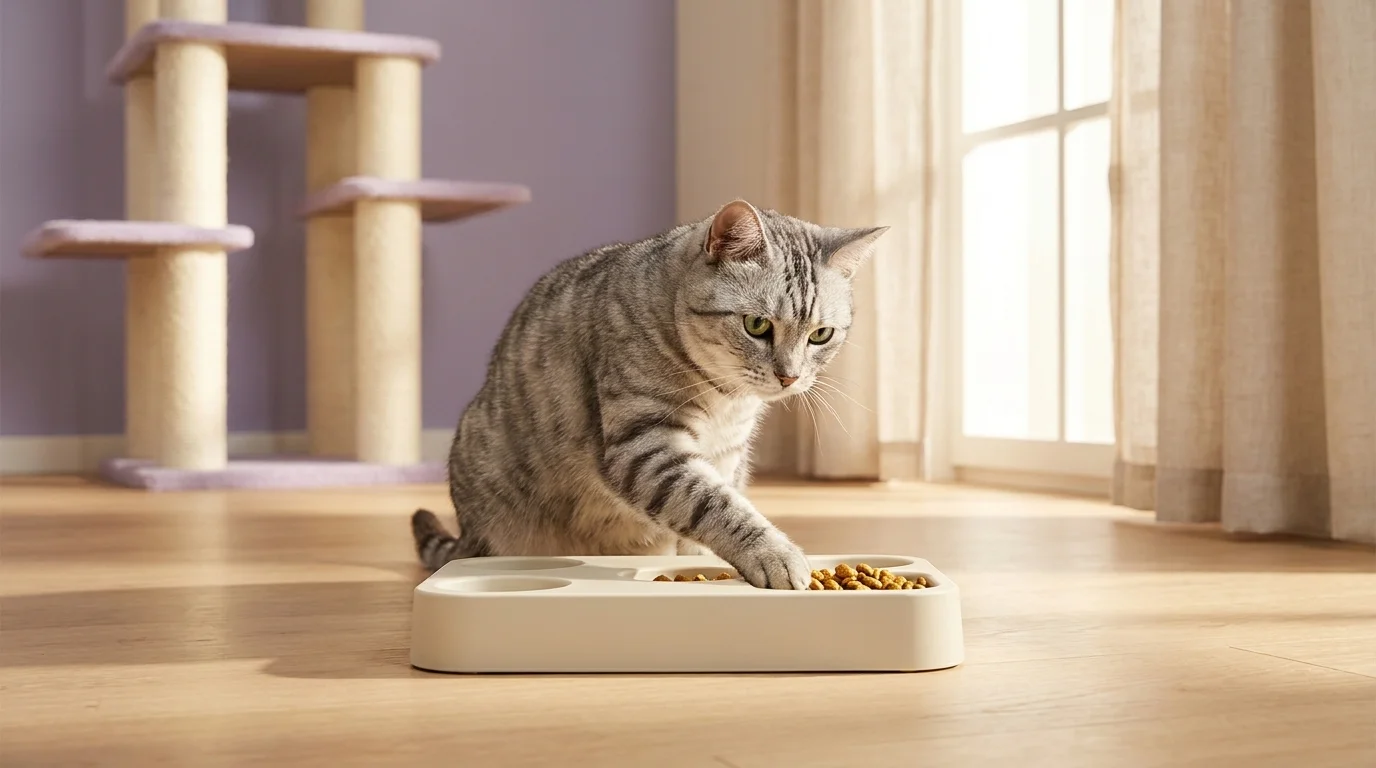
- Opportunity for play and predatory behaviour. Pseudo-predatory play — wand toys triggering the full stalk-chase-pounce-bite-consume sequence — and feeding devices that require active acquisition. Food puzzles (Dantas, Delgado, Johnson, Buffington, 2016 in J Feline Med Surg) have documented case-study outcomes of 6.4–32% body-weight reduction, cessation of attention-seeking behaviour and inter-cat aggression, resolution of inappropriate elimination, and cognitive improvement in senior cats. Roughly 30% of cat owners surveyed in 2019 reported using food puzzles. A 2021 study in Animal Cognition by Delgado and colleagues found that domestic cats prefer freely available food over food that requires effort — they are not contra-freeloaders. The puzzle's value is in expressing the predatory sequence, not in making the meal hard. Introduce gradually: large openings, regular food, fully filled, with the bowl removed from rotation.
- Positive, consistent, predictable human-cat social interaction. Let the cat initiate, moderate, and end the interaction. Forced affection violates this pillar. The slow-blink, the offered cheek for a head-rub, the cat who walks away mid-petting and is allowed to — all of these are the pillar in practice.
- An environment that respects the importance of the cat's sense of smell. Preserve scent-marked surfaces (cheek-rub spots, the corner of the sofa the cat bunts), avoid heavy-fragrance cleaners on resting and scratching areas, and never run essential-oil diffusers in a space a cat can occupy — cats lack the hepatic enzymes to metabolise most monoterpenes safely.
A practical Saturday-morning translation for an indoor cat household: rotate the wand-toy session through three to five minutes of stalk-chase-pounce-bite-consume play, ending in a treat or kibble the cat catches; feed one meal from a stationary puzzle; rearrange one piece of vertical territory or open a new shelf; don't pet the cat unless the cat asks; vacuum and clean without scenting the bunting corners or the litter zone.
Senior Pets: Enrichment and Cognitive Decline
This is the section most consumer enrichment articles skip, and it is the one where the clinical evidence is increasingly clear. The 2025 Canine Cognitive Dysfunction Syndrome Working Group consensus published in JAVMA / AJVR — the first international consensus definition of CCDS — describes it as a progressive neurodegenerative condition with parallels to Alzheimer's disease, affecting more than 50% of dogs by age 15.
The screening framework the working group recommends:
- Annual behavioural screening from age 7. A short senior-health questionnaire covering changes in interaction, sleep-wake patterns, house-soiling, and activity, completed at the wellness visit.
- Full DISHAA assessment every six months from age 10, or sooner if a caregiver reports changes. DISHAA stands for Disorientation, Interactions, Sleep-wake cycles, House-soiling, Activity, and Anxiety. The same household member should complete it each time so that progression can be tracked.
- Early intervention combines environmental enrichment with diet and selegiline (the only FDA-labeled drug for CCD), which together delay progression. The AAHA 2023 Senior Care Guidelines independently recommend cognitive enrichment as first-line management.
For a senior dog, enrichment adapts down rather than away. A sniff-only walk on a long line is enriching to a dog who can no longer manage a brisk hike. A lickimat meal is more accessible than a complex puzzle. Cooperative-care training (consent-based nail trims, brushing, ear checks) is enrichment in itself for arthritic seniors and reduces handling stress at vet visits. Medium-chain triglyceride-enriched diets (Purina NeuroCare and equivalents) have AAHA-cited efficacy data in mild-to-moderate CCDS — they are an adjunct, not a substitute, for the environmental piece.
For senior cats, adapt similarly: lower-pitched ramps and steps to preserve vertical territory access, easier-to-enter litter boxes, gentler wand-toy sessions, and food puzzles that present a smaller difficulty step. The Five Pillars do not change in old age — Pillar 1 (safe places) and Pillar 4 (predictable interaction) become more important, not less.
If you are reading this with a 7-plus-year-old dog, the next-step ask at your wellness visit is straightforward: "Can we do a behavioural baseline today, and run DISHAA at the next visit?" Early detection enables better outcomes; the framework is genuinely useful and underutilised.
Related Article: The Rise of Exotic Pets: Care Tips for Unconventional Companions
Small Pets and Exotics
This article is dog-and-cat-primary, but a brief note for households with other species. Rabbits do best with foraging boxes, dig pits, and chew variety; guinea pigs need scatter-feeding and predictable companions; pet birds need structured foraging shreds, social training, and species-appropriate flock interaction; reptiles need varied substrates, novel branch arrangements, and species-appropriate light cycles. For more, see our exotic pet care guide — and for any chronic behavioural concern, route through an ARAV- or AAV-credentialed exotics veterinarian rather than a general-practice clinic.
A Brief Closing Note
Enrichment, taken seriously, is not pampering. It is the structural answer to the most common behavioural complaints owners bring into exam rooms, and — for senior dogs and cats — it is part of the clinical management plan for a real and progressive disease. The frameworks above are what the major veterinary organisations (AAFP, AAHA, AVMA, IAABC) endorse as of April 2026. The places where the evidence is genuinely thinner — the precise dose-response of scent work for anxiety, the long-term cognitive impact of specific enrichment patterns in cats, the comparative effectiveness of different toy categories — are places where the honest answer is "useful, plausibly mechanism-supported, more research needed."
Individual decisions — the right routine for your dog's breed and life stage, the right adaptation for your senior cat, when to escalate to a veterinary behaviourist — belong with your own veterinarian. This guide is the framework. The animal in front of you is the medicine.
Last reviewed 2026-04-29 by Dr. Maren Holbrook, DVM.
Frequently Asked Questions
Most adult dogs do well with 30–60 minutes of structured enrichment per day, layered into the regular routine — typically a sniff-led walk, one food-puzzle or stuffed-Kong meal, and one short training or nose-work session. Working-line and adolescent dogs often need more. The frequently quoted rule that 15 minutes of mental work tires a dog as much as an hour of physical exercise is behaviorally plausible but not formally measured — treat it as a useful heuristic for routine design, not a substitute for adequate physical exercise.
Yes, when matched to the predatory motor sequence and given a safe outlet. Chewing is a natural component of the grab-bite / dissect / consume sequence and is welfare-positive when directed at appropriate items — stuffable toys, soft food puzzles, supervised cardboard tubes, species-appropriate chews. Destructive chewing of furniture is a sign that the natural drive does not have a legitimate outlet; the answer is not to suppress chewing but to redirect it.
Destructive chewing of furniture in adult dogs, repetitive vocalization, self-directed repetitive behaviors (tail chasing, flank licking to a hot spot, light or shadow chasing), disengagement on walks (refusing the route, lagging, or pulling violently throughout), and hyperarousal indoors that does not settle within 20 minutes. Many of these have medical differentials (allergies, GI conditions, anxiety disorders) and warrant a veterinary visit before they are assumed to be enrichment-driven.
Use the AAFP/ISFM Five Pillars (Ellis et al., 2013) as the framework: provide safe retreats (Pillar 1); separate and multiply key resources — feeding, drinking, litter, scratching, resting (Pillar 2, the n+1 rule for litter boxes); create predatory-play opportunities with wand toys ending in a catch and food puzzles introduced gradually (Pillar 3 — note that cats prefer easy food, so gentle introduction matters); offer predictable, cat-initiated human interaction (Pillar 4); and respect the cat's olfactory environment, including never running essential-oil diffusers around cats (Pillar 5). Vertical territory and food puzzles deliver the largest measurable behavioral changes.
The Canine Cognitive Dysfunction Syndrome Working Group's 2025 consensus recommends annual behavioral screening from age 7, with a full DISHAA assessment (Disorientation, Interactions, Sleep-wake cycles, House-soiling, Activity, Anxiety) every six months from age 10. CCDS affects more than 50% of dogs by age 15. If you observe changes — disorientation in familiar spaces, altered sleep patterns, house-soiling in a previously trained dog, or increased anxiety — bring them up at the next wellness visit and ask for a behavioral baseline. Early intervention combining environmental enrichment, MCT-enriched diets, and selegiline (the only FDA-labeled drug for CCD) has the best outcome.
A snuffle mat is a fabric mat with embedded pockets for hiding kibble — best for foraging and scent-driven enrichment; works for dogs and cats. A lickimat is a grooved silicone mat for slow-licking soft foods — best for calming, parasympathetic activation, and use during stressful events like fireworks. A stuffable rubber toy (Kong-style) is for chewers and can be frozen with food inside for difficulty escalation. A puzzle feeder, mobile or stationary, makes the dog or cat actively manipulate the toy to release kibble — best for cognitive enrichment when introduced at maximum ease and built up gradually.
The evidence base is encouraging, if still building. Duranton and Horowitz's 2019 study in Applied Animal Behaviour Science (n=20) found that two weeks of nose-work training shifted dogs toward a more optimistic affective state in a cognitive-bias paradigm. The 2024 Kokocińska et al. scoping review found that dogs allowed to sniff freely on walks consistently showed lower cortisol than dogs walked on tight leashes — the empirical basis for the decompression walk. A more recent canine executive-function study found nose-work-trained dogs scored higher on the Dog Executive Function Scale than untrained dogs. Sample sizes are small but the direction is uniformly welfare-positive, and scent work is one of the most accessible enrichment modalities for senior dogs and dogs with joint or recovery limitations.