
Pet-Proofing Your Home: Creating a Safe and Comfortable Environment for Your Furry Companion


The call I see most often in the week after a household brings home a new pet is a version of the same call. The puppy got into the trash. The kitten ate the lily. The retired Lab found the chocolate Easter eggs. The cat licked something off the bathroom counter that turned out to be acetaminophen. The owner is calling because the animal has just done something the owner did not realize was dangerous, fifteen minutes after exposure while the animal still looks fine. Pet proofing your home — room by room, with named hazards — is the conversation I wish more owners had before that call comes.
This guide is a pre-call. It will not be exhaustive — no household guide can be. But it will give you the room-by-room map I use when I walk through an exam-room conversation with a new owner, the named hazards that actually drive the calls into veterinary toxicology hotlines, and the 60-second protocol to follow if something does happen. Where the evidence is settled, I will say so. Where it is not, I will say that too.
Why pet-proofing matters — by the 2025 numbers
The ASPCA's Animal Poison Control Center (APCC) crossed five million lifetime cases in the summer of 2025 — roughly fifty years after the hotline launched (ASPCA press release, 5-Million Cases Milestone). In calendar year 2025 alone, APCC fielded more than 376,000 exposure calls — slightly down from 2024, but still on the order of a thousand pets every day in the United States (ASPCA, Top 10 Toxins of 2025).
A few things have shifted in the data since the last general "pet-proofing" piece most readers will have read:
- Over-the-counter medications and supplements overtook food as the #1 exposure category in 2024, and grew their lead in 2025 — driven specifically by social-media-promoted skincare products that pets are now licking off owners' faces, hands, and bathroom counters. This is a category that simply did not appear in pet-safety articles two years ago.
- Kratom exposures rose roughly 400% in APCC's 2025 dataset. Pet-proofing now has to account for the same household drug landscape humans have, including unregulated supplements and edibles.
- Flavored chewable veterinary products — the kind that taste like meat-flavored treats — are showing up as pet-self-dosed exposure cases. The medicine cabinet is no longer the only place to lock up.
- Tartaric acid was identified as the toxin in grapes and raisins by the Cornell Riney Canine Health Center — older articles correctly listed grapes as toxic without knowing the mechanism. The mechanism is now characterized (Cornell, Grape and Raisin Toxicity).
The point of this opening is not to alarm anyone. It is to say: the world your pet lives in has more chemistry in it than it did five years ago, the toxicology literature is keeping up, and a 2026-current guide should reflect that.
If exposure happens: the 60-second protocol
I am putting this section early because it is the section most readers will eventually need, and most pet-safety articles bury it.
If you find your pet has eaten, licked, or chewed something you believe is toxic — and even if the pet still looks fine — do the following in this order:
- Move the pet away from the source. Remove any remaining material and any other pets in the area.
- Call the ASPCA Animal Poison Control Center at (888) 426-4435, or the Pet Poison Helpline at 1-800-213-6680. Both are staffed by veterinary toxicologists, both run 24/7. APCC charges roughly a $95 consultation fee; Pet Poison Helpline is approximately $85. The fee is the cheapest line item in any exposure case. (ASPCA APCC)
- Save the packaging, the plant, the bottle. Photograph it. The toxicologist needs the specific product name, the dose, and the time of exposure to give your veterinarian a treatment plan.
- Do NOT induce vomiting unprompted. This is the single most common mistake. For some toxins — caustics, sharp objects, petroleum products — induced vomiting causes more damage than the original exposure. Wait for the toxicologist's instructions.
- Note the time, the estimated amount, and the pet's weight. All three are inputs the toxicologist will ask for immediately.
- If the toxicologist directs you to your emergency vet, go. Some exposures show clinical signs immediately; many do not. Grape and raisin ingestion, for example, typically does not show gastrointestinal signs until 12–24 hours post-ingestion — the time window in which decontamination is most useful is hours one through three (Cornell, Grape and Raisin Toxicity).
Tape the two phone numbers to the inside of your medicine cabinet. The single biggest predictor of a good outcome in a pet poisoning case is how fast the owner makes the call.
The 2025 top toxin categories — what's actually causing the calls
The APCC's 2025 breakdown, ranked by share of exposure calls (ASPCA, Top 10 Toxins of 2025):
| Rank | Category | Share of 2025 calls | Where it tends to live in your home |
|---|---|---|---|
| 1 | OTC medications & supplements | 16.9% | Bathroom, bedside, handbag |
| 2 | Food and drink (incl. chocolate) | 16.4% | Kitchen counter, low cabinets, trash |
| 3 | Human prescription medications | (in top 5) | Bathroom, bedside, kitchen counter, pillbox |
| 4 | Chocolate (called out separately) | 13.6% | Kitchen, holiday-season locations |
| 5 | Veterinary products | 9.1% | Wherever you store the flavored chewables |
| 6 | Plants and fungi | 7.5% | Living room, kitchen, yard |
| 7 | Rodenticides | 6.5% | Garage, basement, behind appliances |
| 8 | Household products | 6.4% | Laundry, bathroom, garage |
| 9 | Insecticides | 3.8% | Garage, yard |
| 10 | Recreational drugs | 1.9% | Living room, bedside, anywhere edibles are kept |
The single most important pattern in this list: the top three categories are all things owners brought into the house themselves, not things the pet sought out. Pet-proofing in 2026 is, more than anything else, a household-product organization project.
The rest of this guide is room by room. Use it as a walkthrough rather than a checklist — physically stand in each room at your pet's eye level and look around.
Kitchen
The room responsible for the largest share of the food/drink exposures and a substantial share of the OTC-medication calls (the painkillers and supplements that live on the counter).
The kill list, by mechanism:
- Chocolate (theobromine). Dark and baking chocolate are the most dangerous; milk chocolate at high volume can still hospitalize a small dog. 9,300+ grape and raisin cases alone were referred to APCC in 2025 (ASPCA 2025 toxins). Lock chocolate away the same way you would lock prescription medication away.
- Xylitol (a sugar substitute, increasingly in peanut butter, sugar-free gum, sugar-free baked goods, and some toothpastes). Causes a fast, profound hypoglycemia and acute liver failure in dogs at low doses. The lethal dose can be a single piece of gum for a small dog. Check every "sugar-free" label.
- Grapes and raisins (now characterized as a tartaric acid mechanism by Cornell). Can cause acute kidney injury in dogs at variable doses — there is no reliable "safe amount."
- Onions, garlic, leeks, chives (the allium family). Cause oxidative damage to red blood cells (hemolytic anemia) at moderate doses, in both dogs and cats. Cats are more sensitive. This includes onion powder in soup, pizza, and broth.
- Alcohol and unbaked yeast dough. Alcohol from any source is highly toxic to dogs and cats. Bread dough rises in the warm stomach, distorting it and producing ethanol.
- Edibles containing kratom, cannabis, or psilocybin. Up sharply in the 2025 data. Pets eat the entire packet, not the suggested serving. Treat edibles like prescription medication.
- Macadamia nuts. Causes acute weakness and tremor in dogs at low doses; mechanism still under study.
Storage rules:
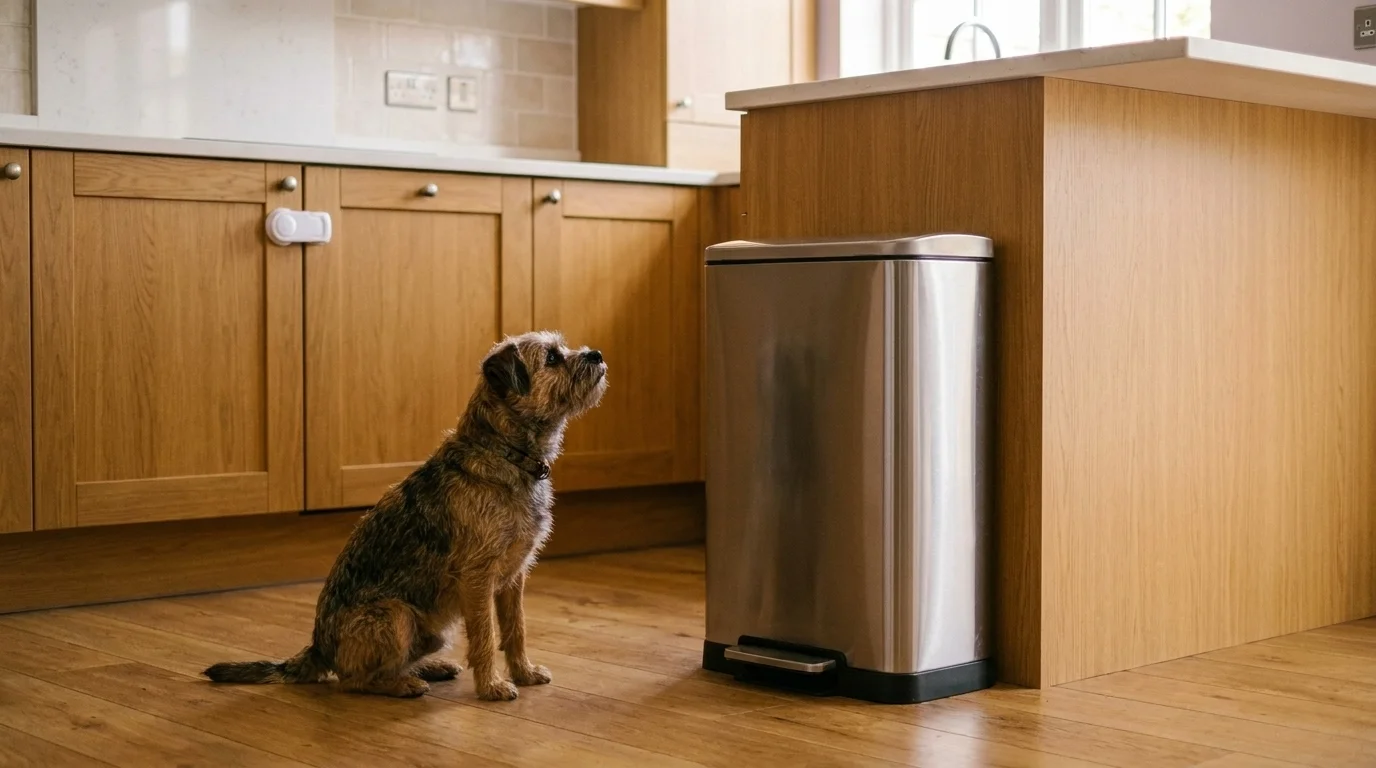
- Trash in a lidded container — ideally dog-proof (a step-lid or locking model rather than a swing-top). The kitchen trash is where the chocolate wrapper, the chicken bones, and the medicine packaging all converge.
- Counter-edge surveillance: a dog who can put two paws on the counter can reach the back of it. If your dog is a counter-surfer, the front-of-counter is for vegetables; everything else stays in a cabinet.
- Low cabinets — child-proof magnetic latches. A magnetic latch is the cheapest pet-proofing intervention and the highest-yield in the kitchen.
Species note for cats: cats are less likely to seek out chocolate, but they are more sensitive to allium and to the small-meal nibbling of stovetop drippings (especially onion-bearing). Cover food in progress; do not feed table scraps that include alliums.
Living room
The room that generates the largest share of the plants/fungi exposures and a fair share of the small-object swallowing cases. The hazards split sharply by species.
Plant kill list — cats:
- All true lilies (Lilium species — Easter, Tiger, Stargazer, Asiatic) and daylilies (Hemerocallis) are lethal to cats. The whole plant is toxic: leaves, flowers, pollen, and the vase water. A cat licking pollen off its own fur can develop fatal kidney failure within roughly three days (ASPCA Lily Toxicity). There is no safe-distance lily arrangement in a home with cats. Do not bring them in.
- Sago palm (severe — affects both species)
- Cyclamen, kalanchoe, dieffenbachia, philodendron, pothos, monstera (variable severity; most cause oral irritation and GI signs)
Plant kill list — dogs:
- Sago palm. A single ingested seed can cause acute liver failure. The leaves are toxic; the seeds are worse.
- Autumn crocus, cyclamen, lily of the valley (cardiotoxic)
- Mushrooms growing in the yard during wet seasons — Amanita species (the deadly ones look like ordinary white mushrooms)
- Marijuana, in any form
Electrical and small-object hazards:
- Cord covers for accessible cables. Most cord-chewing happens during the puppy/kitten phase and during un-supervised solo time. Cover the cables behind the TV, behind the desk, and behind the sofa. Cheap polyurethane sleeves work fine.
- Hair ties, rubber bands, dental floss, sewing thread, AirPods, small toys. Linear foreign bodies (string, floss, thread) are surgical emergencies in cats — they can saw through intestine over hours. Keep all sewing supplies behind a door.
- Baby gates for stairs and doorways while a puppy is house-training and during decompression after adoption. Pressure-mounted gates around $45–$100; hardware-mounted gates for the top of stairs around $80–$150 (Fixr Pet-Proofing Guide).
Furniture and fabric: durability matters more than style. Tightly-woven microfiber, leather, and outdoor-grade fabrics survive cats and dogs better than linen or loose wool. This is not a safety question per se — it is a "fewer destruction-replacement cycles" question.
Bathroom and laundry — the new #1 risk zone
This is the room where the toxin landscape has shifted most since the last general guide was written. OTC medications and supplements overtook food as the leading exposure category in 2024, and the 2025 data showed the gap widen — driven specifically by social-media-promoted skincare products (masks, retinol creams, dermatological serums) that pets lick off owners and bathroom counters (ASPCA 2025 toxins).
Storage rules:
- Every medication, human and pet, behind a closed door. Magnetic latches on the under-sink cabinet; medicine cabinet door closed.
- Pill organizers locked away when not actively in use. Pets crunch the plastic weekly-pill cases when left on a nightstand.
- Detergent pods in a locked cabinet, never on top of the washer or dryer. Detergent pods are the single most pet-attractive household-chemistry hazard — bright color, soft texture, dosed for ingestion. Pets bite them.
- Toilet lid closed. Especially for households using in-tank bowl cleaners.
The skincare callout — this is the 2025 update no other pet-proofing piece is making yet: retinol-containing creams (most night creams, anti-aging serums), psoriasis treatments, prescription topical NSAIDs, and salicylate-based pain creams are all toxic to dogs and cats at the doses found on a fingertip. Cats are especially sensitive to topical NSAIDs and to the inhalation of essential oils used in some "natural" skincare. Wash your hands before touching the cat.
Cleaning chemistry is the next sub-section on its own — see "Pet-safe cleaners" below.
Bedroom and home office
Smaller exposure share, but the room where the prescription-medication and small-object cases originate.
Storage rules:
- No bedside medication except in a closed nightstand drawer with a magnetic latch. This includes vitamins, melatonin, and over-the-counter sleep aids.
- Pet-treat-flavored veterinary products in a high cabinet. Flavored chewable heartworm preventatives and chewable joint supplements are increasingly involved in self-dosing exposure cases — the pet finds the bottle, recognizes it as treats, and eats the entire bottle.
- Small electronics (AirPods, earbuds, batteries) put away when not in use. Button batteries are an emergency: they can burn through esophagus tissue within hours.
- Curtain and blind cords — pulled up out of reach or cut to safe lengths. Long cords are strangulation hazards, particularly for kittens.
Garage and storage
The toxicology in this room is severe but predictable.
- Antifreeze (ethylene glycol). Sweet-tasting, neurotoxic, nephrotoxic. As little as one teaspoon can be lethal to a cat; one tablespoon to a small dog. Store on a high shelf, clean every spill immediately, switch to propylene-glycol-based formulations where available.
- Rodenticides (6.5% of 2025 calls). Anticoagulant baits cause delayed bleeding 3–5 days post-ingestion; bromethalin (a newer, non-anticoagulant rodenticide) causes neurological signs and is harder to treat. If you must use baits, use tamper-resistant stations and document where every station is placed — the toxicologist will ask.
- Insecticides (3.8% of 2025 calls). Permethrin in concentrated form is acutely toxic to cats (causes tremors and seizures); dilute formulations applied to dogs can still be transferred to cats by contact. Read every label. Do not apply dog-only flea products to a cat.
- Lawn and garden chemicals. Fertilizer pellets (especially the iron-containing varieties), slug bait (metaldehyde — neurotoxic), and concentrated herbicides. Store sealed; observe reentry intervals on the label.
- Tools, paint, motor oil, windshield washer fluid (methanol). Variable toxicity; the general rule is treat the garage as you would a chemistry lab — closed, ventilated, child-locked.
Yard, balcony, and pool
The outdoor section the original article reduced to one sentence on fencing. Here is the real list:
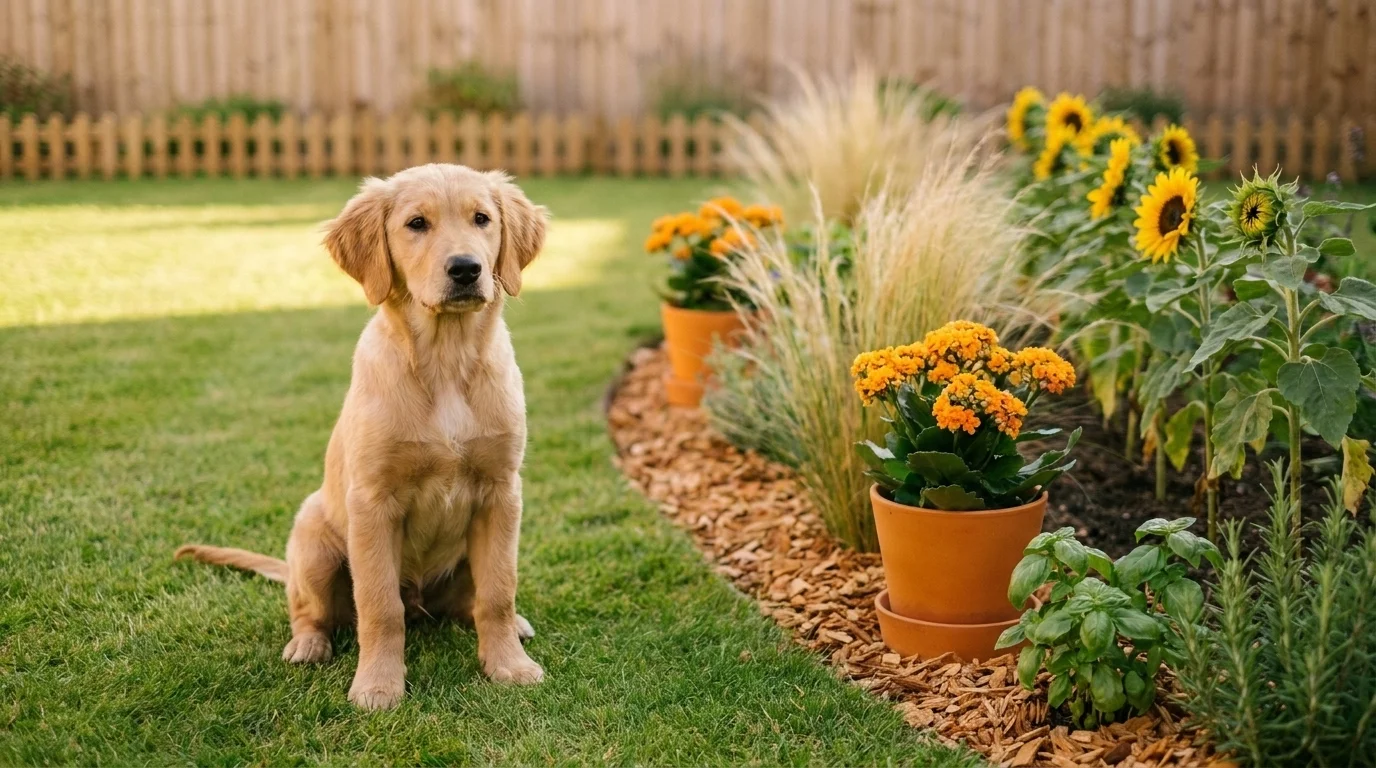
- Cocoa mulch. Smells like chocolate, contains theobromine, and dogs will eat it. Use cedar, pine, or rubber mulch instead.
- Antifreeze in the driveway. Re-stated because it is the highest-fatality outdoor hazard. Clean every spill immediately.
- Lawn pesticides and herbicides — reentry intervals. Most professional applications have a 24- to 48-hour reentry interval before pets should be on the treated area; the label is law. If your lawn service does not tell you the interval, ask.
- Foxtail grass. Migrating barbed seed heads that lodge in ears, nostrils, between toes, and occasionally migrate into the body cavity. A frequent surgical emergency in West Coast and inland-California dogs in summer. Mow before seed heads form; check feet after walks in dry-grass areas.
- Mushrooms during wet seasons. Identify and remove. If you cannot identify them, treat them as toxic.
- Pool and spa. Pool drowning is a leading cause of accidental death in young dogs and the rare cat that gets out. Install pool fencing (mesh ~$2,000, metal ~$6,500 per Fixr) or a pool alarm if a fence is not feasible. Teach dogs where the steps are; do not assume a dog can locate them in a panic.
- Balcony and high windows for cats. "High-rise syndrome" is the veterinary term for cats falling from upper-story windows and balconies, and the injury pattern (jaw fractures, lung contusions, fractured limbs) is consistent. Cats do not reliably land safely from heights, particularly low-to-mid heights where they lack the time to right themselves. Tight-fitting window screens, balcony netting, or a catio enclosure are not optional in a multi-story home with cats.
Puppy-proofing overrides
Beyond the room-by-room walkthrough, puppies introduce a few category-specific risks:
- Chewing is universal until growth-plate closure plus a margin. Soft rubber chew toys in the household; cord covers on every accessible cable; shoes and bags off the floor.
- House-training accidents are not pet-proofing failures. Crate or expen the puppy when unsupervised during the first six to twelve weeks.
- Socialization window (3–14 weeks). Not strictly pet-proofing, but the window during which exposure to varied surfaces, sounds, and people drives long-term temperament. Do this on-leash or in arms; protect against parvovirus exposure until vaccines are complete.
- The "5-minute rule" for structured exercise — five minutes of lead-walked or controlled play per month of age, twice daily, until growth plates close (6–8 months toy breeds, ~12 months medium, 12–18 months large, 18–24 months giant). Free indoor and fenced-yard play, where the puppy self-regulates, is not subject to the rule.
Kitten-proofing overrides
- Lilies, restated. Worth its own line. Do not allow them in the home.
- String, ribbon, dental floss, sewing thread, yarn. Linear foreign bodies in cats are surgical emergencies — the string saws through intestine over hours and the prognosis worsens with delay. All sewing supplies behind a closed door. Take Christmas tinsel off the holiday list permanently if you have a cat.
- Window and balcony netting, restated.
- The litter-box +1 rule. One more litter box than you have cats, distributed across the home (not stacked in one bathroom). This is environmental safety in the behavior sense — it prevents the urinary stress responses that show up as litter-box avoidance and, in chronic cases, idiopathic cystitis.
- Heat sources. Stovetops, glass-front fireplaces, heated mats. Cats jump and they do not check the surface temperature first.
- Cleaning products. Cats groom obsessively; anything left on the floor or a counter is transferred to fur and then to mouth. Pet-safe disinfectants are non-negotiable in a cat home — see the next section.
Senior pets — a brief note
Older pets see most of the same hazards plus a few age-specific ones: cognitive decline (canine cognitive dysfunction syndrome) increases the chance a familiar dog walks into a trash bin she would once have avoided; hearing loss increases driveway and traffic risk; arthritis pain increases the chance a cat avoids a previously-used high resting spot, sometimes ending up in places that are less safe. Pet-proofing for seniors usually means more night-light, fewer obstacles in walkways, and a willingness to re-do the proofing decisions you made when the animal was young.
Pet-safe cleaners — the 2025 hot category
Searches for "pet safe cleaners" have risen roughly 560% year-over-year, and the cleaner-chemistry conversation has moved from "vinegar and baking soda" to a small set of registered disinfectants that actually kill household pathogens without leaving toxic residue (Preventive Vet, Pet Safe Home Cleaning Products; Force of Nature).
Seek:
- Hypochlorous acid (the active ingredient in Force of Nature and similar electrolyzed-water systems). EPA-registered as a disinfectant; rinses to salt water; safe on most surfaces.
- Hydrogen peroxide at 3% household concentration for general disinfection; rinse after.
- Thymol-based cleaners (the active ingredient in some Seventh Generation and Benefect products). Plant-derived, registered as an antimicrobial.
Avoid:
- Bleach (sodium hypochlorite) on surfaces pets walk on or lick. The fumes alone are irritating to feline airways.
- Formaldehyde-containing cleaners (rare on labels; check Material Safety Data Sheets).
- Isopropyl alcohol as a floor cleaner — toxic on ingestion.
- Phenols (Pine-Sol, Lysol's classic phenol formulations). Cats lack the liver enzymes to metabolize phenols efficiently; these are particularly dangerous in cat homes.
- Essential-oil "cleaners" containing tea tree, eucalyptus, citrus, pine, peppermint, or wintergreen oil at undiluted strength. Direct contact and inhaled vapor are both significant cat-toxicity hazards.
A practical rule: if the cleaner leaves a residue and the cleaner contains anything you would not let a child lick off the floor, it is the wrong cleaner for a household with a young, low-to-the-ground pet.
What pet-proofing actually costs
A realistic budget range, based on the named ranges Fixr published in April 2025 (Fixr Pet-Proofing Guide):
- Magnetic cabinet latches — a 10-pack from any home-improvement supplier is the highest-yield per dollar of any pet-proofing intervention.
- Cord covers — $15–$40 for a household.
- Baby gates — $45–$100 pressure-mounted; $80–$150 hardware-mounted for stairs.
- Lidded or locking trash can — $40–$120.
- Pet-safe cleaner starter kit — $30–$80.
- Window or balcony netting — $50–$200 depending on coverage.
- Pool fencing — mesh approximately $2,000; metal approximately $6,500. The single largest line item.
A reasonable household-wide pet-proofing budget is $300–$1,000 if you do not own a pool, and considerably more if you do. The cost is trivial compared with a single emergency-vet visit for an exposure case — every owner I have walked through a toxin call has told me afterward that the prevention spend was the better trade.
When to call your vet — and when to call APCC first
A short decision rule, the one I give in clinic:
- Caustic substance, sharp object, petroleum product, or any sudden neurological sign (seizure, profound weakness, collapse) — emergency vet immediately. Call APCC from the car.
- Known dose of a known toxin (your dog ate one Hershey's bar; your cat licked pollen off a lily) — call APCC first. They will direct you to the vet if needed.
- Pet looks fine but you found packaging — call APCC. The window for decontamination is narrow; do not wait for clinical signs.
- No clear exposure but the pet is acting wrong (lethargy, vomiting, ataxia, hiding when normally social) — your regular vet, today.
The phone numbers, restated, because they are the most useful information in this article: ASPCA APCC (888) 426-4435, Pet Poison Helpline 1-800-213-6680. Both 24/7. Both staffed by veterinary toxicologists. The fee is the cheapest line item in the case.
The article does not need a sentimental close. Walk your house. Look at it from your pet's eye level. Fix what you find.
Frequently Asked Questions
ASPCA APCC: (888) 426-4435 — 24/7, with a consultation fee of about $95 per case. Pet Poison Helpline alternative: 1-800-213-6680. Both are staffed by veterinary toxicologists. Call before inducing vomiting or attempting any home treatment — for some toxins (caustics, sharp objects, petroleum products) induced vomiting causes more damage than the original exposure.
Per APCC's 376,000+ exposure calls: OTC medications and supplements (16.9%), food and drink (16.4%), human prescription medications, chocolate alone (13.6%), veterinary products (9.1%), plants and fungi (7.5%), rodenticides (6.5%), household products (6.4%), insecticides (3.8%), and recreational drugs (1.9%). OTC medications overtook food as the #1 category in 2024 and grew the gap in 2025, driven by social-media-promoted skincare products.
Walk each room at puppy eye level. Kitchen: lock low cabinets with magnetic latches, lidded trash, secure chocolate/xylitol/grapes/raisins. Living room: cord covers, baby gates, remove toxic plants (sago palm in particular). Bathroom: close toilet, lock all medications including OTC, secure detergent pods. Bedroom: nothing on the nightstand, flavored veterinary chewables high and locked. Garage: antifreeze sealed, rodenticide stations documented. Yard: fence audit, no cocoa mulch, check for foxtail grass.
All true lilies (Lilium species — Easter, Tiger, Stargazer, Asiatic) and daylilies (Hemerocallis) are lethal to cats. The whole plant is toxic — leaves, flowers, pollen, and the vase water. A cat licking pollen off its own fur can develop fatal kidney failure within roughly three days. There is no safe-distance arrangement; do not bring lilies into a home with cats.
Hypochlorous acid (the active ingredient in Force of Nature and similar systems), 3% hydrogen peroxide, and thymol-based cleaners disinfect without leaving toxic residue. Avoid bleach, formaldehyde-containing cleaners, isopropyl alcohol, and phenols (Pine-Sol classic, Lysol's phenol formulations) — particularly dangerous in cat homes because cats lack the liver enzymes to metabolize phenols efficiently. Most essential-oil cleaners (tea tree, eucalyptus, citrus, pine, peppermint, wintergreen) are also unsafe for cats.
Move the pet from the source; call ASPCA APCC (888) 426-4435 or Pet Poison Helpline 1-800-213-6680; save the packaging or plant and photograph it; do NOT induce vomiting unprompted; note the time, estimated amount, and pet's weight. If the toxicologist directs you to your emergency vet, go. Grape and raisin ingestion typically does not show GI signs until 12–24 hours later, so a 'pet still looks fine' is not reassurance — the decontamination window is hours one through three.