

Every few weeks, a client with a stiff, gray-muzzled dog asks me about red light therapy for dogs. They have usually just watched a video of a Labrador dozing inside a glowing wrap, and they want to know whether it is real medicine or an expensive heated blanket.
Let me be straight about my lane. I am a dog trainer, not a veterinarian. I cannot diagnose your dog's hips, and I cannot tell you what dose to point at them — that is your vet's job, and I will say so again before we are done. What I can do is what I was trained to do in a university canine cognition lab, and what the device blogs will not: read the actual studies and report what they say, including the inconvenient parts.
So I read them. There is real peer-reviewed veterinary evidence here. There is also less of it than the marketing implies — and, the part nobody mentions, it was not produced with the device you are being sold. Both things are true at once, and you deserve both.
What is red light therapy for dogs?
Red light therapy for dogs — photobiomodulation — uses low-level red and near-infrared light to stimulate cellular activity, aiming to ease inflammation and support tissue repair.
You will see the same idea sold under several names: photobiomodulation (PBM), low-level laser therapy (LLLT), cold laser therapy. Same family, different marketing.
The proposed mechanism, as the explainers and device makers describe it: light at particular wavelengths is absorbed by mitochondria — the structures that generate cellular energy — which raises ATP production, which in turn supports tissue repair and damps down inflammation. Hold onto the word proposed. I will come back to how firmly that is nailed down, because the answer is less tidy than the brochures suggest.
Two things it is not. It is not a heat lamp — at therapeutic doses the light is non-thermal, and your dog should not feel warmth. And it is not fringe. In my experience it sits in the pet therapy toolkit next to hydrotherapy and massage, not out with the crystals — rehabilitation and sports-medicine practices are where I have run into it.
What is genuinely new is the at-home version: LED wraps, pads, and wands you use on your living-room floor. Keep that distinction — clinic device versus living-room device — in hand for the rest of this article. It matters more than anything else in it.
Does red light therapy actually work for dogs?
Peer-reviewed canine studies suggest red light therapy can reduce arthritis pain and improve mobility, but the evidence base is small and dose-dependent.
Two canine studies are worth your time, and they are not equally strong. I am going to grade them, because grading the evidence is the job.
The strong one: a head-to-head against an actual drug. In 2022, researchers published a randomized, double-blinded, controlled trial — the design that earns the word evidence — in the American Journal of Veterinary Research. From the published abstract, indexed at PubMed: "Forty joints were assigned to a control group (CG; n = 20) or treatment group (photobiomodulation therapy PBMT; 20). CG received a 21-day course of meloxicam, and PBMT received treatment with a Class IV therapeutic laser over 3 weeks." Meloxicam is a standard veterinary anti-inflammatory: this was light against a real drug. Dogs were assessed before treatment and again at +8, +15, +30, +60, and +90 days after the first session.
Two sentences carry the result. "Joint range of motion improved in PBMT from +15 to 90 days," and — the one that matters most — "Kaplan-Meier estimators showed that PBMT produced longer periods with better results." The authors' own published bottom line stays deliberately plain: "PBMT reduced pain levels and improved clinical findings in dogs with hip osteoarthritis."
In plain English: the dogs on light held their gains longer than the dogs on the drug, and range of motion was still improved at the ninety-day check. Almost no device blog cites this trial, which baffles me — it is the best argument they have.
They would leave out the next part anyway: those forty joints came from twenty dogs. Twenty. Bilateral hip arthritis means each dog brought two hips. "Forty joints" makes the trial sound twice the size it is.
One more thing about that trial, and it is why I quoted the abstract rather than a summary. A punchier version of the conclusion circulates online: the PBMT joints took significantly longer to "return to baseline values" than the meloxicam group, with gains "sometimes out to +90 days after discontinuing treatment." The only place I found that wording was a page published by a laser manufacturer. It may be a faithful copy of the paper's conclusions section — the full text is paywalled, so I cannot tell you either way. But look at what the phrasing does: the published abstract counts +90 days from the first treatment; the manufacturer's counts from the last, quietly adding three weeks of durability to the same trial. When the best number in a field turns up only in the seller's rendering, quote the study.
The weaker one: bigger numbers, softer design. A 2022 Veterinary Medicine and Science study followed 23 dogs with naturally occurring osteoarthritis through six weekly sessions at 808 nm and 5 J/cm². Accelerometers, not owner impressions, measured the result — I like that a great deal. Daily step counts climbed from 1,109 to 8,416 (p < 0.001), and systemic analgesics were reduced in 50% of the dogs. The authors concluded it "may be used as an adjuvant therapy to treat chronic joint pain and reduce pharmacological therapy."
But it was a prospective cohort — not randomized, not blinded, no placebo group. Without a control group you cannot separate the light from everything else that changed across six weeks. Owners who enroll a limping dog in a study walk that dog differently, and a dog starting at 1,109 steps a day has nowhere to go but up. The measurement is real; the attribution is not established.
So what does it add up to? An enthusiastic 2026 explainer frames the state of play this way: "The mechanism is not disputed by serious researchers. The debate is about dose, how much energy at what wavelength for how long." I would take that with salt — it appears on a page in the business of recommending devices. The Merck Veterinary Manual, which sells nothing, is noticeably cooler: it calls the live controversies around pulsed therapy, power, and long-term safety a matter of "questions and unproven claims," and states flatly that "The specific dose(s) of laser required to heal tissue and treat pain remains unclear."
And this is the one thing I most want you to carry out of this article. The AJVR trial used a Class IV therapeutic laser; the cohort study used a LaserVet 1000, a veterinary unit. Every result above came from clinical equipment in professional hands. Not one of these studies tested a consumer LED wrap off a pet-store shelf. The evidence is real — and it is evidence about a different machine than the one in the advertisement. That is not a reason to dismiss it, but it is a reason to stop treating "studies show it works" and "this wrap works" as the same sentence.
Bottom line: promising, genuinely evidenced for canine osteoarthritis, worth raising with your vet — and an adjunct, not a cure.
What conditions can red light therapy treat in dogs?
Dogs most often receive red light therapy for arthritis, hip dysplasia, ACL/CCL injuries, post-surgical incisions, wounds, soft-tissue strains, and some chronic skin conditions.
Notice I wrote receive, not are cured of. Every item below is a condition the therapy is used for and studied for, and every one needs a veterinary diagnosis before a light goes near it. A limp is not a diagnosis. It is a symptom with roughly a dozen possible causes, several of which get worse if you spend six weeks shining a light at them instead of imaging them.
Arthritis and joint pain
This is the number one use case and the only one with the canine trial evidence I walked through above. I will not re-argue it here — reread that section, note that it rests on twenty dogs and twenty-three dogs, and take it to your vet.
Hip dysplasia and ACL/CCL injuries
Both are common reasons owners come looking for a drug-free option, and both are where I get most cautious. A torn cruciate ligament is a structural problem — a mechanical failure inside the joint. Light does not reattach a ligament. Photobiomodulation is used here as support alongside the real treatment plan, which frequently includes surgery. If a device's marketing implies you can skip the orthopedic consult, that marketing is telling on itself.
Post-surgical incisions, wounds, and soft tissue
Recovery support — incisions, wounds, strains — is a long-standing application in rehab settings, and the use case where "ask your vet first" is least negotiable: your vet is already managing that incision and needs to know what else is being applied to it.
Muscle soreness and some chronic skin conditions come up as well. I will mention them and stop there; the canine evidence does not stretch far enough to say more without overclaiming.
How do you use red light therapy on a dog at home?
At home, sessions typically run 5–20 minutes over the affected area; the studied clinical protocol was weekly. Confirm your dog's dose and frequency with your vet.
Those are typical studied and marketed parameters, not a prescription from me. The clinical cohort study used six weekly sessions. Device makers commonly suggest roughly 4–10 J/cm² across 5–20 minute sessions, and the 2026 explainer argues a consumer device needs "15 to 20 minutes over the treatment area" to approach a meaningful energy density. Your dog's condition, coat, and size all move those numbers — which is exactly why the number should come from your vet, not from me or a box.
The mechanics are simple: position the emitter at or near skin contact over the target joint, and part the fur so the light reaches skin rather than lighting up a coat. Consistency beats intensity — expect gradual change across weeks, not an overnight miracle.
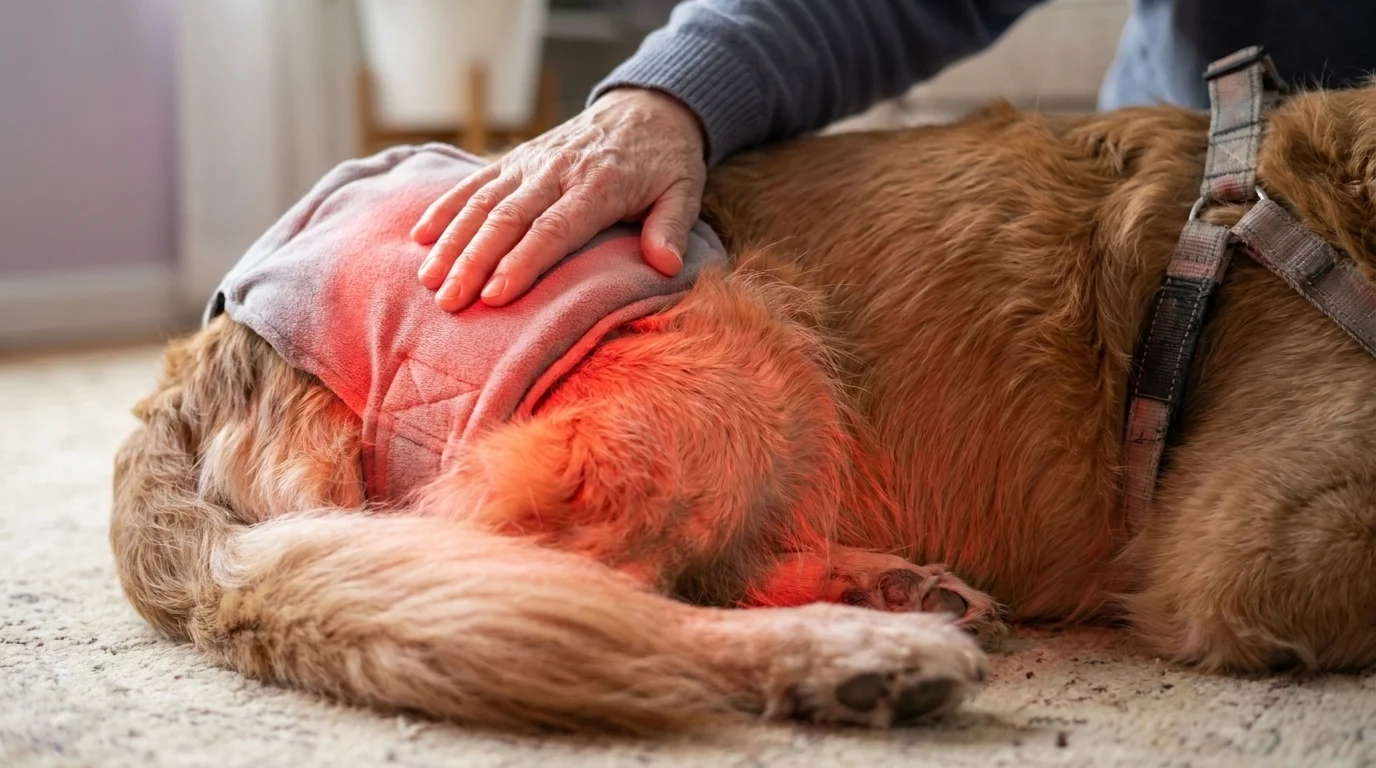
One honest flag: the guidance contradicts itself. I found sources recommending at-home use three to four times daily while also insisting the treatment should only be carried out by a trained professional. Both cannot be true. The distinction that resolves it is the one from the top of this article — clinical laser units are professional equipment; low-powered at-home LED devices are sold for owner use. Know which you are holding.
Now the part that is my job rather than your vet's. A therapy session is a handling procedure — you are asking a sore, elderly dog to hold still while you press something against the exact joint that hurts. Owners come to me when that goes wrong, and it goes wrong the same way every time: the dog gets restrained, learns the wrap predicts being trapped, and by week two leaves the room when it comes out.
Teach a consent behavior instead. A chin rest, a nose target, a settle on a mat. Pair it with the wrap, pay generously, and let your dog end the session by breaking position. You are not bribing your dog — you are giving them a vote. A dog with a vote holds still longer, and a dog who holds still gets the dose your vet intended. Compliance is the delivery mechanism, and compliance is a training problem.
Wavelengths and dose: why energy density matters more than price
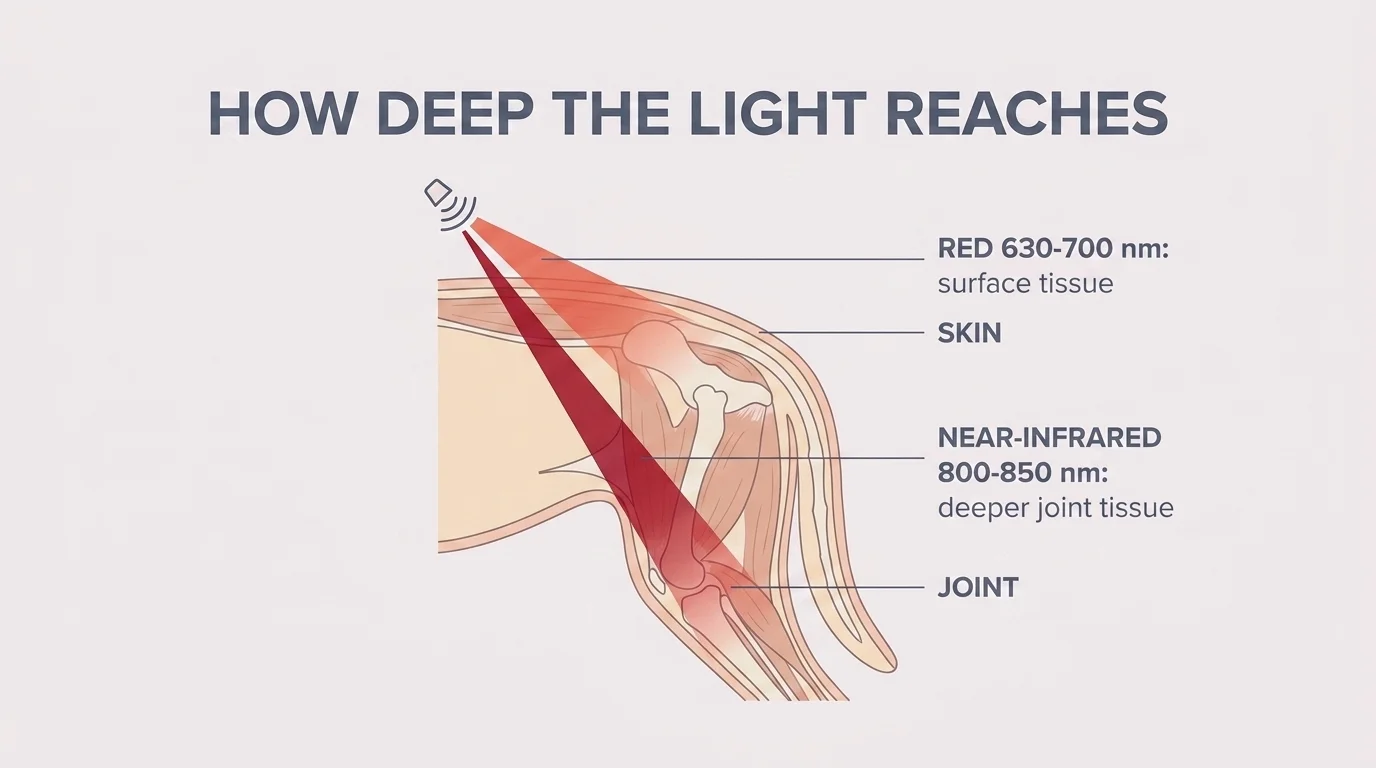
Red light (630–700 nm) treats surface tissue; near-infrared (800–850 nm) reaches deeper joints. One 2026 device explainer says energy density (J/cm²), not a device's power rating, drives results — though Merck calls the required dose unclear.
Wavelength decides depth. Red, roughly 630–700 nm, is absorbed near the surface — skin, superficial wounds. Near-infrared, around 800–850 nm, reaches further toward the joints underneath; the canine cohort study used 808 nm, and consumer devices commonly pair something like 635 nm with 850 nm. A light that never reaches an arthritic hip is a warm feeling and nothing more.
Dose is the other half. The 2026 explainer puts it bluntly: "energy density (joules per square centimetre) is the primary determinant of clinical outcome, not the power level." That is the sentence device marketing would rather you skipped, because it means a $1,500 price tag is not itself a therapeutic claim.
But I will not hand you "just check the J/cm²" as a tidy shopping rule, because Merck will not let me: "Calculating actual joules of energy delivered is considerably complex and, ultimately, uncertain" — and the required dose "remains unclear." The honest position is the uncomfortable one. Dose matters most, and the number printed on the box is not the guarantee it appears to be. Anyone selling you certainty here is selling.
Red light therapy vs. cold laser therapy (LLLT)
Same family, different hardware. Both are photobiomodulation. "Cold laser" or LLLT usually refers to a higher-powered clinical laser, applied by a professional in a practice — the class of device that produced the evidence in this article. "Red light therapy" more often means a lower-powered LED wrap or wand made for home use. When someone tells you cold laser therapy for dogs is proven, they are describing the clinic machine. That claim does not automatically transfer to the wrap in your cart.
Is red light therapy safe for dogs? Side effects and when not to use it
Red light therapy is drug-free, non-thermal, and generally well tolerated; protect the eyes. Merck's manual says laser therapy must avoid tumors, a pregnant uterus, and the retina outright.
The reassuring half is real enough: it is drug-free and non-thermal, and that is a fair part of its appeal. But I am not going to hand you "low risk" as a closed question, because Merck does not — long-term safety sits on its list of live controversies, next to pulsed therapy and power. "Low risk" is not "no rules," and the rules are specific.
Eyes first, and precisely. Merck's manual is blunt that "Laser light can damage the retina, whether reflected off shiny surfaces or shown directly into the eye," and that "the operator should never look into the applicator of a laser therapy device." Those warnings concern therapy lasers — I will not tell you a low-powered LED wrap will blind your dog, because overstating the hazard is the same sin as overstating the benefit. But one point applies to any near-infrared emitter, and it is the safety fact I most want an at-home user to know: near-infrared light "longer than 760 nm is invisible to the human eye," so unless your device has a finder beam or an audible signal, you cannot tell by looking whether it is emitting. Merck notes such devices "pose potential safety hazards." Do not assume a dark-looking emitter is an off emitter.
When not to use it, per Merck. Laser therapy "must avoid areas of neoplasia/malignancy, a hyperactive thyroid gland, areas of active hemorrhage, the retina, and a pregnant uterus," and is "contraindicated for patients with lymphoma or on immunosuppressant medications." In dogs under a year old, caution is warranted over long bones, because higher-powered devices "may stimulate premature closure of epiphyses" — growth plates. For dogs on photosensitizing medications, intensity should be lowered.
The cancer point deserves its own line, being the one most likely to matter and least likely to come from a seller. This is not merely "avoid the lump." Merck states that "Questions remain about the ability of laser therapy to stimulate neoplastic growth." That is an open question, not a settled reassurance. If your dog has any history of cancer, that is a conversation with your vet before you buy anything.
Which is the whole point: this is an adjunct. It does not diagnose, and it does not replace what your vet prescribed.
Choosing an at-home red light device
Prioritize a red plus near-infrared wavelength pairing and a stated dose over price; at-home wraps and wands typically run $150–$600.
I am not naming a winner. Every "best device" roundup I read was published by a company that sells one of the devices, and the winner was reliably its own.
What to look for: stated wavelengths, ideally a red and near-infrared pairing (something like 635 nm plus 850 nm) covering both surface and depth; and a stated dose and coverage area rather than a headline power rating. Form factors are wraps, pads, and wands — the wrap wins on the practical grounds that it stays put on a dog who would rather be elsewhere.
On price, the market splits cleanly: at-home LED devices run about $150–$600, clinical-grade Class IV lasers roughly $1,500–$5,995, and in-clinic sessions are billed per visit. That gap buys power and professional operation; whether it buys your dog a better outcome is not something the evidence here can tell you, since the trials ran on the clinical machines and nobody has tested the two tiers against each other. But hold both halves of what we established: price is not the therapeutic variable, and the variable that is one is hard to verify from a box, since even practitioners find delivered joules "complex and, ultimately, uncertain" to calculate. Buy skeptically, and after talking to your vet.
Read owner communities with the right lens. Reddit threads on senior-dog arthritis skew mixed-but-often-positive, which is worth something as sentiment. It is not evidence — twenty happy anecdotes and no control group is the second study's weakness scaled up and stripped of accelerometers.
The honest bottom line
The canine evidence for red light therapy for dogs is real but modest: strongest for arthritis and joint pain, plausible for recovery support, and dependent on a dose nobody has standardized. One good randomized trial found the light's gains outlasting an NSAID's, with range of motion still improved at the ninety-day check — in twenty dogs, using a clinical laser. That is a promising adjunct, not a cure, and not grounds to stop anything your vet prescribed.
Judge a device by its wavelengths and its dose rather than its price tag, remembering that even professionals find dose hard to pin down. In a drug-free mobility plan, red light is one tool alongside weight management, controlled exercise, and hands-on work like pet massage.
Before you buy a wrap or book a session: get the diagnosis, get the dose, get the go-ahead. Your vet knows your dog's joints. I just read the studies — and told you where they run out.
Frequently Asked Questions
Photobiomodulation is used in rehab and sports-medicine practice as an adjunct for arthritis, pain, and post-surgical healing, and reported side effects at appropriate parameters are minimal — though the published canine trials used clinical lasers, not the at-home LED devices sold to owners. The Merck Veterinary Manual lists real contraindications: laser therapy must avoid tumors, a pregnant uterus, and the retina outright. It is not a replacement for veterinary diagnosis. Have a vet diagnose the condition and set the protocol first.
The published canine studies did not settle on one schedule. A cohort study ran six consecutive weekly sessions at 808 nm and 5 J/cm², and the randomized trial ran its laser course over three weeks — both using veterinary clinical lasers, not at-home LED devices. At-home guidance typically ranges from 5 to 20 minutes per session. Frequency depends on the condition, so confirm your dog's dose with your vet.
They are the same family: photobiomodulation. "Cold laser" (LLLT) usually means a higher-powered clinical laser applied by a professional, which is the type of device used in the published canine trials. "Red light therapy" more often refers to lower-powered LED wraps and wands sold for home use.
At-home LED wraps and wands typically run $150 to $600, while clinical-grade Class IV lasers cost roughly $1,500 to $5,995; in-clinic sessions are billed per visit. One 2026 device explainer argues energy density (J/cm²), not a device's power rating, drives results, though the Merck Veterinary Manual notes that calculating delivered joules is complex and uncertain.