The Rise of AI-Powered Emotional Support: Tailored Companionship for Mental Health Enhancements in Pets


Your dog is not giving you a hard time. Your dog is having a hard time. That distinction is the whole foundation of working with dog anxiety, because an anxious dog who paces, barks, or shreds the doorframe isn't being disobedient or "dominant" — he's coping with an emotional state he can't switch off on command. Anxiety is genuinely common: roughly 14% of dogs show signs of separation anxiety, with peer-reviewed studies putting the broader range at 14–20% (AKC; Scientific Reports).
Before we go further: if your dog's anxiety is sudden, severe, or new, see your veterinarian first to rule out medical causes like pain, thyroid disease, or cognitive decline. What follows is general guidance for owners, not a treatment plan for your individual dog.
What dog anxiety actually looks like
Owners often miss anxiety because they're watching for the dramatic version. Most of it is quieter. Common signs include:
- Pacing, restlessness, or an inability to settle
- Panting or drooling when it isn't hot
- Trembling or a tucked tail and lowered body
- Excessive barking, whining, or howling — especially when alone
- Destructive chewing, digging, or scratching at exits
- Indoor accidents in a house-trained dog
- Lip licking, yawning out of context, and "whale eye" (the whites of the eyes showing)
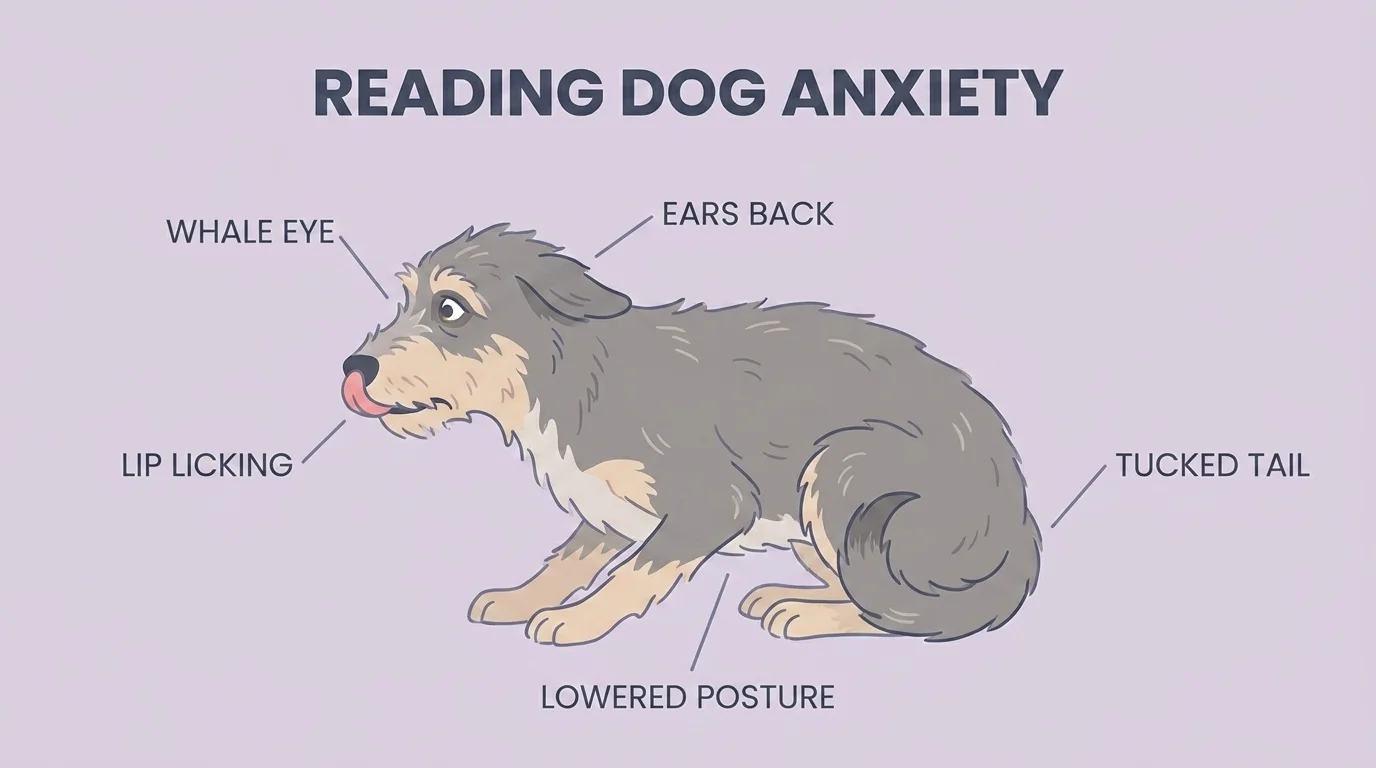
Here is the part I'll be relentless about: do not punish these behaviors. Punishing an anxious dog for barking or chewing suppresses the visible signal without touching the fear underneath — and a dog who learns that showing distress brings a correction is a dog who escalates, not one who calms down. The goal is to change how the dog feels, not to silence how the dog tells you.
What causes dog anxiety
Before you fix a behavior, name its function — what is the dog trying to get, or trying to avoid? Anxiety usually traces to one of three buckets:
- Fear-based anxiety — triggered by specific things: thunderstorms, fireworks, the vacuum, strangers, the vet. The dog is trying to create distance from a perceived threat.
- Separation anxiety — distress when left alone, the single most-searched form. The dog is trying to avoid the absence of its people.
- Age-related anxiety — in senior dogs, canine cognitive dysfunction (CDS) can produce confusion and new nighttime restlessness. This one especially warrants a vet visit.
Triggers also "stack." A dog who copes fine with the mail carrier or a thunderstorm may come apart when both land in the same afternoon. Knowing which bucket and which triggers you're dealing with is what makes the rest of the plan work — and if you genuinely can't identify the function after a week of careful observation, that's your cue to bring in a certified behavior consultant, not to guess harder.
How to calm an anxious dog: start with the behavior plan
Tools and gadgets come later. The foundation is behavior work, and the most important principle is the least flashy. As Dr. Katherine Houpt of Cornell University's College of Veterinary Medicine puts it, what works best is predictability: "If dog does X, then Y happens" (Cornell). A dog who can predict their day carries less baseline worry.
The two techniques with the strongest behavior-science support are desensitization and counterconditioning, almost always used together:
- Desensitization means exposing the dog to a watered-down version of the trigger — a recording of thunder at very low volume, a stranger at a comfortable distance — kept below the threshold where the dog reacts.
- Counterconditioning pairs that mild trigger with something wonderful (high-value food), so the dog's emotional response slowly shifts from "threat" to "good things happen."
The non-negotiable rule is to work under threshold — quiet enough, far enough, slow enough that the dog stays relaxed. Push too fast and you sensitize the dog instead, making the fear worse. This is gradual, unglamorous work measured in weeks, and it does not involve a single correction, prong collar, or "showing the dog who's boss." Anxiety has never once been resolved by dominance.
Calming music for dogs: what the research shows
This is the rare calming tactic with actual controlled evidence behind it. Studies of shelter dogs found that classical, reggae, and soft-rock music measurably lowered stress — less barking, slower breathing, reduced pacing, and lower cortisol — while heavy metal did the opposite, increasing trembling and agitation (AKC).
One useful caveat the AKC flags: "Dogs tend to tune out music they hear all the time. The relaxing effect declines once music turns into ambient noise." So rotate genres rather than looping the same playlist forever. You don't need anything fancy to start — Spotify offers a pet-playlist generator, and a startup called One by One Music debuted AI-generated, personalized calming music for dogs at CES 2024. The delivery mechanism matters less than the genre and the novelty.
Natural and at-home calming, ranked by evidence
For everyday, lower-grade anxiety, several at-home approaches genuinely help — roughly in order of how much I'd lean on them:
- Routine and exercise. A predictable schedule and enough physical and mental work take the edge off baseline arousal. This is foundational, not optional.
- A safe space. A covered crate or quiet room the dog chooses to use — never one they're forced into — gives them somewhere to decompress.
- Enrichment and puzzle toys. Licking and sniffing are self-soothing behaviors; a frozen stuffed feeder during a storm does real work.
- Pressure wraps (Thundershirt-style) help some dogs through noise events — worth a cheap try.
- Calming scents. Lavender and chamomile are the best-researched, with lavender shown to reduce barking and stress signs (PetMD).
- Supplements (CBD, valerian, etc.). Here I hand off: talk to your veterinarian before giving any calming supplement. Dosing, interactions, and product quality are medical questions, not training ones.
Where AI and smart tech actually help (and where it's marketing)
Tails' Talks lives in the pet-technology world, so let me give you the honest version that the gadget ads won't: smart tech can assist an anxiety plan, but it doesn't replace one — and a lot of the "AI calms your dog" claims are marketing, not evidence.
What's genuinely useful right now:
- Distress-detection cameras. Furbo's Smart Alerts distinguish distress barking, crying, howling, and anxious chewing from ordinary noise, and its "Calm My Pet" feature runs a real detect-and-soothe loop: when two barking events occur within 15 seconds, it plays calming sounds for about six seconds (repeating up to five times) and can toss a treat once the dog quiets (Furbo). For monitoring a dog with mild separation anxiety, that's a concrete, useful tool.
- Communication buttons. FluentPet's soundboard buttons have moved from viral novelty to peer-reviewed study (UC San Diego, 2024–25; Eötvös Loránd University, 2025). The plausible anxiety mechanism is indirect but real: giving a dog a way to communicate a need reduces the frustration that drives some anxious behaviors (FluentPet).

Where to stay skeptical: any product promising "84% stress reduction" or "80% less anxiety" is quoting its own marketing, not a peer-reviewed result — I'd ignore those numbers entirely. And no camera can substitute for desensitization work; it's a thermometer and a delivery system, not a therapist. Use the tech to observe and support, then do the actual behavior plan.
Related Article: Harnessing Technology: Smart Solutions for Pet Care and Monitoring
When it's not a training problem: see a veterinary behaviorist
This is the line I draw in every article, because it matters most here. Some anxiety is a training-and-management project you can lead yourself. Some is a clinical disorder that needs medical help — and trying to train your way out of the second category is unfair to the dog.
If your dog panics rather than worries — self-injures, can't eat or settle even with the plan, or has anxiety severe enough to wreck their quality of life or yours — that's a behavior problem, not a training one. The right next step is your veterinarian, and ideally a referral to a board-certified veterinary behaviorist (DACVB), who can diagnose the disorder and, when appropriate, prescribe medication that makes the behavior work actually possible. As the AKC puts it plainly: "If you think your dog might have an anxiety issue, consult your veterinarian. They can provide a diagnosis, rule out other health issues, and help you develop a plan that fits your lifestyle."
Medication isn't a failure or a shortcut. For a genuinely anxious dog, it's often the thing that lowers the fear enough for everything else on this list to start working.
So: name the function, work under threshold, lean on the evidence-backed tools, let the tech assist without overselling it — and know exactly when to hand off to a professional. Your dog isn't giving you a hard time. Help them stop having one.
Frequently Asked Questions
It's a guideline for newly adopted or rescue dogs — roughly 3 days to decompress, 3 weeks to learn the routine, and 3 months to fully settle in. It eases the anxiety of adjusting to a new home; it is not a treatment for an established anxiety disorder.
Combine a predictable routine, exercise, and a safe space with vet-guided options: desensitization and counterconditioning training, calming music (classical or reggae), a pressure wrap, and — for severe cases — medication prescribed by your vet or a veterinary behaviorist.
Lean on routine, exercise, a quiet safe space, calming music, enrichment and puzzle toys, lavender or chamomile, and a pressure wrap like a Thundershirt. Check with your veterinarian before giving any supplement such as CBD or valerian.
They can assist, not replace a plan. Cameras like Furbo detect distress barking and can auto-play calming sounds or toss a treat, which helps you monitor and soothe remotely — but pair them with vet-guided behavior work, and ignore vague "X% calmer" marketing claims.
Pacing and restlessness, panting or drooling when it isn't hot, trembling, a tucked tail, excessive barking or howling, destructive chewing near exits, indoor accidents, hiding, lip licking, and "whale eye" (the whites of the eyes showing).
See your veterinarian if the anxiety is sudden, severe, or new, or if your dog panics rather than worries — self-injuring, unable to eat or settle. Ask for a referral to a board-certified veterinary behaviorist (DACVB), who can diagnose and, when needed, prescribe medication.