


Your dog eats, and twenty minutes later you are cleaning the rug. So you go looking for the best dog food for sensitive stomach relief, and you find a wall of bags saying the same four things: gentle, digestible, limited-ingredient, hypoallergenic. Every brand sells a sensitive stomach dog food. Several sell a sensitive stomach and skin dog food. The prices run from roughly a dollar a day to several times that.
Here is what the aisle does not tell you. Most of those front-of-bag phrases carry no regulatory weight. The one line that does sits on the back in eight-point type: the AAFCO nutritional adequacy statement, which AAFCO calls "perhaps the most important part of a label". It certifies the food is complete and balanced for a life stage. It does not certify that the protein list on the front is accurate — and when researchers PCR-tested eleven limited-ingredient wet diets, more than half carried protein the label never declared.
I have no house brand and take no affiliate money. This is reporting, not a diagnosis. Your vet knows your dog; I know the paperwork.
Best Dog Food for Sensitive Stomach: The Picks, Ranked
Four products surface again and again — in Google's AI summary, in the vet-clinic blogs it cites, in the retail aisle. I am listing them because you will meet them, not because being mentioned often is evidence of anything. Popularity is a marketing outcome, not a clinical finding.
So each gets the same three questions: what does the label promise, who profits, and what would you have to do to learn whether it works on your dog?
| Pick | Best for | Form | Who owns it | What you're actually buying |
|---|---|---|---|---|
| Purina Pro Plan Sensitive Skin & Stomach (Salmon & Rice) | The sensible first try | Dry kibble | Nestlé (acquired Ralston Purina, 2001) | An over-the-counter salmon-and-rice formula — the cheapest way to run a real trial |
| Royal Canin Veterinary Diet Gastrointestinal Low Fat | A diagnosed GI case | Prescription | Mars Petcare | A therapeutic diet for a diagnosis you may not have yet |
| Hill's Science Diet Sensitive Stomach & Skin | Gut and skin signs together | Dry / wet | Colgate-Palmolive — disclosed on Hill's own site | The same over-the-counter regulatory tier as Pro Plan |
| JustFoodForDogs | Fresh feeding, if you'll fund it | Fresh, gently cooked | Independent, private-equity-backed; Petco holds a warrant and is its exclusive national retailer | Fresh-food positioning at a fresh-food price |
Three of those four brands belong to multinational consumer-goods giants — Nestlé, Mars, and Colgate-Palmolive. That is not an accusation; scale is precisely why they can afford feeding trials and quality control. It is context you are entitled to before you read the word "veterinarian" on a bag.
For how vet recommendations get made in the first place, see our reporting on vet recommended pet food; the rest of our coverage lives in pet industry.
Best Overall: Purina Pro Plan Sensitive Skin & Stomach (Salmon & Rice)
The name tells you the formulation: salmon and rice. One named protein, one gentle carb, no vet's signature required. It earns the top slot on grounds that have nothing to do with magic ingredients — it is the cheapest, fastest way to run the only test that matters.
The caveat is structural. NC State's veterinary hospital notes that "prescription hydrolyzed diets and novel protein have far stricter quality control while OTC diets can contain contaminant proteins". This is an OTC diet. That matters below.
Related Article: Regulatory Navigation: Harmonizing International Pet Care Standards and Regulations
Best Prescription / GI: Royal Canin Veterinary Diet Gastrointestinal Low Fat
Vet authorization required, and the gatekeeping is the point rather than the inconvenience. This is a therapeutic diet for a diagnosed condition, so the honest question is not "should I buy it" but "do I have a diagnosis?" If you don't, you are paying therapeutic prices to guess.
Where the equivalence stops: in the Cornell work below, the eight dogs with severe protein-losing enteropathy were not part of that story — seven of the eight reached sustained remission on hydrolyzed diets, and nothing cheaper was tested against them. So the finding that a limited-ingredient diet matches hydrolyzed does not carry over to severe disease. Whether something cheaper would have done the same job there is untested, which makes severe disease a conversation for your vet rather than a line in a buying guide.
Best Fresh / Human-Grade: JustFoodForDogs
Currently the top fresh pick among the vets Forbes Vetted interviewed, alongside The Farmer's Dog, Ollie, and Open Farm in a fast-growing direct-to-consumer category.
Petco does not own it, despite how the shelf placement reads. Petco is the exclusive national brick-and-mortar retailer and holds a warrant for equity tied to hitting plan — worth knowing when a retailer's staff recommends a brand. "Human-grade," meanwhile, is a phrase I would treat as positioning until a company shows you what it means at their facility. That is my standing view, not a finding — but if a premium rests on a word, ask what the word buys.
Related Article: E-commerce in Pet Care: Navigating Opportunities and Challenges
Best Wet: stay in the named lines, and know the risk
Wet food's case, as I would make it, is hydration and palatability — useful for a picky or older dog who has gone off kibble. But wet is also where the label evidence is worst, because the contamination study below tested wet diets specifically. I am not naming a wet SKU: nobody has published per-formula testing that would justify pointing you at one. Stay inside the two over-the-counter lines above and treat the ingredient panel as a claim, not a guarantee.
Best for Puppies & Seniors: the answer is on the back of the bag
This is the slot where guides invent things. The real answer is regulatory. AAFCO's adequacy statement names the life stage a food is for — gestation/lactation, growth, maintenance, or all life stages — because "different quantities and ratios of nutrients are necessary for different life stages". A sensitive-stomach formula labeled for adult maintenance is not a puppy food, however gentle the front of the bag sounds.
And for puppies, one safety line outranks the shopping question. Dr. Emily Gould of Texas A&M notes that "puppies, in general, also become dehydrated very quickly, so more than one or two episodes of vomiting or diarrhea in a young dog necessitates veterinary care". A puppy with a bad gut is a vet visit, not a purchase.
Best Budget: I'm not naming one, and here's why
"Most affordable" is the easiest verdict to assert and the hardest to check. Nobody publishes per-day feeding costs in a form that survives contact with a kitchen scale, and I will not invent a price tier to fill a row.
The money question already has a peer-reviewed answer anyway, and it is in your favour. Cornell's team found an honestly-labeled limited-ingredient diet matched expensive prescription hydrolyzed diets in dogs with low-grade chronic enteropathy. The best budget food is the cheapest honest limited-ingredient diet you are willing to feed exclusively for six to ten weeks.
Is a "Limited-Ingredient" Label Worth the Premium?
Sometimes. PCR found undeclared protein in 6 of 11 limited-antigen wet diets; in low-grade chronic enteropathy, Cornell matched an honest limited-ingredient diet to a prescription one.
Start with the finding almost nobody else writing about this will tell you. Researchers ran PCR analysis on eleven dietetic limited-antigen wet diets and reported that "PCR analysis confirmed the contamination of 6 of the 11 (54.5%) limited-antigen wet diets with undeclared animal protein". One of those six "was solely composed of animal protein sources completely unrelated to those declared on the label." Not trace contamination — a different animal entirely.
Be precise about what that study is and isn't, because precision is the whole point. It is Pagani and colleagues in BMC Veterinary Research, 2018: eleven products, wet diets only, spanning cat and dog foods. It does not tell you dry kibble is mislabeled, and eleven is a small sample. It tells you the declared ingredient list on a limited-antigen wet diet is a claim that failed verification more often than it passed — and the entire logic of a limited-ingredient diet is that you know what is in it. If the label is wrong, you haven't run a controlled trial. You've run a guess at a premium price.
Now the reframe. A Cornell College of Veterinary Medicine team compared two hydrolyzed protein diets against a limited-ingredient diet with non-hydrolyzed proteins in dogs with chronic enteropathy, publishing in the Journal of Veterinary Internal Medicine. All the dogs improved regardless of diet type — 19 of 23 with low-grade disease responded to their assigned diet, and four that didn't improved after switching. "Our findings question assumptions that have been made about the cause of food intolerance in dogs with CE, which was largely considered an adverse immune response to dietary antigens," said Dr. Kenneth Simpson.
So the premium tier is not a swindle. NC State's point about stricter quality control is the honest case for it, and PCR testing in the OTC aisle makes it a real one. But you are buying verification, not different biology — and the variable that decides your outcome is free. NC State advises the diet be "fed exclusively for 6-10 weeks, followed by a dietary rechallenge." Simpson's caution: "a single trial may simply not be enough to identify the right diet for your dog."
On grain-free, which the aisle will push at you next: a 2025 narrative review in Veterinary Sciences records that the FDA announced an investigation in July 2018 into diet-associated dilated cardiomyopathy, logging 1,382 reports by November 2022. Its authors write that "current evidence supports an association between grain-free diets and the development of DCM in dogs" while noting the influence of diet "remains not fully understood." An association, in a narrative review — not proof of cause. Grain-free is a tool for a confirmed grain sensitivity, not a default. Take that one to your vet.
What Ingredients Should You Look For — and Avoid?
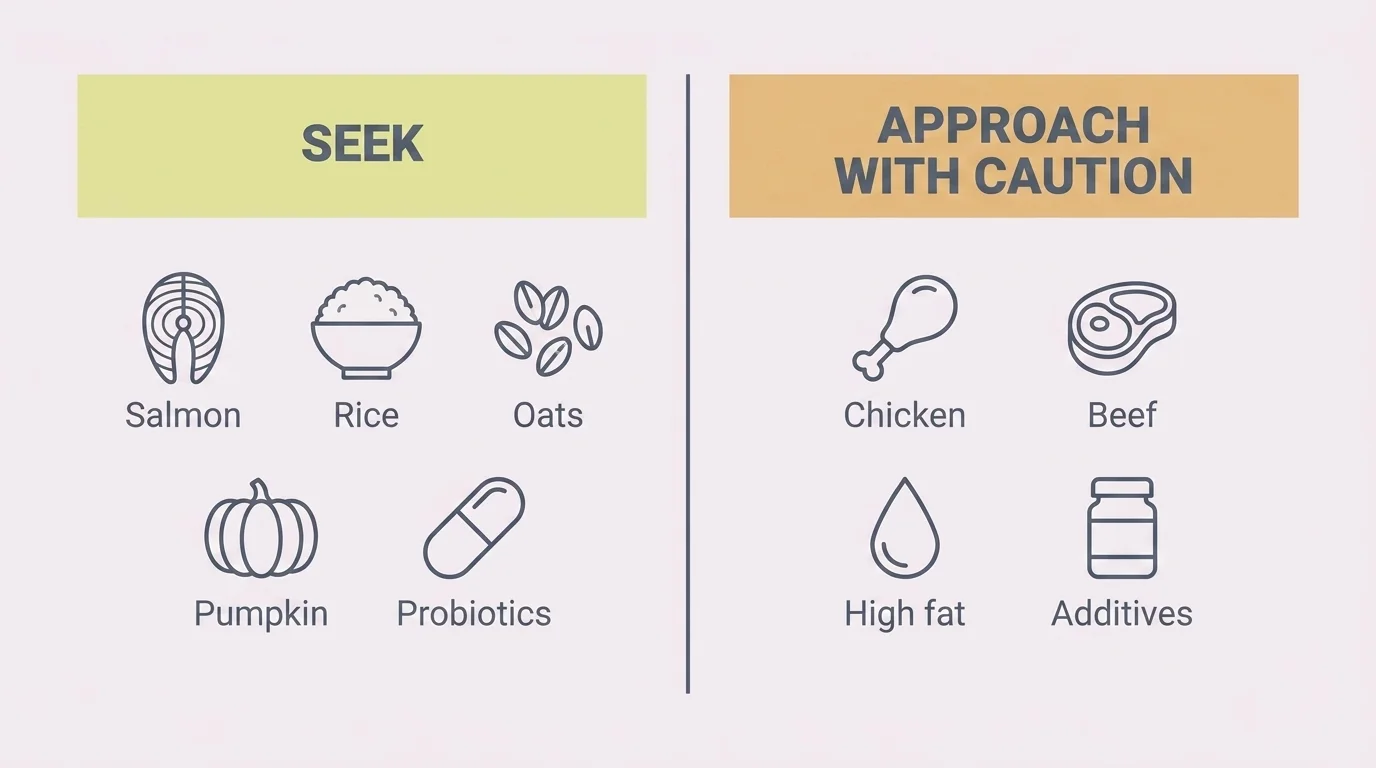
Look for one named protein, a gentle carb like rice or oatmeal, and added probiotics — then read the adequacy statement on the back.
The seek list is what every page in this aisle converges on — the clinic blogs, the retailer hubs, Google's AI summary — which makes it consensus, not evidence: a single lean or novel protein, a gentle carbohydrate, added prebiotics or probiotics, low-to-moderate fat, and high digestibility. I find it credible anyway, and I will label the reason as mine rather than dress it up as a finding: the list is short, boring, and points at no particular bag. Nothing on it is proprietary — there is nothing there for a brand to own — and what makes a food work for a sensitive gut is mostly what has been left out of it.
Novel protein is the one lever with a number attached, and I want to be scrupulous about where the number comes from. The Purina Institute reports that nearly 50% of cats and 60% of dogs with chronic gastrointestinal signs respond positively to a novel protein diet. That figure is published by the research arm of the company that makes the first pick in the table above and sells novel-protein diets. It is plausible, it is widely repeated, and you should read it knowing who is holding the pen.
Ingredients to avoid
Chicken and beef lead the list, which surprises owners — they are the two most common canine protein sensitivities, and vets increasingly steer owners toward venison, duck, salmon, or fish instead. "I've seen the benefits of novel protein sources in reducing inflammation and promoting digestive health," Dr. Alex Crow told Forbes Vetted. Beyond protein: high fat, and any ingredient you cannot identify the purpose of.
One discipline, though. No ingredient is guilty until a trial convicts it. AAFCO's adequacy statement certifies that a food is complete and balanced — and note that a food labeled "intermittent or supplemental" does not meet those standards. What no statement on any bag certifies is that the food will settle your particular dog.
The Best Food for a Sensitive Stomach AND Skin Allergies
What helps a dog with both? A single novel protein your dog has never eaten — the one dietary lever that addresses both complaints at once.
The combined "stomach and skin" search is one of the largest in this category, which is why nearly every brand sells a formula named for both. The tidy story — that the gut and the coat are one problem with one trigger — is a marketing convenience as much as a settled clinical finding, and I am not going to assert a mechanism I can't source for you.
What I can source is narrower and more useful. The dietary lever is the same in both directions: a single protein your dog has not encountered before. Chicken and beef being the most common sensitivities is precisely why the novel-protein steer exists, and Crow's clinical observation was about inflammation, not digestion alone. If you are going to run one trial, a novel protein is the one that addresses both complaints at once.
The two products named for this overlap are Purina Pro Plan Sensitive Skin & Stomach and Hill's Science Diet Sensitive Stomach & Skin — Nestlé and Colgate-Palmolive respectively, and both over-the-counter. Neither is a hypoallergenic prescription diet, and neither is sold as one.
One limit worth stating plainly: if the skin signs are severe, food may not be your variable at all. Itch has environmental and atopic causes that no bag of kibble will fix, and six to ten weeks spent testing a diet is six to ten weeks not spent treating the actual cause. That is a conversation for your vet before it is a purchase.
Matching Food to Your Dog's Symptoms: Diarrhea, Gas & Vomiting
Diarrhea. Low-fat and highly digestible is the shape of the answer. For the acute flare, PetMD's veterinary team suggests you "can add fiber by giving canned 100% pumpkin puree or powder", and that probiotics "can also help relieve an upset stomach." A bland diet can bridge the gap: "small amounts of a homemade bland diet, such as boiled white-meat chicken and white rice with no salt, fat, or seasonings," per veterinarian Barri J. Morrison.
Read the conditions on that advice, because they are the important part. It applies if the upset has lasted under 48 hours and your dog is still eating and drinking, is not lethargic, and has no blood in the stool or vomit. A bland diet is a bridge, not a destination — it is not complete and balanced, and it is not a food you feed for a month.
Gas and loose stool. Rich, fatty food and speed-eating are the first two things I would rule out before buying anything, and slowing the meal down costs nothing. Treat this as ordinary owner triage rather than a clinical protocol.
Vomiting. Before you blame the food, note that PetMD lists abrupt diet change itself as a common cause of upset stomach. If you switched foods last week to fix the vomiting, the switch may be the vomiting. Persistent vomiting is a vet call — see below.
How to Transition Your Dog to a New Food Without Making It Worse
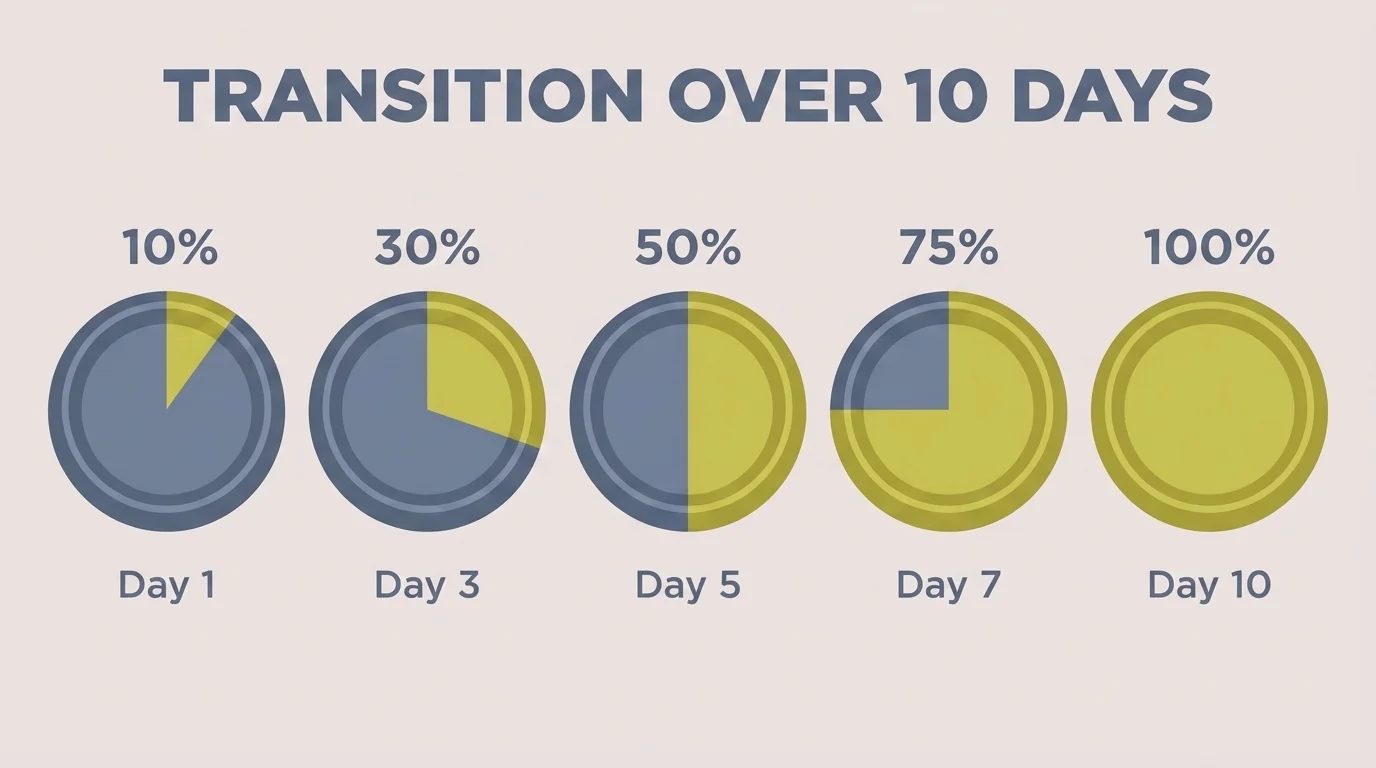
Go slow: start at 80-90% old food and 10-20% new, then shift the ratio gradually across about ten days. Rushing causes the upset you're fixing.
The AKC's schedule is the one most repeated online: "the first meal should contain about 80-90 percent old food and 10-20 percent new food. Change this ratio slowly over the course of 10 days." PetMD's vet-authored version says seven to 10 days and adds that you should consult your veterinarian. Worth noting which of those carries a named DVM byline — when two sources disagree slightly, prefer the one that shows you its credentials. Either way, the direction is the same and the deadline is not real. Go slower if your dog tells you to.
Skip it and, in the AKC's words, "you could end up worsening your dog's sensitive stomach, or your dog could refuse to eat the new food." That is the trap: a rushed switch produces exactly the symptom you bought the food to stop, and then you blame the food and switch again.
On judging the result: separate the two clocks. The transition is about ten days. Deciding whether the food actually works is six to ten weeks of feeding it exclusively, per NC State — and Simpson's warning that one trial may not be enough means a first failure is information, not a verdict. AAFCO also notes that printed feeding directions "are guidelines that may need modification to meet a particular pet's needs." The number on the bag is a starting point, not a dose.
When Should You See a Vet?
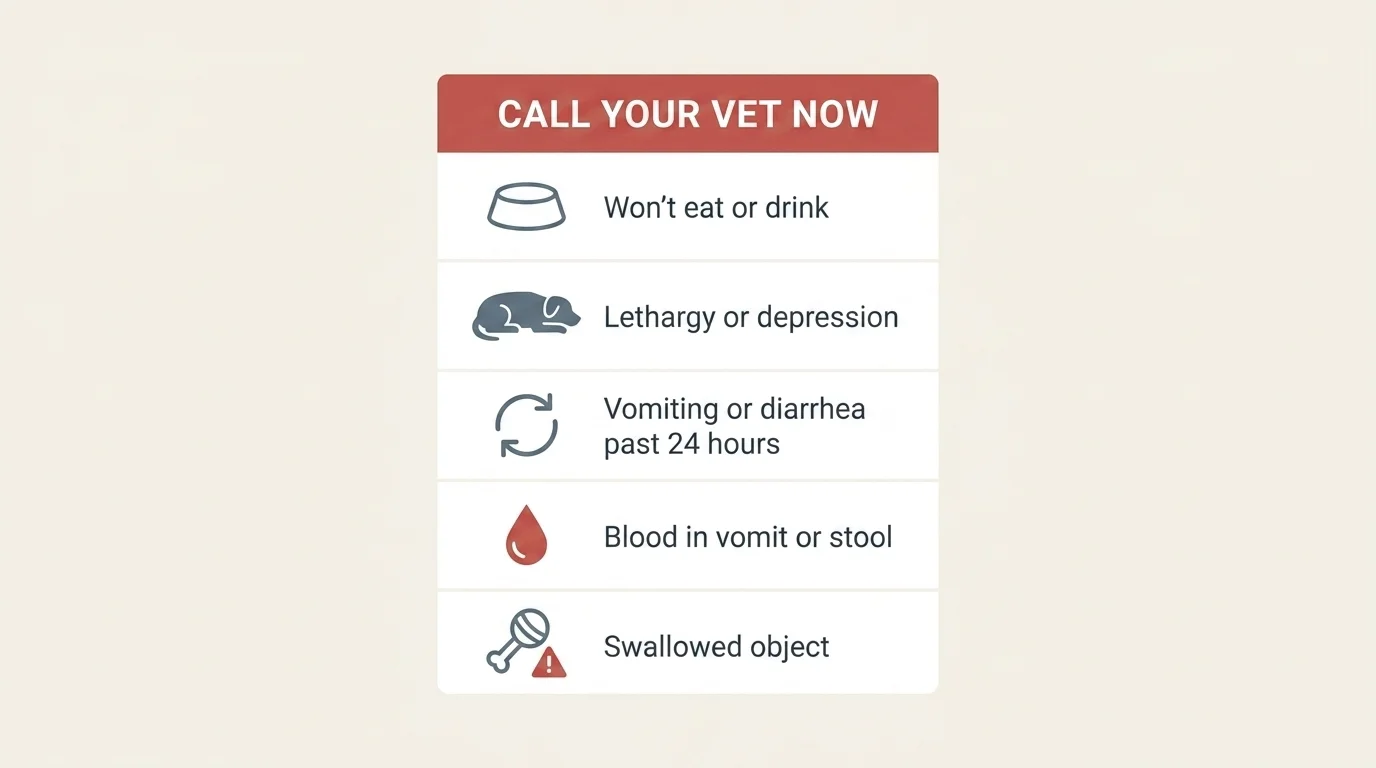
Under 48 hours, with a dog otherwise acting normally, you can usually watch and wait. Blood, lethargy, refusal to eat, or repeated vomiting means call now.
The clearest statement of the rule comes from Dr. Emily Gould, clinical assistant professor at the Texas A&M College of Veterinary Medicine & Biomedical Sciences: "for the most part, if your pet is still acting like itself and eating and drinking normally, there is not always a need to bring them in for signs lasting less than 48 hours." Past 48 hours, care is warranted.
The red flags do not wait for the clock: a dog that stops eating or drinking, depression or lethargy, frequent or persistent vomiting or diarrhea lasting beyond 24 hours, blood in the vomit or diarrhea, or a known swallowed object. Puppies get a tighter rule, as above — more than one or two episodes and you go.
And a distinction the aisle has an incentive to blur: chronic, recurring GI signs are a reason for a workup, not a reason to buy a fourth bag. The dogs in the Cornell study got better on diet — but they got there after a diagnosis, under supervision, with a rechallenge at the end. Buying your way through the shelf is not the same procedure.
This guide informs. It does not diagnose.
The bottom line
The best dog food for sensitive stomach relief is almost certainly less exotic and less expensive than the aisle wants you to believe. Pick a food with one named protein and a gentle carb, check that the adequacy statement matches your dog's life stage, transition over about ten days, and then commit to the full six-to-ten-week trial — because the trial, not the price tag, is what produces the answer. Most of these dogs get better.
Two questions to take with you. At the shelf: what does this premium buy that the eight-point type doesn't already promise? At the vet desk: do we have a diagnosis, or are we still guessing?
Frequently Asked Questions
A highly digestible diet built on one named protein, a gentle carb like rice or oatmeal, and added pre/probiotics. The names vets and Google's AI summary converge on are Purina Pro Plan Sensitive Skin & Stomach, Hill's Science Diet Sensitive Stomach & Skin, and JustFoodForDogs — but the brand matters less than running the food properly. Check that the AAFCO nutritional adequacy statement on the back matches your dog's life stage, and confirm the plan with your vet.
Often no. A 2023 Cornell study published in the Journal of Veterinary Internal Medicine compared hydrolyzed diets against a limited-ingredient diet in dogs with chronic enteropathy and found all the dogs improved regardless of diet type — 19 of 23 with low-grade disease responded to their assigned diet. Prescription hydrolyzed diets are for vet-directed elimination trials and severe disease; NC State notes their stricter quality control is the real advantage you are paying for.
A single novel protein your dog hasn't eaten before — salmon, venison, duck, or fish. Chicken and beef are the two most common canine protein sensitivities, which is why vets routinely steer owners away from them. The Purina Institute reports that roughly 60% of dogs with chronic gastrointestinal signs respond positively to a novel protein diet, though it's worth knowing that figure is published by a company that sells novel-protein diets.
Not inherently. Grain-free is only needed for a confirmed grain sensitivity. The FDA announced an investigation in July 2018 into a possible link between certain diets and dilated cardiomyopathy (DCM), and had logged 1,382 reports by November 2022. A 2025 narrative review in Veterinary Sciences concludes current evidence supports an association between grain-free diets and DCM — an association, not proven causation, with the mechanism still not fully understood. Choose grain-free only on your vet's advice.
Mild upset may settle within days on a vet-guided bland bridge, but judging whether a new food truly works takes longer. NC State's veterinary hospital advises feeding the diet exclusively for 6-10 weeks, followed by a dietary rechallenge. Cornell's Dr. Kenneth Simpson also cautions that 'a single trial may simply not be enough to identify the right diet for your dog' — a first failure is information, not a final verdict.