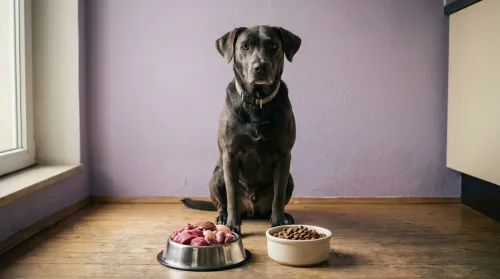


The bag costs about four times what kibble costs, and the owner holding it almost always asks me the same question: is this actually better for him?
If you are shopping for the best freeze dried dog food, start with the fact the front of the bag leaves out and the AI answer box at the top of your search results does not mention. "Freeze-dried" almost always means freeze-dried raw. Not cooked. Not sterilized. Dried.
That is not a scare tactic — it is a manufacturing description, and it should change how you shop. What follows is a ranked, independent guide: category winners with named formulas, what the current evidence actually says about pathogen risk, how to tell a complete diet from a topper, and the places where I would push back on the marketing. No brand paid for a slot on this list. I do not have one to sell.
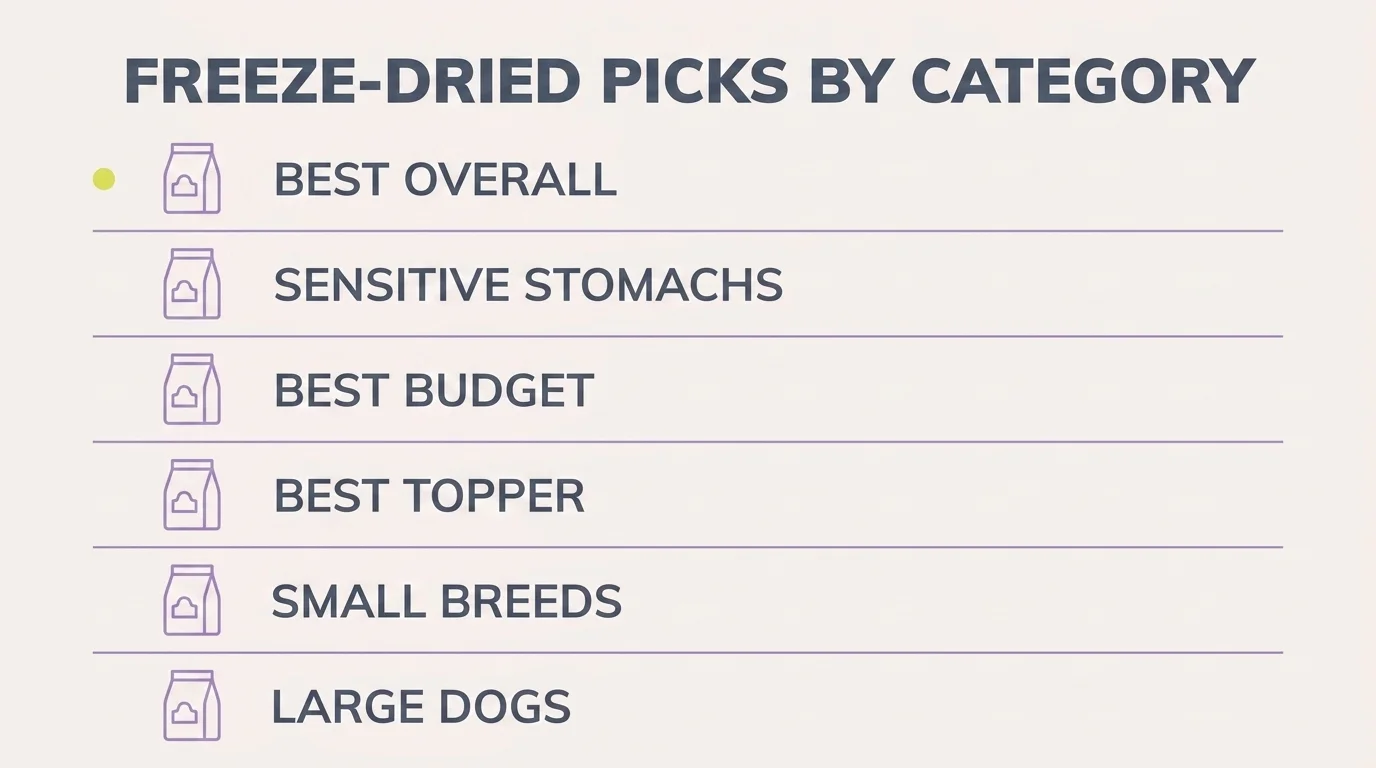
The Best Freeze-Dried Dog Foods of 2026, Ranked
If you have decided on freeze-dried, the best freeze dried dog food for most dogs is a variety-rich diet its maker labels complete and balanced — Stella & Chewy's Super Beef Dinner Patties, for one — but verify that label on the bag in your hand.
Picks first, because that is what you came for. Read the safety section before you buy, though; it changes the arithmetic.
| Category winner | Brand + formula | Why it earns the slot | Check before you buy |
|---|---|---|---|
| Best Overall | Stella & Chewy's Super Beef Freeze-Dried Raw Dinner Patties | The market positions it on variety and retail availability; the brand labels this line "100% complete & balanced" | That the bag says Dinner Patties, not Meal Mixers — the topper shares the name |
| Best for Sensitive Stomachs | Dr. Marty Nature's Blend; Open Farm Surf & Turf | Limited, clearly-declared protein lists make an elimination trial easier to run | That it is a complete diet, not a topper |
| Best Budget | Stella & Chewy's | The one brand here whose prices I verified at the source, so it is the one you can budget against with real numbers | Cost per serving for your dog's weight, not per bag |
| Best as Topper/Mixer | Ultimate Pet Nutrition Nutra Complete; Vital Essentials | Suited to the job most owners actually want: flavour over a complete base diet | That you are not relying on it as the whole diet |
| Best for Small Breeds | Primal | Small nuggets portion cleanly at 8–15 lb, where a rounding error is a real percentage of daily calories | Calories per nugget |
| Best for Large Dogs | Orijen; Bravo | Broadly available lines worth price-checking — but see below | That the specific line carries an AAFCO complete-and-balanced statement — and cost per calorie before you commit |
Best Overall — Stella & Chewy's Super Beef Freeze-Dried Raw Dinner Patties
It earns the slot on unglamorous grounds, and I will be exact about whose grounds they are: the market positions this brand on variety and retail availability, and I have not audited every brand's protein range or shelf presence to rank that myself. So take it as positioning, not a verdict I ran. The principle underneath the slot is mine, though, and I will stand behind it: the diet you can restock reliably beats the diet you cannot, and consistency is worth more to a dog's gut than any ingredient on a marketing page.
Now read that product name again, all of it, because my own top pick demonstrates the trap I describe further down this page. Stella & Chewy's sells Super Beef Freeze-Dried Raw Dinner Patties, which its storefront calls "100% complete & balanced." It also sells Super Beef Meal Mixers — same brand, same protein, no completeness claim in the listing, because that one is a topper. Two products, one name. And price will not separate them: when I checked on 17 July 2026, the largest bag of the topper cost $84.99 against $64.99 for the largest bag of the complete diet. The more expensive Super Beef is the one that is not dinner. Buy the words after the name.
Best for Sensitive Stomachs — Dr. Marty Nature's Blend or Open Farm Surf & Turf
Open Farm keeps its protein list short and clearly declared, which is what makes a diet trial interpretable — you cannot identify a trigger in a formula carrying eleven proteins. Dr. Marty's list I could not read against the company's own published data, so I am naming that one as a candidate to check rather than a formula I am vouching for. That is reasoning from digestibility and label clarity, not from a head-to-head study, because none exists here. For genuinely reactive guts, our guide to dog food for sensitive stomachs covers the cooked options too.
Best Budget — Stella & Chewy's
Let me be exact about what this slot means, because "budget" invites a claim I have not earned. I checked Stella & Chewy's prices at its own storefront on 17 July 2026; I did not run that check across every brand in the table above. So I cannot tell you this is the cheapest freeze-dried food on the market, and I will not imply it — it is simply the pick you can do arithmetic on before you spend. And the arithmetic is the point, because a bag price means little alone: one Super Beef line ran $16.99 to $64.99 on that visit, a near four-fold spread driven by nothing but bag size. The honest budget lever is cost per serving at your dog's actual weight. Run it before you commit.
Best as Topper/Mixer — Ultimate Pet Nutrition Nutra Complete or Vital Essentials
This is the job most owners actually want done — flavour and variety over a complete base diet, at a fraction of the cost of feeding freeze-dried outright. It is a legitimate use of the format, as long as you are clear with yourself that a topper is a topper.
Best for Small Breeds — Primal
Published breed-specific data in this category is scarce, and I did not measure nugget size against Primal's own published specs — so take this as a format argument rather than a measurement. Nugget-format food portions more forgivingly than a solid patty for an 8–15 lb dog, where a carelessly halved piece is a meaningful share of the day's calories. Check the piece size on the bag against your dog's actual ration before you commit to it.
Best for Large Dogs — Orijen or Bravo
Both are broadly available lines worth price-checking. But the independent answer is that for an 80-pound dog, freeze-dried as a complete diet is often not affordable to sustain — and a diet you abandon in month three helps no one. The format, not the brand, is the constraint here, which is why many large-dog owners are better served using freeze-dried as a topper over a complete cooked base. No retailer is going to tell you that.
One name sits outside the table on purpose: Spot & Tango describes its "FreshDry" process as slow-cooking the food and then freeze-drying it, which would make it a genuinely different proposition from everything above. Note the "describes" — I come back to that below.
You will also notice there is no "complete and balanced?" checkmark column. That is deliberate. Manufacturers reformulate, and a brand can sell a complete diet and a topper under one name: Stella & Chewy's "Super Beef" is both a complete Dinner Patties line and a Meal Mixers topper, which is why my own top pick needed its full name spelled out — and why the pricier of the two is the one that is not dinner. Any checkmark I printed today could be wrong by the time you shop — and being wrong about that question means a dog eats an incomplete diet for months. The only trustworthy answer is the bag in your hand, and I will show you exactly where to look.
The same goes for prices, and I am going to be precise about what I actually checked rather than hand you a confident-looking range. I am not printing per-brand price cells: they move by retailer, bag size, and week. The one brand in this table that publishes a full public price list is Stella & Chewy's, and on 17 July 2026 its freeze-dried dog range ran $9.99 to $84.99, with the complete Dinner Patties between $14.99 and $76.99. Those are one brand's numbers on one day. I have not price-checked the rest of this table against their own storefronts, so I am not going to quote you a category-wide band I did not verify — and you should be suspicious of pages that do, because that number is the easiest thing on a buyer's guide to copy from last year's version. Price-check on the day. Our wider pet nutrition library goes deeper on matching a diet to the dog in front of you.
What "Freeze-Dried" Really Means — It's Raw, Not Cooked
No — freeze-drying removes water, not pathogens. Nearly all freeze-dried dog food is raw, just shelf-stable: it is preserved, not cooked or sterilized.
Freeze-dried ≠ cooked. This is the single most under-communicated fact in the category, and it is not a fringe view. Veterinary nutritionists at Tufts put it plainly in their October 2025 research update: "Many pet owners are unaware that most freeze-dried pet foods and treats are freeze-dried raw instead of freeze-dried after cooking."
The process explains why. Freeze-drying works by sublimation: the food is frozen, then held under vacuum so the ice converts straight to vapour without ever passing through a liquid stage. Nothing gets hot. That is precisely the appeal — you keep the nutrient profile and the flavour of the raw ingredient — and it is also precisely the problem. A process designed not to cook the food does not cook the bacteria either. As Brittany Kleszynski, DVM, writes in PetMD's review of the format, "Freeze-drying does not eliminate all pathogens in the diet."
How confident should you be that your bag is raw? When Cornell researchers tested 49 freeze-dried products, every one of them turned out to be raw — and note how they found out: "All of the freeze-dried cat foods were confirmed to be raw when the manufacturers were contacted." Researchers had to phone the companies. The label did not say.
Two honest caveats about that finding, because you should know what you are leaning on. It was cat food, not dog food. I am extending it to dogs deliberately: freeze-drying is the same process in both aisles, so the finding describes how the category is manufactured rather than anything about cats. It is still an inference, and I would rather you hear that from me than not notice.
This is why the next section exists, and why a retailer page will not write it for you.
Is Freeze-Dried Raw Dog Food Safe? What the 2025 Data Shows
It carries real pathogen risk. Freeze-drying only reduces bacteria: FDA testing found Salmonella and Listeria in raw pet food, and a 2025 Cornell study grew dangerous bacteria from 42% of raw cat foods. Safe handling is essential.
Start with the primary source everyone cites and few date. The FDA's Get the Facts analysis found that "of the 196 raw pet food samples analyzed, 15 were positive for Salmonella and 32 were positive for L. monocytogenes." The comparison arm is what gives those numbers meaning: of 120 dry dog food samples, zero were positive for either organism.
Now the part the citing pages omit. That was a two-year study running from October 2010 through July 2012 — it is the peer-reviewed baseline (published in Foodborne Pathogens and Disease in 2014), not fresh evidence. And the raw products it tested were, in FDA's own description, "usually frozen in tube-like packages and made from ground meat or sausage." No freeze-dried products were in that sample. Anyone citing the FDA's 196 samples as proof about freeze-dried food specifically is stretching it. I am telling you the number and its limits in the same breath.
The 2025 data closes some of that gap. In the Cornell work summarised by Tufts, "potentially dangerous bacteria could be grown from 42% of the raw cat foods but from none of the cooked cat foods" — 85 raw samples against 27 cooked. Freeze-dried was not a footnote to that 42%: 49 of the 85 raw samples were freeze-dried products. And the summary does say something about format — something that cuts in freeze-dried's favour, so I am going to say it plainly rather than let it get lost. Tufts reports that viable bacteria "were cultured from all forms of raw cat food but were most common in the frozen raw foods." Freeze-dried was not the worst performer of the raw formats. That complicates the paragraph I have just written, and it is the most decision-relevant sentence on the page for someone standing in the aisle holding a freeze-dried bag, which is exactly why it would be dishonest to leave it out.
What the summary does not give is the positives broken out by format as percentages, and that is the number I would want before saying anything stronger in either direction. That specific number is the evidence gap — not the question itself. Tufts also flags a limitation that runs the other way: the authors "did not specify if any of the raw cat foods selected for this study utilized" high-pressure pasteurisation, "which could result in fewer positive tests for live bacteria and viruses." So the 42% could understate the risk for products that skip HPP. Hold both. The same work found that "almost 18% (15/85) of samples contained animal proteins that were not present on the label" — a label-accuracy problem worth holding onto when you read the next section.
Is this hypothetical for freeze-dried? No. On October 9, 2025, Foodynamics recalled specific lots of Raw Dog Barkery, BellePepper Cats, Kanu Pets, and What's In the Bowl freeze-dried chicken-heart treats after FDA sampling found Salmonella.
Read that recall the way I do. It is small: eight packages reached consumers across Wisconsin, New York, and Florida, and "no adverse health effects have been reported in pets or humans to date." Those were treats, not complete diets. It is not evidence of a category-wide crisis, and I am not going to inflate it into one. What it is — and this is the point — is proof of mechanism. Freeze-dried products do test positive for Salmonella. The format is not a shield.
Tufts' summary of the whole picture is the sentence I would have you keep: "All forms of raw pet food and treats carry the risk of bacterial, viral, or parasitic contamination and that these infections can make dogs, cats, and even people very sick!" That last clause matters — the risk is not only your dog's. Our deeper piece on raw diets versus commercial foods works through the trade-off in full.
One emerging concern, flagged briefly and honestly: H5N1 avian influenza has killed domestic and exotic cats that ate raw poultry-based commercial food, with Tufts reporting a fatality rate "greater than 50%." That is a cat figure. Dogs are not cats here, and I have not seen equivalent dog data — but raw poultry is raw poultry, and the exposure route is shared. Call it an open question rather than a settled risk.
Do Vets Recommend Freeze-Dried Dog Food?
Some accept AAFCO complete-and-balanced freeze-dried formulas as a minimally processed option. Others, including me, do not recommend raw diets — but if you feed one, handling and label-reading are not optional.
You asked a veterinarian, so you get a straight answer rather than a hedge. I do not recommend raw diets, and freeze-dried is raw. The peer-reviewed evidence for a health benefit over a cooked complete diet is not there — that is an evidence gap, not a conspiracy — while the contamination evidence above is reasonably consistent. So I cannot tell you this is an upgrade.
What I can tell you is that "vet recommended freeze-dried dog food" is not a lie either, because the profession is genuinely not unanimous, and neither is the regulator. Note that even the FDA does not tell you never to do it. Its guidance opens with "if you choose to feed raw pet food to your pet, be aware that..." — the agency's posture is informed handling, not prohibition. You are an adult with a dog you know better than I do. My job is to make sure the decision is an informed one rather than a marketing one.
If you go ahead, this is the check that matters most.
The AAFCO statement. Only a formula whose label carries an AAFCO "complete and balanced" statement for your dog's life stage is a full diet. As PetMD's review notes, "some freeze-dried dog food may not be formulated to contain the nutrients recommended by AAFCO for a complete and balanced diet," and approval "should be noted on the packaging." It is usually in small print on the back or side panel, near the guaranteed analysis — a sentence like "formulated to meet the nutritional levels established by the AAFCO Dog Food Nutrient Profiles for maintenance." If the bag says "for intermittent or supplemental feeding only," it is a topper. That is not a defect; it is just not dinner.

A vet recommends by use case and label, not by brand loyalty — the same reasoning we apply across our vet-recommended pet food picks. And one benefit I will grant freely: freeze-dried is extremely palatable, and for a senior dog who has stopped eating or a post-operative dog who needs calories today, that can matter more than anything else on this page. The evidence for it is anecdotal but consistent across clinicians, which is exactly how I would want you to weigh it.
Freeze-Dried Raw Dog Food: Pros and Cons
PetMD's vet-authored list lines up closely with what I see in practice. Rows marked * are mine, added from the exam room; the rest are PetMD's, in PetMD's words — with my own note in square brackets where I have added one:
| Pros | Cons |
|---|---|
| Extended shelf life | Potential pathogen exposure |
| Integrity of ingredients | Pet parent safety the handling burden is yours |
| Natural preservation | Cost |
| Nutrient-dense | Potential incomplete nutrition topper vs. complete |
| Digestibility | * Calorie density makes overfeeding easy |
| * Lightweight and shelf-stable vs. frozen raw | * The rehydration step, every meal |
Two notes on that table. I have deliberately left "enzyme retention" off the pros, though you will see it on plenty of bags — it is a marketing claim without peer-reviewed support behind it, and I am not going to repeat it just because it is popular. And on the pathogen column, high-pressure pasteurisation is not the escape hatch it is sold as: per Kleszynski, "even with high-pressure pasteurization (which some companies choose to do), pathogens may be decreased but not fully eliminated."
The vet takeaway: the pros here are real, and every one of them is about convenience, palatability, and processing — not about a demonstrated health outcome. Weigh them accordingly.
Freeze-Dried vs. Dehydrated, Air-Dried, and Kibble
Freeze-dried food stays raw — moisture is removed, not cooked out. Kibble is fully cooked. Dehydrated and air-dried sit in between, and the format name alone will not tell you which.
| Format | Process | Cooked or raw? | Shelf-stable? | Typical cost |
|---|---|---|---|---|
| Freeze-dried | Frozen, then vacuum sublimation — no heat | Raw | Yes | Highest |
| Dehydrated | Low-heat air drying | Depends on the temperature reached — ask | Yes | High |
| Air-dried | Gentle warm-air drying | Depends — ask | Yes | High |
| Kibble | High-heat extrusion | Cooked | Yes | Lowest |
I want to be careful in that "cooked or raw?" column, because this is where confident-sounding pages get it wrong. Freeze-dried is raw; that one is settled. But "dehydrated" and "air-dried" describe equipment, not a temperature, and whether a given product ever reached a pathogen-killing temperature is a question about that specific manufacturer's process. Remember that Cornell's researchers had to contact manufacturers to establish what was raw. If trained investigators could not tell from the package, neither can you. Ask the company directly.
The nearest thing to an outlier is Spot & Tango's "FreshDry," which the company describes as ingredients "first slow-cooked at low temperatures... then freeze-dried." If your interest in this category is the shelf-stability and the convenience rather than the raw part, cook-then-dry is a coherent answer to that want — and if the description holds, it would sidestep most of the safety section above.
I am hedging deliberately. That description is the manufacturer's own, published on a page that also ranks the manufacturer first in its own buyer's guide, and I have not seen it verified by anyone independent of the company. I have just told you that you cannot settle raw-versus-cooked from a package — a marketing blog is not a higher authority than a label. So treat it as a promising claim rather than a verified fact, and do what I recommended a paragraph ago: ask the company directly, and ask in writing. Pick the process that fits your priorities, and see our pet nutrition coverage to weigh those priorities properly.
How to Serve Freeze-Dried Dog Food (Rehydrate, Transition, Store)
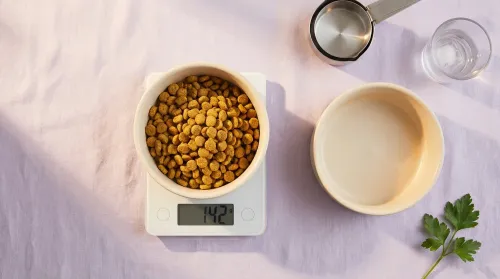
Add warm water at the ratio printed on your package and let it soak until the nuggets are soft — roughly 5–10 minutes for most products. It improves palatability and adds water to the diet, though many formulas can be fed dry.
Rehydrate. Warm water, not hot — you are softening the food, not cooking it, and nothing you do at the bowl will sterilise it. The ratio on the bag is the instruction that actually matters; the 5–10 minute range is simply where most products land, and yours may differ. It is worth doing for senior dogs, dogs with poor dentition, and picky eaters.
Transition. Swap gradually over 7–10 days, increasing the new food a little each day. Abrupt diet changes cause avoidable GI upset, and a rich new food on day one is a common cause of the vomiting-and-diarrhoea calls we take.
Handle it like raw meat, because it is. This is the part I will not soften. The FDA's safe-handling guidance for raw pet food is specific, and it is written for you, not your dog:
- Wash your hands with soap and water for at least 20 seconds after handling the food or anything it touched — bowls, utensils, counters, cutting boards.
- Clean, then disinfect. Wash with hot soapy water first, then disinfect. FDA gives the ratio: 1 tablespoon of bleach to 1 quart of water.
- Do not let your dog lick your face, and wash after being licked — especially right after a raw meal.
- Cover and refrigerate leftovers immediately, or discard them.
None of this is theatre. FDA's concern in that study was explicitly "a potential health risk for the pets eating the raw food, and for the owners handling the product."
When Freeze-Dried Isn't the Right Choice
Some households should skip this category, and no retailer is going to say so.
If anyone in your home is immunocompromised — on chemotherapy or immunosuppressants, pregnant, very young, or elderly — I would not feed raw in that kitchen, including freeze-dried. The FDA's own framing is that handling raw pet food puts owners at risk of Salmonella and Listeria, and those are the people for whom those infections are most dangerous. That is a conversation for your physician as much as your vet.
If the economics do not work, be honest early. For a large dog, complete freeze-dried is a sustained expense, and calorie-dense food fed by eye is easy to overfeed — watch the body condition score, not the scoop.
For puppies and large-breed growth, the label is non-negotiable: feed only a formula whose AAFCO statement covers growth or all life stages, and for large-breed puppies, one that specifically addresses large-breed growth. Calcium and phosphorus balance during growth is not a place to improvise.
If any of that describes you, a cooked complete diet is the straightforward alternative — and worth raising with your own veterinarian, who knows your dog's history in a way an article cannot.
The Bottom Line
The best freeze dried dog food is the one that is genuinely complete for your dog, handled safely, and chosen on evidence rather than on the front of the bag or the answer box above your search results.
The wedge, in one line: freeze-dried means raw, so verify the AAFCO statement, handle it like the raw meat it is, and only then pick the category winner that fits your dog.
I have given you my position — I do not recommend raw diets, and the benefit evidence is not there yet — alongside the honest picks, because you are capable of holding both. Check the label for the AAFCO adequacy statement. Transition over 7–10 days. And talk to your own veterinarian about whether raw freeze-dried suits your dog, your budget, and everyone else who lives in your kitchen.
Frequently Asked Questions
It depends on the use case rather than on one winner. The names that recur across this category are Stella & Chewy's, Primal, Open Farm, Orijen, Vital Essentials, Dr. Marty, and Bravo. Note that all of these are freeze-dried raw — the food is not cooked, so read the safety section before you buy. Whichever you choose, pick a formula whose label carries an AAFCO "complete and balanced" statement for your dog's life stage — brand reputation is not a substitute for that sentence on the bag.
Only if the label says so. A formula is a full diet only when it carries an AAFCO "complete and balanced" statement for a specific life stage. Many freeze-dried products are toppers or treats meant to supplement a diet, not replace it — if the bag says "for intermittent or supplemental feeding only," it is not dinner. Check the small print near the guaranteed analysis before you buy.
Not automatically. Freeze-drying preserves the nutrient profile and flavour of the raw ingredient, and palatability is a genuine advantage for picky or senior dogs. But only a formula labelled complete and balanced is a full diet, and unlike kibble it is not cooked — so pathogens are reduced, not eliminated. The peer-reviewed evidence for a health benefit over a cooked complete diet is not there yet.
There is no reliable published endorsement worth citing here, and a celebrity pick is a poor basis for a diet decision in any case. Choose on the label instead: an AAFCO complete-and-balanced formula appropriate to your dog's life stage, from a manufacturer you can ask questions of. Then confirm the choice with your own veterinarian, who knows your dog's history.
Only if the label's AAFCO statement covers growth or all life stages — and for large-breed puppies, one that specifically addresses large-breed growth. Calcium and phosphorus balance during growth is not a place to improvise. Because freeze-dried food is raw, talk to your veterinarian before feeding it to a growing dog, particularly if anyone in the household is immunocompromised.