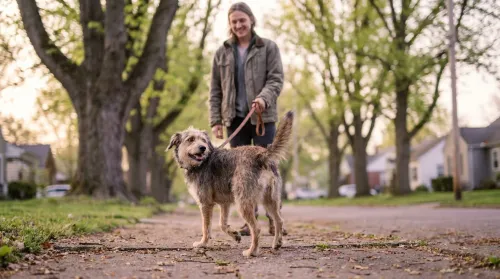


The photograph I never manage to get is the one that would actually help you. It would show nothing at all: a puppy, outside, in the right place, doing the ordinary thing, no drama, no mess, no story in the frame. I have spent a lot of early mornings in Montreal kitchens waiting on that non-event with a camera, and from behind the lens the pattern is hard to miss — most dog potty training tips fail not because the advice is wrong but because the timing is.
Let me be straight about what I am. I am not a trainer. I photograph animals and the people learning to live with them, and I credit trainers and veterinarians by name because the craft is theirs. What follows is what those people and the research actually say, arranged the way I have watched it work: the age-by-age schedule, the evidence on why punishment backfires, and the mistakes I see on repeat — for puppies and for the adult rescue who arrives already grown. There is no three-day miracle here. Accidents are a gap in the routine, not a verdict on the dog.
The 7 Core Rules of Dog Potty Training (Start Here)
Take the dog to one spot on a fixed schedule, reward the instant they finish, supervise or confine between trips, and never punish an accident. That is the whole method.
- Pick one potty spot and go there on-leash. Hill's advice is to decide where you'll bring your dog and then "take them to the same area every time." The scent of last time's success is the instruction; you are not choosing scenery, you are building a cue.
- Run a consistent schedule. The American Kennel Club's trigger list is the one to steal: "first thing in the morning and last thing at night," "after playing indoors," "after spending time in a crate or upon waking up from a nap," and "after chewing a toy or bone, eating, or drinking."
- Reward within seconds, outside, before you go back in. American Humane is precise about the window: "The moment elimination is complete, praise warmly, deliver several treats quickly, and then play."
- Supervise or confine — there is no third state. American Humane again: the dog "needs to be within your direct line of sight at all times — tethered to you, gated in your room, or crated."
- Feed on a fixed schedule, and go out after they drink. Hill's notes that "many dogs produce a bowel movement within 30 minutes of a meal," and that you should "take your puppy out shortly after drinking." Fixed meals make the output predictable, which is the entire game.
- Interrupt calmly. Never punish. The evidence for this is stronger than most guides let on, and it gets its own section below.
- Clean every accident with an enzymatic cleaner. American Humane is blunt: "Standard household cleaners don't eliminate pet urine odor." Dogs "are attracted back to spots where they've previously eliminated," and "incomplete cleaning leaves scent that draws them to 'refresh' the area."
Your Age-Based Potty Schedule (8 Weeks → 6 Months)
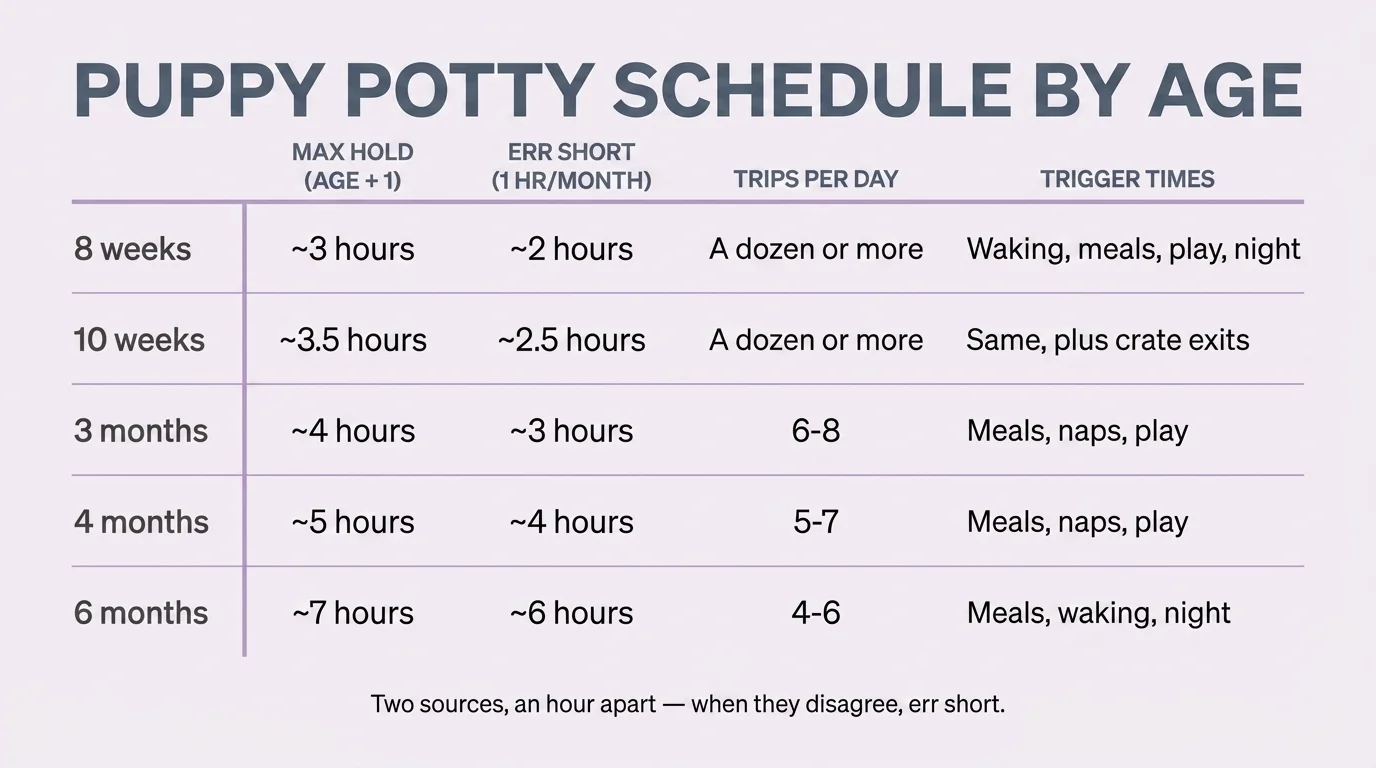
Take your puppy's age in months and add one — that is roughly the maximum number of hours they can comfortably hold it. A three-month-old tops out around four hours.
That's the AKC's month-plus-one rule, stated plainly: "Take the age of your puppy in months and add one, and that is the maximum number of hours that your puppy should be able to comfortably hold it between potty breaks. A 3-month-old puppy plus one equals 4 hours." Worth knowing, and worth saying out loud: the AKC page puts no upper age limit on the rule, so don't let anyone tell you it expires on a particular birthday.
Here is something neither of the big guides mentions, and I think it matters. Hill's uses a different arithmetic — "generally, puppies can 'hold it' for about one hour for every month of age" — which for a three-month-old gives three hours, not four. Two well-regarded sources, an hour apart. When they disagree, err short. Nobody has ever regretted taking a puppy out an hour early.
The Puppy Potty Schedule by Age
| Age | Max hold — AKC (age + 1) | Err short — Hill's (1 hr/month) | Trips per day | Triggers that override the clock |
|---|---|---|---|---|
| 8 weeks (2 months) | ~3 hours | ~2 hours | A dozen or more | Waking, after every meal, after play, last thing at night |
| 10 weeks (~2.5 months) | ~3.5 hours | ~2.5 hours | A dozen or more | The same, plus every exit from the crate |
| 3 months | ~4 hours | ~3 hours | 6–8 † | Meals, naps, play, first thing and last thing |
| 4 months | ~5 hours | ~4 hours | 5–7 † | Meals, naps, play, first thing and last thing |
| 6 months | ~7 hours | ~6 hours | 4–6 † | Meals, waking, last thing at night |
The "dozen or more" is the AKC's own figure for a young puppy — their guide warns this "could have you running for the puppy pad, backyard, or street a dozen times or more in a 24-hour period." † The trip counts for three months and up are my arithmetic from the month-plus-one rule, not a published number — no source I could find gives per-age trip counts past the puppy stage. Treat them as a floor. The two hold columns are simply each source's rule applied across the ages — when they disagree, use the shorter one. The triggers add trips on top, and either way the hold time is a ceiling, not a target: a six-month-old can last seven hours, which is not an argument for making him.
Meals set the clock, so keep them boring and identical — if you're still working out what goes in the bowl, settle that first, because a changing diet makes a changing schedule.
How to Potty Train a Puppy, Step by Step
Take the puppy out on-leash to the same spot after every meal, nap, and play session, reward the second they finish, and repeat until the routine is boring. That's it.
Go out on every trigger, not on a hunch. The list in rule two is your alarm clock. A young puppy's bladder does not negotiate.
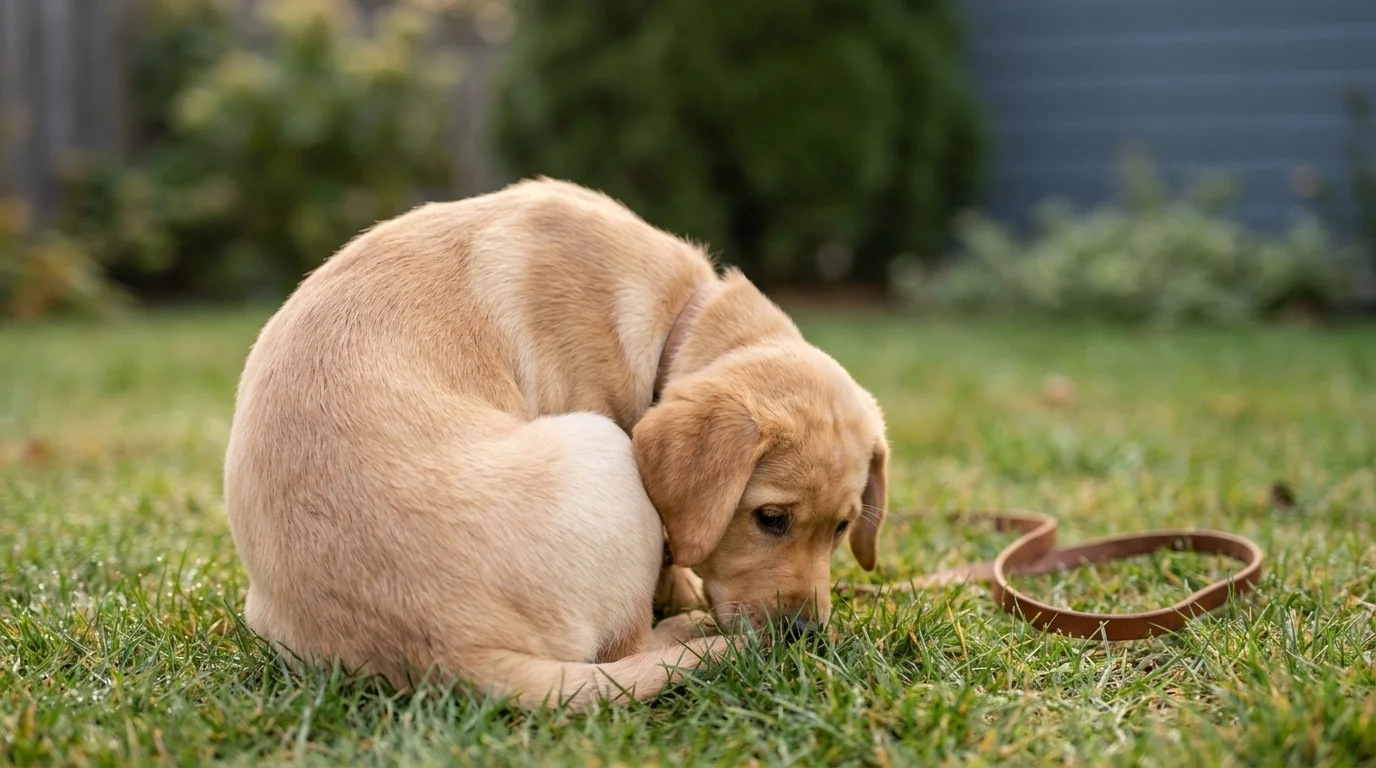
Learn the tells, but don't wait for them. Hill's names the signs worth watching: "smelling their rear, pacing in circles, barking or scratching at the door, sniffing the floor, squatting." This is the part of the job that is genuinely photographic — you are watching for a moment you cannot stage, and the tell always arrives before the event. But here is the trap: a puppy who signals reliably is a puppy who has already learned. Reading the signs is your safety net. The schedule is the method. If you find yourself waiting to be told, you have handed an eight-week-old the responsibility for a system he has not been taught yet.
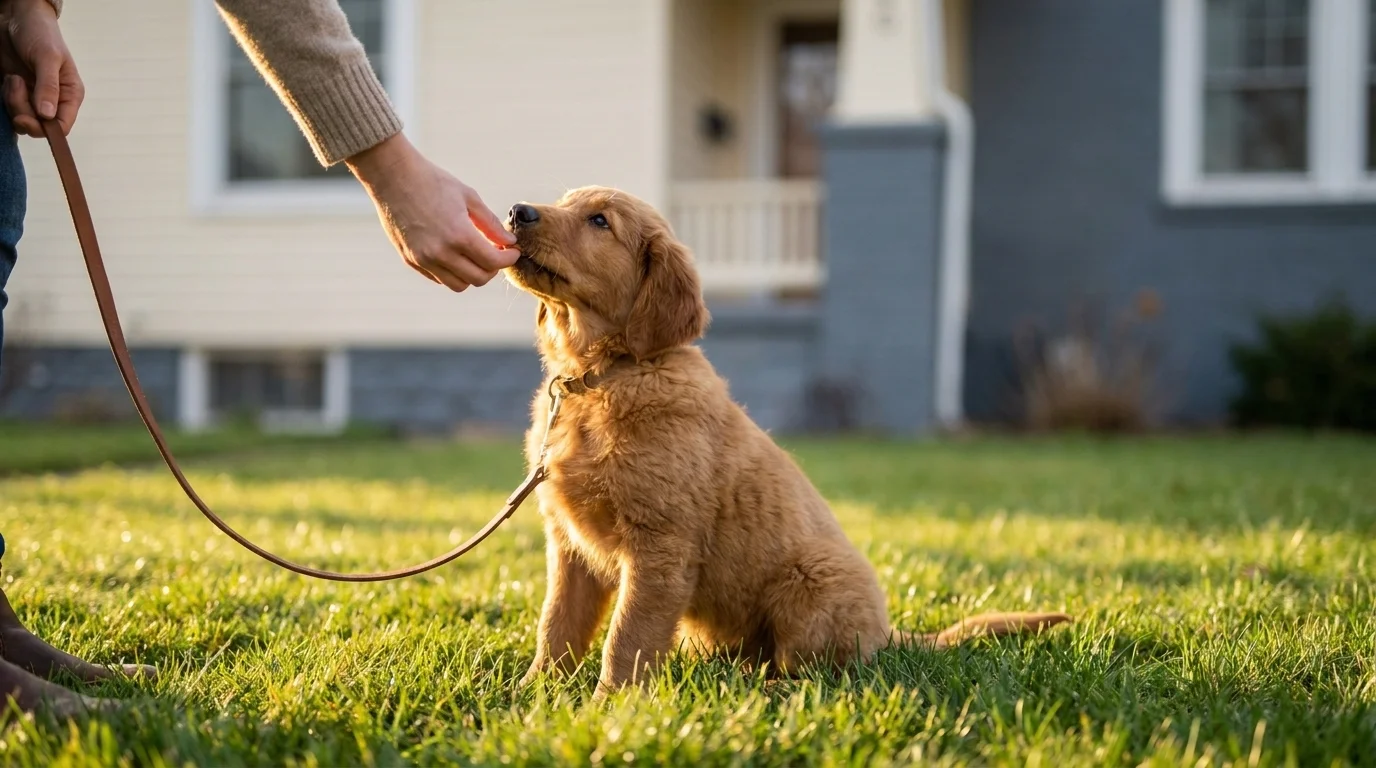
Reward inside the window. Every photographer knows the difference between the moment and one second after the moment. Housetraining runs on the same margin: the treat has to land while the puppy is still standing over the evidence, outdoors, before you walk back in. Praise delivered at the door is praise for walking through a door.
Give the act a name. The trainers I've watched pair a quiet cue — "go potty" — with the act itself, then the reward, and they say it as the puppy goes rather than as a command beforehand. It's a label, not an instruction. Beforehand, the word means nothing to him; during, it means this.
Walk them out, don't carry them. I have no study for this one — it's what I've watched. A puppy carried to the lawn learns that the lawn appears by magic. A puppy walked to the door learns the route to the door, which is the thing you actually want him to know at 2 a.m.
Related Article: Chronicles of Cultural Diversity in Pet Care Practices Worldwide: Tracing Ancestral Roots and Modern Innovations Across Cultures
Why You Should Never Punish Accidents — The Science
American Humane states the mechanism plainly: punishment does not teach bladder control, it teaches fear — "your dog will learn to hide when they need to go, making training harder." He goes behind the couch instead.
Start with the thing that still needs saying: never rub a dog's nose in it. Best Care Pet Hospital puts it flatly — "scolding or rubbing your pet's nose in a mess doesn't teach them what to do — it only causes fear." American Humane draws the line to the consequence: "Never rub a dog's nose in urine or feces, or punish a dog for an accident. Punishment teaches fear, your dog will learn to hide when they need to go, making training harder."
That's the mechanism, and every rival guide asserts it. Almost none of them shows you the evidence underneath.
Here it is. In 2020, Ana Catarina Vieira de Castro and colleagues published a study in PLOS ONE comparing 92 companion dogs across seven training schools in Porto, Portugal — some using reward-based methods, some using aversive ones. The dogs trained with aversive methods "displayed more stress-related behaviors, were more frequently in tense and low behavioral states and panted more during training, and exhibited higher post-training increases in cortisol levels than dogs from Group Reward." Their conclusion: "aversive-based training methods, especially if used in high proportions, compromise the welfare of companion dogs both within and outside the training context."
I want to be honest about what that study is and isn't, because the distinction gets flattened constantly. Those dogs were learning sit, stay, recall and loose-leash walking — not housetraining. What the research establishes is that aversive method carries a measurable physiological cost, in the dog's own body, that follows him out of the session. The housetraining-specific part — that he learns to hide rather than to hold — is what the veterinary sources say. Put the two together and the case is closed from both ends.
And pause on the scene from his side. A dog who has been punished for a puddle has not learned a rule about floors. He has learned that you are unpredictable near a very ordinary bodily function. What you photograph after that is a dog who watches you before he goes.
So when you catch one in progress: interrupt calmly — a neutral sound, no theatre — carry on out to the spot, and reward if he finishes there. When you find one after the fact, Dr. Mary Burch of the AKC has the only sane instruction: "if your dog has an accident, don't make a fuss, just clean up the mess." Then clean it properly, with the enzymatic cleaner, because otherwise the scent is a standing invitation back to the same square foot of rug.
Crate & Confinement: Prevent Accidents Before They Start
A correctly sized crate is not a punishment. It's the simplest accident-prevention tool you have, and it works because of something the dog brought with him.
The AKC's framing is the clearest I've read: "dogs are den animals and will seek out a little canine cave for security whether you provide one or not." The housetraining logic follows from ordinary fastidiousness rather than obedience — "the principle behind using a crate for housetraining is that dogs are very clean creatures. They don't like a urine-soaked rug in their living spaces any more than you do."
Which makes sizing the entire ballgame. The crate should be "just large enough for the dog to lie down, stand up, and turn around." Any bigger and you have not built a den, you have built a studio apartment with a bathroom in the corner — he'll sleep at one end and go at the other, and you have taught him the exact opposite lesson. For longer stretches, use a pen instead and accept that a pen is management, not training.
Confinement and supervision are the two states an untrained dog should be in, always: "tethered to you, gated in your room, or crated." Never use the crate as a place you send him when you're angry — it only does this job while it remains somewhere he wants to be.
This is the summary version. Crate training done properly is its own long conversation — introduction, duration, the whole build — and it deserves a dedicated guide rather than four paragraphs borrowed from a potty piece.
Housetraining an Adult or Rescue Dog
Dr. Mary Burch's instruction for a rescue who soils where he sleeps is to "go back to square one with crate and house training" — puppy-grade structure, then extend. The bladder is grown; the habits may not be.
The physical part is easier — an adult can hold it far longer than any puppy in that table. The rest can be harder. Burch names the case directly: rescued dogs "who come from situations where they were confined for long periods and had no other choice but to eliminate in their kennels will often soil their crates." That inverts the section above it: the den instinct assumes a dog who was ever offered a clean place to sleep. It's a genuine reversal to work through, not stubbornness. A dog rehomed from a house with a dog door has never once had to tell a human anything. Neither of them is starting from zero; they're starting from somewhere else, which is slower.
So run the same core rules without improvising: one spot, on-leash, every trigger, reward inside the window, supervise or confine, enzymatic cleanup. Burch's own list for these dogs is the same shape, with one addition worth stealing: "assess how well your dog can control their bladder and bowels when not in the crate" — find that out before you extend anything, rather than after. How long to run it before you read anything into the result, I can't source, and I'd be wary of anyone who hands you a number for it. The honest answer is longer than feels necessary. It's worth going in with your assumptions about an adopted dog held loosely — the history you invent for him is usually wrong, and the routine works either way.
Two things to watch. Marking — small, frequent, vertical, targeted — is, in my read, a different problem from a housetraining gap, and one people conflate with it constantly and then wonder why the schedule isn't fixing it. And if an adult regresses suddenly, stop training and start with medicine. Dr. Jerry Klein, the AKC's chief veterinarian, is explicit: "if you feel that you're not making progress, you should have the puppy checked out by a veterinarian. They may have a urinary tract infection or some other health issue causing the delay in house-training." That goes double for a dog who was reliable last month and isn't now. This article is not a diagnosis, and a sudden change in a dog's toileting is a veterinary question first.
Apartment & No-Yard Potty Training (+ Pad-to-Outdoors)
Build the elevator into the schedule. If the street door is four minutes away, every hold in that table is four minutes shorter than it looks, and the difference is your carpet.
None of what follows is research — it's what I've watched work in buildings like the one I live in. Keep the grab-and-go kit by the door: leash, treats in the pocket already, shoes you can jam on. Every second spent hunting for a treat bag is a second the puppy is holding a decision. Take the stairs if the elevator is slow, and pick the closest patch of ground you can legally use, not the nicest one.
Pads and indoor grass are a bridge, not a destination, and they cost you something: you're teaching that indoors can be correct, then un-teaching it. If you need the bridge — a young puppy, a fourteenth floor, a night shift — use it deliberately. Start the pad near the door rather than in the middle of the room, then migrate it toward and eventually through the door, a little at a time. Once you're transitioning, reward outdoor success only. Two rewarded venues means two venues.
Name the tools honestly: pads, indoor grass trays, and attractant sprays are conveniences that shape where a dog goes, not methods that teach him to hold it. And on a shared balcony, be the neighbour you'd want — a balcony is somebody's ceiling, and the enzymatic cleaner matters more out there, not less.
Related Article: Global Perspectives on Pet Companionship and Culture
The Mistakes I See Owners Make Most
These are the ones I see over and over, in that order of frequency.
Freedom too early. The most common by a distance. Best Care Pet Hospital says it plainly: "free-roaming too early can lead to frequent accidents and confusion about where to go." A dog earns the run of the house by being boringly reliable in one room first.
Waiting to be told. Covered above, and worth repeating because it's the one that quietly stalls a month of progress: the tells are your safety net, the schedule is your method.
Carrying instead of walking. My observation, not a citation — but the route to the door is a thing he has to learn on his own four feet.
Teaching four exits at once. Also mine. Pick one door for the training weeks. A dog who has been taken out through the patio, the front, the garage and the side has been taught that all doors are potentially doors, which is the same as no door.
Making 3 a.m. interesting. The overnight trip is business, not a party. Minimal light, no chatter, no game, out and back. Mine as well: celebrate a 3 a.m. success with any real enthusiasm and my read is that you have not rewarded elimination, you've rewarded waking up — and you may be living with it for weeks.
Start Tonight
Potty training is a routine, not a talent. Almost every one of these dog potty training tips is just the same instruction wearing different clothes: make the right thing happen on a schedule, pay for it immediately, and make the wrong thing impossible rather than punished. Run that and the accidents thin out on their own.
Give it months, not days. Dr. Klein's benchmark is the honest one — "if training begins early, a 6-month-old puppy is usually able to be depended on most of the time to eliminate outside." Most of the time, at six months. Anyone promising you a weekend is selling something.
Save the schedule table, put the treats by the door tonight, and go take a photograph of nothing happening. More training and pet-culture writing lives in pet culture.
Frequently Asked Questions
It's a socialization guideline, not a potty rule. The Rule of Sevens asks that a puppy meet seven new surfaces, objects, locations, people and so on in its first seven weeks. For housetraining, use an age-based schedule and the month-plus-one hold rule instead: age in months plus one is roughly the maximum hours a puppy can comfortably hold it.
It isn't a recognised dog-housetraining rule — the answers that surface for it are drawn from human potty-training advice, not canine. For puppies, use age-based frequency instead: take your puppy's age in months and add one, and that's the maximum number of hours between trips outside.
Feed on a fixed schedule and go out about 30 minutes afterwards — Hill's notes that many dogs produce a bowel movement within 30 minutes of a meal. Supervise or confine between trips rather than allowing free roaming, and clean every accident with an enzymatic cleaner: American Humane notes that standard household cleaners don't eliminate pet urine odour, and the scent left by incomplete cleaning draws the dog back to the same spot.
Plan in months, not days. Dr. Jerry Klein, the AKC's chief veterinarian, says that if training begins early, "a 6-month-old puppy is usually able to be depended on most of the time to eliminate outside." Most of the time, at six months — your consistency and schedule, not the breed alone, set the pace.
There's no real shortcut. A strict schedule, constant supervision, and a reward delivered within seconds of the puppy finishing outdoors is the fastest route available — but reliability is still measured in months, not days. Anyone promising you a weekend is selling something.