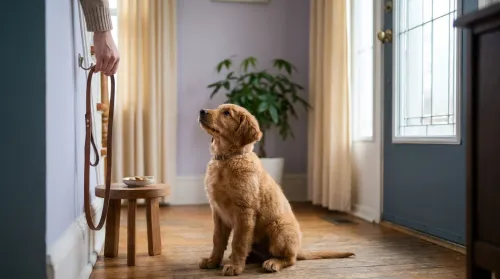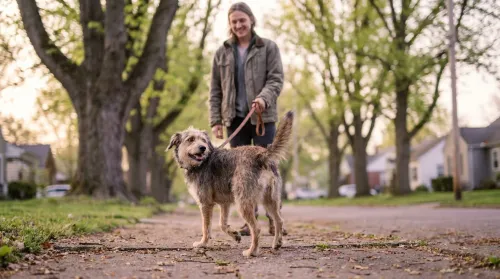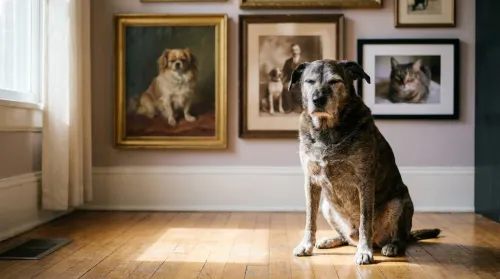


The host stand is where it happens. You are on the sidewalk in July, leash in one hand, and the patio is right there — four tables of people eating in good light. Your dog looks up at you. Mine is a greyhound, a senior, with firm opinions about waiting. And the person holding the menus is about to say yes, or no, or the thing they say most often: I think so? Let me go ask someone.
That hesitation is the whole problem. Search for dog friendly restaurants and you will find a hundred lists of places in a hundred cities, and not one of them explains the layer underneath the list — what the rules actually are, who decides, and why the answer changes when you cross a state line. So people leave the dog at home when they didn't need to, or they bring her and get politely walked back out.
This guide is that layer: the real rules on patios versus indoors, the etiquette that keeps the door open behind you, a method for finding a spot in any town rather than a list you can't use, and the chains that reliably say yes.
Are Dogs Actually Allowed in Restaurants? The Rules Nobody Explains
Sometimes — on outdoor patios, in about 23 states that allow it by law or regulation, if the health authority and the venue agree. Indoors, almost never — service dogs aside.
Here is the fact that reframes everything, and that I have never once seen in a city listicle: the federal model code that every state health code is built from did not permit your dog on that patio until 2022. Not 1822. Not 1972. 2022. And the states did not wait for it.
The FDA Food Code is the model set of food-safety rules that US states adapt into their own health codes. As the National Restaurant Association summarizes it, "Historically, the Food Code has not allowed any live animals, other than service animals, on the premises of a food establishment." The 2022 revision changed that — it "now, for the first time, provides guidance allowing dogs in outdoor dining spaces, if approved by the local regulatory authority."
For the first time. Every prior edition of that code said no.
Read that last clause closely, though, because it carries the catch: if approved by the local regulatory authority. The Food Code is model guidance, not binding federal law. Nothing about it obligates your state, your county, or the place on the corner. It is a template — and the states, it turns out, had stopped waiting on it a long time before 2022.
Which brings us to the number that actually governs your evening. The Animal Legal & Historical Center at Michigan State keeps the tally: about 23 states allow dogs in outdoor dining areas by state law or regulation, breaking down to "14 states that have a law allowing dogs (or other animals) in outdoor dining areas and 6 states that do the same through state regulations (which have the force of law)" — with Virginia, they note, appearing twice on the list. Twenty-three. Not fifty. Restaurants that allow dogs are operating inside a patchwork.
Now look at when those laws were passed, because the timeline turns inside out. The Center lists those laws "in chronological order from when they were enacted," and the first one is Florida's, in 2006 — sixteen years before the Food Code came around to the idea. Florida's mechanism is the tell: it lets a local government adopt an ordinance "that acts as an exemption to the state's Food and Drug Administration Food Code." Not an adoption of the code. An exemption carved out of it. Illinois followed in 2008, Tennessee in 2009, Maryland and New Mexico in 2011, California in 2014, on through Kentucky — "the newest state to enact such a law" — in 2023. So the patchwork is not the 2022 Food Code's offspring. It predates it, it outran it, and it was built by statehouses that got tired of asking. The model code was the last to catch up, which is the real reason there is no national rule tonight: the states never had one to begin with.
And treat that number as a snapshot rather than a live feed. The Center's own page dates the count in two different places and doesn't quite agree with itself, which is less sloppiness than an honest symptom of the thing being counted: statehouses amend food codes on their own schedules, and the tally is always chasing them. Even the people tracking this professionally are working from a photograph of a moving subject.
A disclosure, because the frame should be honest: I live in Montreal. Everything above is American law. The FDA Food Code and the ADA are US instruments, and they have no force whatsoever on the patio outside my apartment. I am reporting these rules, not living under them — which, as it turns out, is the strongest possible argument for the method further down this page. The only rule that travels is ask first.
And the reason interiors mostly stay closed isn't squeamishness. It's the sentence the Food Code itself uses, quoted by the Restaurant Association: "Animals carry disease-causing organisms and can transmit pathogens to humans through direct and/or indirect contamination of food and food-contact surfaces." That is the entire logic of the patio line, and it's worth understanding rather than resenting, because the logic doubles as the map. The risk is open food and food-contact surfaces. Outside, in the open air, away from the pass and the prep, the math changes — and in a room that handles no open food at all, it changes too. That second case is rarer, and we'll get to it.
None of this is legal advice, and I'm not the person to give it. Rules shift, counties amend, and a statute in force when I wrote this may read differently by the time you're standing at that host stand. Confirm with the venue and, if you genuinely need certainty, your local health authority. For more on how we cover the culture and rules of living alongside animals, the rest of our pet culture writing is here.
Inside or Patio Only? Where Your Dog Can Go — and Where Service Dogs Fit In
The patio only, where it's permitted. Pets stay out of interiors and food-prep areas in nearly every state — often even walking through to reach the patio. Only ADA service dogs have a federal right to go indoors.
The patio is the frontier of what's legal. For very nearly everyone, it is also the end of it.
The question I get most is some version of but she's well-behaved, can she come inside? — and the answer is almost always no, and it isn't about her behavior. The laws in that 23-state tally are, with one exception I'll come to, patio laws: they open outdoor dining and stop there. The 2022 Food Code revision did the same — outdoor dining spaces, and nothing else. Plan your evening as though the interior is closed to her, because in nearly every state it is.
But nearly is doing honest work in that sentence, and I'm not going to tidy it away. Washington is the exception, and it sits on the same Animal Legal & Historical Center page I've been quoting all along: "the permit holder may allow dogs in the INDOOR area of a food establishment if the permit holder has notified the regulatory agency in advance." The conditions are narrow — the venue may only pour beverages from a food processing plant and serve ready-to-eat food in its original packaging — and, in the regulation's own terms, "there must be signage informing customers that the facility allows dogs inside." Read that list once more: poured drinks, packaged food, a sign on the door. That is a coffee shop. That is a taproom. Washington doesn't merely tolerate the indoor dog — it contemplates a room that has to announce her, which is a stranger and better fact than the flat no I used to give people.
Everywhere else, the reason is surfaces and pathogens, not manners, so being the best-behaved dog on the block earns you exactly nothing at the threshold.
Then there's the catch that trips up almost everyone, including me the first time I read the statutes: in many states you can't even walk through the restaurant to reach the patio. New Mexico's law puts it flatly — "Patrons may not bring the dog through the indoor dining space to enter or exit the restaurant" — and Florida's does the same, per the Animal Legal & Historical Center's state-by-state summary. It is not universal, but it's common enough to assume. Look for the side gate. The Restaurant Association tells venues to offer "a patio entrance that won't require dogs to traverse through the inside of the restaurant," which means when you find a place with a dedicated gate, someone thought about this before you arrived.
Service dogs vs. emotional support animals vs. pets
These are three legally distinct categories, and collapsing them causes real harm to the people in the first one.
A service dog is, in the ADA's terms, a dog individually trained to do work or perform tasks for a person with a disability. Service animals are permitted in dining areas under federal law, indoors included — service dogs "can go into: Restaurants," in the ADA's own words. Staff may ask only two questions: whether the dog is a service animal required because of a disability, and what work or task it has been trained to perform. Not for papers. Not for a demonstration.
An emotional support animal is not a service animal. The ADA is unambiguous: "If the dog's mere presence provides comfort, it is not a service animal under the ADA." That isn't a judgment about whether the comfort is real — it plainly is, for a lot of people. It's a statement about task training. Legally, an ESA is a pet — which means she goes exactly where pets go, and not a step further.
A pet is a pet. Mine included. Patio, where permitted; indoors only in the rare room that has opted in and posted the sign.
And that gap is the one worth holding onto, because it isn't a gap in how much the dog is loved. A service dog has a right to be indoors — written into federal law, the same in every state, and not a matter of the manager's preference. A pet, at her absolute best, has permission: in a state or two, in a room that chose to offer it, revocable tonight. Rights and permissions do not behave the same way at a host stand.
I'll be direct, because the documentary habit is to name the cost: every pet passed off as a service dog raises the tax on the handlers who depend on one. They are the ones who get interrogated at the door afterward. Don't do it.
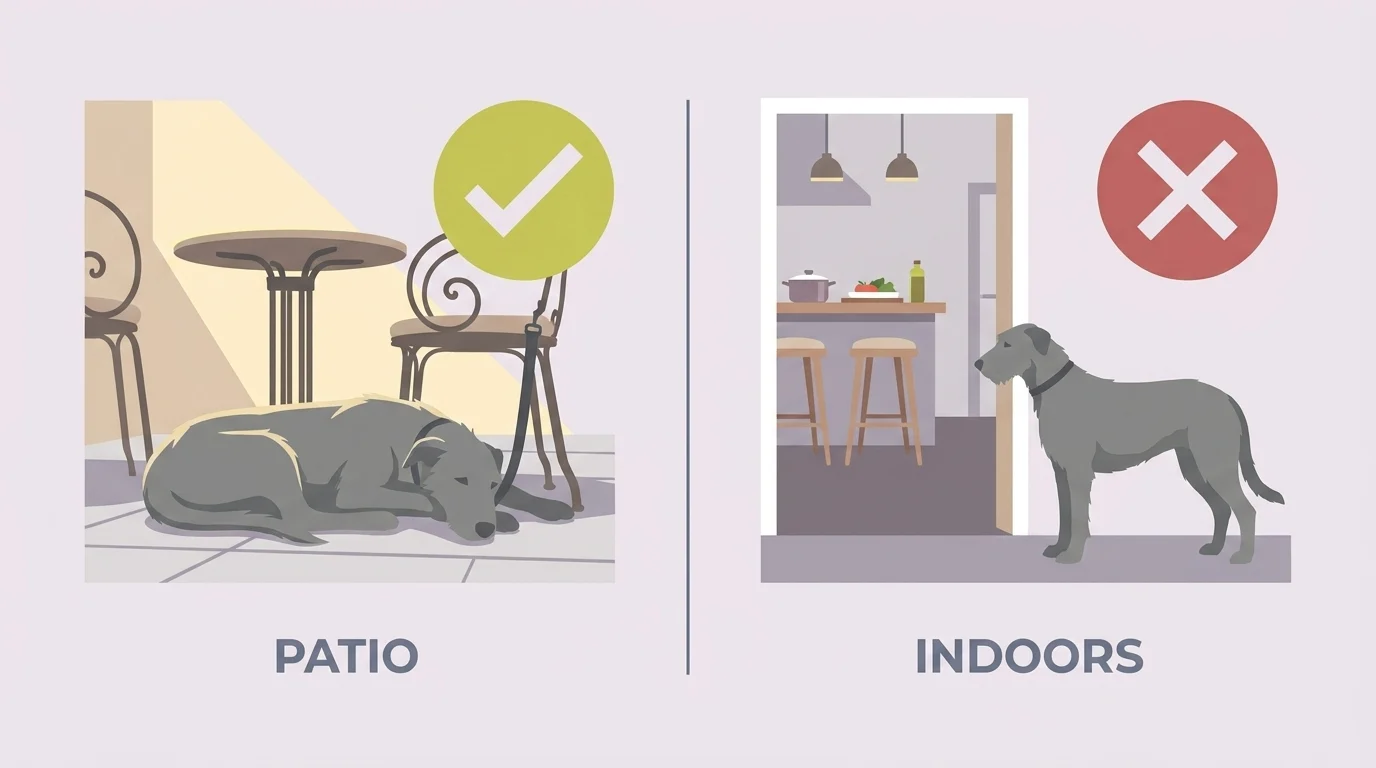
And the last word belongs to none of this. Even where the state allows it, where the county has adopted it, where the gate is right there — the restaurant can still say no. Often it isn't corporate policy making that call. It's whoever is running the floor tonight.
How to Find Dog-Friendly Restaurants Anywhere
Call ahead to confirm today's policy, check an app like BringFido, and favor patios, breweries, beer gardens, and coffee shops — the venue types most likely to say yes.
Most people searching for a dog-friendly spot want a list for their own city. I'd rather hand you the method, because the method works in a town no listicle has ever covered — and because a list published two summers ago is a rumor, not information.
Call. It takes fifteen seconds. "Hi — do you allow dogs on the patio right now?" That word, right now, is doing real work. Policies move with the season, with a change in ownership, with a new manager who had a bad experience in June. A phone call reaches the one authority that matters, which is the person who will be standing at that host stand when you arrive.
Use the apps, then verify. BringFido and tools like it let you filter for dog-friendly patios and are a good way to build a shortlist. Treat them as leads, not as guarantees — crowd-sourced listings lag reality, and the app doesn't know that the patio closed for renovation.
Learn the venue types. Some categories skew dog-welcoming so reliably you can almost predict them: places built around a patio, breweries and beer gardens, casual taco and counter-service spots, coffee shops. The common thread is architectural, not sentimental — these are businesses whose seating is already outside, already hosed down, already separated from the kitchen. Dog-friendly outdoor dining is easiest where the outdoors was the point all along. It is the same logic that gets a dog through a door in Washington: the less a room does with open food, the less it has to defend.
The reason I'd take this over any directory: it survives. It works in a strange city at 7pm, in the off-season, in the town you drove through instead of to. If your outing is part of a longer trip, our guide to stress-free pet travel covers the ground before the patio.
Related Article: Chronicles of Cultural Diversity in Pet Care Practices Worldwide: Tracing Ancestral Roots and Modern Innovations Across Cultures
Restaurant Etiquette: Be the Dog Owner They Welcome Back
Dog friendly restaurant etiquette is mostly one idea wearing several hats: you are a guest, and so is she.
Before you go. Walk her out first — a tired dog settles, an under-exercised dog auditions. Feed her beforehand so the smell of somebody's short rib isn't the most interesting thing that has ever happened to her. And give her the chance to relieve herself before you're anywhere near a table, for reasons that need no elaboration.
At the table. A short leash, about four feet, tied or anchored to your chair rather than looped around your ankle — you want her tethered to furniture, not to your balance. She settles under the table, not in the aisle where a server carrying a full tray has to solve a puzzle at knee height. Not on a chair. The Restaurant Association's own guidance to venues is that "dogs should not come into contact with chairs, tables, linens, tableware or other foodservice items" — so a dog in a chair isn't a charming photo. It's the exact line the industry's own guidance draws.
During the meal. No table-feeding, no begging tolerated, and bring a collapsible water bowl — July patios are hotter at dog height, down at the flagstone, than they are where you're sitting. If a server declines to pet her, that's not coldness; the same guidance tells staff to "refrain from touching, petting, or handling dogs," because their next stop is your food. And you're allowed to decline on her behalf too, when a stranger's hands arrive uninvited or another dog turns the table into an event.
And the pivot. Here's the part the etiquette lists leave out, because they're all written about the humans: the dog is not out to dinner. The dog is enduring dinner — a hot stone floor, a forest of legs, food she can smell and won't get, ninety minutes of nothing to do. Some dogs genuinely love it. Plenty are simply tolerating it for you, which is a gift, and worth noticing while it's being given. Watch her, not just the room. If the answer is that she'd rather be home on the cool tile, that's an answer, and it's allowed.
Dog-Friendly Chains & the Venue Types That Almost Always Say Yes
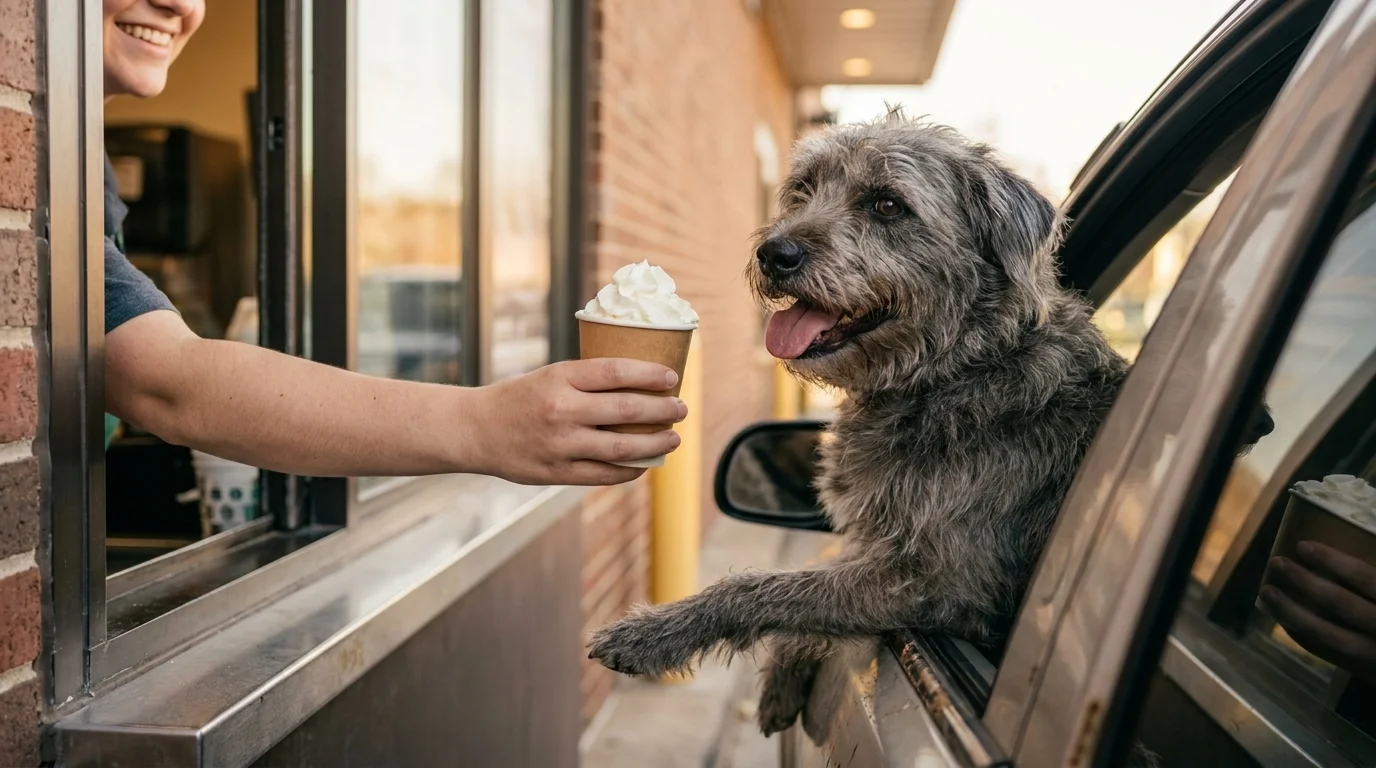
The dog friendly chain restaurants worth knowing are the ones that turned dog-friendliness into a menu item, and there are more of them than there used to be. A roundup by Bark catalogs the reliable ones:
- Starbucks — the Puppuccino, which Bark describes as "a small cup of fluffy deliciousness (whipped cream)." The most famous of the lot, and the one most baristas will produce without blinking.
- Dairy Queen — the Pup Cup: "a free scoop of vanilla soft serve topped with a crispy dog treat."
- In-N-Out — the pup patty, "this plain patty (no salt, no bun)."
- Shake Shack — a dedicated dog menu, "available at all Shake Shacks except stadiums, ballparks, airports."
- Sonic — "at select Sonics," a pup may "receive his own puppy ice cream or dog treat when your meal is delivered."
Notice what these have in common. Dog-friendliness here isn't a nuisance being tolerated — it's an amenity, with a proprietary name and a place in the marketing. That's not the restaurant industry going soft. That's the industry deciding the person on the other end of the leash is a customer worth having, and pricing a scoop of soft serve accordingly.
Two caveats, both the kind the bare lists bury. First: these are patio and drive-thru offerings. A Puppuccino does not come with an indoor table. Second, and more important — availability is local, always. Bark's own phrasing gives the game away: at select Sonics. Corporate can put an item on a menu; the manager on shift decides whether your dog is on the patio tonight. Call ahead. Same fifteen seconds.
Beyond the named chains, the venue-type rule from earlier still does the heavy lifting: breweries, beer gardens, and coffee shops remain the safest categories in most towns, and none of them needed a marketing department to get there.
What to Do If You're Asked to Leave
It will probably never happen. But the fear of it is why a lot of people never try, so let's take the teeth out of it.
Read the room early, and read your dog earlier. The escalation is almost always visible before it's audible — the whining, the repositioning, the fixed stare at the next table's plate. That's your cue to ask for the check, not to hope she settles. The graceful exit you choose yourself is a different event from the one that gets chosen for you.
And if a staffer does come over: go. Don't argue, don't cite the statute you read in a guide, don't make them repeat it. The policy is theirs to set — service-dog cases aside, where the law genuinely is on the handler's side — and the person delivering the news is rarely the person who wrote it. You are not going to win the argument, and the cost of having it lands on the next person who shows up with a dog.
Have a fallback so the evening isn't a loss. Get the order to go and eat it in a park. Know a second patio nearby. The outing bends; it doesn't break.
Mostly, though: do the prep and this stays hypothetical. In my experience the failure mode isn't a confrontation. It's a dog who was never going to enjoy that ninety minutes, brought anyway.
The Short Version
Dining out with your dog comes down to three things: know the rules (patio yes, indoors almost never, unless she's a service dog), show up prepared, and call ahead — because the map of dog friendly restaurants is redrawn by whoever is running the floor tonight, not by whoever wrote the list you found.
Do that, and you become the owner the patio wants back. Which is, in the end, how the map gets redrawn: one uneventful dinner at a time.
So pick one patio this week. Call first. Walk her out, feed her, bring the water bowl, take the outside gate. And watch her under the table — if she settles into the shade with a sigh, you've done it right. If you want the wider view of how law and life with animals intersect, our piece on international pet laws picks up where this one stops.
Frequently Asked Questions
No — dogs are not allowed on restaurant patios in every state. It's a patchwork: the Animal Legal & Historical Center counts about 23 states that permit dogs in outdoor dining areas by statute or regulation, in laws enacted from 2006 through 2023. That tally is a snapshot and states keep amending their food codes, so treat it as a starting point — the local health authority and the individual restaurant still decide. Confirm before you go.
No, emotional support animals do not count as service dogs in restaurants. A service dog is trained to perform a task directly related to a person's disability; as ADA.gov puts it, if a dog's "mere presence provides comfort, it is not a service animal under the ADA." Emotional support animals are legally pets: patios where permitted, and indoors only in the rare opted-in room — a service dog's access indoors is a federal right, a pet's is not.
Several national chains are dog-friendly at patio and drive-thru locations. Bark's roundup names Starbucks (the Puppuccino), Dairy Queen (the Pup Cup), In-N-Out (a plain pup patty), Shake Shack (a dog menu at all locations except stadiums, ballparks and airports), and select Sonic locations. Availability is local and the manager on shift has the final say, so call ahead.
The etiquette for taking a dog to a restaurant starts before you arrive: exercise and feed your dog first, and let them relieve themselves. At the table, use a short four-foot leash anchored to your chair, keep your dog settled under the table and out of aisles, never on chairs, and bring a collapsible water bowl. If they get disruptive, leave promptly and graciously.