
The Everlasting Charms of Iconic Animal Companions in Literature and Cinema


The first of the famous animal characters I remember crying over was not a real dog. I was eight, lying on the carpet in front of my grandmother's television in Trois-Rivières, watching a worn VHS copy of Lassie Come-Home dubbed into Québécois French. I knew the dog was an actress — a male collie named Pal, my grandmother told me later, who had played Lassie in the original 1943 film — and I cried anyway. So did my grandmother, who had seen the same scene thirty years earlier in a small cinema on rue des Forges, and so did the dog at our feet, a beagle named Caillou, who had not seen anything at all and was crying mainly because we were.
This is the strange and durable thing about famous animal characters: they enter our households as fiction and end up shaping how we treat the actual animals on our actual couches. Search interest for "famous animal characters" sits steadily at about 320 queries a month and has climbed roughly 23% year over year through 2025. The reason is not nostalgia. It is that around 94 million American households now live with a pet, every one of them shaped, in some measurable way, by Lassie or Hedwig or Charlotte or Simba. What follows is a grouped roster of sixteen of those characters — across dogs, cats, cartoon icons, and the more unusual species the canon keeps adding — with one observation per character about what they actually left behind in the real pet world.
Famous dogs across books and movies
Dogs are the most-searched category of famous animal character on the internet — famous dogs in movies alone draws around 3,600 monthly Google searches — and the canon has been remarkably stable for half a century. These are the five who set the template.
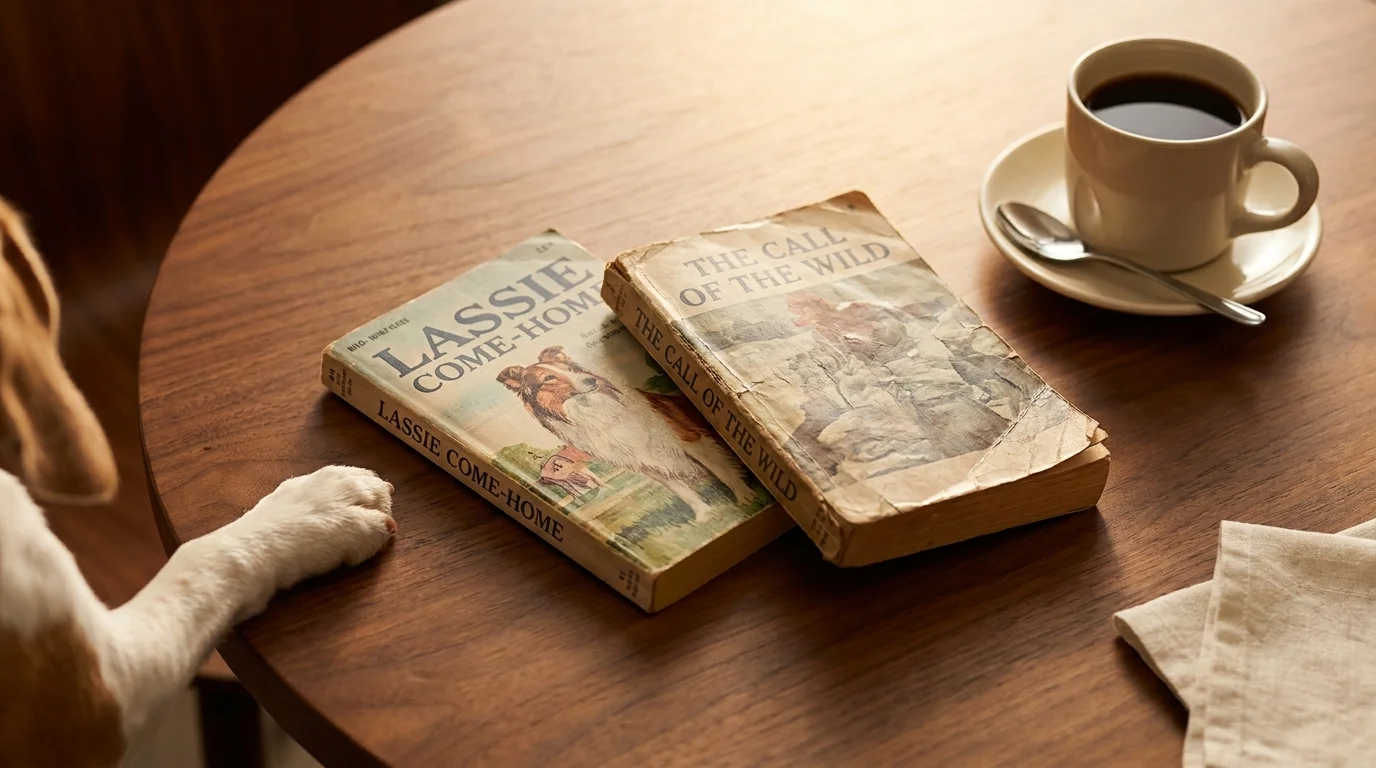
Lassie (Eric Knight's 1940 novel Lassie Come-Home; 1943 MGM film; subsequent television series). The rough collie who walks home across the Highlands to find a boy named Joe Carraclough is the founding modern animal character — the prototype every loyal-dog story since works against. The first film's title role was played by a male collie named Pal, trained by Rudd Weatherwax, whose descendants played Lassie on screen for forty years. Pet-culture takeaway: the rough collie became one of the most-registered breeds in the AKC for a generation after the films, an effect later confirmed by peer-reviewed AKC-registration research.
Hachiko (real Japanese Akita, 1923–1935; later the basis for the 1987 Japanese film Hachikō Monogatari and the 2009 American remake Hachi: A Dog's Tale). Hachiko was an actual dog who waited daily at Tokyo's Shibuya Station for his owner, Professor Hidesaburō Ueno, to return from work, then continued waiting for nearly a decade after Ueno died of a stroke at the lectern. The bronze statue at Shibuya is still one of the most-visited animal memorials in the world. Pet-culture takeaway: Hachiko is the rare case where the fictional adaptations did not eclipse the real animal — both films treat the source story with care, and the real Hachiko's preserved hide is on display at Tokyo's National Museum of Nature and Science.
Buck (Jack London's 1903 novella The Call of the Wild; multiple film adaptations including the 2020 Disney version). The St. Bernard / Scotch shepherd mix stolen from a California ranch and sold into Klondike sled-team work is the spine of American literary dog writing — the model for every story in which a domesticated animal returns to a wilder version of itself. Pet-culture takeaway: every modern essay on sled dogs and working-breed welfare borrows Buck's frame, often without naming him.
Toto (L. Frank Baum's The Wonderful Wizard of Oz, 1900; 1939 MGM film). A small, scruffy companion who follows Dorothy out of Kansas and rarely leaves her side. Toto's film performance was by a female Cairn terrier named Terry, whose fee for The Wizard of Oz was reportedly higher than that of several human cast members. Pet-culture takeaway: Cairn terrier registrations spiked after the 1939 release; the breed is still informally known among American breeders as "the Toto dog."
Snoopy (Charles Schulz's Peanuts comic strip, 1950–2000; subsequent television specials and films). The most-merchandised beagle in human history, and one of the few comic-strip animals who functioned simultaneously as a real-seeming pet and an internal-monologue narrator. Pet-culture takeaway: beagle adoption-and-registration numbers in the United States have tracked Snoopy's cultural visibility since the 1960s, and the World War I Flying Ace doghouse remains one of the most-photographed Halloween costume props in North America.
A current-era anchor for the dog canon: the 2024 release of Paddington in Peru continues to position Paddington as one of the very few modern animal characters who genuinely span book and screen, and Andy Serkis's Cinesite-animated Animal Farm (2025) put Boxer the cart-horse back into mainstream cinematic circulation for the first time since the 1954 animated adaptation.
Famous cats on the page and the screen
The cats run a smaller cluster — famous cats in movies at roughly 720 monthly searches, famous cats in literature at 110 — but the canonical list is just as stable, and the picks are spread more evenly across centuries.
The Cheshire Cat (Lewis Carroll's Alice's Adventures in Wonderland, 1865; Disney's 1951 animated adaptation; Tim Burton's 2010 live-action film). The vanishing tabby whose grin remains after the cat is gone is the most-quoted line in English literature about cats and arguably the most-quoted line about any animal. Pet-culture takeaway: tabby cats with strong facial markings have a noticeably higher Instagram engagement than other coat patterns, and the Cheshire's smile lineage is part of why.
Garfield (Jim Davis's comic strip, 1978–present; the 2024 animated Garfield Movie). The lasagna-eating, Monday-hating orange tabby who has occupied the longest continuous run in syndicated newspaper-comic history. Pet-culture takeaway: Garfield is the reason a generation of American pet owners forgave their cats for being aloof, demanding, and contemptuous of dogs.
Crookshanks (J. K. Rowling's Harry Potter series, 1997–2007; subsequent film adaptations). Hermione's half-Kneazle ginger cat is one of the few literary cats who is materially smarter than the human protagonists around him and unmistakably written by an author who lived with a cat. Pet-culture takeaway: ginger-cat adoption rates in the UK rose measurably through the Potter-publishing decade, and Crookshanks is the reason older shelter cats now reliably move faster off the adoption wall.
Salem (the family-pleasing modern Salem Saberhagen of Sabrina the Teenage Witch, both the 1990s sitcom and the 2018 Chilling Adventures; before him, a long line of literary witch-cats running back to early-modern English folklore). Pet-culture takeaway: the black-cat adoption stigma in North America began to soften, demonstrably, in the years after the sitcom went into syndicated rerun; a sitcom cat doing comedy is harder to fear at the shelter window.
Puss in Boots (Charles Perrault's 1697 tale; Shrek franchise; the 2022 DreamWorks Puss in Boots: The Last Wish). The swashbuckling cat with hat and rapier is one of the oldest continuously-recognized fictional animal characters in European literature — three and a quarter centuries of continuous publication. Pet-culture takeaway: the 2022 film is one of the rare cases of a contemporary children's animation treating an aging-cat protagonist's mortality with adult care, and shelter workers reported a noticeable post-release uptick in senior-cat adoptions.
Related Article: Cultural Connotations: Exploring How Different Colors Hold Diverse Symbolism in Pet Care Around the World
Disney and cartoon animal icons
Animated animal characters are a category in their own right, with famous cartoon animal characters rising about 55% year over year as a search phrase through 2025. The Disney canon dominates by pure cultural mass, and four picks carry the weight.
Mickey Mouse (Walt Disney and Ub Iwerks, Steamboat Willie, 1928). The black-eared mouse whose silhouette is one of the most-recognized human-made shapes in the world. Pet-culture takeaway: the long argument inside Disney over whether Mickey is "an animal" or "a person who is also a mouse" is the same argument every pet owner has internally about their own animals, just with better merchandise.
Simba (Disney's The Lion King, 1994; the 2019 photorealistic remake; the 2024 prequel Mufasa: The Lion King). The story arc of a young lion who flees responsibility and returns to assume it has shaped more children's emotional vocabulary about loss than any non-animal story since Bambi. Pet-culture takeaway: house-cat adoptions of orange tabby kittens spike measurably in the months following each Lion King release.
Bambi (Disney's Bambi, 1942, adapted from Felix Salten's 1923 novel Bambi, a Life in the Woods). The white-tailed fawn whose mother's off-screen death is the foundational childhood-grief moment in animated cinema. Pet-culture takeaway: Bambi is the reason a significant fraction of North American adults grew up unable to consider deer hunting; the cultural effect is large enough that wildlife-management writers still publish papers on "the Bambi effect."
Pluto (Disney, first appearing as "Rover" in The Chain Gang, 1930; in his own name and form by 1931). The most expressive non-speaking dog in animation history. As of January 1, 2026, the 1930 "Rover" version of Pluto entered the public domain along with the original Betty Boop, the most consequential animated-canon entry into open culture in nearly a century. Pet-culture takeaway: Pluto is the first major cartoon dog who was meaningfully drawn from observation, not symbolism — his ear-droop, his head-tilt, his impatience are real beagle and bloodhound mannerisms — and that observational lineage runs forward to every modern animated dog from Up's Dug to The Wild Robot's animal cast.

Beyond cats and dogs: octopuses, horses, owls, and a pig named Wilbur
The richest category for newer additions to the famous-animal canon is the one most lists ignore: animals who aren't dogs or cats.
Hedwig (J. K. Rowling's Harry Potter series, 1997–2007). The snowy owl who carries Harry's mail to and from Hogwarts and is, in the final book, the most overtly grieved animal death in modern children's literature. Pet-culture takeaway: Hedwig is also the source of one of the bleakest unintended consequences in modern pet-culture history — a peer-reviewed PLOS ONE study traced a Harry-Potter-linked UK trade-in-owls signal, and India's environment minister publicly blamed the franchise for an owl-pet craze accelerating illegal trade in protected species.
Wilbur (E. B. White's Charlotte's Web, 1952). The runt piglet who is rescued by Fern and then by a spider who writes words in her web. Pet-culture takeaway: Charlotte's Web is, by some librarian accounts, the single most-cited book in the autobiographies of working farm-animal sanctuary directors; Wilbur has done more for pig welfare than any policy paper.
Charlotte (the spider in the same book). The grey barn spider whose word-weaving saves Wilbur's life and whose death at the end of the book is the second great early-childhood-grief moment in twentieth-century American children's literature, after Bambi's mother. Pet-culture takeaway: a generation of American adults are less afraid of house spiders because of Charlotte; arachnid welfare borrows her name in fundraising more than any other animal.
Joey (the bay horse in Michael Morpurgo's 1982 novel War Horse, the 2007 National Theatre stage adaptation with puppeteers from the Handspring Puppet Company, and Steven Spielberg's 2011 film). One of the few twentieth-century animal characters to anchor a major novel, a Tony-winning stage production, and an Oscar-nominated film. Pet-culture takeaway: the stage adaptation's documentary attention to horse posture and breath is the most-cited reference in modern equine-welfare training programs that use puppetry for veterinary student desensitization.
Marcellus (Shelby Van Pelt's 2022 novel Remarkably Bright Creatures; the Netflix adaptation arriving in 2026 with Sally Field opposite Marcellus the giant Pacific octopus). The rare contemporary literary animal character who is genuinely an animal — observed, intelligent, alien — without being anthropomorphized into a human in a costume. Pet-culture takeaway: Marcellus is the reason a measurable share of younger readers will, in 2026, treat cephalopod cognition as a moral fact rather than a marine-biology curiosity.
One more contemporary line: Pixar's Hoppers, released March 6, 2026, centers on a beaver named King George and a premise built around interspecies communication — exactly the kind of recent canonical entry that has driven "famous animal characters in movies" up roughly 200% year over year off a small base.
Related Article: Chronicles of Cultural Diversity in Pet Care Practices Worldwide: Tracing Ancestral Roots and Modern Innovations Across Cultures
What fictional animals do to real pet culture
The single most-cited piece of research in this corner of pet culture is a PLOS ONE study published through the National Center for Biotechnology Information, which tracked 87 years of American Kennel Club breed registrations against the release of 100 dog-led films. The finding is unambiguous: when a breed gets a starring role in a successful film, AKC registrations for that breed climb measurably and remain elevated for up to ten years after the release. The effect is not advertising. It is the slow, individual diffusion of "I saw that dog and wanted one" through a population of 94 million pet-owning households. The collie peak after Lassie, the Dalmatian peak after the 1996 live-action 101 Dalmatians, the Cairn terrier peak after The Wizard of Oz — all empirically documented.
The effect runs in other directions too. Developmental psychology research summarized by Earth.com finds that young children perform measurably better on theory-of-mind tasks involving animal characters than the same tasks involving human characters, and that anthropomorphic animals boost both engagement and retention in early-learning settings. That is the deep reason Bambi's mother and Charlotte and Hedwig do what they do to children: the brain processes a non-human face with less defensiveness, which lets grief in earlier and lets the lesson register.
And the effect now extends to travel. A 2025 study in the Journal of Sustainable Tourism found that celebrity animals significantly increase travel intentions over ordinary animals, with the researchers naming "ecological charisma" and "aesthetic charisma" as the two mediating factors. The pilgrimage routes to Shibuya Station to see the Hachiko statue, to Edinburgh to see Greyfriars Bobby's grave marker, to the New Hampshire farmhouse where E. B. White wrote Charlotte's Web — these are not metaphors. People travel to be near these animals, even, sometimes especially, the ones who are not literally there.
Where this leaves us
The greyhound named June in the opening of this piece is fictional in one specific sense: she is one of mine, from a different essay, not a real photograph I have shown anyone. She is also entirely true: every detail in her is drawn from a real Montreal dog I knew and loved and lost in 2022, and the photograph I described actually exists, on the phone of her actual owner, my friend Claire. That is what fictional animal characters have always been. They are the animals we knew, lent to other people who needed to know them too, so that their actual dogs and cats and owls and pigs and octopuses get a slightly better chance at being seen for what they are. Lassie, Hachiko, Hedwig, Charlotte, Marcellus — the canon is alive because it keeps doing that. The work is not over.
Frequently Asked Questions
Three names sit at the top of almost every cross-generational poll: Mickey Mouse (the most-recognized human-made silhouette on the planet, debuting in 1928), Snoopy (the most-merchandised beagle in human history, syndicated continuously since 1950), and Lassie (the founding modern animal character, in print since 1940 and on screen since 1943). Each one anchors a different kind of cultural memory — Mickey the corporate icon, Snoopy the inner life, Lassie the loyal companion — and most readers grew up with at least two of the three.
Lassie is the most consistently cited, with Toto (from The Wizard of Oz), Old Yeller, and Hachiko as the closest contenders. The pattern matters beyond fandom: a peer-reviewed PLOS ONE study covering 87 years of American Kennel Club breed registrations found that breeds featured in popular dog films see population-level popularity surges that persist for up to 10 years after release. Lassie's collies, Toto's Cairn terriers, and the 1996 Dalmatian boom are all documented examples.
The canonical cats span almost four centuries. From Charles Perrault's 1697 Puss in Boots through Lewis Carroll's Cheshire Cat (1865) and T. S. Eliot's Mr. Mistoffelees (1939), to Jim Davis's Garfield (1978–present), J. K. Rowling's Crookshanks (Harry Potter, 1997–2007), and Salem Saberhagen (Sabrina the Teenage Witch, 1990s and 2018), the consistent thread is cats who are visibly smarter than the humans around them — a literary tradition that has measurably softened the older cultural stigma against shelter cats.
Boxer, Napoleon, Snowball, and Benjamin return in Andy Serkis's Cinesite-animated Animal Farm (2025), the first major theatrical adaptation since 1954. Paddington made his third screen appearance in Paddington in Peru (2024). Marcellus the giant Pacific octopus arrives in Netflix's 2026 adaptation of Shelby Van Pelt's Remarkably Bright Creatures with Sally Field. King George the beaver headlines Pixar's Hoppers, released March 6, 2026. And on January 1, 2026, the original 1930 'Rover' version of Pluto entered the public domain alongside Betty Boop — one of the most consequential canonical entries into open culture in nearly a century.
Empirically, because they do. The same PLOS ONE breed-popularity study shows that a starring film role drives measurable AKC-registration increases for up to 10 years. Developmental-psychology research finds that children process animal characters with less defensiveness than human ones, which makes the emotional lessons of Bambi, Charlotte, and Hedwig land earlier and stick longer. A 2025 study in the Journal of Sustainable Tourism shows that 'celebrity animals' — Hachiko at Shibuya Station, Greyfriars Bobby in Edinburgh — significantly increase travel intentions. The fictional and the real don't sit in separate compartments.
The genuinely cross-medium canon is shorter than most lists imply. Lassie (1940 novel, 1943 film, multiple TV series), Buck from The Call of the Wild (1903 novella, multiple films including 2020), Toto (Wizard of Oz, 1900 novel, 1939 film), Paddington (Michael Bond's novels from 1958, three films through 2024), Hedwig (Harry Potter series, 1997–2007 in both forms), Wilbur and Charlotte (Charlotte's Web, 1952 novel and multiple adaptations), Joey (War Horse, 1982 novel, 2007 stage, 2011 film), and now Marcellus (2022 novel, 2026 Netflix adaptation) are the central group — the test for cross-medium endurance is whether the character survives the translation, and these are the ones who consistently do.