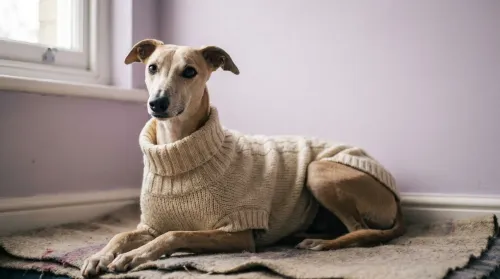


There is a dog fashion photograph I keep in a folder on my desktop: a beagle named Hari, six years old, standing very straight in the courtyard of his owner's parents' apartment in Pune during the second night of Diwali. Hari is wearing a small marigold-coloured kurta with mirror-work along the placket, sewn for him by his owner, Anika Bhatt, who runs a children's-wear studio and made the kurta from offcuts. The light is bad, the photograph is overexposed in the upper right where a string of fairy lights washes out the frame, and Hari is leaning his weight slightly to the right because the kurta is half a centimetre too tight under the front legs.
I keep coming back to that photograph because it is the whole story of dog fashion in 2026 in one frame. Hari's kurta was not bought from a Western "globally-inspired" pet brand. It was made in India, by an Indian designer, for an Indian dog, for an Indian holiday — and most of the editorial coverage you will read about culturally-themed dog apparel in English still gets the direction of cultural authorship exactly backwards.
The dog fashion category itself is large and growing. The global pet clothing market is estimated at USD 5.7 to 5.98 billion in 2025, projected to reach USD 7.23 billion by 2030 at a 4.8% CAGR, with North America leading regional growth. That growth has a demographic engine behind it: 72% of Gen Z pet owners and 58% of Millennial pet owners consider their pet a family member, average annual pet spend reached $2,360 in 2025, and Gen Z averages $178 per month on pet care alone. The dogs are not making the purchase decisions. The people who consider them family are.
A brief history of dog fashion
The history is older than most coverage gives it credit for. The earliest documented dog garment is a decorated collar found in 1440 BC in the tomb of Egyptian nobleman Maiherperi. Henry VIII's court records show silver, silk, and velvet dog collars; Renaissance European nobility dressed their hunting dogs in padlocked engraved collars to mark ownership; American designer Anthony Rubio staged "Last Bark at Bryant Park" at New York Fashion Week in 2011; Oscar de la Renta launched a line of tailored dog coats in 2014. The pattern across three and a half thousand years is consistent and uncomfortable: a decorated dog has, throughout most of human history, been a status object for the human attached to the other end of the leash.
The reason this matters for a 2026 piece on dog fashion is that the structural function of dog apparel has not changed nearly as much as the marketing language around it. A $60,000 Louis Vuitton pet kennel reads, structurally, very much the same as a Renaissance padlock collar. The owner, not the animal, is the audience.
What has changed is who designs what, for whom. The framing I want to push back against is the one in which non-Western traditions exist as decorative source material for Western pet brands. Some of the most sustained, sourced, and historically continuous traditions of dog apparel are designed inside the cultures they come from, by named people, for a domestic market that has been there all along.
The countries already designing for their own dogs
Japan: dog kimono from Tokyo ateliers
There is a real Japanese pet-kimono industry, and it is not the party-store costume the Western SERP suggests. Tamakiya Gofuku, a traditional kimono atelier in Tokyo, makes purpose-built pet kimono in the same construction tradition as the human garments. Spirit of Japan and Japan Trend Shop export authentic versions abroad for owners who want the real garment rather than a costume facsimile. The distinction is not abstract. A purpose-made pet kimono from a working kimono atelier is the product of a textile tradition with sourcing, dyeing, and construction conventions that have continuity. A "dog kimono Halloween costume" from a US party-supply store is something else.
Search demand suggests the audience for the real version is growing — roughly 390 monthly searches for "dog kimono" in the US alone, and another 70 for "japanese dog clothes," both currently served almost entirely by Etsy listings and mass-produced costume sellers. The named ateliers exist; the editorial coverage that points to them has been mostly missing.
India: kurtas, lehengas, and the festival market
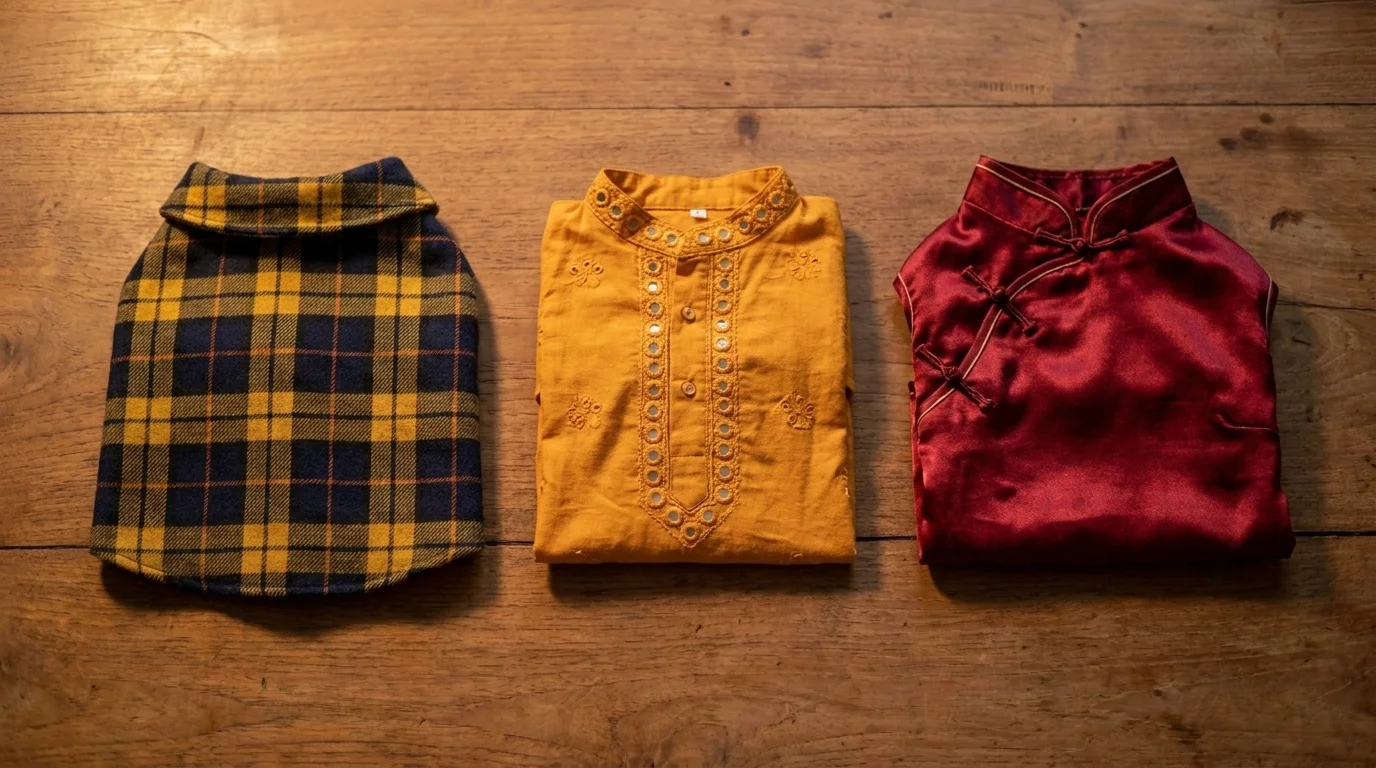
The Indian dog-apparel industry has matured into a recognisable domestic segment built around the same calendar of festivals and weddings that the human fashion industry serves. BOOFBYBELLA makes hand-embroidered luxury dog kurtas and lehengas; Petaloons makes pet sherwanis; For The Fur Kids runs a Swadeshi collection of anarkalis and mirror-work pieces designed for the Indian domestic market; Supertails carries brocade and silk pieces sold around Diwali and the wedding season. The roughly 110 monthly US searches for "indian dog clothes" understate the size of the Indian domestic market these brands actually serve, which is the point: these are not export-oriented appropriation-bait brands. They are local design houses for local festivals.
The framing inversion matters. Hari's kurta is not "ethnic inspiration for pet fashion." It is dog fashion in India.
Scotland: clan tartans and heritage retail
The Scottish side of the conversation is less couture and more high-street heritage retail. Heritage of Scotland sells dog coats in named clan tartans — Black Watch, Stewart Royal, Anderson, Bannockbane Silver — at £25.99, with matching blankets at £28.99 to £32.99, in 75% recycled wool. The "tartan dog coat" cluster runs roughly 110 monthly US searches, heavily seasonal toward November through January for obvious reasons (a tartan dog coat is, before anything else, a warm dog coat). The retail tier is accessible. The fabric is real. The named tartans correspond to actual clans. This is not a high-fashion story; it is a heritage-retail story, and worth covering honestly rather than dressing up as luxury.
China: cheongsam and qipao for wedding-day pets
The smallest and most narrowly-served of these markets is the Chinese-wedding pet-attire niche — cheongsam and qipao pieces cut for dogs, sold most often as part of a wedding-day package. The search volume is tiny (around 20 monthly US searches for "chinese dog clothes"), but a couple of named retailers like East Meets Dress have built small pet collections inside their wedding-focused businesses. As with the Japanese and Indian sections above, the most accurate framing is that this is a domestic ritual market with light export, not a Western-borrowed aesthetic.
Designers and their dogs
A more honest entry point into the Western luxury side of dog fashion is the one most magazines skip: the personal-dog lineage of named designers. Valentino Garavani named his ready-to-wear "Oliver" line after his pug, a relationship documented at length in the 2008 documentary Valentino: The Last Emperor. Karl Lagerfeld's cat Choupette became enough of a public figure to receive a memorial spread in Vogue and is referenced across the Chanel design archive. Thom Browne's wirehaired dachshund Hector inspired the Hector tote in SS17, and Hector has continued, in collaboration with curator Andrew Bolton, to act as what Browne himself has called the "ceremonial figurehead and iconic mascot" of the house, recurring in seasonal fabrications ever since.
This is the part of dog fashion where the animal is genuinely the subject, not the prop. The Hector tote exists because of Hector, not the other way around.
A documentary aside on luxury that bears repeating because most coverage gets it wrong: Louis Vuitton does not produce dog garments. The actual LV pet line is monogrammed carriers, leashes, and a $60,000 leather kennel — no clothing. Garments marketed online as "Louis Vuitton dog hoodies" are counterfeit. For comparison, Gucci's pet pieces run from roughly $930 to $2,600, while Ralph Lauren Pet offers cable-knit sweaters, polos, and fleeces in the $65 to $70 range, and is the only major luxury house genuinely miniaturising its signature human garments for dogs.
Streetwear: the only sub-trend currently rising
If there is a single growth segment in dog fashion right now, it is streetwear. Supreme produces a B.B. Simon studded-collar collaboration; Moncler partners with Italian pet brand Poldo Dog Couture on miniature puffer jackets; Maxbone and Fresh Pawz lead the editorial-streetwear pet space, with Fresh Pawz running licensed collaborations with Champion, NBA, MLB, Spongebob, and Death Row Records. Search demand for "dog streetwear" is small in absolute terms — around 50 monthly US searches — but it is the only term in the dog-fashion keyword cluster trending upward year over year. The volume is not the story. The direction is.
The streetwear sub-genre is also where the design-for-the-animal question lands most directly. A miniature puffer jacket cut for a French bulldog or a dachshund is a garment with a real winter-functional case behind it, regardless of where it lives on the cultural register. A studded streetwear collar made for an 80lb working dog is, by contrast, mostly about the person walking the dog. Both can be true at the same time.
Is it safe to dress a dog?
This is the section most coverage in the dog fashion category quietly avoids. The honest answer is that it depends on the garment, the dog, and the duration, and the published veterinary literature is more conservative than the brand pages suggest.
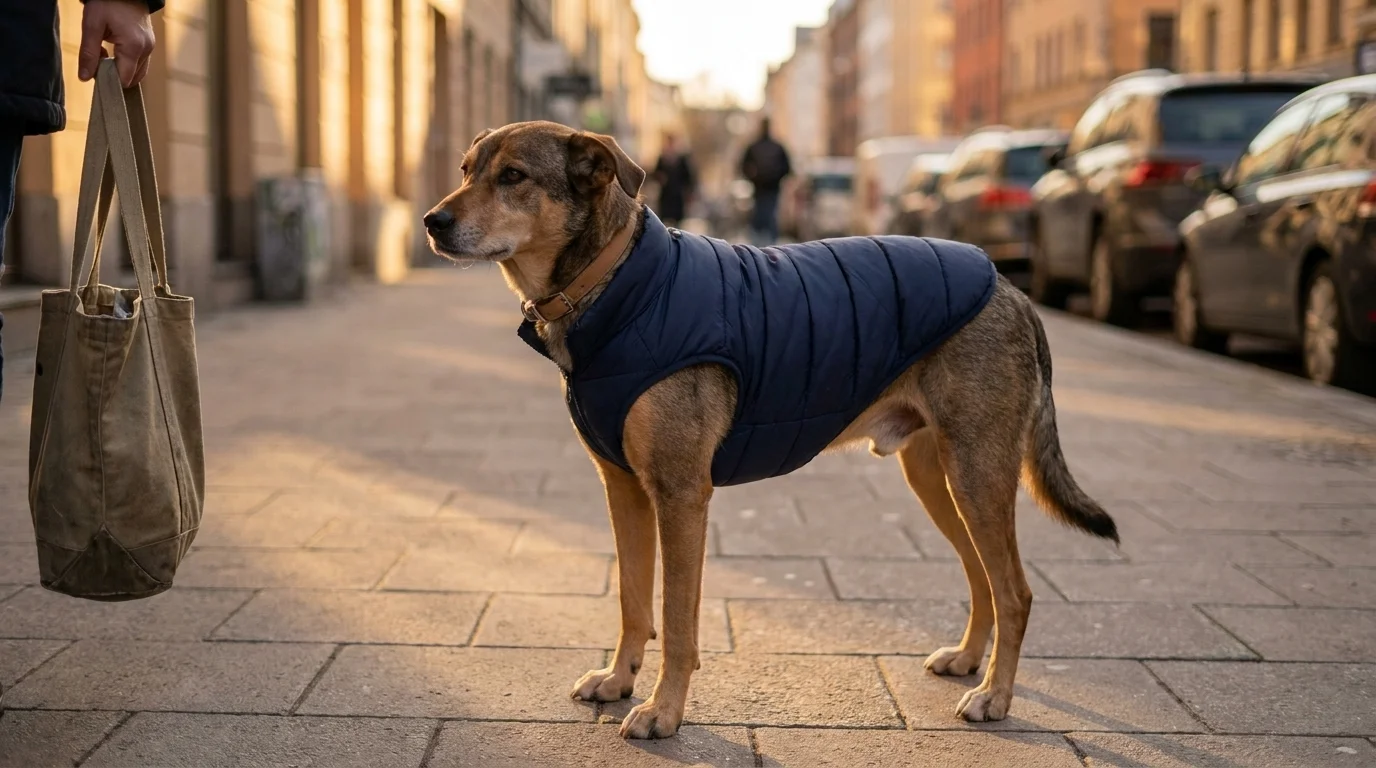
A 2026 review in Frontiers in Veterinary Science of dog-worn equipment risk catalogues the range of welfare concerns: restricted movement and gait, interference with the body-language signals dogs use to communicate with each other (tail position, hackle visibility, shoulder posture), skin reactions to synthetic fabrics, and regulatory ambiguity around what counts as "equipment" for dogs in public spaces. The clearest welfare-positive case for dog clothing is cold-weather warmth for short-haired, geriatric, underweight, or recovering dogs — the kind of layering case the Heritage of Scotland tartan coat solves cleanly and the Halloween costume cluster does not.
The honest framing for an editorial piece on dog fashion in 2026: a tailored cold-weather coat on an elderly whippet is a welfare-positive garment. A full-body costume worn by a French bulldog for the length of a Diwali dinner or a Christmas family gathering is a heat-stress event. A studded collar on a dog who pulls is a cervical-pressure problem. The garment is not the only variable — the animal, the duration, the temperature, and the fit are all part of the same question — and the honest version of any "dog fashion guide" needs to say so out loud.
What this is actually about
Across the four thousand years of dog clothing documented by the Wikipedia article alone, the most consistent fact is that dog fashion is not, primarily, a story about dogs. It is a story about the people attached to them — what they value, what they want to display, what they consider family, what they can afford to spend, and which traditions they live inside. The country-specific industries I've described in this piece are interesting because they tell that human-side story without erasing the named designers who actually make the work. The luxury houses are interesting because they reveal, more clearly than the marketing pages do, where the line sits between miniaturising a human garment for an animal and using the animal as a display surface.
The animal in the photograph, in every case, is the part most worth pausing on. Hari leaning slightly to the right under the half-centimetre-too-tight kurta. The senior whippet warm under a clan-tartan layer. The pug who never asked for a couture line. The dog at the centre of the dog fashion conversation is the part the conversation routinely forgets to look at. The photograph is doing the work photographs are for when it doesn't.
Frequently Asked Questions
No. Louis Vuitton's actual pet line is accessories — monogrammed carriers, leashes, and a $60,000 leather kennel. Garments marketed online as 'LV dog hoodies' or similar are counterfeit. For luxury dog clothing, Gucci pet pieces run $930 to $2,600 and Ralph Lauren Pet ($65 to $70) miniaturises signature human garments like cable-knit sweaters and polos.
Valentino Garavani named his 'Oliver' ready-to-wear line after his pug, documented in the 2008 film 'Valentino: The Last Emperor.' Karl Lagerfeld's cat Choupette became a Chanel design reference. Thom Browne built the Hector tote (launched SS17) and a recurring seasonal motif around his wirehaired dachshund Hector, who he and Andrew Bolton describe as the house's 'ceremonial figurehead and iconic mascot.' Oscar de la Renta launched a line of tailored dog coats in 2014.
Authentic. Indian brands including BOOFBYBELLA, Petaloons, For The Fur Kids, and Supertails design dog kurtas, sherwanis, lehengas, and anarkalis for the domestic Indian market — primarily for Diwali, weddings, and other festivals. These are not export-oriented appropriation-bait brands; they are local design houses serving local rituals.
It depends on the garment, the dog, the temperature, the fit, and the duration. A 2026 Frontiers in Veterinary Science review of dog-worn equipment catalogues welfare concerns including restricted movement, interference with the body-language signals dogs use to communicate with each other, skin reactions to synthetic fabrics, and overheating. The clearest welfare-positive case is cold-weather warmth for short-haired, geriatric, underweight, or recovering dogs. Full-body costumes worn indoors at warm holiday gatherings are the highest-risk case.
Tamakiya Gofuku, a traditional kimono atelier in Tokyo, makes purpose-built pet kimono in the same construction tradition as its human garments. Spirit of Japan and Japan Trend Shop export authentic versions abroad. The distinction worth knowing is between purpose-made pet kimono from a working kimono atelier and mass-produced 'kimono costume' outfits sold as Halloween or party items — only the first is the real cultural garment.
The shorthand is sourcing and authorship. Purpose-made pet kimono from a Tokyo atelier, hand-embroidered dog kurtas from an Indian luxury studio, and named-clan tartan dog coats from a Scottish heritage retailer are designed inside the traditions they come from, by named designers, for domestic markets. Western 'globally-inspired' pet brands borrowing the surface aesthetics without naming the source, paying the source, or sourcing the materials are what the appropriation conversation is actually about.
Mostly no, as a search category. 'Canine couture' as an organic search term is dominated by a Beverly Hills grooming salon and a Shark Tank pitch — it points to a single local-business brand, not an editorial category. The real editorial term to use is 'dog fashion,' which is what designers, journalists, and search engines like Wikipedia (currently ranking third for it) actually treat as the category.
Streetwear. Supreme runs a B.B. Simon studded-collar collaboration; Moncler partners with Italian brand Poldo Dog Couture on miniature puffer jackets; Maxbone and Fresh Pawz lead the editorial-streetwear pet space with licensed collaborations across Champion, NBA, MLB, Spongebob, and Death Row Records. Search demand for 'dog streetwear' is small in absolute terms (around 50 monthly US searches) but is the only term in the dog-fashion keyword cluster trending upward year over year.